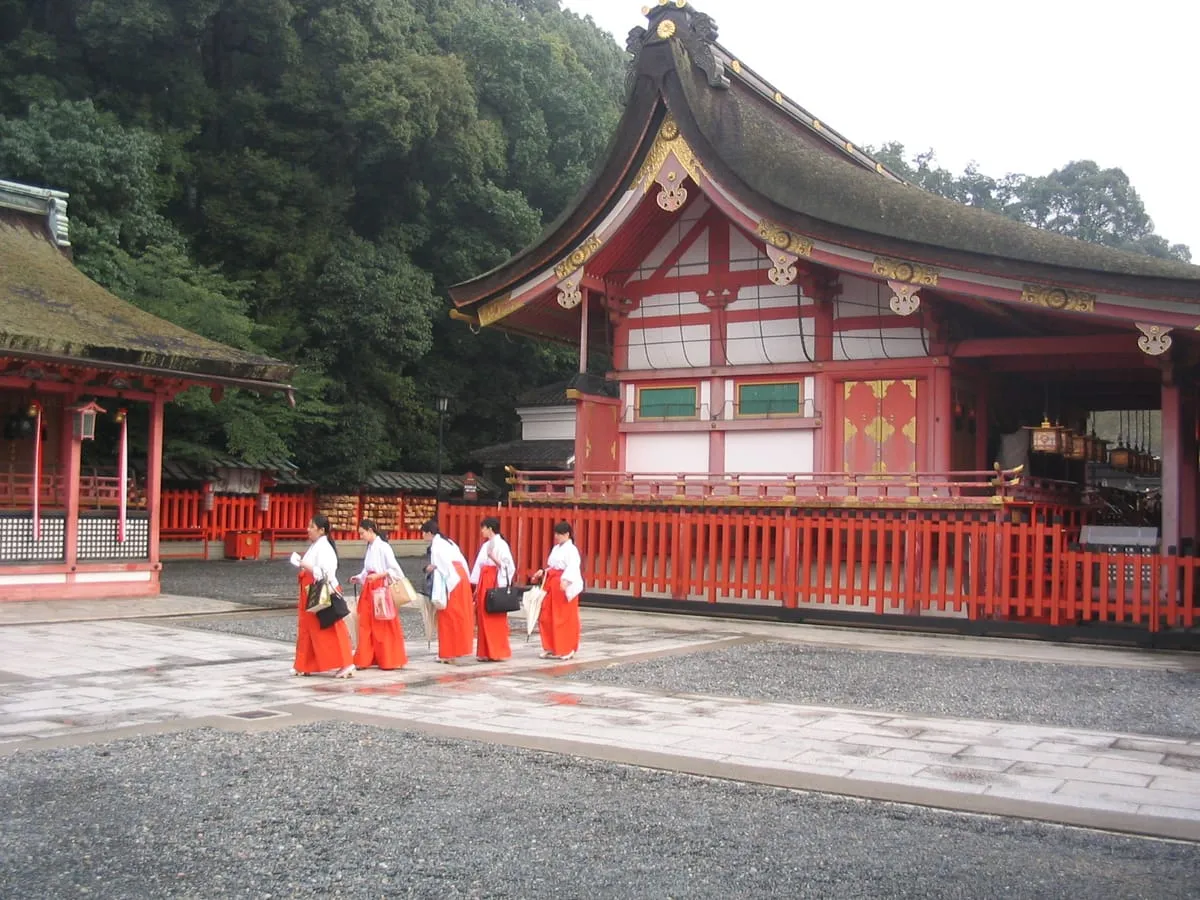
At almost every Shinto shrine in Japan, you’ll encounter them: young women in flowing white robes and deep red hakama skirts, moving with quiet purpose through the shrine grounds. They hand over goshuin stamps, carry offerings, and on festival days, perform sacred dances before the altar.
These women are miko (巫女) — shrine maidens. And their role reaches back to one of the oldest strata of Japanese religious life.
What Does “Miko” Mean?
The word miko has ancient and layered origins. One interpretation reads it as “child of the kami” (mi = honorific; ko = child). Another links it to a verb meaning “to divine” or “to channel.” Both readings point in the same direction: the miko was originally not a temple assistant but a spiritual medium — a person through whom the gods could speak.
In the Shinto worldview, certain humans could enter a state called kamigakari (神懸かり) — “possessed by the kami” — and act as conduits between the divine and human worlds. The miko was this conduit. She did not merely serve the kami; at the peak of the ritual, she was the kami’s voice.
This original function has been largely ritualized away in modern practice. Today’s miko is primarily a shrine staff member — educated in sacred protocol, trained in ceremonial duties, identifiable by her costume. But understanding what she once was changes how you see what she still does.
History: From Shaman to Shrine Staff
Ancient Mediums
The clearest ancient precedent for the miko is found in figures like Yamato Totohimomoso-hime (倭迹迹日百襲姫命), described in the Nihon Shoki as a woman who received divine messages from Ōkuninushi-no-kami. She stands at the beginning of a long line of female spiritual intermediaries in the Japanese historical record.
The most famous of these is Himiko (卑弥呼), the semi-legendary queen of Yamatai recorded in the 3rd-century Chinese chronicle Wei Zhi. Himiko is described as a shaman-queen who “bewitched the people” through kidō — a form of ritual practice — and communed with spirits. She received envoys from the mainland but reportedly secluded herself so deeply in her sacred duties that even her attendants rarely saw her. Most scholars read her as a chieftain whose political authority was inseparable from her shamanistic power — the archetypal miko-ruler.
Medieval and Edo-Period Miko
Through the medieval period, shrines across Japan maintained female attendants whose roles varied widely. Some performed sacred dances (kagura), some recited ritual poetry, some served as oracles.
Outside the formal shrine system, aruki miko (歩き巫女 — “walking miko”) traveled between villages performing divination and spirit communication for ordinary people. In the Tohoku region, these figures evolved into the itako — blind women trained as spirit mediums who still practice today. In Okinawa, the parallel figure is the yuta. These traditions represent the unbroken thread of female mediumship that runs from the ancient miko down to the present.
The Meiji Transformation
The Meiji Restoration of 1868 fundamentally reorganized Japanese religion. The state separated Buddhism from Shinto, formalized a national Shinto system, and regulated shrine practice in unprecedented detail.
For the miko, this meant a sharp break. A Ministry of the Interior directive in 1908 prohibited the practice of spirit mediumship and oracular divination at officially recognized shrines. Miko were redefined as ceremonial assistants — performers of kagura dance, helpers in shrine ritual, custodians of the sacred space. The shaman became the staff member.
This transformation was not total — many of the older practices survived in folk religion outside the formal shrine system. But the institutional miko of the modern shrine descends directly from this Meiji-era redefinition.
The Costume: White and Red
The miko’s appearance is one of the most recognizable visual codes in Japanese culture.
Hakui (白衣) — the white upper garment. White in Shinto signifies purity, freedom from kegare (pollution/impurity). Anyone approaching the sacred must be clean; the white robe externalizes that inner requirement. The sleeves are wide and the fabric falls past the waist, worn over the hakama.
Hibakama (緋袴) — the red hakama skirt. Hi (緋) specifically denotes a deep, saturated crimson. Red in Japanese religious culture carries the force of the sun, fire, and vital energy. It also repels malevolent spirits — the same principle that makes torii gates red. The white-over-red combination expresses both purity (white) and spiritual power (red) in a single garment.
On formal ceremonial occasions, miko add a chihaya (千早) — a light white outer robe — over the standard costume. The chihaya is specifically associated with kagura performance.
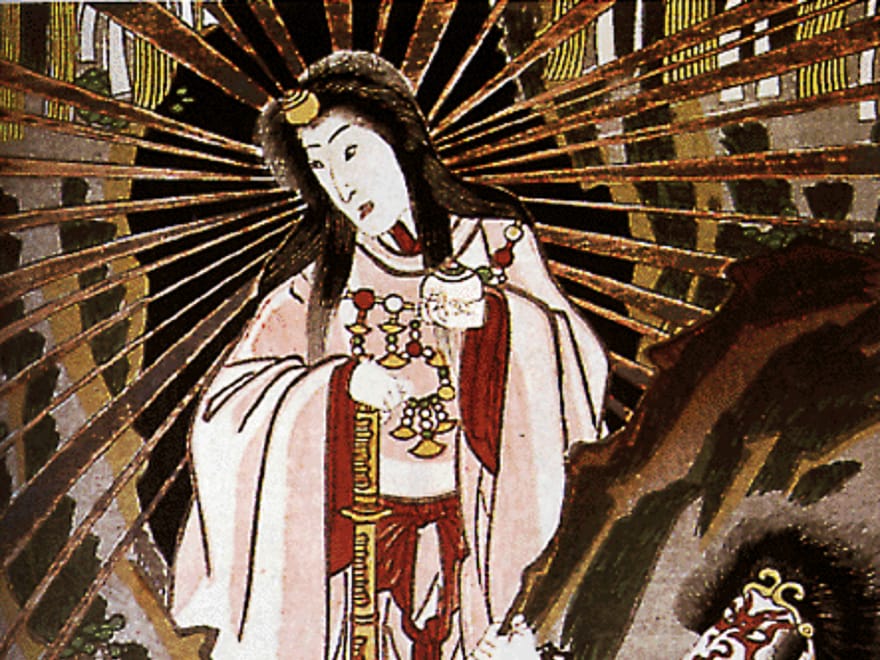
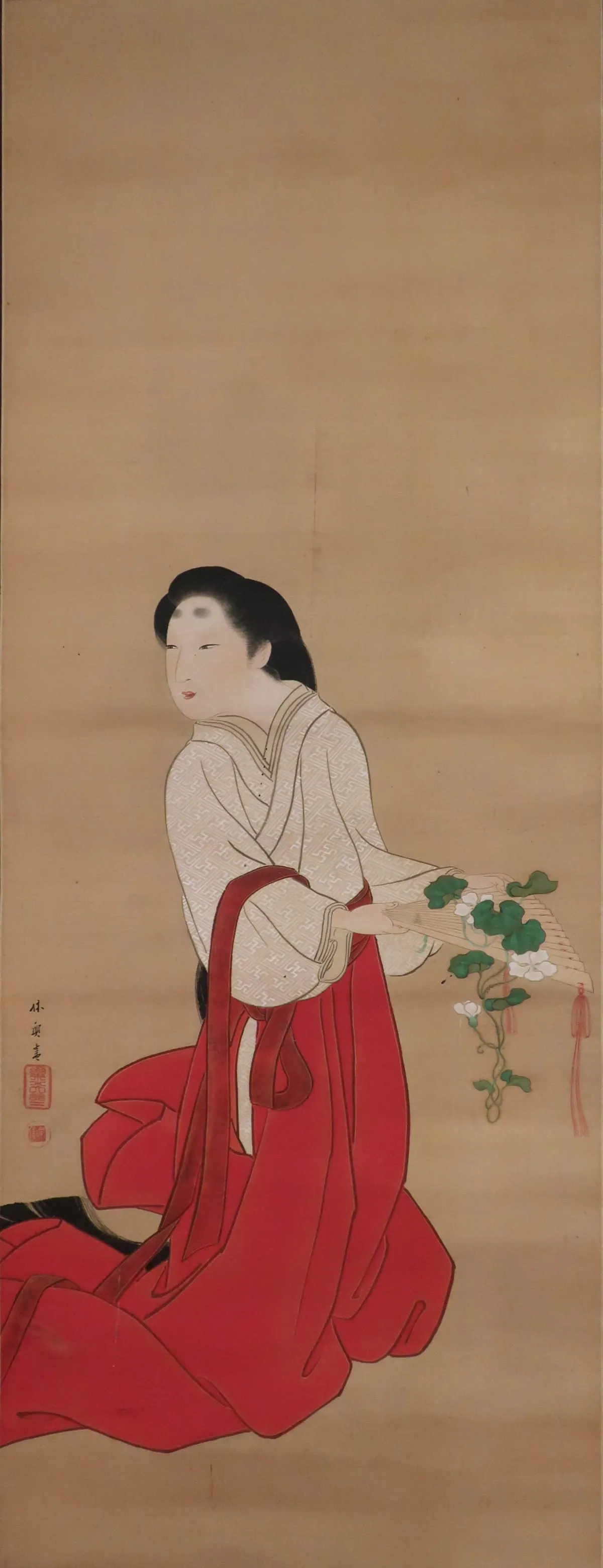
The historical artwork below, painted in the late 19th century, captures the miko in ceremonial dress before the modern standardization of the costume:
What Miko Actually Do Today
Goshuin and Omamori Distribution
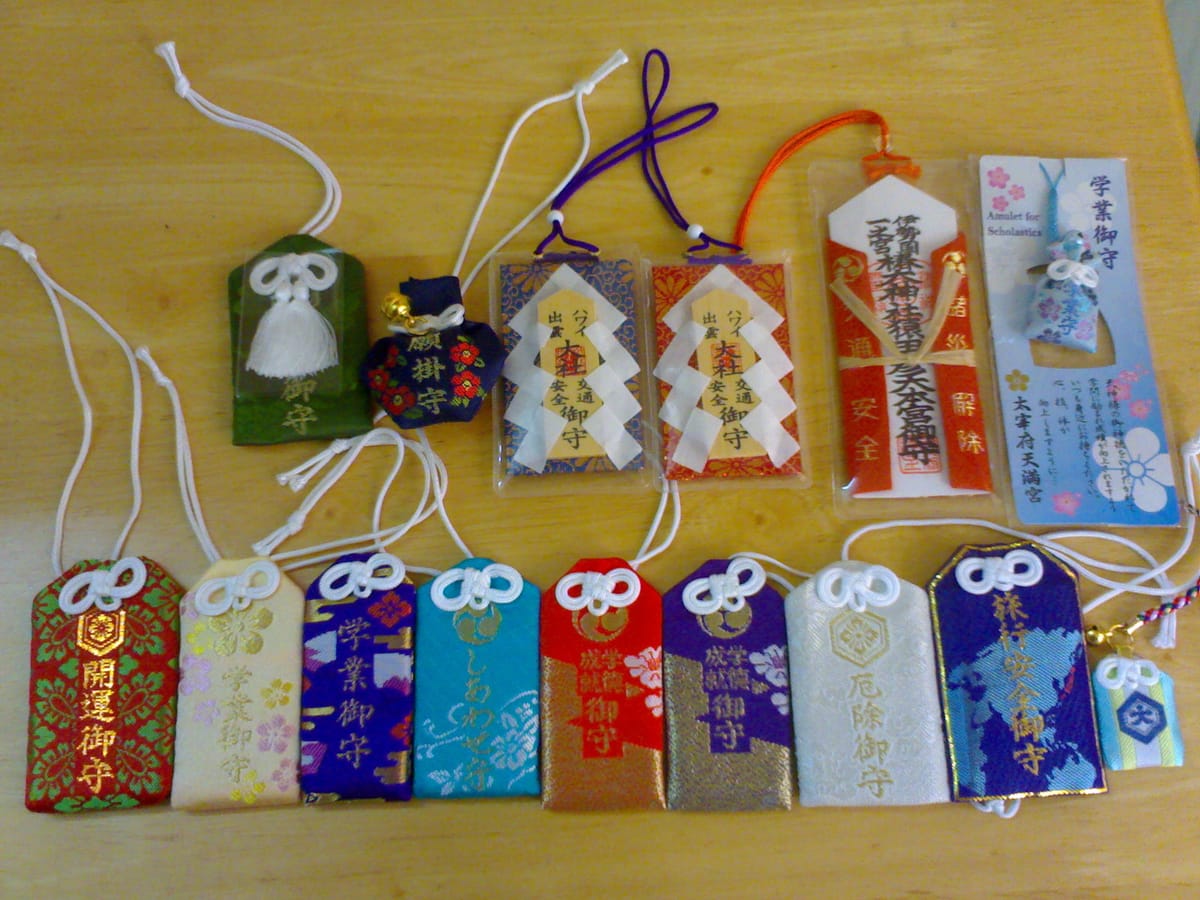
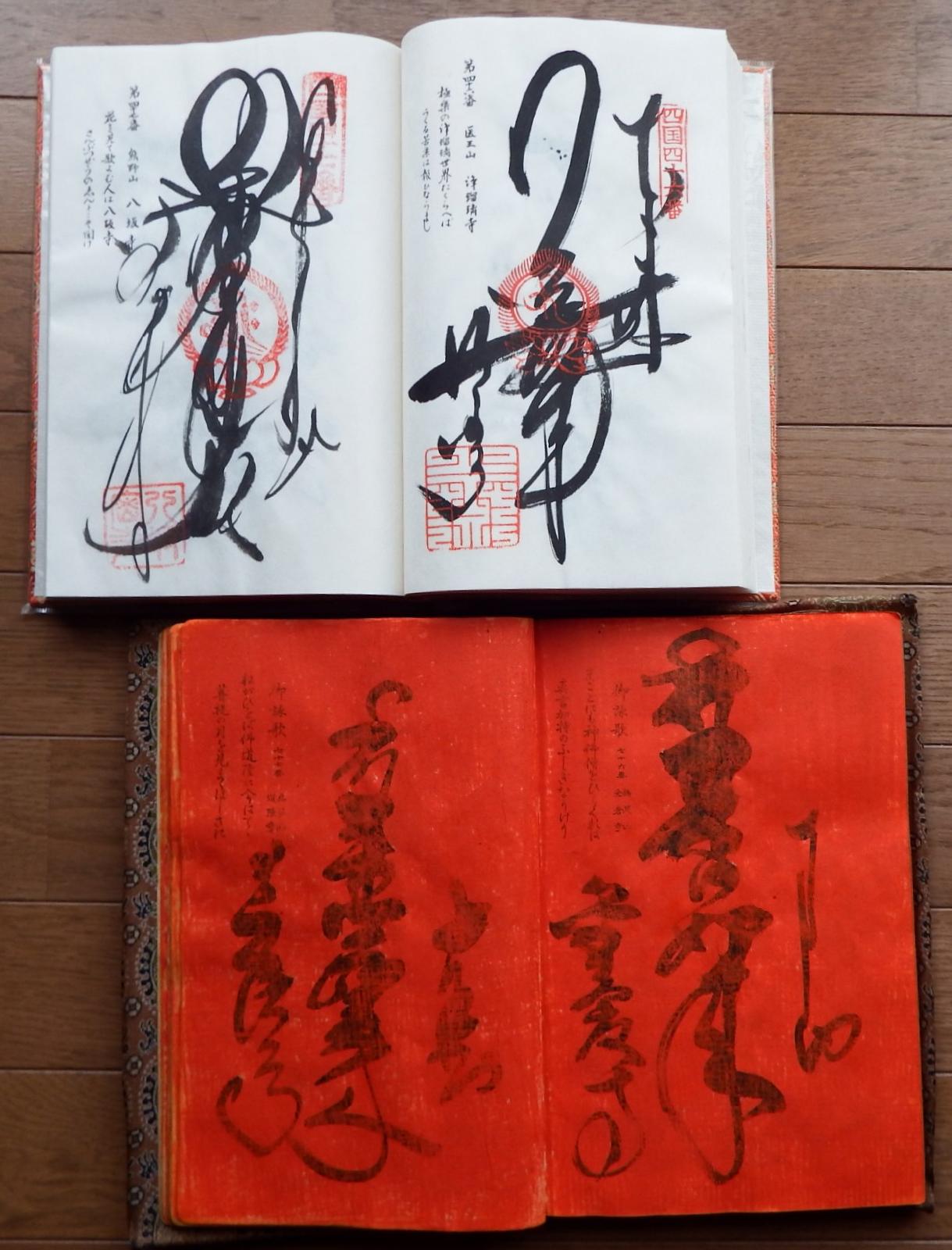
For most visitors, the miko at the reception desk (jushojo) is the primary point of contact. She writes or stamps goshuin in your goshuincho, hands over omamori (charms) and ema (votive tablets), and provides basic information about the shrine. The careful, two-handed manner of receiving and presenting objects — always deliberate, always respectful — is a quiet expression of the sacred character of these exchanges.
Kagura Dance
Kagura (神楽) is sacred music and dance performed as an offering to the kami. The specific form performed by miko is called miko-mai (巫女舞). On major festival days, miko in full ceremonial dress perform these dances in the worship hall or on an outdoor stage.
The central instrument of miko-mai is the kagura-suzu (神楽鈴) — a cluster of bells mounted on a handle, shaken during the dance to summon and purify the presence of the kami. The ringing of the bells, like the sound of the taiko drum and the shakubyoshi wooden clappers, creates the sonic environment in which the kami are understood to draw near.
Other Duties
The practical work of a miko extends well beyond ceremony:
- Maintaining and purifying the chōzuya (water basin for ritual hand-washing)
- Guiding visitors during festivals and processions
- Assisting priests during formal rites (standing in ceremonial positions, carrying sacred objects)
- Administrative and reception duties at the shrine office
Full-Time vs. Seasonal Miko
Large shrines employ miko year-round. Smaller shrines hire seasonal miko — particularly during the New Year rush, the Shichigosan children’s ceremony in November, and summer festivals — often recruiting university students for short-term positions. Some women pursue longer careers within the shrine system, studying for formal Shinto priest (shinshoku) credentials; Japan’s major shrine schools have accepted female students since the 1990s.
Famous Shrines Known for Their Miko
Fushimi Inari Taisha (Kyoto): The headquarters of Japan’s 30,000+ Inari shrines. The contrast between the vermillion torii gates and the white-and-red miko costume is especially striking during the New Year period.
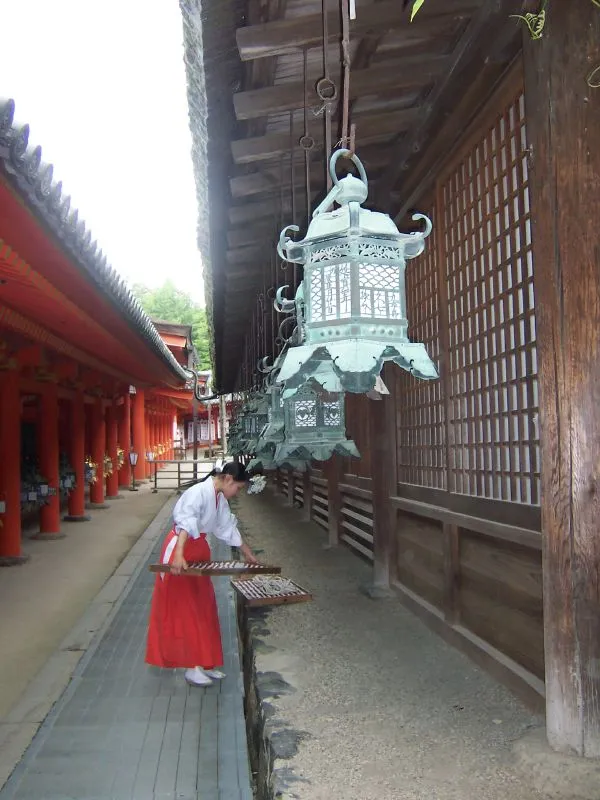
Kasuga Taisha (Nara): One of Japan’s oldest shrines, with an unbroken tradition of kagura. The Kasuga Wakamiya On-matsuri festival in November includes miko in the procession and formal kagura performances.
Izumo Taisha (Shimane): The great shrine of the god of relationships. Miko here distribute en-musubi (bond-tying) charms and goshuin that draw visitors from across Japan.
Miko and Goshuin
When you receive a goshuin, the hands writing or stamping it may well belong to a miko.
In larger shrines, the goshuin desk is often staffed by miko who have been trained in calligraphy and the specific stamps of that shrine. In smaller shrines, the same task falls to the priest or a single attendant. Either way, the object passing between those hands carries the accumulated weight of an institution that has been serving as an intermediary between human beings and the divine since before Japan had a writing system.
Some shrines offer goshuin designs that incorporate miko imagery — a dancing figure rendered in brushwork, a kagura-suzu rendered in seal form. Spotting these designs is one way to take a shrine’s particular heritage home with you.
The ancient miko channeled the kami’s voice. The modern miko channels the shrine’s presence into the objects she places in your hands. The intermediary function, at its core, has not changed.
Related Articles
- An Introduction to the Kami of Shinto: Amaterasu, Susanoo, Inari, and More
- The Annual Rituals of Shinto Shrines: From Hatsumode to Ōharae
- What Is a Shintai? Sacred Objects at the Heart of Shinto Shrines
Image Credits
- Five miko at Fushimi Inari Taisha, Kyoto (2004): Collin Grady, CC BY 2.0, via Flickr / Wikimedia Commons
- Miko at Kasuga Taisha, Nara Prefecture: Chris Gladis (MShades), CC BY 2.0, via Flickr / Wikimedia Commons
- Shrine Maiden (late 19th century, ink and color on silk), Honolulu Museum of Art: Gakuōsai Kyūshin Dōshin, Public Domain (PD-Japan), via Wikimedia Commons