Walk into the main hall of almost any Japanese temple and you’ll find yourself face to face with a Buddhist statue. It might be a serene gilded figure seated in meditation, a multi-armed deity adorned with jewelry, a fierce wrathful figure surrounded by flames, or an armored warrior holding a miniature pagoda. All are called butsuzō (仏像) — Buddhist images — yet they represent entirely different beings in the cosmology of Japanese Buddhism.
Japanese Buddhist statues fall into four broad categories: Nyorai (如来), Bosatsu (菩薩), Myōō (明王), and Ten (天). Learn to distinguish these four and the visual complexity of a temple interior suddenly becomes readable. The goshuin (御朱印) you receive at each temple — whose central characters usually name the principal deity — also gains new meaning.
Nyorai: Those Who Have Attained Enlightenment
Nyorai is the Japanese rendering of the Sanskrit tathāgata — “one who has arrived at suchness.” Nyorai are the highest category of buddhas: beings who have completed the path of enlightenment and stand beyond the cycle of birth, death, and rebirth.
How to Identify a Nyorai
Three physical features mark virtually every Nyorai figure:
Rahotsu (螺髪) — the snail-shell curls covering the head. These tightly coiled bumps are the single most reliable visual identifier for a Nyorai. Once you know them, you’ll spot them on every Nyorai image.
Byakugō (白毫) — the mark between the eyebrows, often a raised dot or crystal inset. In Sanskrit texts, this is a whorl of white hair said to emit radiant light.
Unadorned robes — the most important identifying feature. Unlike Bosatsu, Nyorai wear plain monk’s robes with no crowns, necklaces, or bracelets. They have transcended the material world.
The Principal Nyorai
Shaka Nyorai (釈迦如来) — the historical Gautama Siddhartha after his enlightenment. The founding buddha of all Buddhist traditions, Shaka is particularly prominent in Zen and Tendai temples. He is typically depicted making the semui-in (right hand raised, palm outward — “fear not”) and yogan-in (left hand lowered, palm outward — “wishes granted”) gestures.
Amida Nyorai (阿弥陀如来) — the Buddha of Infinite Light and Infinite Life (Amitābha in Sanskrit). Amida presides over the Pure Land in the western direction and has vowed to welcome all who sincerely call his name (namu amida butsu) into that realm at death. He is the principal Buddha of Pure Land Buddhism — the Jōdo-shū, Jōdo Shin-shū, and related sects — and typically appears in seated meditation posture with hands resting together in jōin.
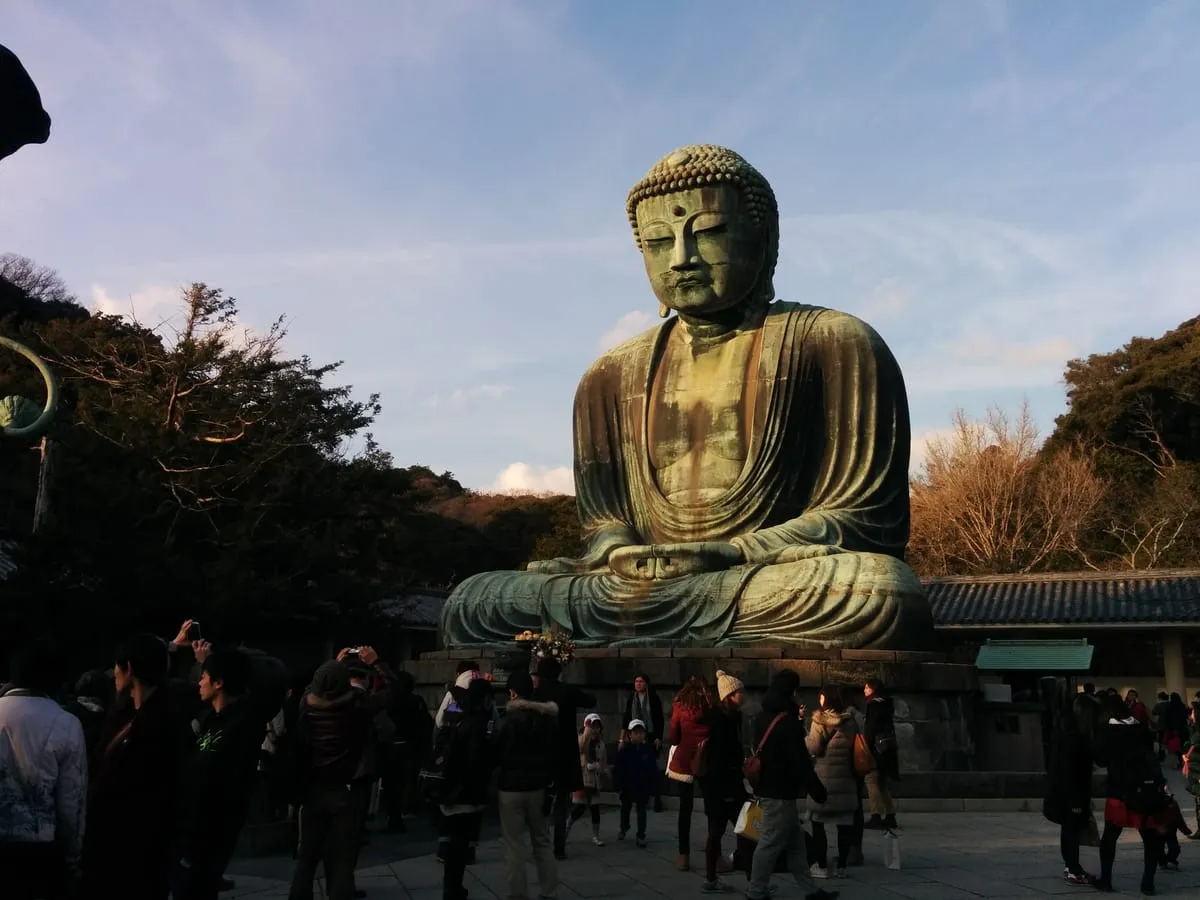
The Great Buddha at Kōtoku-in in Kamakura is an Amida Nyorai seated in the open air — the wooden hall that once housed it was destroyed by a tsunami in the fourteenth or fifteenth century. At 11.3 meters in height, it is a National Treasure and one of the most recognizable Buddhist images in Japan.
Dainichi Nyorai (大日如来) — the Cosmic Sun Buddha, Mahavairocana in Sanskrit. Central to esoteric Buddhism (Shingon and Tendai Mikkyō), Dainichi represents the fundamental truth of the universe. Unlike other Nyorai, Dainichi may wear ornaments — an exception within esoteric iconography. His distinctive gesture, the chiken-in (right index finger clasped inside the left fist), identifies him immediately.
Yakushi Nyorai (薬師如来) — the Medicine Buddha. Yakushi holds a medicine jar (yakko) in his left hand and heals both physical illness and spiritual ignorance. His cult was enormously popular in the Nara and Heian periods; Yakushi-ji in Nara and Jingo-ji in Kyoto are centered on Yakushi images.
Bosatsu: Those on the Path to Enlightenment
Bosatsu is the Japanese pronunciation of the Sanskrit bodhisattva — “enlightenment being.” Bosatsu have progressed far along the Buddhist path but vowed to remain in the world and guide all sentient beings to liberation before entering final enlightenment themselves. This selfless commitment to others defines the Bodhisattva ideal.
How to Identify a Bosatsu
Ornamentation — crowns, necklaces, armbands, flowing scarves. While Nyorai wear simple robes, Bosatsu appear in the regalia of an Indian prince. This is the easiest way to distinguish them from Nyorai at a glance.
Multiple arms and heads — many Bosatsu have multiple sets of arms or faces to symbolize their inexhaustible capacity to help beings in all directions.
The Principal Bosatsu
Kannon Bosatsu (観音菩薩) — Avalokiteśvara, “the one who perceives the sounds of the world.” Among all Bosatsu, Kannon is the most widely venerated in Japan. Kannon appears in dozens of forms:
- Shō Kannon (聖観音) — the basic form, with two arms holding a lotus
- Senju Kannon (千手観音) — Thousand-Armed Kannon. Either carved with 1,000 arms or shown with 42 arms representing them symbolically. Each hand holds a different implement to help beings with different needs
- Jūichimen Kannon (十一面観音) — Eleven-Faced Kannon, with ten smaller faces arranged around the crown, perceiving suffering in all directions simultaneously
- Nyoirin Kannon (如意輪観音) — holds the wish-fulfilling jewel and the Dharma wheel
- Batō Kannon (馬頭観音) — Horse-Headed Kannon, a fierce form who protects livestock and travelers; common as roadside stone images in rural Japan
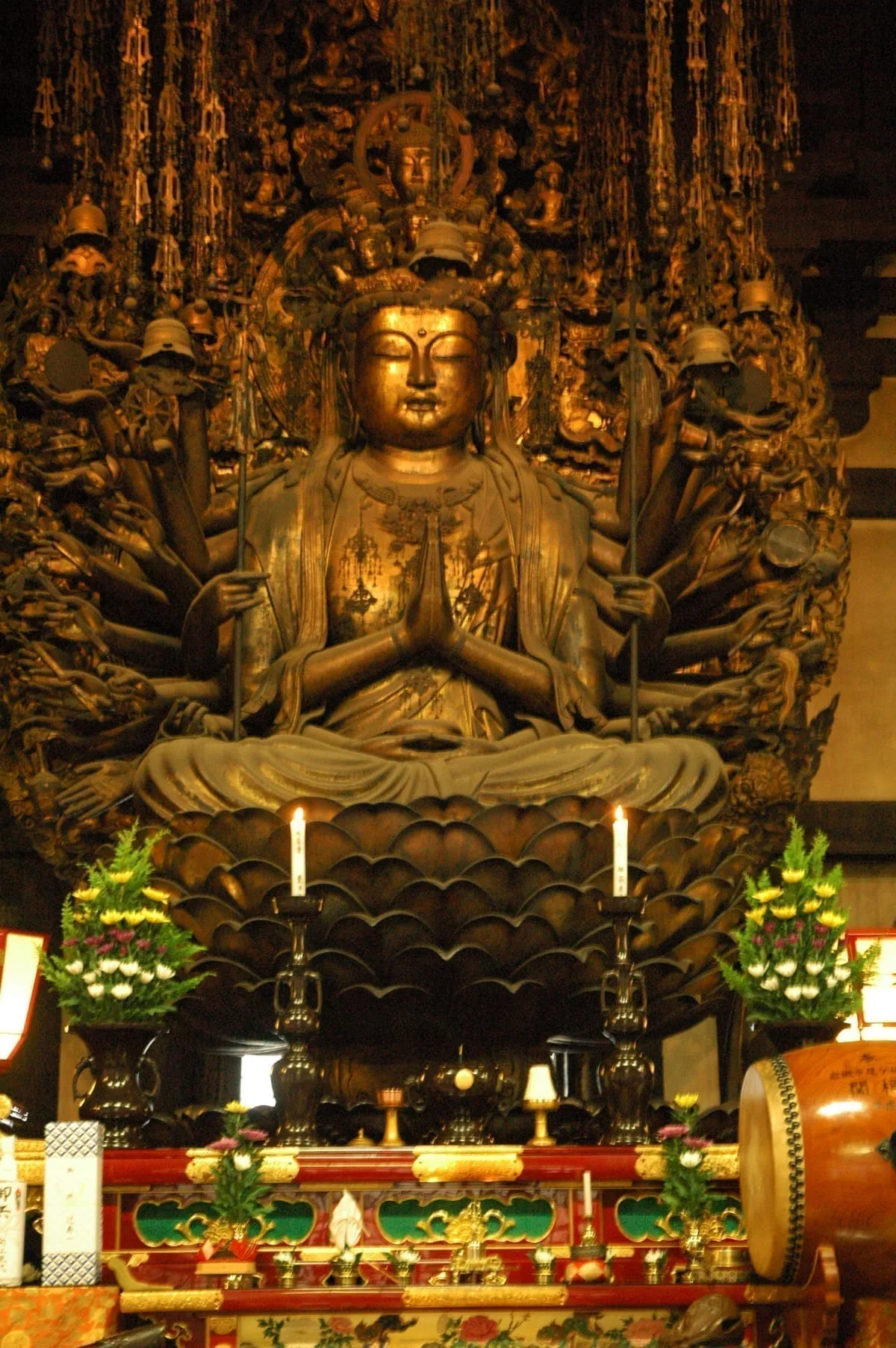
Sanjūsangen-dō (Rengeo-in) in Kyoto houses 1,001 Thousand-Armed Kannon statues: a central seated figure nearly 3.4 meters tall (by the Kamakura-period master sculptor Tankei) flanked by 500 standing figures on each side. The hall extends 120 meters end to end — standing inside it is among the most extraordinary experiences Japanese Buddhist art offers.
Jizō Bosatsu (地蔵菩薩) — Kṣitigarbha, “Womb of the Earth.” Jizō has vowed to save all beings during the long era between Shakyamuni’s parinirvana and the appearance of the future Buddha Maitreya. He appears as a monk holding a ringed staff (shakujō) and a wish-fulfilling jewel. The small stone Jizō figures with red bibs that line Japanese roadsides and temple paths are ubiquitous. He is the patron of travelers, children, and those who died before birth.
Miroku Bosatsu (弥勒菩薩) — Maitreya, the Future Buddha. Currently residing in Tuṣita Heaven, Miroku is prophesied to descend into this world billions of years from now to rescue all remaining beings. He is most often shown in hanka shiī posture — one leg folded, one resting on the other knee, with one hand lightly touching the cheek in contemplation. The Miroku Bosatsu at Kōryū-ji in Kyoto is considered one of the supreme masterpieces of Japanese Buddhist sculpture.
Monju Bosatsu (文殊菩薩) — Mañjuśrī, the Bodhisattva of Wisdom. The Japanese proverb about “three heads are better than one” literally translates as “the wisdom of three people equals Monju.” He holds a sword (to cut through ignorance) in the right hand and rides a lion. Popular among students seeking academic success; Abe Monju-in in Nara is among the most famous destinations.
Fugen Bosatsu (普賢菩薩) — Samantabhadra, the Bodhisattva of Practice. Where Monju represents wisdom, Fugen represents compassionate action. He rides a white elephant and is paired with Monju as flanking attendants to Shaka Nyorai.
Myōō: Wrathful Emanations of the Cosmic Buddha
Myōō renders the Sanskrit vidyārāja — “King of Wisdom Spells.” Myōō are unique to esoteric Buddhism: they are wrathful manifestations of Dainichi Nyorai, appearing in fierce form specifically to save beings who cannot be reached by gentle means. The anger of a Myōō is entirely an expression of compassion — the force necessary to wake those who have been unresponsive to softer approaches.
How to Identify a Myōō
Wrathful expression — wide eyes, bared fangs, furrowed brows. The most immediately striking feature.
Flames — most Myōō are surrounded by a blazing halo (kaen kōhai), representing the burning away of delusion.
Weapons — swords, ropes, vajra, and other forceful instruments.
The Principal Myōō
Fudō Myōō (不動明王) — Acala, “the Immovable One,” leader of the Five Great Wisdom Kings. Fudō holds a sword in his right hand (to cut through delusion) and a rope (kensaku) in his left (to bind and save beings). He sits or stands on a rock before a wall of flames. Fudō Myōō is the most widely worshipped figure in Japanese esoteric Buddhism, deeply connected with mountain asceticism (shugendō) and fire ceremonies (goma).
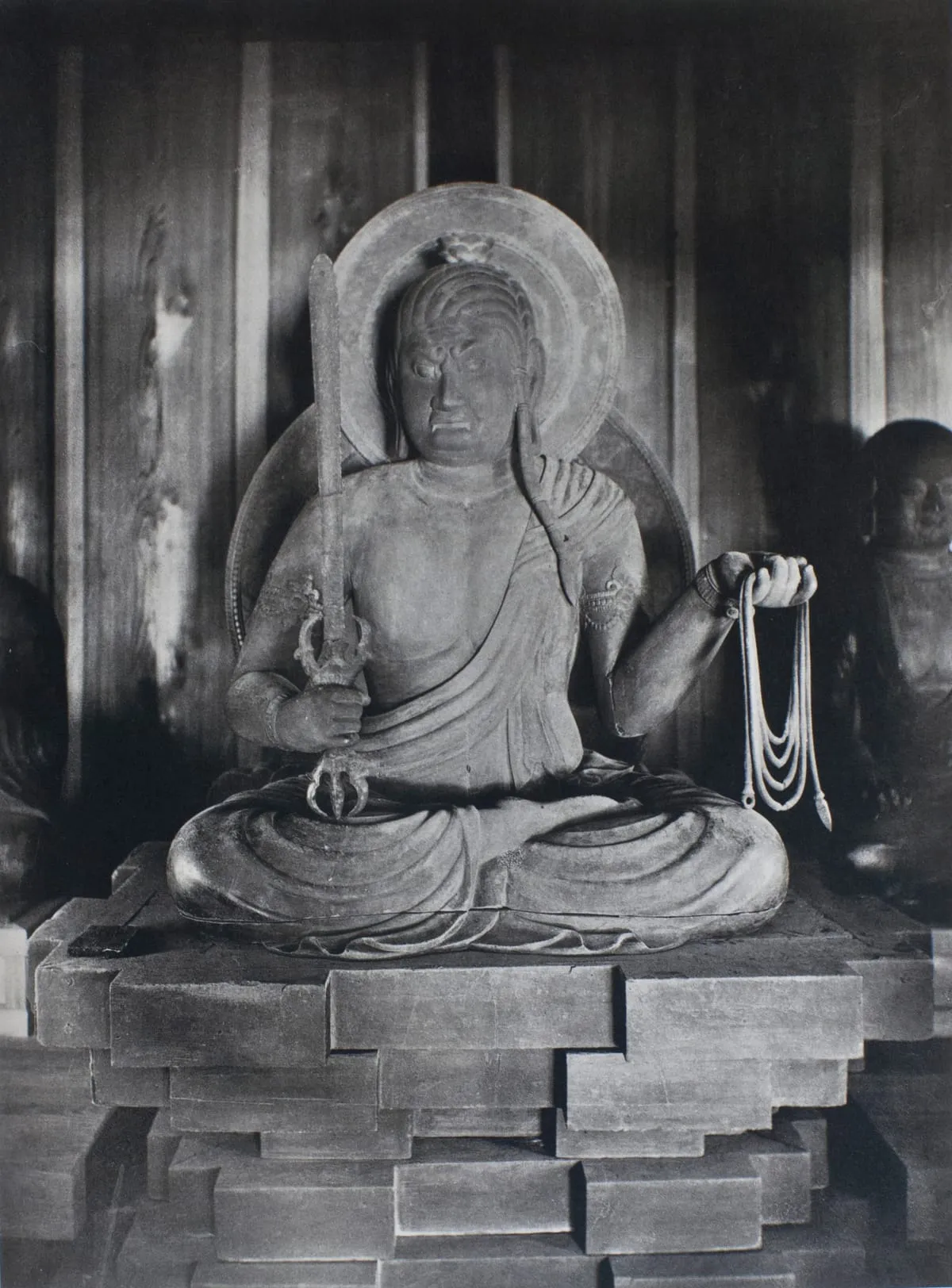
Major Fudō sites include Narita-san Shinshō-ji in Chiba and Takahata Fudō in Tokyo. The goshuin from these temples almost always feature Fudō’s name or image prominently.
Aizen Myōō (愛染明王) — Rāgarāja, “King of Passion.” Aizen transforms desire into enlightenment. He has a red body, three eyes, six arms, and a lion-head headdress; popular for love and relationship prayers.
Kujaku Myōō (孔雀明王) — the Peacock Wisdom King. The peacock’s ability to eat poisonous plants symbolizes overcoming spiritual toxins. Uniquely among Myōō, Kujaku has a peaceful expression. Rites invoking him were performed to end droughts.
Ten: Gods of Ancient India as Buddhist Protectors
Ten translates the Sanskrit deva — “divine being.” This category encompasses figures who originated in Vedic or Hindu religion and were absorbed into Buddhism as protectors of the dharma. They have not yet attained enlightenment themselves but serve as guardians of the Buddhist universe.
How to Identify a Ten
More than any other category, Ten images vary enormously in appearance — armored warriors, graceful women, demonic figures, elderly sages. Many retain recognizable features of their Hindu origin.
The Principal Ten
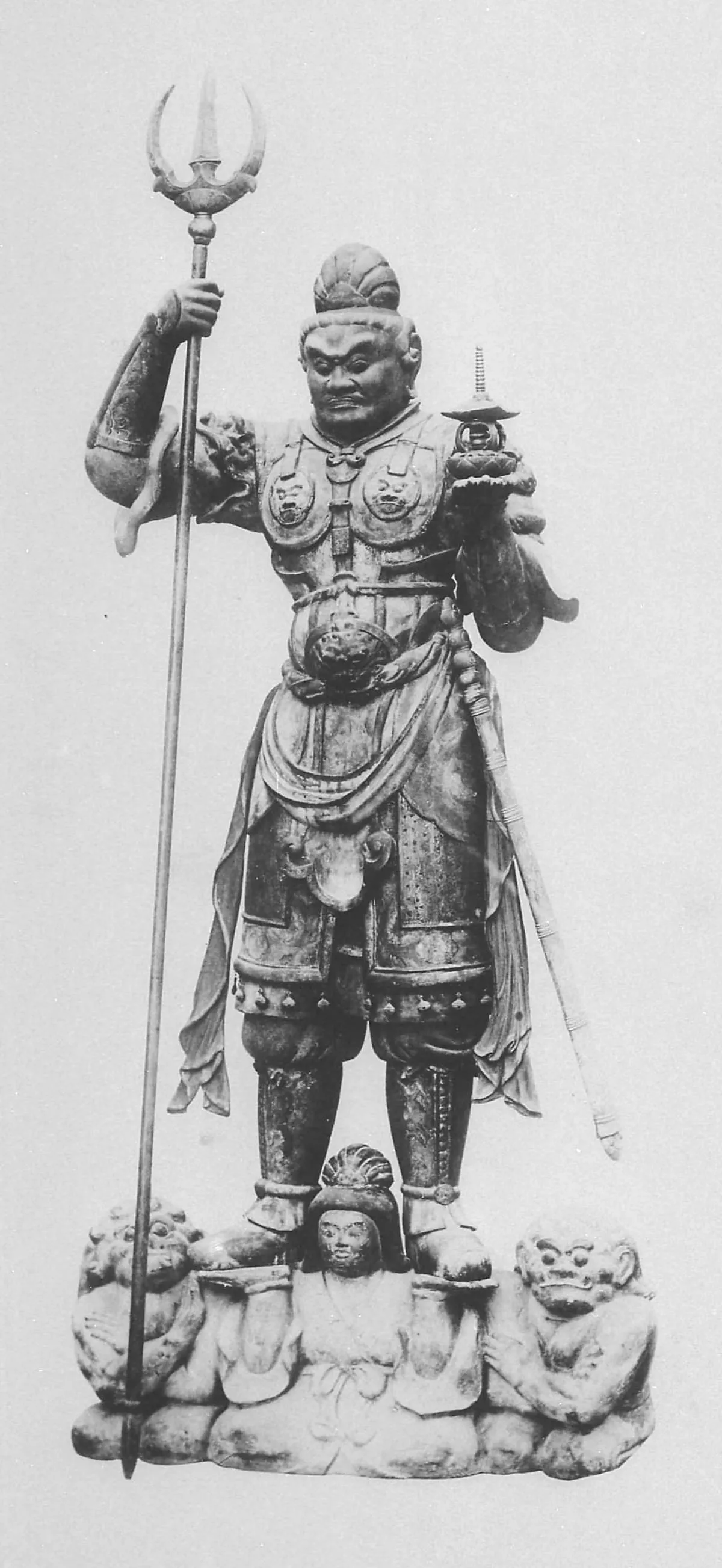
Bishamonten (毘沙門天) — Vaiśravaṇa. One of the Four Heavenly Kings guarding the north, and one of Japan’s Seven Lucky Gods (Shichifukujin). He holds a miniature pagoda in one hand and wears full armor. As a protector of warriors and a granter of good fortune, he is venerated by samurai lineages and commoners alike.
Benzaiten (弁財天) — Sarasvatī. The only female deity among Japan’s Seven Lucky Gods, Benzaiten governs music, arts, eloquence, and wealth. She appears as an elegant woman holding a biwa (Japanese lute). The three most famous Benzaiten sites are Enoshima Jinja in Kanagawa, Hōgon-ji on Chikubushima island, and Itsukushima Jinja in Hiroshima.
Daikokuten (大黒天) — Mahākāla. Originally a fearsome manifestation of the Hindu god Shiva, Daikoku transformed in Japan into a cheerful god of fortune, food, and farming. He appears as a stout, smiling figure with a large sack and a magic mallet (uchide no kozuchi), seated on rice bales. He syncretized with the native deity Ōkuninushi, reinforcing his connection with abundance. Another of Japan’s Seven Lucky Gods.
Taishakuten (帝釈天) — Indra. Once the king of the Hindu gods, Indra was incorporated into Buddhism as a devoted protector of the dharma. He is typically paired with Bonten (Brahmā) as attendants flanking a Shaka Nyorai image.
Shitennō (四天王) — the Four Heavenly Kings, guarding the four cardinal directions from the summit of Mt. Sumeru: Jikokuten (East), Zōchōten (South), Kōmokuten (West), and Tamonten (North, identical with Bishamonten when worshipped independently). They appear in full armor, standing on defeated demons. Fine examples appear at Tōdai-ji and Hōryū-ji.
Niō (仁王) — Vajrapāṇi, the Thunder Bearers. Placed left and right at temple gates, Niō ward off evil. They form a pair: agiō (mouth open, “a”) and ungiō (mouth closed, “un”) — together forming a-un, the alpha and omega of Sanskrit and the source of the Japanese expression for wordless mutual understanding. The Niō at Tōdai-ji’s South Great Gate (Nandaimon), carved in 1203, stand 8.4 meters tall and represent the apex of Kamakura-period sculpture.
Four Categories at a Glance
| Category | Status | Visual Clues | Key Examples |
|---|---|---|---|
| Nyorai | Fully enlightened buddhas | Snail-shell curls, brow mark, plain robes (no ornaments) | Shaka, Amida, Dainichi, Yakushi |
| Bosatsu | Bodhisattvas on the path | Crowns, jewelry, varied implements, multiple arms possible | Kannon, Jizō, Miroku, Monju |
| Myōō | Wrathful emanations (esoteric) | Fierce expression, flames, weapons | Fudō, Aizen, Kujaku |
| Ten | Indian gods as Buddhist protectors | Armor, female forms, diverse attributes | Bishamonten, Benzaiten, Daikoku, Shitennō |
What the Principal Deity Reveals About a Temple
The honzon (本尊) — the principal image at the center of the main hall — reveals a temple’s sectarian identity:
- Zen temples (Rinzai, Sōtō): Shaka Nyorai. Enlightenment is pursued through one’s own effort, anchored in the historical Buddha.
- Pure Land temples (Jōdo-shū, Jōdo Shin-shū): Amida Nyorai. Salvation comes through Amida’s grace by calling on his name.
- Shingon temples: Dainichi Nyorai or Yakushi Nyorai. The esoteric cosmos centered on Dainichi.
- Nichiren temples: Shaka Nyorai, or a mandala inscribed with namu myōhō renge kyō.
- Tendai temples: variable — Yakushi, Amida, or Shaka depending on the specific hall.
When you receive a goshuin, the central characters nearly always name the honzon. Knowing who the honzon is transforms the goshuin from a beautiful stamp into a direct record of your encounter with that particular being.
Goshuin and the Pilgrimage Tradition
Japan has numerous pilgrimage circuits centered on specific Bosatsu or Nyorai: the thirty-three-temple Saigoku Kannon Pilgrimage, various regional Kannon circuits, and the eighty-eight-temple Shikoku Pilgrimage. Completing such a circuit and looking through the accumulated goshuin means reading, in sequence, encounters with the same cosmic figure expressed in different local forms — the thousand-armed Kannon at one temple, the Eleven-Faced Kannon at another, the Horse-Headed Kannon at a third, all understood as faces of the same inexhaustible compassion.
Related Articles
- Buddhism in Japan: A Complete Introduction from Arrival to Modern Day
- The Sanmon and Sangedatsumon: Understanding the Temple Gate
- What Is Goshuin? A Complete Guide for Beginners
Image Credits
- The Great Buddha of Kamakura (Amida Nyorai, Kōtoku-in, Kanagawa): x768 (Flickr), CC BY-SA 2.0, Wikimedia Commons
- Thousand-Armed Kannon statues, Sanjūsangen-dō, Kyoto: Bamse, CC BY-SA 3.0, Wikimedia Commons
- Fudō Myōō image (Tō-ji collection): Commission impériale du Japon à l’Exposition universelle de Paris, 1900; Public Domain, Wikimedia Commons
- Bishamonten statue, Ishiyamadera (Heian period): National Diet Library Digital Collections, 1910 publication; Public Domain (PD-Japan-oldphoto), Wikimedia Commons