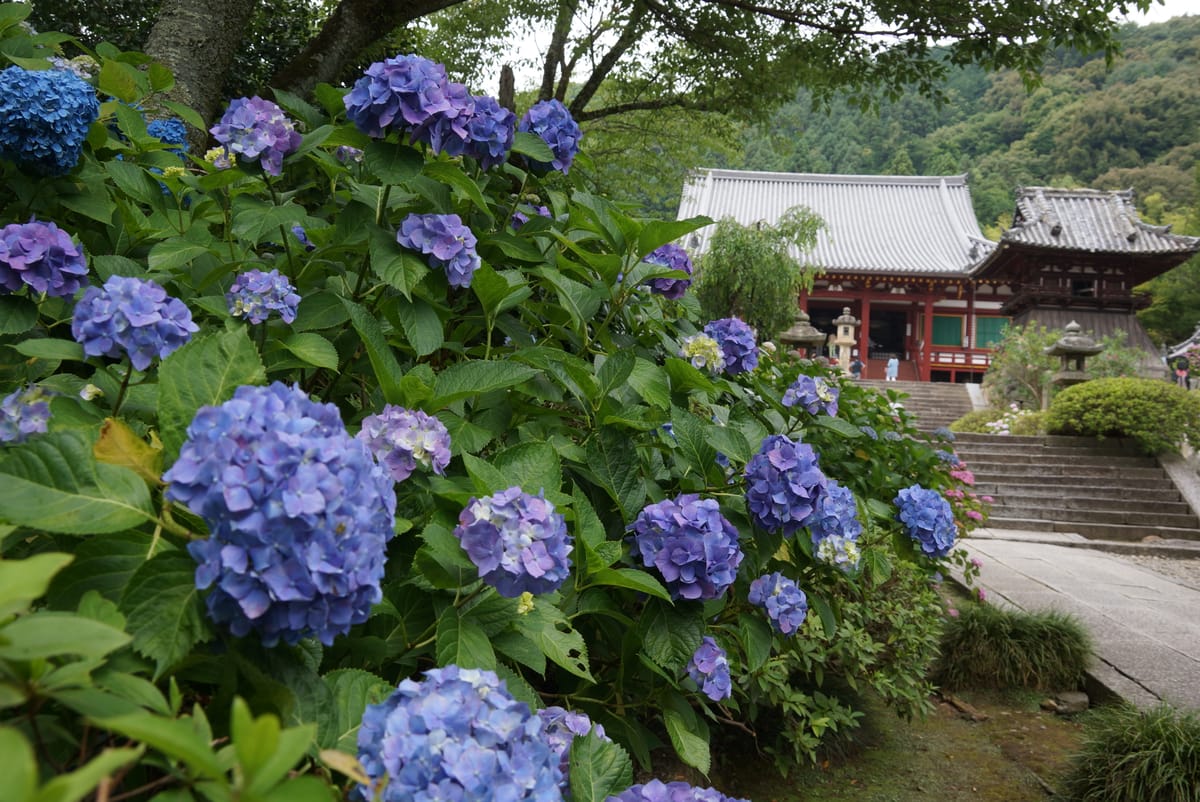
Yatadera Temple (矢田寺), nestled in the Yata hills of Yamato-Koriyama City, Nara, is known as the “hydrangea temple.”
The temple grounds are planted with approximately 10,000 hydrangeas in around 60 varieties, which burst into bloom with the rainy season. The 2026 Ajisai Mairi season runs from Saturday, May 31 through Monday, June 30. As one of Japan’s most celebrated temples for hydrangeas, it draws considerable attention among those who collect limited temple goshuin.
Jizo and Hydrangeas — A Shared Place at the Boundary Between Worlds
The principal image at Yatadera is the Enmei Jizo Bosatsu. The temple’s formal name is Yatazan Kongosen-ji, and it is said to have been founded in 679, the seventh year of Emperor Tenmu’s reign. It enshrines one of Japan’s oldest Enmei Jizo Bosatsu, and has long been cherished by locals as “the Jizo of Yata.”
Jizo Bosatsu was originally revered as a bodhisattva who saves the dead at the gates of hell. Jizo statues placed at roadsides and crossroads carry the meaning of standing at the boundary between this world and the next, protecting those who pass.
Hydrangeas, too, have long been regarded in Japan as a “flower of the threshold.”
Because the flower’s color changes, it was associated with fickleness and inconstancy, and there were periods when it was considered inauspicious in Buddhist contexts. At the same time, hydrangeas bloom at the boundary between spring and summer — the rainy season — and in eras when burial in the earth was common, they were often planted in cemeteries. They carry a folk image of being close to the realm of the dead.
Jizo and hydrangeas — seen as things that stand at the border between this world and the next, their association in the context of a temple begins to feel natural. It makes the history of hydrangeas gathering at Yatadera feel less like coincidence and more like inevitability.
From “Inauspicious Flower” to the Face of the Hydrangea Temple
The rehabilitation of hydrangeas in Japan is a relatively recent phenomenon.
After the Meiji era, Western hydrangeas were selectively bred and re-imported to Japan, gradually shifting the flower’s image. Large, symmetrical, ball-shaped flower clusters were highly valued as ornamentals, and hydrangeas became established as the “flower of rain” — a fresh, clean presence in the rainy season.
Yatadera is said to have begun actively planting hydrangeas in the 1960s or thereabouts. Planting large numbers of “boundary flowers” in a sacred site dedicated to Jizo worship — that combination may not have been coincidental, but rather something that grew naturally from an indigenous sensibility.
Today, 60 varieties and 10,000 plants bloom across the temple’s 25,000㎡ grounds, and Yatadera has become established as one of the premier hydrangea temples in the Kansai region. It took a hundred years or more for an “inauspicious flower” to become the face of a temple.
2026 Ajisai Mairi — Basic Information
| Item | Details |
|---|---|
| Period | Saturday, May 31 – Monday, June 30, 2026 |
| Visiting Hours | 9:30–16:30 (last entry 16:00) |
| Admission | Adults ¥700 / Elementary school students ¥300 |
| Scale | Approx. 60 varieties, 10,000 plants, 25,000㎡ |
The temple grounds spread across the slopes of the Yata hills, with hydrangeas blooming in layers along the hillside. The colors are most vibrant on overcast days after rain.
Paper-Cut Goshuin
During the Ajisai Mairi period, Yatadera offers a paper-cut goshuin featuring a hydrangea motif.
Paper-cut goshuin are made using a technique of precisely cutting thin washi paper to create raised patterns. Their delicate, semi-transparent quality when layered is their hallmark, and this style spread to temples and shrines across Japan from around 2019. Yatadera’s paper-cut goshuin incorporates hydrangea designs, creating a striking combination of Jizo Bosatsu imagery and the seasonal flower.
Quantities are limited and distribution ends when supplies run out. Even within the official period, stock may be exhausted, so those who want one should realistically aim for a weekday in the first half of the month.
Special Exhibition: Jizo Bosatsu Standing Statue and Enma Hall
During the Ajisai Mairi period, the Jizo Bosatsu Standing Statue and the Enma Hall — normally closed to the public — are specially opened.
The Enma Hall enshrines Enma Daio (the Great King Yama), a form of worship unique to Yatadera. It draws on a Buddhist interpretation in which Jizo Bosatsu and Enma Daio are considered one and the same — the theory that Jizo is a manifestation of Enma, the judge of the dead. Both are seen as beings who determine the fate of the deceased, forming the spiritual core of the temple’s faith.
Spaces not normally accessible to the public open only during the hydrangea season.
Access
| Item | Information |
|---|---|
| Address | 3508 Yatacho, Yamato-Koriyama City, Nara Prefecture |
| Access | Take a bus from Kintetsu Kashihara Line or JR Yamatoji Line Koriyama Station (bound for Yatadera/Yata) → alight at “Yatadera-mae” |
| On Foot | Approx. 40 minutes from Kintetsu Koriyama Station (a viable distance for a full-day walking route) |
| Parking | Available (paid during the hydrangea season; expect congestion) |
| Official Website | Yatadera Nenbutsu-in |
For a broader look at Nara’s shrines and temples, see Nara Shrine and Temple Guide — Highlights of Yamatoji and Goshuin.
Sources:
- Yatadera Nenbutsu-in Official Website
- Yatadera Hydrangea Garden Opening – Yamato-Koriyama Tourism Association
- Celebrate your visit to the stunning hydrangea garden with a limited paper-cut goshuin – Yahoo! News
Image credit: Yatadera Ajisai DSC09953 — Yamato-Koriyama City Hall, CC BY-SA 4.0, via Wikimedia Commons
Information in this article is current as of May 21, 2026. Goshuin availability and visiting hours are subject to change. Please check the Yatadera official website for the latest information.