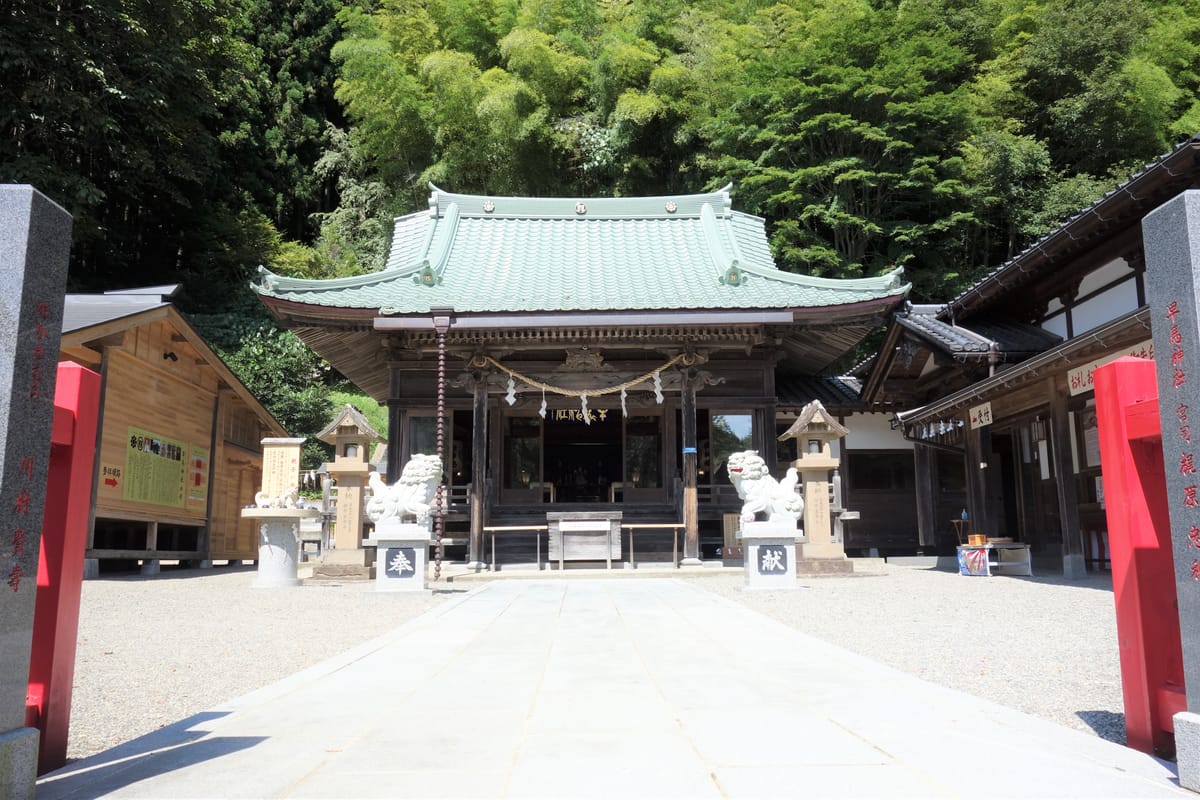
2026 is the Year of the Horse. Hayama Jinja in Kesennuma, Miyagi Prefecture is observing its once-in-12-years “Uma-doshi Go-en-nen.” One of the few shrines in Japan whose name contains the character for “horse,” it has prepared a special array of offerings for the year. At the center of it all is the nademe-uma — a sacred horse statue that survived the massive tsunami of 2011.
The Water Reached Up to Its Ears
Hayama Jinja stands on high ground in Karakuwa-cho, Kesennuma, at approximately 12 meters above sea level. On March 11, 2011, a tsunami surged higher even than that elevation. The sacred horse statue on the grounds — known locally as the “nademe-uma” (the horse you stroke) — had water reach all the way to the tips of its ears.
It did not fall.
The shrine’s floor was submerged, the mikoshi was damaged, and the fishing settlement of Yadonoura at the base of the hill was destroyed. And yet the horse statue stood. What that fact means to the people of Kesennuma is not something an outsider can put into a single sentence. But the belief continues to this day: “stroke the head and legs of the tsunami-surviving nademe-uma, and things will go well.” In this uma-doshi go-en-nen year, many people are making the journey to lay their hands on that horse.
The Once-in-12-Years “Go-en-nen”
Hayama Jinja designates the Year of the Horse as its “go-en-nen” (special anniversary year). The term refers to a year with a particularly deep connection to a sacred deity — the same logic as Bishamonten and the Year of the Tiger, or Tenjin-sama and the Year of the Ox. For a shrine that venerates horses, the interpretation that the Year of the Horse is “a special cycle that comes every 12 years” is a natural one.
Special offerings different from those of ordinary years are available throughout 2026.
Go-en-nen Offerings
The Uma-doshi Go-en-nen Limited Goshuin (¥800) features a dedicated design distinct from the regular three-color goshuin. Distribution began January 27, 2025 (Reiwa 7) and continues through the end of the year. Reception hours: 9:00–16:00.
A paper-cut goshuin (¥1,200) is also available. Crafted using the delicate paper-cut technique, it is a special edition specific to the go-en-nen.
The Umaku Iku Mamori — Uma-doshi Go-en-nen Limited (white) (¥500) is a special go-en-nen version of the most popular amulet. Unlike the regular version, this one is white, and cannot be obtained outside this year.
Other offerings include ema votive tablets (¥500) and horse-shaped fortune lots (uma-mikuji).
A Connection Going Back to 1217
In the 5th year of Kenpo (1217), Kajiwara Kagemi — a retainer of the Kamakura shogunate — built a shrine on this site. Kagemi’s older brother Kajiwara Kagetoki had been a close confidant of Minamoto no Yoritomo, but fell from power after Yoritomo’s death and the clan was destroyed. Kagemi, grieving over what had happened, is said to have left Kamakura and eventually arrived at the Karakuwa Peninsula.
A connection to safe childbirth is also recorded here. When Hojo Masako suffered a difficult labor, Kagemi performed prayers at Yoritomo’s command, and a healthy boy was born — later known as Minamoto no Yoriie. Because of this, Hayama Jinja is also known as a deity of safe childbirth and child-rearing.
The combination of horses, safe childbirth, and a warrior clan may seem strange at first. But for samurai of that era, a horse was a lifeline. It is no coincidence that the phrase “umaku iku” — meaning “to go well” — is still alive today.
Access and Basic Information
| Item | Details |
|---|---|
| Address | 75 Yadonoura, Karakuwa-cho, Kesennuma City, Miyagi Prefecture |
| Visiting Hours | 6:00–17:00 (granting office: 9:00–16:00) |
| Phone | 0226-32-2321 |
| Access (by car) | Approx. 15 minutes from Sanriku Expressway “Karakuwa Peninsula IC” |
| Access (public transit) | Approx. 25 minutes by bus from Ofunato Line “Shishiori-Karakuwa Station” |
| Parking | 40 spaces on grounds; temporary lot (Yadonoura Port) 100 spaces |
| Go-en-nen Period | January–December 2026 |
Far Away, and That’s Exactly Why
Getting to Kesennuma from Tokyo takes over three hours by Shinkansen and local train connections. A day trip is not realistic. But the once-in-12-years go-en-nen is a reason that can hold its own against “it’s far.”
Walk through the Yadonoura settlement rebuilt after the disaster. Climb up to the shrine on the hill. Look out over the sea of the Karakuwa Peninsula from the grounds, and place your hand on the nademe-uma whose ears the water nearly touched. Whether you feel something in that moment is something only those who go will know.
The next Uma-doshi Go-en-nen is in 2038.
Image: “Hayama Jinja Haiden” by Makusakura, CC BY-SA 4.0, via Wikimedia Commons
Sources: Hayama Jinja Official Website / Miyagi Marugoto Tanbo