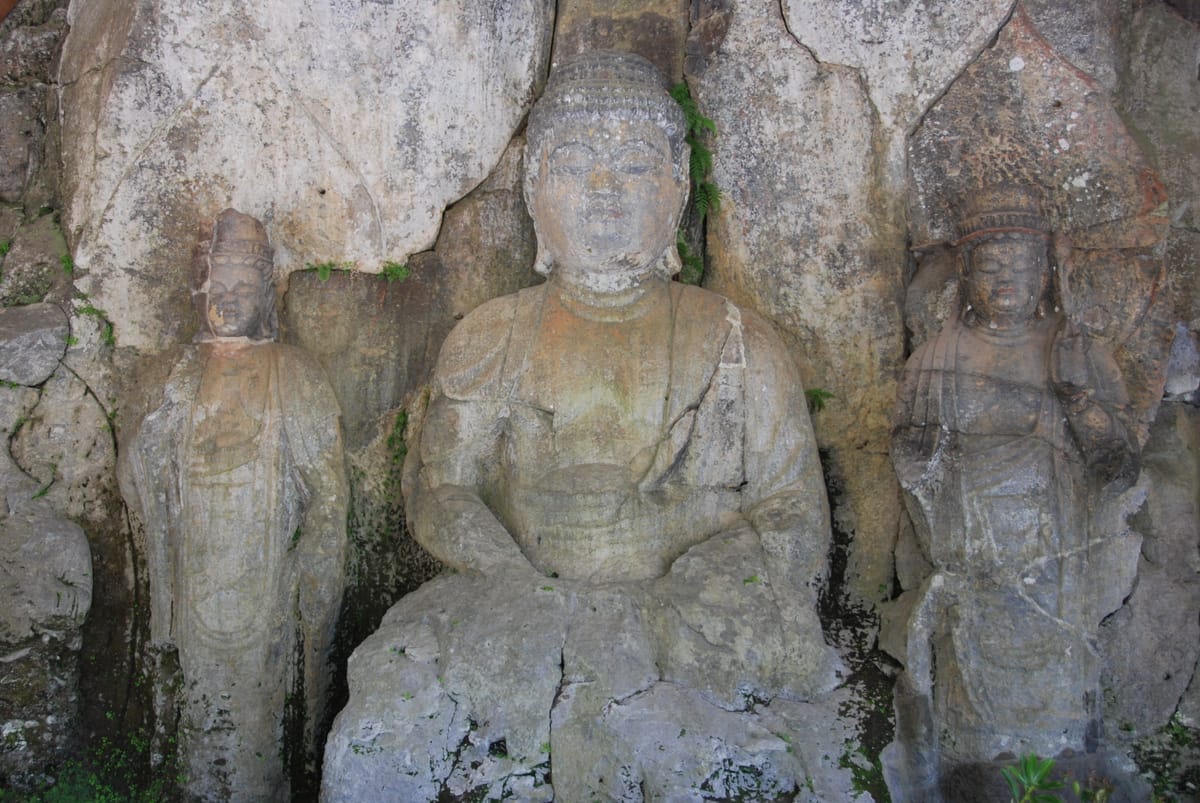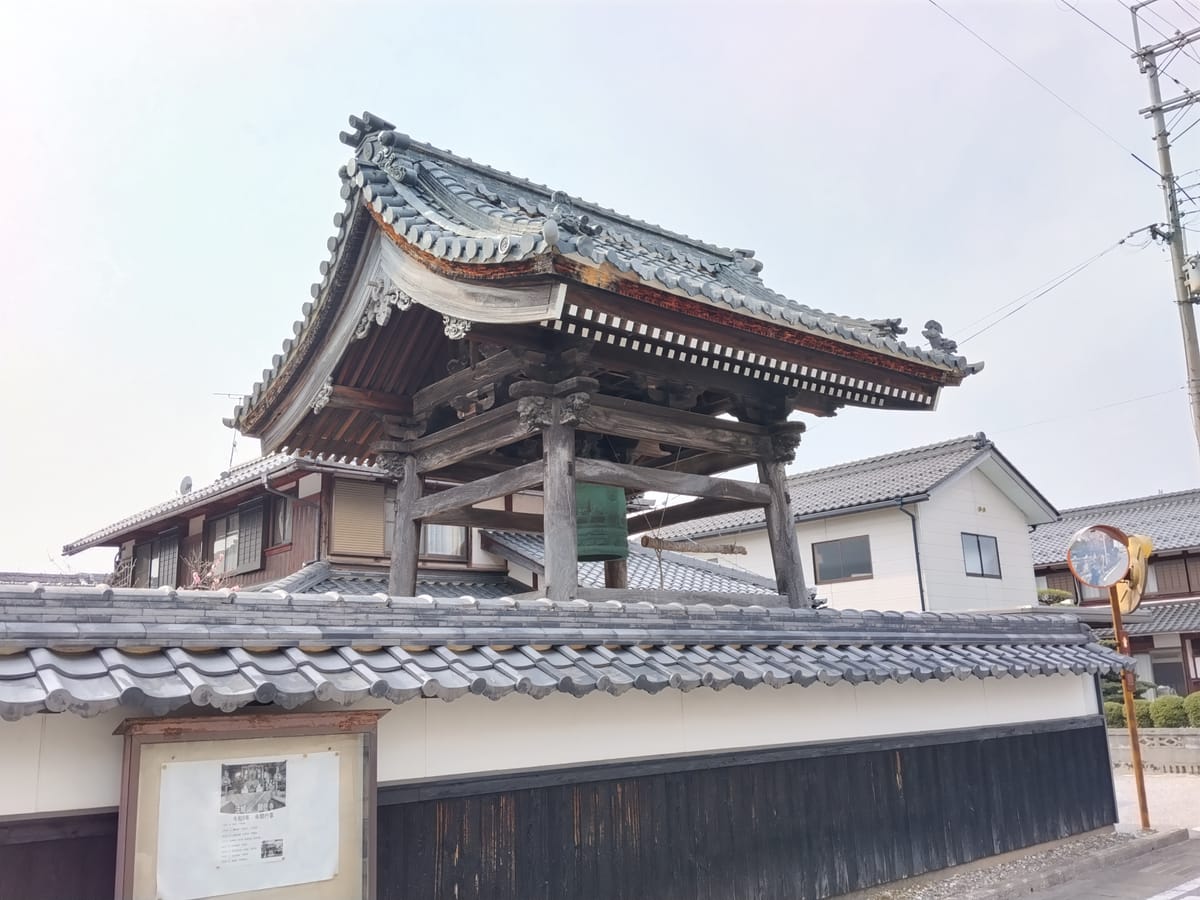
Walk far enough into a Japanese temple precinct and you will find a place that changes tone. The main hall, the lecture hall, the bell tower — all of those recede. Ahead is a gate, sometimes low, sometimes unmarked. Beyond it: rows of stone towers in various states of age and repair, narrow paths between them, the quiet drip of water from a bamboo ladle, and — almost certainly — clusters of tall, pale wooden boards standing behind the grave markers, inscribed with vertical columns of characters you cannot read.
This is a temple cemetery (jiinbochi, 寺院墓地), and in Japan it is nearly universal. Walk into almost any Buddhist temple of significant age, and you will find the dead nearby. The relationship between Buddhist temples and the human dead in Japan runs roughly fourteen centuries deep. It is encoded in architecture, in the shape of stone markers, in the form of those wooden boards, in the rituals performed at specific times of year.
When you visit Japanese temples to receive goshuin stamps, you are passing through spaces where all of this is present — sometimes obvious, sometimes quietly embedded in the landscape. Understanding what these elements are and where they come from deepens what you see. This guide explains the history, the stone towers, the wooden boards, and what to do when you find yourself walking among them.
How Japanese Temples Became Places of the Dead
Before Buddhism: Ancient Burial Practices
Buddhism arrived in Japan in the sixth century, traditionally dated to 538 or 552 CE. Before that, Japanese burial practices were varied and regionally distinct.
Jōmon-period settlements (from roughly 14,000 BCE to 300 BCE) typically placed burials close to the living area — graves within or adjacent to the village, often with the body in a flexed position and personal objects placed alongside. Yayoi-period burials (300 BCE to 300 CE) introduced jar burials (kamekansō) and moated rectangular tombs. The Kofun period (250–710 CE) produced the large earthen mound tombs — kofun — that still dot the Japanese landscape, built for rulers and powerful clans, some of them among the largest funerary monuments ever constructed.
Running through all these periods was a Shinto sensibility about death: death as ritual pollution (kegare), the dead as requiring careful management and separation from the living. Shrines remained separate from places of death. This boundary persisted even as Japan absorbed continental cultural influence, though Buddhism would eventually alter the relationship between the living and the dead in fundamental ways.
Buddhism and the Culture of Death
Buddhism brought with it two ideas that reshaped Japanese attitudes toward death: rinne tenshō (輪廻転生), the doctrine of cyclical rebirth, and tsuizen kuyō (追善供養), the practice of merit transfer — performing rituals on behalf of the dead to improve their situation in the next life or help them attain birth in a pure land.
The logic of merit transfer required a place where such rituals could be performed — and temples filled that role. Aristocratic patrons of the Nara and Heian periods (710–1185) founded temples partly to serve as ongoing ritual centers for their deceased ancestors. Monks chanted sutras; memorial services accumulated merit on behalf of the dead. The dead needed tending, and the temple was the place to tend them.
By the Kamakura period (1185–1333), when new Buddhist schools — Pure Land, Rinzai Zen, Sōtō Zen, Nichiren — spread from the aristocracy to the warrior class and eventually to commoners, funerary Buddhism (sōshiki bukkyō) had become a central function of many temples. Different schools developed different funeral rites, memorial protocols, and styles of grave marker, but all of them positioned the temple as the institution responsible for the dead.
The Danka System: Cementing the Bond
The relationship between temples and death was formalized — and made compulsory — in the Edo period (1603–1868) through the danka seido (檀家制度), the “parishioner system.”
The Tokugawa shogunate, alarmed by Christian conversion among some Japanese, required every household in Japan to register with a Buddhist temple. Each family was assigned to a dannaji or bodaiji (菩提寺) — a home temple — and was obligated to conduct all funerals, memorial services, and grave maintenance through that temple. The system also functioned as population registration: the temple essentially ran the census.
The practical consequence was that every temple in Japan now had a constitutive relationship with the families in its territory. Those families needed graves. Temples provided land for graves. The “temple plus cemetery” configuration that you see across Japan today crystallized in this period and has remained the dominant model ever since.
The Meiji-period policy of separating Shinto from Buddhism (1868) restructured religious institutions but left the funeral functions of Buddhist temples largely intact. Japanese Buddhism became, for much of the modern population, primarily “funeral Buddhism” — the Buddhism of death rites, memorial services, and ancestral care. This is not the whole of Japanese Buddhism, but it is a large part of how many Japanese encounter it.
Sotoba: The Wooden Memorial Boards
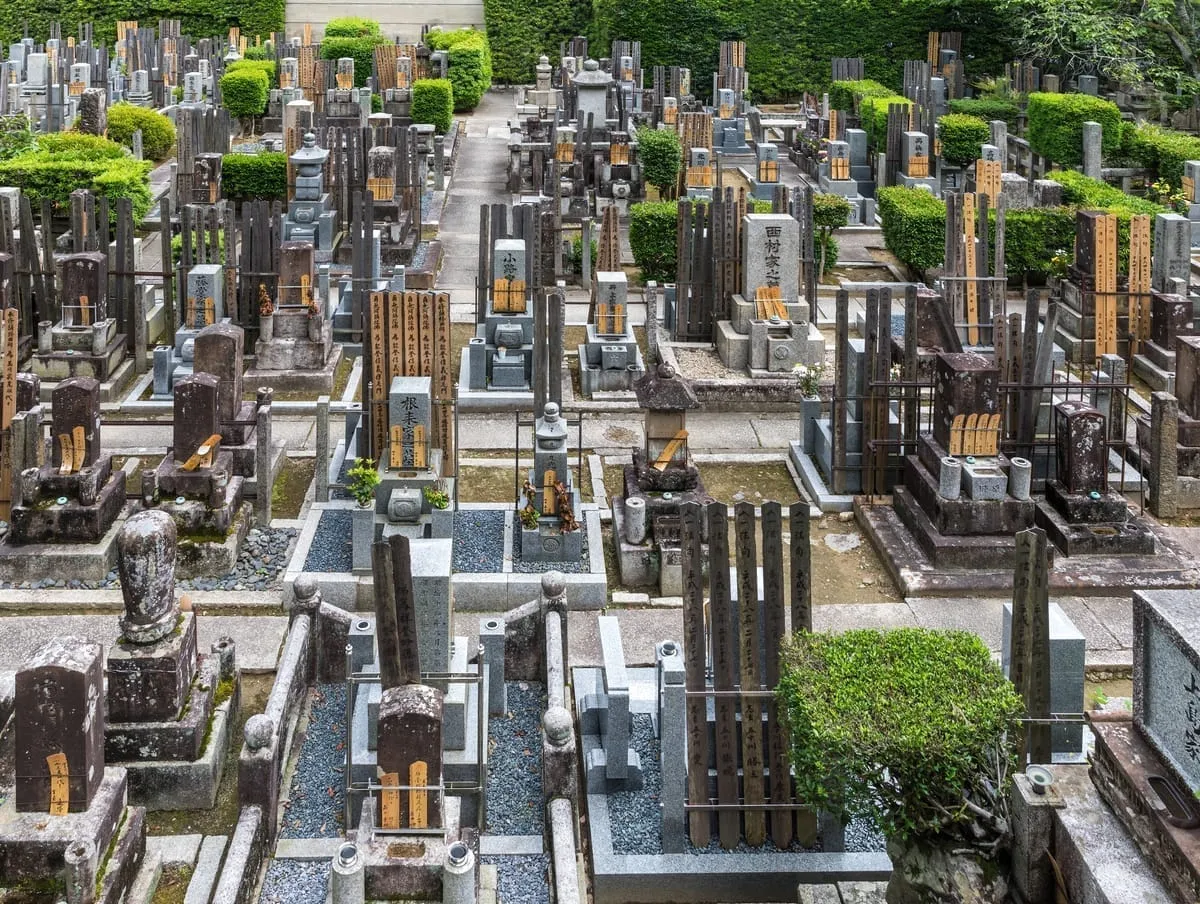
Behind and beside the stone grave markers in a Japanese Buddhist cemetery, you will almost always find tall, pale boards of wood. These are sotoba (卒塔婆), and they are one of the most characteristic objects in the landscape of Japanese Buddhist death culture.
Etymology and Origins
The word sotoba is a Japanese phonetic rendering of the Sanskrit stūpa — the domed relic monument of early Buddhism. The earliest Indian stūpas were structures built to contain relics of the historical Buddha or of Buddhist saints; later they became objects of veneration in themselves, circumambulated by pilgrims. The word traveled from Sanskrit to Chinese (zhuì tǎ pó, 卒塔婆) to Japanese (sotoba), and as the form traveled, so did the meaning.
In Japan, the stūpa concept was transformed into something that exists nowhere else in the Buddhist world: a tall, narrow wooden board, inscribed with Sanskrit seed syllables and Japanese text, erected at gravesites as a form of merit-making on behalf of the dead. The board is understood as a miniature stūpa — a relic monument in a highly abstract, planar form. It is both a marker and an offering, both a memorial and a ritual object.
The Shape and Its Meaning
A standard Japanese sotoba (called itatōba or “board stūpa”) is typically between 60 centimeters and 2 meters tall, roughly 10 centimeters wide, and relatively thin. At the top, five notches are cut into the board, dividing the upper portion into five sections.
These five sections represent the go-dai (五大) — the five great elements of Buddhist cosmology:
| Section (from top) | Shape reference | Element |
|---|---|---|
| 1st (top) | Jewel form | Space (kū) |
| 2nd | Crescent | Wind (fū) |
| 3rd | Triangle / flame | Fire (ka) |
| 4th | Circle | Water (sui) |
| 5th (bottom) | Square | Earth (chi) |
This five-element structure also corresponds to the five sections of a gorinto (five-element stone tower), which we will examine in the next section. The sotoba is, in effect, a gorinto laid flat and made in wood — the same cosmological structure expressed in a different medium.
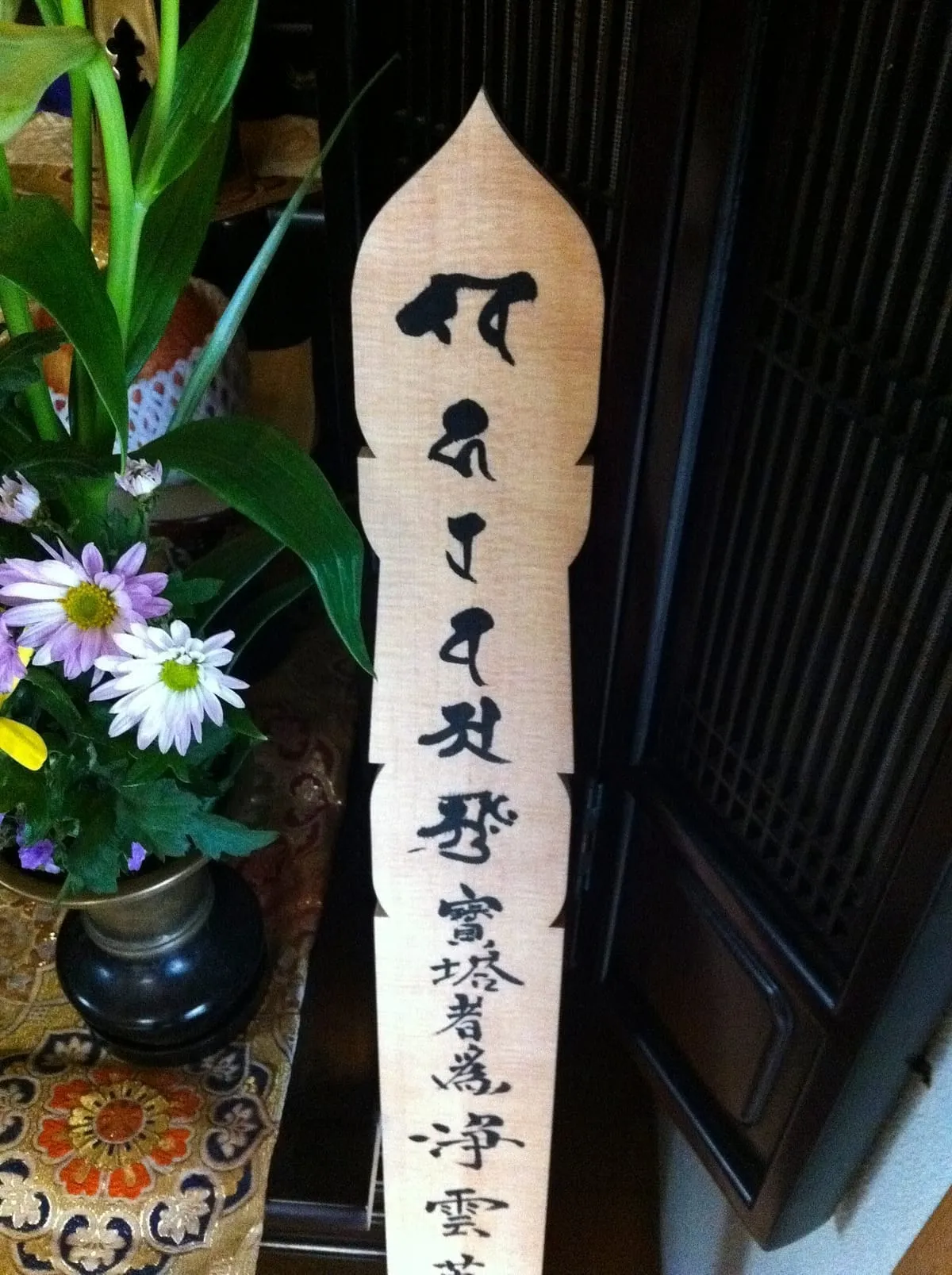
What Is Written on a Sotoba
The text on a sotoba is dense with ritual significance. Reading from top to bottom, a typical board contains:
Seed syllables (梵字, bonji): Sanskrit characters written in the Siddhaṃ script, each representing a Buddha or a cosmic principle. The specific syllables correspond to the deceased’s guardian Buddha — the deity whose protection is invoked for them in the afterlife.
A sutra passage: A few lines from the Heart Sutra (Hannya Shingyō) or another relevant text, written in Japanese or classical Chinese. The act of writing sutra text is itself meritorious.
A dedication formula (回向文, ekōmon): Something like “For the Buddhist merit (bodhi) of [posthumous name].” This explicitly states on whose behalf the merit-making is performed.
The posthumous Buddhist name (戒名/法名, kaimyō/hōmyō): The name given by the temple at death, indicating the deceased’s religious identity and — in many traditions — their position in a symbolic monastic hierarchy.
The donor’s name and date: Who commissioned this sotoba, and when.
When Sotoba Are Erected
Sotoba are raised at specific ritual moments:
Memorial services and death anniversaries (nenkī): The 49th day after death, first anniversary, third anniversary, seventh, thirteenth, thirty-third, and fiftieth anniversaries each involve a service at which new sotoba are erected. The more intervals observed, the more boards accumulate behind a grave.
O-bon and O-higan: The seasonal ancestral observances (discussed below) are major occasions for sotoba donation. In the days before O-bon, fresh pale boards appear throughout temple cemeteries as families prepare for the visit of ancestral spirits.
A sotoba is explicitly temporary. It begins aging the moment it is erected — weathering, fading, darkening, eventually becoming illegible. This impermanence is not a problem to be solved; it is part of the logic. When a board has served its time, the temple collects and burns it in a ritual burning (shōnō). New boards are raised at the next occasion.
Types of Sotoba
Beyond the standard flat board (itatōba), two other types appear in Japanese cemeteries.
Kakutōba (角塔婆): A square-sectioned timber sotoba, thicker and heavier than the standard board. Associated particularly with Nichiren-sect temples and certain regional traditions. Because of its cross-section, it sits closer to the volumetric gorinto form.
Kyōgi-sotoba (経木卒塔婆): A very thin cedar or cypress slip with a name and brief sutra text written on it. These are typically small — 30 to 40 centimeters — and are used for short-term memorial purposes, often placed at a communal ossuary or cemetery chapel during O-bon, then burned afterward.
Denominational Differences
Whether a Buddhist funeral tradition uses sotoba at all depends on the school.
Schools that use sotoba: Sōtō Zen, Rinzai Zen, Nichiren, Shingon, Tendai, and much of Pure Land Buddhism (Jōdoshū).
Schools that do not use sotoba: Jōdo Shinshū (True Pure Land Buddhism), by far the largest Buddhist denomination in Japan by number of adherents. Jōdo Shinshū teaches that the deceased are immediately received into the Pure Land through the power of Amida Buddha’s vow — without any need for posthumous merit transfer by the living. Since there is no merit to transfer, sotoba have no function. Jōdo Shinshū cemeteries are identifiable by the absence of wooden boards behind the grave markers, and by the distinctive inscription on the grave stones themselves: rather than Namu Amida Butsu (南無阿弥陀仏, the nembutsu formula), Jōdo Shinshū graves often bear the phrase Kuechissho (倶会一処) — “we shall meet again in one place” — a reference to reuniting in the Pure Land.
Gorinto: The Five-Element Stone Tower
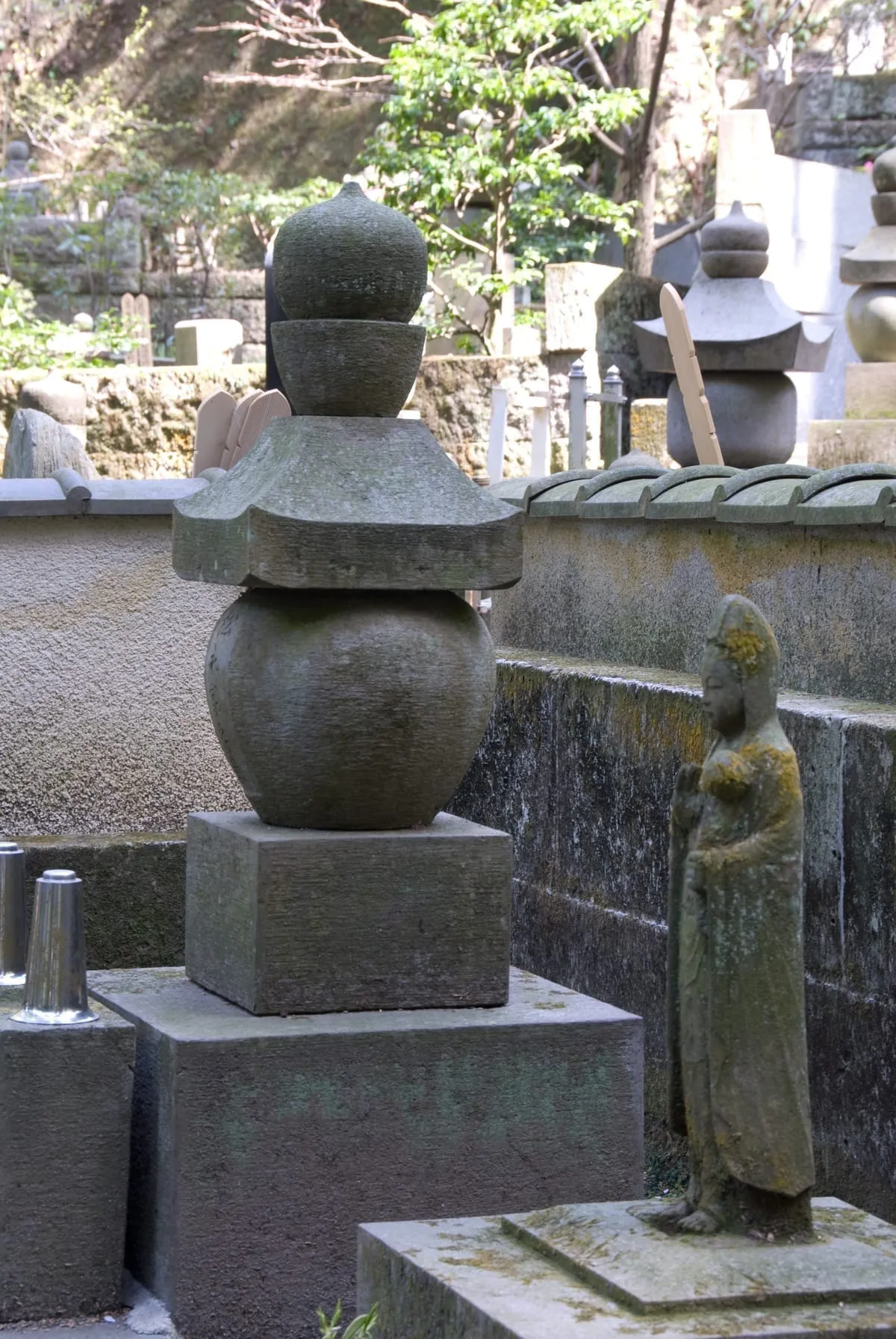
The gorinto (五輪塔) is the archetypal Japanese Buddhist grave marker — five stones stacked in sequence, each cut to a prescribed form, each representing one of the five cosmological elements. It appears throughout Japan’s temple cemeteries, from small individual monuments 30 centimeters tall to monumental examples several meters high, and the same form has been used for roughly nine hundred years.
The Five Elements
The five sections of a gorinto, from bottom to top, are:
| Position | Form | Element | Sanskrit syllable |
|---|---|---|---|
| 1 (base) | Square prism | Earth (chi) | A |
| 2 | Sphere | Water (sui) | Va |
| 3 | Triangle / pointed prism | Fire (ka) | Ra |
| 4 | Crescent / dome | Wind (fū) | Kha |
| 5 (top) | Jewel shape (hōju) | Space (kū) | Kha |
These five elements — the godai — are the building blocks of all material existence in Buddhist cosmology. The human body itself is composed of these five. To place a grave marker in the gorinto form is to acknowledge that the body of the deceased has returned to the five elements from which it came, while the spirit passes toward liberation. The grave is not a body — the body has dissolved into earth, water, fire, wind, and space. The gorinto memorializes the dissolution.
History and Development
The gorinto form arrived in Japan through esoteric Buddhism — specifically through texts transmitted in the Shingon tradition — and appears to have developed into its characteristic shape during the late Heian and early Kamakura periods (late twelfth to early thirteenth century). Early examples appear in court and aristocratic Buddhist contexts; the form spread to the warrior class through the Kamakura period and to commoners through the Muromachi and Edo periods.
The greatest concentration of gorinto anywhere in Japan — indeed among the largest anywhere in the world — is at Kōyasan Okunoin in Wakayama Prefecture, where an estimated two hundred thousand grave markers of various types line over two kilometers of a cedar-shaded path through deep forest. Visiting Okunoin is, among other things, walking through eight hundred years of gorinto accumulation.
Hokyointo and Muhoto
Two other stone forms appear alongside gorinto in temple cemeteries and are worth knowing.
The hōkyōintō (宝篋印塔) — “jeweled-chest-seal tower” — takes the form of a base supporting a square body, topped by a distinctive lid-shaped cap with corner finials (sumikazari). It is named for the Hōkyōin Dhāraṇī Sūtra, which attributed enormous merit to the production or circumambulation of such towers. The hōkyōintō became popular in the late Kamakura and Muromachi periods and appears frequently alongside gorinto in older temple cemeteries. The key visual distinction: the gorinto is identified by its jewel-shaped topstone; the hōkyōintō by the square cap with corner projections.
The muhōtō (無縫塔) — literally “seamless tower” — is used specifically for the graves of high-ranking Zen priests. Its defining characteristic is an egg-shaped or onion-shaped topstone, smooth and unjointed (muhō means “without seams”), symbolizing the seamless, undivided nature of enlightened mind. Walking into the abbot’s memorial garden at a major Zen temple — Kenchōji, Eiheiji, Tōfukuji — you will encounter rows of egg-topped muhōtō, each marking a prior abbot.
Japanese Grave Markers: Forms and History
The most common grave marker in contemporary Japanese temple cemeteries is the wagataboroseki or “Japanese-style grave stone” (wagata bōseki, 和型墓石): a tall, narrow vertical stone pillar (saoseki, 竿石) mounted on a tiered stone base. The pillar typically bears the family name followed by “之墓” (no haka, “grave of”), or a religious formula such as “Namu Amida Butsu” or “Namu Myōhō Renge Kyō.”
This form consolidated in the Edo period. Before that, grave markers ranged widely: wooden stūpa-boards (sotoba), flat stone memorial boards (itahi), natural stones, wooden posts. The Edo-period demand for family graves — a single memorial serving an entire lineage rather than a single individual — gave the vertical pillar form its particular utility: it could accommodate a family name and multiple generations of interred remains beneath a shared marker.
From the Meiji period onward, the vertical stone became essentially standard. Today, however, Japanese burial culture is changing. Western-style horizontal grave stones (yōgata bōseki, 洋型墓石) — lower, wider slabs, often with personalized inscriptions — now account for a significant share of new grave purchases. Tree burial (jumokusō, 樹木葬) — interring remains beneath or around a tree rather than beneath stone — is growing rapidly, particularly in urban areas where grave-maintenance burden on small families is a practical concern. Several major urban temples in Tokyo have opened tree-burial areas in recent years.
Perpetual care tombs (eitaikuyō-bo, 永代供養墓) represent another shift: a family or individual pays a one-time fee to the temple, which then performs memorial services in perpetuity without requiring the family to maintain a dedicated plot or attend services. Often these are communal structures — a single stone monument over a large communal ossuary — rather than individual family graves. As Japan’s birth rate continues to fall and family structures change, perpetual care tombs are increasingly the practical solution for people who cannot or do not wish to pass grave maintenance obligations to the next generation.
Notable Temple Cemeteries
Kōyasan Okunoin (Wakayama Prefecture)
The most sacred and the largest temple cemetery in Japan is Okunoin (奥の院), the inner precinct of the Shingon headquarters temple on Mount Kōya. Founder Kūkai (Kōbō Daishi) is said to remain in eternal meditation in the mausoleum at the end of the approach path; his presence is believed to be continuously active in the world. To be buried near him — to have one’s remains interred in his spiritual field — is regarded as the highest form of posthumous placement available to a Japanese Buddhist.
The result, over more than eight hundred years, is the accumulation of over two hundred thousand grave markers along roughly two kilometers of cedar-shaded path. Daimyo, generals, and samurai of the Sengoku period are heavily represented: Oda Nobunaga, Toyotomi Hideyoshi, Takeda Shingen, Uesugi Kenshin, and Tokugawa Ieyasu all have monuments here — men who fought each other across decades of civil war, now lying within meters of one another beneath the cedars of Okunoin. The effect is both historically vertiginous and quietly equalizing.
Corporate cenotaphs stand alongside samurai grave markers: Japanese firms including termite extermination companies, beverage manufacturers, and heavy industry conglomerates have placed memorial stones here for workers killed in industrial accidents or for company founders. The cedar forest contains one of the strangest and most affecting mixtures of Japan’s history available to a traveler.
Okunoin’s path is part of the UNESCO World Heritage Site “Sacred Sites and Pilgrimage Routes in the Kii Mountain Range.” The goshuin available at the Okunoin precincts carries weight that comes from walking those two kilometers first.
Chion-in (Kyoto)
The headquarter temple of the Jōdo (Pure Land) school founded by Hōnen, Chion-in contains a large cemetery precinct behind and around the main halls. Hōnen himself is enshrined on the site. The cemetery includes graves of nobles, samurai, and literary figures from the Heian period onward, and walking into it from the monumental sanmon gate involves a distinct change of atmosphere — from the ceremonial grandeur of the temple’s public face to the quieter density of stone and memory behind.
Zōjōji (Tokyo)
The Pure Land bodaiji (ancestral temple) of the Tokugawa shogunate stands at the foot of Tokyo Tower in Minato Ward. Six of the fifteen Tokugawa shoguns are buried here, along with their wives and children: the second shogun Hidetada, the sixth Ienobu, the seventh Ietsugu, the ninth Ieshige, the twelfth Ieyoshi, and the fourteenth Iemochi. The mausoleum structures were largely destroyed in World War II air raids, but surviving stone enclosures and memorial markers remain. Standing beside the grave of a seventeenth-century shogun in the shadow of a 1958 television tower is one of Tokyo’s more disorienting historical juxtapositions.
Yanaka (Tokyo)
The Yanaka district in northern Tokyo — stretching across parts of Taitō and Arakawa wards — is Tokyo’s densest concentration of Buddhist temples. Over seventy temples operate in the area, most of them with adjacent or integrated cemeteries. Yanaka Cemetery (Yanaka Reien, Tokyo Metropolitan Yanaka Cemetery) was established in 1874 as one of Tokyo’s first public cemeteries; the last of the Tokugawa shoguns, Yoshinobu, is buried here. The older private temple cemeteries surrounding it date from the Edo period and contain an extraordinary concentration of grave markers from the seventeenth century onward.
Walking through Yanaka is the closest Tokyo comes to a pre-modern neighborhood — the 1923 earthquake and the 1945 air raids spared much of this area, leaving intact a scale and texture of streets and buildings that has otherwise disappeared from the city. Temples and cemeteries are not separate from the neighborhood; they are woven through it.
Kenchōji (Kamakura)
Japan’s oldest formal Zen monastery, founded in 1253, has at its rear and surroundings an accumulation of stone markers going back to the Kamakura period. The grave of fifth Kamakura regent Hōjō Tokiyori — who founded the temple — is on the grounds. Sengoku-period and Edo-period markers stand alongside Kamakura-era gorinto, providing a compressed timeline of Japanese grave-marker history within a single precinct. The path continuing beyond the main halls toward Hansobo provides one of the best views over Kamakura while passing through a landscape thick with old stone.
O-bon and O-higan: Seasonal Cemetery Visits
Two annual observances concentrate cemetery visiting in Japan and give temple cemeteries their most animated moments.
O-bon (お盆) is observed in mid-August (in most regions; some areas observe it in mid-July). According to Buddhist folk belief, the spirits of the dead return to the world of the living during O-bon, guided by the light of lanterns placed by their families. Households prepare the family grave in the days before O-bon — cleaning the stone, replacing water, placing fresh flowers, erecting new sotoba. On the 13th, fires (mukaebi, “welcoming fires”) are lit to guide the spirits home. On the 16th, fires again (okuribi, “sending fires”) to see the spirits back. In Kyoto, the Gozan no Okuribi — enormous kanji characters lit on five mountainsides — is the urban expression of this sending-fire practice.
O-higan (お彼岸) takes place twice a year, for seven days centered on the spring equinox (March) and autumn equinox (September). Higan (彼岸) means “the other shore” — in Buddhist usage, nirvana, or the Pure Land, as opposed to shigan (此岸), “this shore,” the world of suffering. The equinox is understood as the moment when the sun sets precisely due west — the direction of the Pure Land in most Japanese Buddhist traditions — making the distance between this world and the other world at its minimum. Grave visits during O-higan are among the most widely observed Buddhist practices in contemporary Japan, cutting across denominational lines and levels of religious engagement.
During O-bon and O-higan, temple cemeteries fill with activity that the rest of the year lacks: multiple generations at a single grave, fresh flowers everywhere, the smell of incense drifting through the paths, new white sotoba standing behind nearly every marker. If you want to understand what a temple cemetery is for, visiting during one of these periods shows it more clearly than any explanation.
Etiquette and Goshuin in Temple Cemeteries
Walking Through a Cemetery
Temple cemeteries are open to visitors, and there is no expectation that you only enter if you have deceased relatives there. Walking through is both acceptable and, for anyone interested in Japanese history or culture, genuinely rewarding.
Observe a few simple courtesies. Walk to the side of the main paths — the center is sometimes considered to be reserved for the passage of spiritual beings. Do not step on or sit on grave markers. Do not touch sotoba boards standing at graves that are not your family’s. Do not take photographs of grave markers that include living individuals’ names or private family information, and think carefully about whether to post any cemetery photographs on social media.
If you pass a grave that has fresh flowers or active signs of family care, lower your pace and give that space respectfully. Grief and memory are active in those moments; a tourist’s curiosity should yield to them.
Water, Incense, and Flowers
The standard ritual acts at a Japanese grave — pouring water over the grave stone, offering incense, placing flowers in the vase — are done by family members for their own graves. You may observe these acts; do not participate unless invited to by the family.
Water is poured from a ladle (hishaku) using water from a bucket, typically provided at the grave plot. The meaning is compassionate — to quench the thirst of the deceased. Incense is lit and placed in a sand-filled incense stand (kōro). Fresh flowers go in the stone vases built into the grave base.
Seasonal Timing
Visit temple cemeteries in the weeks before O-bon (early August) or at O-higan (mid-March or mid-September) to see the spaces at their most vivid — fresh flowers, new sotoba, families working quietly at the graves. Spring cherry blossoms and autumn foliage also transform many temple cemeteries into spaces of particular beauty.
Goshuin and the Cemetery
When you collect goshuin at a temple that has a significant cemetery or mausoleum precinct, the stamp you receive sometimes refers to what lies at the back of the precinct rather than the main hall alone.
At Kōyasan Okunoin, the approach to the mausoleum precinct where goshuin are available takes you through the full two-kilometer path of grave markers before reaching the stamp-granting booth near the mausoleum. The walk through the cemetery is not incidental to the goshuin; it is the goshuin experience. You are not collecting a stamp at the end of a pleasant path — you are receiving a mark that records your having walked through one of the great accumulations of Japanese spiritual history.
At temples like Chion-in, Kenchōji, and Zōjōji, goshuin are available at the main hall, with the cemetery occupying adjacent space. The visit integrates both — the living prayer of the hall and the accumulated memory of the graves.
The wooden boards in a Japanese temple cemetery begin to age the moment they are erected. The Sanskrit characters blur in the first rain; the Japanese text fades through seasons; the pale wood darkens, cracks, and eventually returns to the soil. This is not failure or neglect. It is the logic of the object: the board has done its work — it carried the act of memorial into the world and held it there for a span of years. When its time is done, new boards take its place.
A temple cemetery is not a place where things end. It is a place where a particular kind of practice continues: the practice of holding the dead in mind, erecting markers, pouring water, burning incense, returning at the turning points of the year. The stone towers have been standing for centuries and will stand for centuries more. The wooden boards are temporary by design. Both together express the full range of what human beings do when they try to stay in relation with those who are gone.
When you visit a Japanese temple to receive a goshuin stamp, you pass through all of this — the stone, the wood, the water, the incense, the Sanskrit characters you cannot read. The stamp you carry away is a mark of having been in that space. It is one more layer in an accumulation that has been building for a very long time.
Image Licenses
- Buddhist cemetery near Chion-in, Kyoto (Chioningu cemetery near Isshin-in Buddhist temple in Chion-in Kyoto Japan.jpg): Basile Morin, CC BY-SA 4.0, via Wikimedia Commons
- Gorinto stone tower (Gorinto.jpg): Tarourashima, Public Domain, via Wikimedia Commons
- Sotoba board (Sotoba.jpg): Urashimataro, CC BY-SA 3.0, via Wikimedia Commons
- Yanaka Cemetery, Tokyo (Yanaka_cemetery_1.jpg): Gustave67, CC BY-SA 4.0, via Wikimedia Commons