A small stone figure stands at the edge of the path. Its surface is thick with moss. Someone has tied a red bib around its neck; someone else has left a spray of wildflowers at its base. The hands of whoever placed them there are gone. But their gesture remains, layered over other gestures reaching back centuries.
Stone Buddhist figures — sekibutsu (石仏) — are among the most quietly insistent presences in the Japanese landscape. They appear at temple gates, beside mountain paths, at crossroads in old towns, in cemeteries, at the mouths of caves. Their number across Japan is estimated in the millions. Their forms range from crudely hewn roadside markers a few centimeters tall to masterworks of sculpture carved into living rock.
When you visit a Japanese temple to receive a goshuin stamp, you are surrounded by stone. Stone lanterns, stone water basins, stone torii, stone towers. Much of this stonework holds religious meaning that is legible once you know how to read it. This guide gives you the vocabulary to identify the most common stone figures and structures, understand their functions, and engage more fully with the spaces you walk through.
What Are Stone Buddhas?
Sekibutsu (石仏) — literally “stone Buddha” — is the general term for Buddhist figures carved from stone. They represent one of three main media for Buddhist sculpture in Japan alongside wood and metal. Because stone weathers rather than rots, stone Buddhas are placed outdoors where wooden and metal figures cannot safely go.
Two principal carving techniques are used. Marubori (環彫り) — fully sculpted figures carved in the round, visible from all sides — mirrors the approach used for wooden and bronze statues. Ukibori (浮彫り) — relief carving — cuts images into the face of a flat stone. When relief carving is applied directly to a natural cliff face or rock outcrop, the result is called magaibutsu (磨崖仏): cliff-face Buddha.
Stone’s permanence is central to its religious function. Wood decays; metal corrodes. Stone endures. To carve a Buddha in stone was to make a prayer that would outlast the person who made it — potentially outlasting the temple that commissioned it. This permanence gave stone carving a particular kind of merit in Buddhist practice. Even a rough, unskilled figure chiseled into a wayside rock by a layperson accumulated merit for its maker, because the prayer it embodied would continue long after the maker’s death.
The range of quality in Japanese stone Buddhas reflects this open access. At one end: the National Treasure carvings at Usuki in Ōita Prefecture, large-scale masterworks of the late Heian and Kamakura periods (late 12th to early 13th century). At the other: anonymous roadside figures carved by village stonecutters, rough enough that the type of Buddha represented can only be guessed. Both ends of this range share the same purpose — to make the sacred durable in stone.
Jizō Bosatsu: The Ubiquitous Stone Figure
No figure appears more often in the Japanese landscape than Jizō Bosatsu (地蔵菩薩). Called simply “Ojizō-san” in everyday speech, these small stone figures stand at roadsides, temple gates, mountain paths, cemeteries, and the intersections of old post roads throughout Japan. Their total number is estimated in the hundreds of millions.
Jizō derives from the Sanskrit Kṣitigarbha — “womb of the earth.” In Indian Buddhism, Kṣitigarbha was a bodhisattva who vowed to remain in the world, refusing final liberation, until all beings had been saved from the lower realms of existence. In Japan, this function expanded significantly, and Jizō became protector of travelers, guardian of children, guide for the dead, and keeper of the crossroads.
Identifying Jizō
The iconography of stone Jizō is consistent and distinctive. Where most bodhisattvas wear elaborate crowns and jewelry, Jizō appears as a shaved-head monk (僧形, sōgyō) — simple robe, no crown. This makes Jizō immediately identifiable: look for the bald head. In the right hand, Jizō holds a shakujō (錫杖) — a ringed staff carried by Buddhist monks as they walk, the rings chiming to warn small creatures to move out of the path. In the left hand, a hōju (宝珠), a wish-granting jewel. These two attributes together confirm the identification.
The red bib (前掛け, maekake) tied around the necks of stone Jizō figures is specifically associated with their role as protectors of children and of souls in the underworld. According to folk belief, children who died young were sent to the bank of the Sanzu River (三途の川) — the boundary between the living and the dead — where they were forced to pile stones as expiation for the grief they caused their parents by dying first. Jizō comes to comfort them and shield them from the demons who knock the stones down. The red bibs placed by the living on stone Jizō figures extend this protection: “please watch over this child.”
Six Jizō (Roku Jizō)
Many temple gates are flanked by six Jizō standing in a line — Roku Jizō (六地蔵). Buddhism teaches that all beings cycle through six realms of existence: hell (jigoku), hungry ghost (gaki), animal (chikushō), fighting spirit (ashura), human (ningen), and heaven (ten). The six Jizō guard each of these realms, ensuring that no being is left without a protector regardless of where their karma has placed them. Passing six stone Jizō at a temple gate is passing through a symbolic representation of the entire wheel of existence — all six realms acknowledged and protected.
Types of Jizō
Beyond the standard roadside figure, several specialized Jizō types carry distinct functions.
Enmei Jizō (延命地蔵) — longevity and recovery from illness. Often holds a lotus rather than the standard staff-and-jewel combination.
Koyasu Jizō (子安地蔵) — safe childbirth and child-rearing. Sometimes depicted holding a baby or with a child seated on the lap. In a country where infant mortality was historically very high, these figures answered prayers of desperate urgency.
Migawari Jizō (身代わり地蔵) — substitute Jizō, who absorbs suffering on behalf of believers. Figures with visible damage — chips, cracks, missing limbs — are sometimes explained through local legends as injuries sustained on behalf of a devotee. The damage itself becomes evidence of the figure’s efficacy.
Mizuko Jizō (水子地蔵) — guardian of mizuko, literally “water children”: fetuses or infants lost to miscarriage, stillbirth, or abortion. Clusters of small stone Jizō figures with bibs and toys, common in contemporary temples, represent this practice, which expanded significantly in the late twentieth century. The theology connects to the ancient Jizō role as protector of children in the underworld; the ritual is modern.
Other Stone Buddhist Figures
Kannon Bosatsu
Kannon Bosatsu (観音菩薩) — Guanyin in Chinese, Avalokiteśvara in Sanskrit — is the bodhisattva of compassion, and the second most commonly represented figure in Japanese stone carving after Jizō. Kannon is said to manifest in thirty-three forms, adapting to the needs of different beings in different circumstances. In stone carving, the most common form is Shō Kannon (聖観音) — the “holy” or standard form, with a single face and two arms, holding a willow branch or water vessel.
The system of thirty-three Kannon pilgrimage circuits — most famously the Saigoku Sanjūsan-sho in western Japan — spread stone Kannon images across the country. Each of the thirty-three temples on such a circuit enshrines a specific Kannon form, and stone figures were installed along the routes as trail markers and roadside shrines.
Batō Kannon (馬頭観音) — horse-head Kannon — is visually distinctive and historically interesting. A horse’s head rises above the crown; the face is wrathful rather than serene. The primary function of Batō Kannon was the memorial and protection of horses: pack animals, farm horses, post horses worn out in the service of transport. Before mechanization, horses were working partners whose deaths created real religious obligation. Batō Kannon stone figures cluster along old roads and mountain passes where pack-horse traffic was heavy. They stand as markers not only of faith but of an economy of movement that no longer exists.
Amida Nyorai
Amida Nyorai (阿弥陀如来) — Amitābha — the Buddha of the Western Pure Land, whose name is invoked in the nembutsu chant: Namu Amida Butsu. In stone carving, Amida appears as a Buddha figure rather than a bodhisattva: spiral hair (螺髪, rahotsu), no crown, the body of an enlightened being rather than a being still working toward enlightenment. The identification is confirmed by the hands: Amida holds either the jō-in (定印), a meditative mudra with both hands in the lap forming an oval, or the raigō-in (来迎印), hands raised in a gesture of welcoming — the posture of Amida approaching to escort the dying to the Pure Land.
Stone Amida figures appear frequently in cemeteries and near Pure Land temples, where the message of unconditional salvation through the nembutsu was directed at the suffering and the dying.
Fudō Myōō
Fudō Myōō (不動明王) — Acala in Sanskrit, “the immovable one” — is the most prominent of the Myōō (明王), a class of wrathful protector deities in esoteric Buddhism. Surrounded by flames, holding a sword in the right hand and a rope (羂索, kenjaku) in the left, with a grimacing expression and often a third eye in the forehead, Fudō embodies the fierce compassion that cuts through delusion and binds evil.
Stone Fudō figures are concentrated in the landscapes of mountain ascetic practice: near waterfalls (where practitioners undergo cold-water austerities), along mountain pilgrimage routes, at the entrances to mountain temples associated with Shingon and Tendai esoteric Buddhism. Many were carved by yamabushi — mountain ascetics — as votive offerings for completed training. Finding a Fudō figure on a hiking trail or at a waterfall often means you are near a historically significant site of religious practice.
Kōshin-tō Stone Towers
Kōshin-tō (庚申塔) is not strictly a Buddhist figure but a product of a complex fusion of Chinese Taoist folk belief, Buddhist iconography, and Japanese popular religion. The Kōshin belief system held that on certain calendar days (the Day of the Monkey in the sixty-day cycle), three supernatural worms living in the human body would ascend to heaven and report their host’s sins to the celestial emperor. To prevent this, devotees gathered on these nights and stayed awake until dawn. Over time, these vigils became community festivals, and stone towers carved with the relevant deity — usually Shōmen Kongō (青面金剛), a blue-faced warrior — and sometimes the “three monkeys” (see no evil, hear no evil, speak no evil) were erected as permanent markers.
Kōshin towers proliferated along Edo-period (1603–1868) roads and at village boundaries. They survive in enormous numbers in the Kantō region (the area around Tokyo) and can be spotted at old crossroads and the edges of former villages. They are among the most easily dateable stone markers — the Kōshin calendar date is often inscribed — and serve as documentary evidence of Edo-period community practice.
Magaibutsu: Buddhas Carved in Cliff
Magaibutsu (磨崖仏) are Buddhist images carved directly into natural rock outcrops or cliff faces. They represent the extreme case of the idea of permanence through stone: not just a stone figure, but the mountain itself given sacred form.
The greatest collection of magaibutsu in Japan is the Usuki Stone Buddhas (臼杵石仏) in Ōita Prefecture, Kyushu. Sixty-one figures, carved into pale volcanic tuff cliffs during the late Heian and Kamakura periods, were designated National Treasures in 1995 — the only stone Buddhist figures in Japan to achieve this designation in their entirety. The carvings include the Hoki Cluster, Yamanokami Cluster, and the Ancient Garden Cluster, each grouping representing a different compositional scheme. The most famous figure, the Dainichi Nyorai (大日如来) of the Furuzo group, had its detached head reattached during conservation work in 1993; the repaired join is still visible as a faint line at the neck.
Magaibutsu elsewhere in Japan include the enormous cliff carvings at Ōya (大谷) in Tochigi Prefecture, where volcanic tuff was quarried for centuries and the quarry walls are covered with carved figures and reliefs; and scattered figures throughout Nara, Kyoto, and Osaka, often associated with local rock cults that predated the introduction of Buddhism and were absorbed into it over time.
Stone Pagodas: Towers of the Buddhist Universe
Alongside figures carved in human form, the temple precinct typically contains stone structures derived from a different Buddhist tradition: the stūpa, the monumental funerary mound built over the relics of the Buddha in ancient India. As the stūpa traveled from India to China to Japan, it transformed from a hemispherical earthen mound into the tall, tapered wooden pagoda and eventually into compact stone towers of many forms.
Gorinto: The Five-Ringed Tower
The gorinto (五輪塔) — five-ringed pagoda — is the most common stone tower form in Japanese cemeteries and temple precincts. Five stone units, each a different geometric shape, are stacked from bottom to top: square (cube), sphere, triangle (or triangular prism), crescent, and jewel (a rounded point). These five shapes correspond to the go-dai (五大) — the five elements of esoteric Buddhist cosmology: earth (chi), water (sui), fire (ka), wind (fū), and space (kū). The entire visible universe is compressed into this stack of stones about knee height.
Each section may bear the corresponding Sanskrit bīja (seed syllable) of the associated element: “a” (阿) for earth, “va” (ヴァ) for water, “ra” (羅) for fire, “ha” (ハ) for wind, “kha” (カ) for space. Running your eye up a gorinto from base to apex is traversing the Buddhist model of reality from its densest material form to pure emptiness.
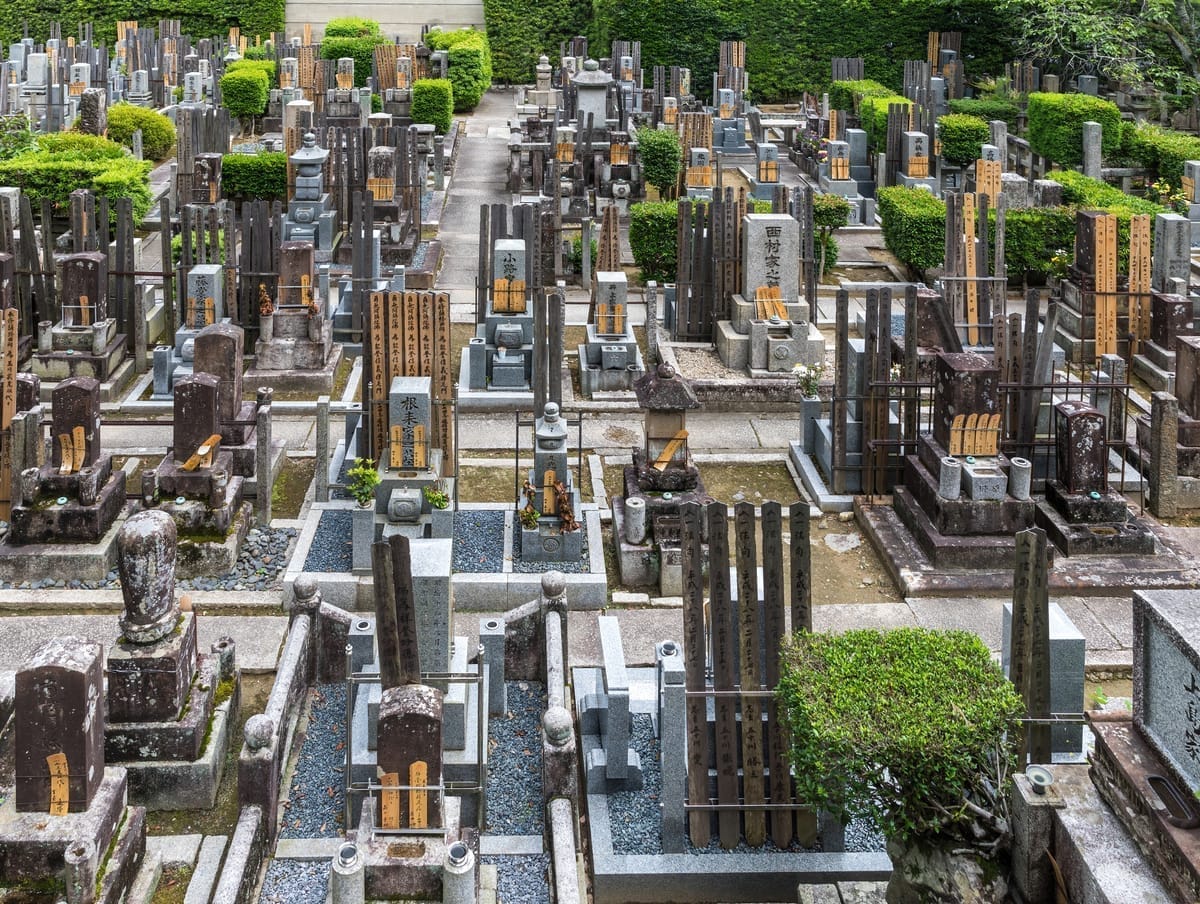
Gorinto came into wide use during the Kamakura period (1185–1333) as grave markers for aristocrats, warriors, and senior monks. Their association with esoteric Buddhist cosmology made them appropriate for marking the spot where a body had been returned to the elements from which it came. Today, gorinto appear throughout Japan as grave markers, memorial stones for warriors killed in battle, and votive offerings at mountain temples. The densest concentration is along the path through Kōyasan’s Okunoin cemetery in Wakayama Prefecture, where more than 200,000 tombstones and memorial towers line the path to the mausoleum of Kūkai (Kōbō Daishi), founder of Shingon Buddhism.
Hōkyōintō: The Treasure Box Seal Pagoda
The hōkyōintō (宝篋印塔) takes a more architecturally elaborate form: a tall, tapering body topped by a finial, with four corner decorations on the cap stone and carved panels on the tower’s four faces. The name derives from the Hōkyōin Dhāraṇī, a particular dharani (ritual incantation from Buddhist scripture) that was believed to purify the sins of any being who came into contact with it. Hōkyōintō were inscribed with this dhāraṇī and placed along pilgrimage routes and at temple entrances so that passersby would receive its purifying effect simply by proximity.
The form was common from the Kamakura through Muromachi periods (13th–16th centuries) and remains a standard element of the formal temple or shrine complex. Its architectural articulation — the carved finial and corner ornaments — makes it more visually refined than the gorinto’s elemental geometry.
Itabi: The Flat Memorial Stone
Itabi (板碑) — literally “board stele” — are flat, thin stone slabs inscribed with sacred Sanskrit characters, Buddhist deity images, and dedicatory text including dates and names. They are concentrated primarily in the Kantō region (the area around modern Tokyo), where they were made during the Kamakura and Muromachi periods from local green phyllite (緑泥片岩, ryokudeihenggan), a distinctive dark greenish-grey stone. Itabi were erected both for the posthumous benefit of named individuals and as “reverse merit” offerings — created by living persons for their own spiritual protection in advance of death. They are among the most precisely dateable objects in Japanese religious material culture, since their inscriptions typically include both the donor’s name and the date of creation.
Famous Sites for Stone Buddhas
Usuki, Ōita Prefecture
The sixty-one National Treasure stone carvings at Usuki represent the most significant surviving magaibutsu site in Japan. The carvings are organized in four groups, spread along the base of tuff cliffs, and span a range of Buddhist iconography from esoteric mandalic arrangements to Pure Land imagery. The site is a 30-minute bus ride from Usuki Station on the Hōhi Main Line. Admission gives access to all four groups.
Okunoin, Kōyasan (Wakayama Prefecture)
The 2-kilometer path through Okunoin cemetery contains more than 200,000 memorial stones, gorinto, and other grave markers, ranging from the medieval to the contemporary. Corporate memorials, clan tombs, and individual graves from across Japanese history stand side by side. The path ends at Tōrōdō Hall, where thousands of lanterns burn continuously, and at the mausoleum of Kūkai. Walking the full path takes about 45 minutes and provides an unparalleled survey of stone Buddhist funerary practice across eight centuries.
Adashino Nenbutsuji (Kyoto, Sagano District)
Over 8,000 stone Buddhas and stone towers are gathered in the precincts of Adashino Nenbutsuji (化野念仏寺) in the Sagano district of Kyoto’s western foothills. The Adashino area was historically a site of field burial — exposure burial of the unclaimed dead — from the Heian period onward. Kūkai is said to have performed nenbutsu rites here for the unburied dead. Over centuries, scattered stone figures from the surrounding hills and former burial sites were collected and placed within the temple grounds. The annual Tōrō Matsuri (燈供養) on the evenings of August 23rd and 24th lights a small flame before each stone figure — the assembled light of 8,000 small flames in the mountain dusk is one of the most memorable sights in Japanese religious culture.
Ōya Stone Buddhas (Tochigi Prefecture)
In the town of Utsunomiya, volcanic tuff (ōya-ishi) has been quarried since ancient times, creating the underground quarry that is now a popular venue. The quarry walls carry Buddhist relief carvings from the early Heian period: a large Thousand-Armed Kannon and attendant figures cut into the tuff face. The quarry context gives these carvings a strange, excavated quality — the Buddha emerging from inside the rock rather than carved onto its surface.
Moss and the Stone Buddha
Among the qualities that make stone Buddhist figures visually compelling is the moss that colonizes their surfaces over decades and centuries. Stone and moss form a collaboration that wood and metal cannot replicate: the human form, the mineral permanence of stone, and the biological slowness of moss together produce something that is simultaneously artifact, natural object, and measure of time.
The distribution of moss on a stone figure reflects its environment. A figure in a shaded, damp location acquires moss quickly and completely; one in a dry, sunny spot may retain the texture of the stone after centuries. In a single temple precinct, the differential growth of moss across different stone figures encodes a map of moisture, drainage, and sunlight. The most heavily mossed figures are often the oldest, or placed in the most protected positions.
Removing moss from stone Buddhas is generally discouraged. In many cases, moss actually protects the underlying stone surface from weathering. Conservation approaches to historic stone Buddhas often focus on stabilizing the moss rather than removing it — the moss has, over time, become part of the object. Visitors should resist the urge to touch or clean figures; stone is fragile in ways that are not immediately visible, and the oils from hands accelerate surface erosion.
Goshuin and Stone Buddhas
Stone Buddhas do not issue goshuin stamps. But the temples that tend stone Buddhist figures often issue stamps that reflect the stone collections in their care.
At Adashino Nenbutsuji, the goshuin acknowledges the temple’s role as keeper of the anonymous dead — the thousands of unidentified stone figures who are the temple’s primary congregation. At Sekibutsuyama temples across Japan — small mountain halls with stone figures as their principal objects of worship — the goshuin often depicts the stone figure itself.
Temples with significant magaibutsu or stone Buddha collections — Murōji (室生寺) in Nara, Sekibutsu-in at various sites, Hasedera (長谷寺) in Kanagawa — often design goshuin that engage with the visual language of stone carving: bold brushwork, compressed iconographic symbolism, the same relationship between line and empty space that makes stone relief carving distinctive.
Collecting goshuin at temples with stone Buddhist collections creates a record not only of shrines visited but of relationships with particular forms of stone — the rough Jizō beside a mountain pass, the refined Kannon of a National Treasure site, the gorinto lining the path through a damp cedar forest. These distinctions in the stone are the distinctions that make the goshuin stamps from different temples readable as different places rather than interchangeable marks.
How to Read a Stone Buddha: A Quick Reference
When you encounter an unidentified stone figure, work through these in order:
Hair and head: Shaved head → Jizō. Spiral curls (rahotsu) → a Nyorai (fully enlightened Buddha: Amida, Shaka, Dainichi). Crown with ornaments → a Bosatsu (bodhisattva: Kannon, Maitreya). Animal head above crown → Batō Kannon.
Facial expression: Peaceful expression → Jizō, Kannon, Amida. Fierce expression, bulging eyes → Fudō Myōō or other Myōō (wrathful protectors).
Hand attributes: Staff + jewel → Jizō. Lotus or water vessel → Kannon. Meditation mudra (hands in lap) or welcoming gesture → Amida. Sword + rope → Fudō.
Surrounding motifs: Flames → Fudō. Three monkeys → Kōshin-tō (not a Buddhist figure strictly speaking, but common). Horse’s head in crown → Batō Kannon.
Context: Multiple figures in a line (typically six) → Roku Jizō. Single large figure at a cliff face → magaibutsu. Stacked geometric forms → gorinto or other stone pagoda. Flat panel with Sanskrit characters → itabi.
Visiting Etiquette
Stone Buddhist figures are objects of active devotion as well as historical artifacts. The appropriate approach is that of a visitor in a place of worship.
Bow or join hands (gassho) before stone figures you wish to acknowledge. For Jizō specifically, the chant Namu Jizō Bosatsu (南無地蔵菩薩) is appropriate; for other figures, Namu followed by the figure’s name. If you prefer not to chant, simply placing your hands together and bowing communicates respectful acknowledgment.
Do not touch figures unnecessarily. Oils from hands accelerate erosion of stone surfaces. Conservation-listed figures should not be touched at all.
Do not rearrange votive offerings placed by others. The stones, flowers, and small objects placed before figures are personal offerings that have their own meaning to whoever placed them.
In cemeteries, maintain quiet and avoid touching grave-marker stones. Photography in cemeteries is generally discouraged; if you photograph memorial stones, ensure you are not framing identifiable names in a way that could compromise living relatives’ privacy.
Red bibs and fabric offerings tied to Jizō figures should not be removed. If you wish to add an offering of cloth or paper, check whether the temple has specific instructions; some sites accept community donations of this type, others do not.
The stone figures that survive in Japanese temple precincts have lasted centuries because generations of people treated them as deserving of care. The habit of pausing, acknowledging, and leaving something in better condition than you found it is the same habit that has preserved them this far.
Image Credits
- Usuki Stone Buddhas © Maarten Heerlien / Wikimedia Commons — CC BY 2.0
- Gorinto © Taraurashima / Wikimedia Commons — Public Domain
- Stone Jizō statue © サイボウ / Wikimedia Commons — CC BY-SA 4.0