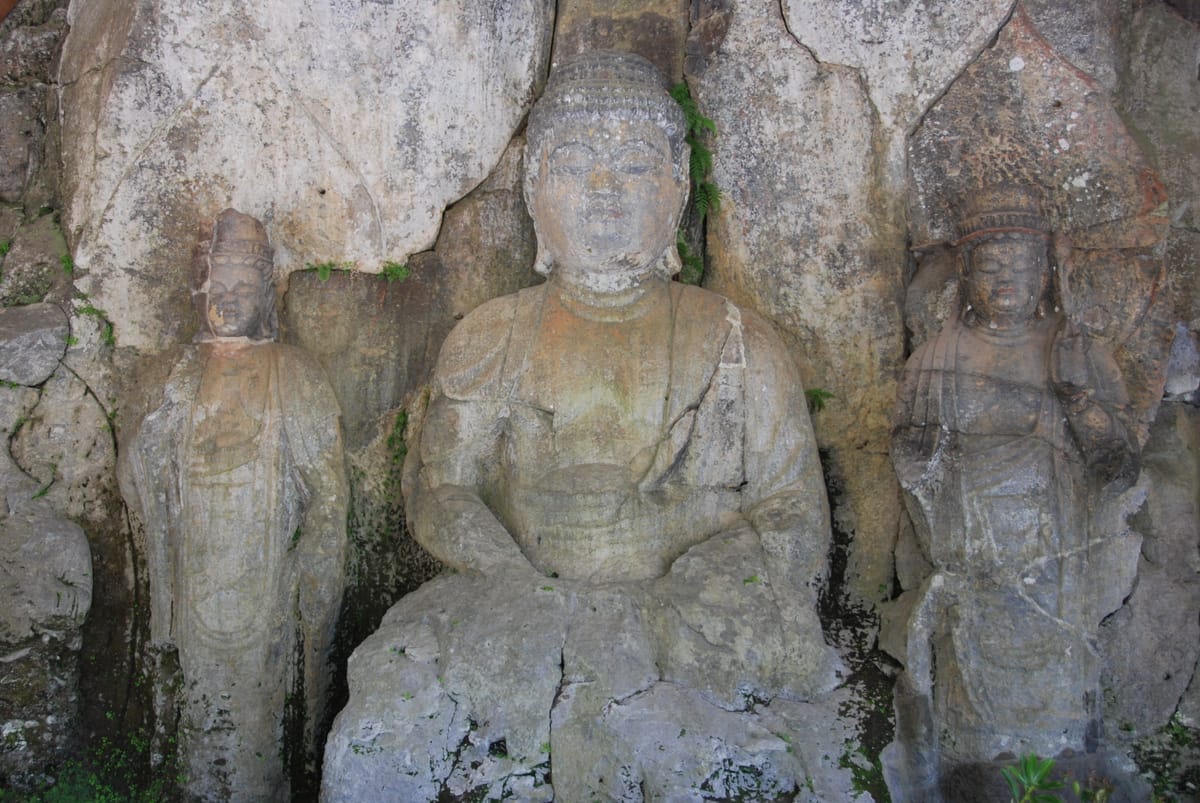
A corner of the temple grounds holds an expanse of white gravel. There is no water. No pond. A few stones stand in the gravel, their surfaces rough with age and moss. Nothing else. And yet visitors stop. Something happens in the space between the stones and the person looking at them.
Why does a waterless garden evoke the ocean? Why does the placement of stones carry weight? To answer these questions is to encounter the core of how Zen Buddhism thinks about emptiness, perception, and the nature of reality. Kare-sansui — the dry landscape garden — is not decoration. It is a philosophical argument made in stone and sand.
What Is Kare-sansui?
Kare-sansui (枯山水) literally means “withered mountains and water” — a landscape in which the water has dried away. The term translates as “dry landscape garden” or “rock garden”; in popular usage it often appears as “Zen garden,” though not every rock garden is a Zen garden in the full philosophical sense.
The defining feature is the absence of water. Most Japanese gardens are built around ponds, streams, and waterfalls. Kare-sansui inverts the premise entirely. White gravel represents the sea or a river. Large stones represent mountains or islands. Raked patterns in the gravel suggest currents, waves, or the passage of time. This works through mitate (見立て) — a Japanese technique of perceiving one thing through another, allowing the essence of what is absent to become present. It is not metaphor in the literary sense; it is a perceptual act.
Equally important is the shift from a garden you walk through to one you observe from a fixed position. Most Japanese gardens are kaiyū-shiki (回遊式) — strolling gardens that reveal different views as you move. Kare-sansui is almost always kansho-shiki (鑑賞式) — a viewing garden experienced from a veranda or corridor while seated. The viewpoint is fixed; the garden completes itself in the interior of whoever is looking at it. Sitting in the posture of zazen meditation and watching a kare-sansui garden is not accidental overlap — the design proposes that posture.
The scale of dry landscape gardens varies enormously. The famous stone garden at Ryōan-ji measures roughly 25 meters by 10 meters. The garden at Daisen-in is a narrow strip only a few meters wide. The “smallest rock garden in Japan” at Ryōgen-in measures about 1.8 by 2.4 meters. What all share is the ambition to contain a universe within a bounded space — to make smallness the vehicle for immensity.
History: From Water Garden to Stone Garden
The Heian Period
The term kare-sansui appears in the Sakuteiki (作庭記), an eleventh-century treatise on garden-making that is the oldest surviving text of its kind in Japan. At this point, “kare-sansui” refers not to a standalone garden type but to a technique for suggesting a dry stream or riverbed within a larger, water-centered garden — a supplementary effect, not a philosophy.
Heian-period gardens (794–1185) were built around large ponds for aristocratic social use: poetry parties, moon-viewing, boat excursions. The water was central to the culture.
Zen Changes Everything
The transformation that created the kare-sansui we recognize today came with the arrival of Zen Buddhism from China during the Kamakura period (1185–1333). Zen holds that enlightenment comes through direct, unmediated experience, not through accumulating knowledge or performing rituals. Zen aesthetics tend toward wabi (quiet austerity), sabi (the beauty of age and impermanence), and ma (meaningful emptiness). The counterintuitive logic of kare-sansui — representing water by removing it, expressing fullness through absence — shares the same intellectual structure as the Zen koan: a question that dissolves the assumptions that made it seem like a question.
The first major figure in kare-sansui’s development is the monk and garden designer Musō Soseki (夢窓疎石, 1275–1351), who created gardens at Tenryū-ji, Saihō-ji (the Moss Temple), Zuisen-ji in Kamakura, and elsewhere. His stone compositions — dynamic, asymmetric, clearly intentional — established the grammar that later garden-makers would inherit and expand. The upper garden at Saihō-ji preserves what is considered the oldest surviving example of pure kare-sansui in Japan.
By the Muromachi period (1336–1573), pure dry landscape gardens — nothing but stone and gravel — had become the dominant form in Zen temple grounds across Kyoto. Two factors drove this: dense urban land constraints made large pond-gardens impossible, and the aesthetics of suiboku-ga (水墨画) — Chinese ink wash painting, which renders mountains and water in contrast of black and white — had been absorbed into Zen temple culture. Kare-sansui is, in one reading, a three-dimensional ink wash painting. White gravel as paper. Dark stones as brushwork. Emptiness as subject.
Modern Revival
The twentieth century produced one major creative renewal. Shigemori Mirei (重森三玲, 1896–1975), a garden historian turned garden designer, spent decades cataloguing classical kare-sansui across Japan before creating his own work. Beginning with the spectacular eight-garden complex at Tōfuku-ji in 1939, he introduced bold geometric abstraction — checkerboard patterns, grid-based stone compositions, sharp color contrasts — into the classical vocabulary. Shigemori called his approach “eternal modernity”: a complete command of historical grammar combined with a refusal to merely repeat it.
The Elements
Stone
Stones are not decorative objects placed for visual effect; they are presences that represent specific entities in the garden’s symbolic program. Tate-ishi (立石), vertical stones, represent mountains, peaks, and Buddha figures. Yoko-ishi (横石), horizontal stones, represent landmasses, islands, and auspicious animals — the turtle (longevity) and the crane (good fortune). Stone groups are almost always arranged in odd numbers — three, five, seven — since even numbers were considered inauspicious.
Stone selection was careful. Named regional stones carried specific associations: Kurama-ishi (a reddish granite from north of Kyoto), Kibune-ishi (blue-grey), Iyo aio-ishi (a blue-green chlorite schist from Shikoku). Unworked natural stones were universally preferred over shaped or polished ones — the idea was to bring nature’s own authority into the garden, not to impose human form upon it.
White Gravel and Samon
The white gravel used in kare-sansui is most properly shirakawa-suna (白川砂) — decomposed granite from the Shirakawa area in northern Kyoto, bright and luminous from its high feldspar content. The raked patterns drawn into the surface — samon (砂紋) — suggest waves, rivers, and currents.
Samon are re-drawn daily as part of the temple’s morning work practice — samu (作務), the meditative physical labor assigned to every Zen monk. That the patterns are made anew each morning is philosophically significant: no two days produce exactly the same garden, enacting mujō (無常) — impermanence, the teaching that nothing is fixed or permanent. The garden is never complete. It is a different garden every day.
Moss and Plantings
Most kare-sansui incorporate koke (苔), moss, at the base of stones and along garden edges. Moss grows without deliberate planting; it is cultivated by creating the right conditions and allowed to establish itself over years and decades. The presence of old moss on a stone communicates something about time that no decoration can replicate.
Many gardens include carefully pruned shrubs or pines behind the stone compositions, providing depth: nearer stones read as foreground mountains, taller plantings as distant peaks. The most austere examples — Ryōan-ji above all — include almost no plantings within the garden. The full burden of meaning falls on stone and gravel alone.
Major Gardens
Ryōan-ji (Kyoto) — The Garden That Asks Questions
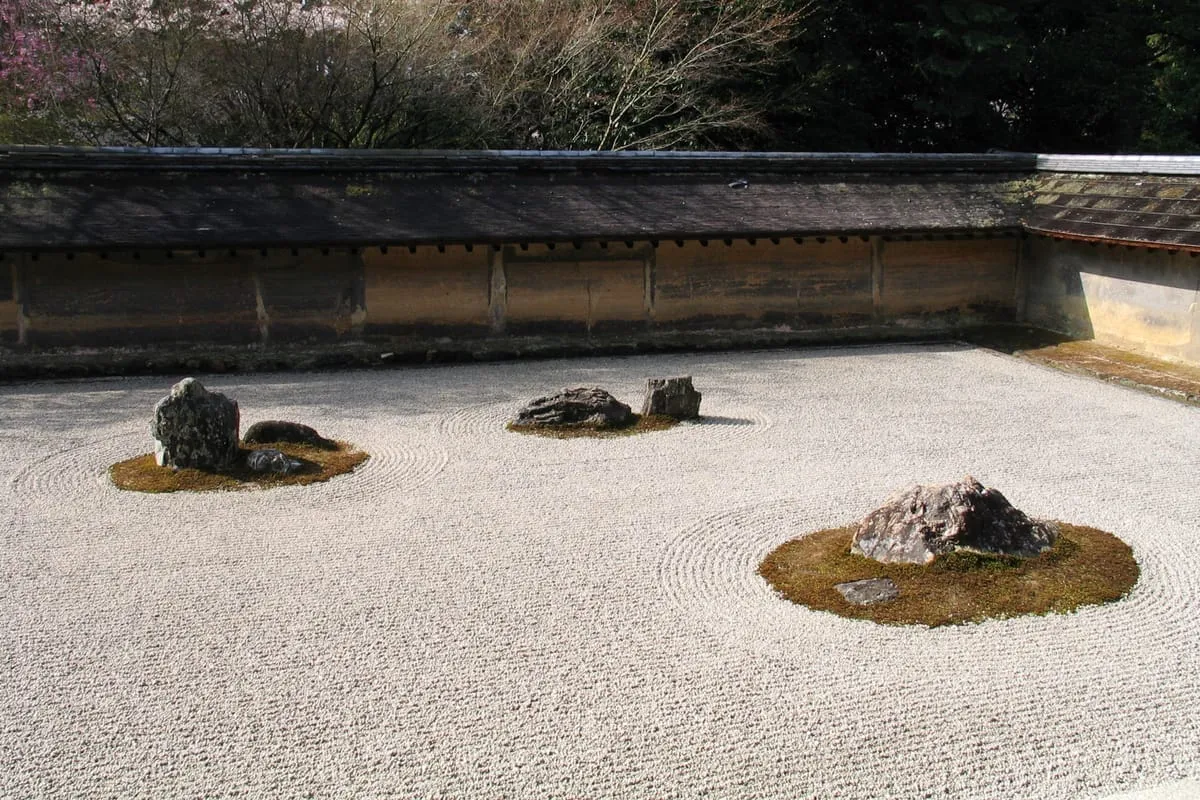
The stone garden at Ryōan-ji (龍安寺) is the most famous kare-sansui in the world. Designated a UNESCO World Heritage Site in 1994, it draws visitors from across the globe.
The garden measures roughly 25 by 10 meters. Fifteen stones are arranged in five groups on raked white gravel. Moss clings to the base of each stone. The enclosing walls are weathered earthen. That is the complete garden.
Its most discussed quality is a perceptual peculiarity: from any single viewing position, one stone is always hidden behind another, so that only fourteen of the fifteen stones are simultaneously visible. Since fifteen is a significant number in Buddhist numerology, this designed invisibility has generated centuries of interpretation. The hidden stone is most often read as an emblem of enlightenment — present but structurally unavailable to ordinary perception, something that can be intuited but not grasped.
The creator is unknown. The meaning is unresolved — the stones have been read as a tiger carrying cubs across a river, as a cosmological map, as pure abstract composition, as a deliberate refusal of interpretation. The garden’s insistence on not explaining itself is part of its argument.
Ryōan-ji became internationally famous after Queen Elizabeth II visited in 1975 and was reported to have stood before the garden in extended silent contemplation — an image that accelerated the global identification of kare-sansui with Zen. Goshuin are available at the kuri near the garden’s viewing area.
Daisen-in (Daitoku-ji, Kyoto) — The Garden as Ink Wash Scroll
Daisen-in (大仙院), a sub-temple within the great Daitoku-ji complex, represents kare-sansui at its most narrative and three-dimensional. Established in 1509 by the monk Kogaku Sōkō, it is designated a Special Place of Scenic Beauty — Japan’s highest official aesthetic designation for gardens.
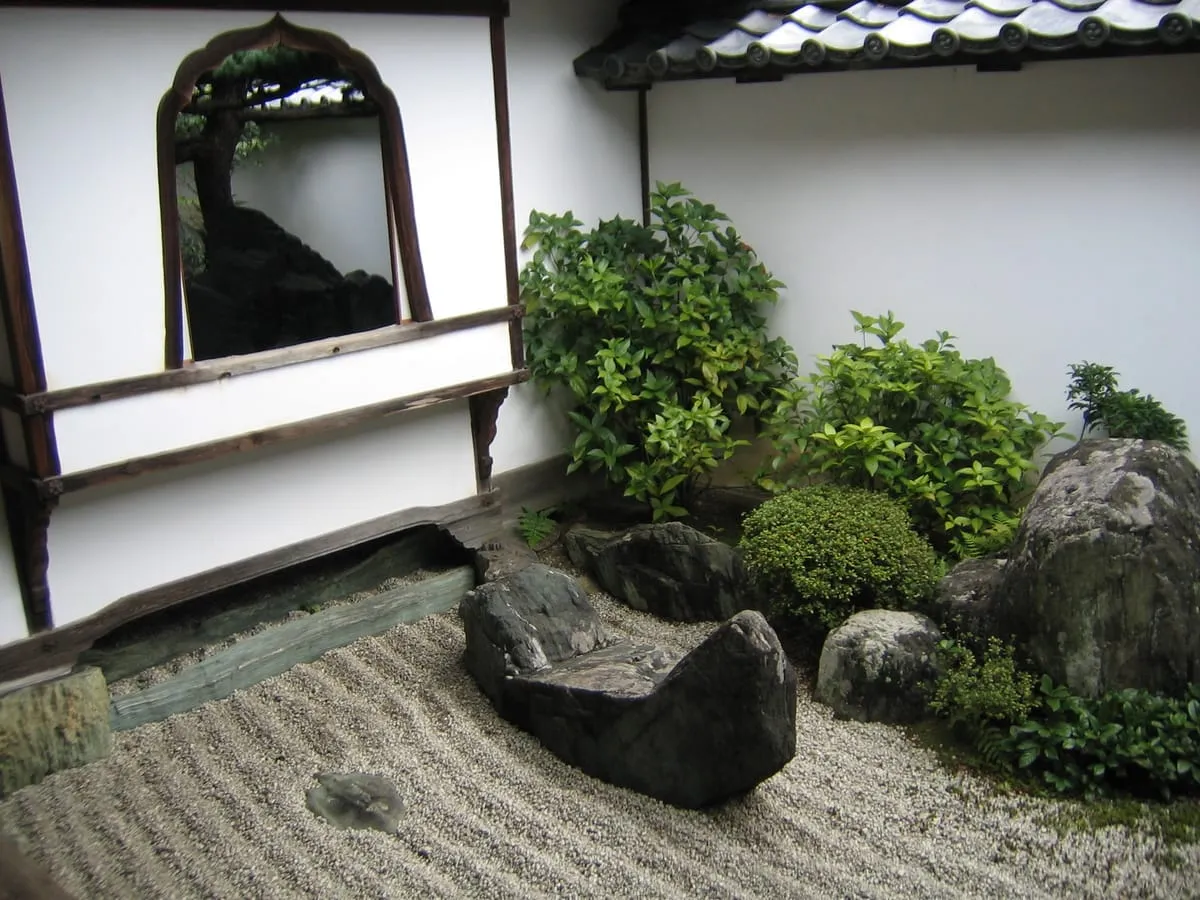
The northeast garden is a narrow corridor only a few meters wide running along two sides of the main hall. High stone compositions represent mountain peaks from which white gravel “waterfalls” cascade into a gravel “river,” which narrows through a passage between stones, widens into a “pool,” and eventually opens into the large flat gravel “sea” of the south and west gardens. The entire journey from mountain to sea takes place in a space you could cross in a few steps.
The visual grammar is that of a Song-dynasty Chinese ink wash landscape painting in three dimensions: tall vertical stones as brushstrokes for distant peaks, lower horizontal stones as promontories, flat gravel as the negative space of sky and sea. This approach — shukkai (縮景), landscape in miniature — is considered to reach its finest expression in Daisen-in.
The garden is best experienced by sitting in the main hall and slowly shifting gaze across the three segments visible from inside, experiencing the “landscape” as a scroll that unfolds. Goshuin here are generous; multiple inscriptions are available, some drawn from Zen phrases specific to the garden.
Tōfuku-ji (Kyoto) — Eternal Modernity
The eight gardens surrounding the abbot’s hall at Tōfuku-ji (東福寺), designed by Shigemori Mirei in 1939, represent the most significant creative intervention in kare-sansui during the twentieth century.
The most famous is the South Garden, in which large mossy boulders are arranged in a checkerboard pattern with alternating squares of raked gravel — a composition that could belong to a Modernist sculpture exhibition but uses materials and proportions entirely consistent with classical kare-sansui. The East Garden’s checkerboard of moss and stepping stones; the North Garden’s bold stone composition in raked gravel: each demonstrates a different principle. Together they argue for what kare-sansui can be when made by someone who masters the classical tradition and refuses to merely repeat it.
The Daitoku-ji Sub-temple Circuit
With more than twenty sub-temples, the Daitoku-ji (大徳寺) complex in northern Kyoto is the single richest kare-sansui destination in Japan. Beyond Daisen-in, the sub-temples Ryōgen-in (containing Japan’s smallest rock garden, approximately 1.8 by 2.4 meters), Zuihō-in, and Kōtōin each offer distinct gardens and distinct goshuin. A full day spent moving through the complex — sitting before each garden, receiving a goshuin at each sub-temple — is among the deepest garden experiences Kyoto offers.
How to Read a Kare-sansui Garden
Mitate: Seeing Through
The conceptual key is mitate (見立て) — the technique of perceiving one thing through another. Seeing white gravel as the ocean is not metaphor; it is a perceptual act in which the gravel becomes a vehicle for experiencing something about the ocean’s nature. The garden does not represent the ocean from outside; it invites the ocean to be present through the gravel.
The most useful approach is to resist the impulse to decode — to avoid asking “what does this stone mean?” and instead allow the question to remain open. The garden is most itself when it is not resolved.
Asymmetry and Emptiness
Kare-sansui stone compositions consistently avoid symmetry. Fukinsei (不均斉) — irregular balance — is achieved through stones of different sizes that offset each other in ways that feel stable but not formulaic. Symmetry closes a composition; asymmetry keeps it open.
The empty gravel areas are not negative space to be filled. In Zen aesthetics, emptiness is positive: it is kū (空), the absence of fixed, independent existence in things. A large, unbroken gravel area gives the viewer space to contribute something of themselves. The garden is a collaboration between the garden and whoever is looking at it.
Light and Season
Kare-sansui is not a static object. Early morning light casts long shadows from stones and accentuates the fine texture of raked gravel. High noon flattens the same scene, washing out shadows. Rain darkens stone surfaces and brings out colors — ochres, blues, greens — that dry sunlight suppresses; moss intensifies to a bright green. Winter snow covers the gravel and erases the samon, producing a garden no human hand designed: another kare-sansui, entirely in white.
The best time to visit is early morning when the temple opens. Crowds accumulate rapidly at famous gardens. Weekday mornings in autumn or winter are ideal for seeing the garden approach the silence it was designed to hold.
Zen Phrases and the Garden
Zen temples are rich in zengo (禅語) — short, aphoristic phrases that condense Zen insight. These appear on calligraphy scrolls in temple interiors, on goshuin stamps, and on building elements. A few are worth knowing.
Honrai muichimotsu (本来無一物) — “originally, not a single thing exists” — from the Platform Sutra of the Sixth Patriarch, Huineng (638–713). Standing before the white expanse of Ryōan-ji with this phrase in mind, the gravel’s blankness opens into something other than emptiness.
Ichigo ichie (一期一会) — “one time, one encounter” — means that any encounter happens exactly once, irreplaceably. The garden you see today, with today’s light, today’s samon, today’s state of your own mind, is not the garden of tomorrow.
Chokushi ninshin (直指人心) — “directly pointing at the human mind” — describes the Zen method of bypassing conceptual mediation to point at experience itself. The garden, at its best, does exactly this.
Kare-sansui and Goshuin
Zen temples with kare-sansui gardens are among the most rewarding destinations for goshuin collectors. The gardens and the stamps are expressions of the same aesthetic sensibility: spare, powerful, and built around the weight that emptiness carries.
The Zen calligraphic tradition — bokuseki (墨跡) — flows directly into the goshuin received at Zen temples. The heavy, decisive brushwork of generations of priest-artists gives these stamps a quality distinct from the more delicate seals at many Shinto shrines. Bold black ink on white paper, the vermilion seal cutting across both: the goshuin and the garden speak the same visual language.
At gardens like Daisen-in, the goshuin may be inscribed with a phrase drawn from the garden’s iconography or the founder’s teachings. Receiving a goshuin after sitting with the garden is not collecting a souvenir. It marks the moment of reception — what the garden gave you, named in ink.
Practical notes: famous Zen temple gardens often charge separate admission fees. Ryōan-ji, Daisen-in, and Tōfuku-ji’s hōjō gardens each have their own schedules and entrance charges beyond general temple admission. Planning ahead allows you to combine garden visits with goshuin collection into a coherent day.
Beyond the Temple
Kare-sansui aesthetics have spread far beyond Zen precincts — into hotel lobbies, corporate offices, airports, and private residences worldwide. Zen’s preference for negative space, its treatment of emptiness as a positive value, its insistence that what is removed can be as consequential as what is added: these principles, which belong to the kare-sansui garden, have been absorbed into twentieth-century design culture and are recognizable in minimalist architecture, product design, and interior sensibility across cultures.
What is lost in that translation is worth naming. The Zen stone garden was designed to accompany zazen meditation, to be re-drawn at dawn as part of daily monastic practice, to function within a schedule of bells and silence. A decorative gravel panel in a hotel lobby cannot provide that context. What the visitor to a Zen temple receives — arriving early, sitting for a while, letting the garden speak — is connected to something that design-derived kare-sansui cannot replicate. The difference is available to experience. It is worth seeking out.
Image Credits
- Ryōan-ji stone garden © Stéphane D’Alu / Wikimedia Commons — CC BY-SA 3.0
- Daisen-in garden © Ivanoff~commonswiki / Wikimedia Commons — CC BY-SA 3.0
- Header image (Ryōan-ji) © DXR / Wikimedia Commons — CC BY-SA 4.0