
Japan has more than 80,000 Shinto shrines and 70,000 Buddhist temples. In major cities, dozens of them can be within a few train stops of each other. If you’re collecting goshuin — the hand-brushed stamps given as proof of visit — you will quickly face a question that stumps every newcomer: how do you plan a day of visiting multiple sites without running out of time, arriving at a closed stamp desk, or spending half the day on trains?
The answer is route design. A badly planned day produces a string of predictable disasters: the stamp desk at a major temple closes at 4:30 PM and you arrive at 5:00; a thirty-minute goshuin queue eats the buffer you needed to reach your next stop; you forget which train to take between neighborhoods. A well-designed route, by contrast, can comfortably carry you through five to eight shrines and temples in a day while giving you time to actually stand in front of the main hall and pray.
This guide covers the essentials: realistic site counts, five core planning principles, model routes for Tokyo, Kyoto, and Kamakura, and the mistakes that most commonly derail first-time visitors.
How Many Sites Can You Visit in a Day?
Set realistic expectations before drawing any routes. The question isn’t only about geography — it’s about how you want to experience each place.
3–5 sites is the right target for first-time visitors or anyone who wants unhurried time at each location. You have room to read explanatory boards, watch the calligrapher at work, and take photographs without feeling rushed.
5–8 sites is achievable for experienced visitors who know the rhythms of shrine and temple visits. It requires tight geography — most sites within walking distance or one train stop — and careful timing around busy periods.
10+ sites is only realistic for structured pilgrimages, such as a Seven Lucky Gods circuit (shichifukujin meguri), where sites are specifically chosen for proximity. For general goshuin collecting, ten sites in a day turns meaningful visits into a stamp sprint.
A practical rule of thumb: budget at least 30–45 minutes per site. This includes the walk from the station (5–15 minutes), the ritual approach and prayer (10–20 minutes), and the wait for your goshuin (10–30 minutes at moderate crowds, up to an hour at peak times on weekends). Add transit between sites and a working day of six to seven hours yields five or six locations with breathing room.
When Crowds Are Worst
At major shrines and temples, the goshuin wait time is the biggest planning variable. The pattern is consistent across sites:
| Time of Day | Crowd Level | Typical Wait |
|---|---|---|
| Opening to 9 AM | Light | 5–10 minutes |
| 9 AM to 11 AM | Moderate | 10–20 minutes |
| 11 AM to 1 PM | Peak | 30–60+ minutes |
| 1 PM to 3 PM | Still heavy | 20–40 minutes |
| 3 PM to closing | Tapering | 10–20 minutes |
The strategic implication: visit your most popular and most crowd-prone destinations first, in the early morning. Leave smaller neighborhood shrines and temples — which rarely have long waits — for the afternoon.
Five Principles of Route Design
1. Group Sites Geographically
The most important rule: minimize travel time between sites. Every hour spent on trains is an hour not spent in a shrine courtyard.
Plan your day around a single neighborhood rather than mixing districts across a city. In Tokyo, the Asakusa and Yanaka areas each contain enough shrines and temples for a full day without leaving the neighborhood. Trying to combine Asakusa, Meiji Shrine in Harajuku, and a Shinjuku destination in a single day means spending two or more hours purely in transit.
Japan’s most walkable goshuin clusters:
- Tokyo – Yanesen: Yanaka Cemetery area to Nezu Shrine, packed with temples and shrines on foot
- Kyoto – Higashiyama: Kiyomizudera north through Sannen-zaka to Yasaka Shrine — shrines and temples every few minutes on foot
- Kamakura: Circuit from Tsurugaoka Hachimangu north to Engakuji, then west to Hasedera
2. Check Stamp Hours in Advance
Most shrine and temple stamp desks close between 4:00 PM and 4:30 PM, even when the grounds themselves remain open later. Arriving after closing means no goshuin regardless of how far you traveled.
General receiving hours:
- Major shrines: 9:00 AM – 5:00 PM (desk closes 4:30 PM)
- Major temples: 8:00 AM – 5:00 PM
- Small or unmanned sites: daytime only, irregular
Place sites with earlier closing times in the first half of your day. Work backward from closing times when scheduling: if a site closes at 4:00 PM and takes thirty minutes to reach from your previous stop, you need to depart that previous stop by 3:30 PM at the latest.
Also verify whether the site will offer chokugaki (direct writing in your book) on your visit day. During busy periods, some sites switch to kakioki (pre-written slips on paper). These are received the same way but require gluing into your book afterward.
3. Carry Two Stamp Books
Whether to mix shrine and temple goshuin in the same book is debated. In practice, most sites have no objection to a combined book. But certain shrines — particularly those affiliated with Ise Jingu — may decline to stamp a book containing temple stamps.
The safest solution: carry two books, one for shrines and one for temples. This eliminates the risk of being turned away and lets you choose the appropriate book before approaching the desk. If your itinerary is shrine-only or temple-only that day, you can leave one book at the hotel.
4. Account for Real Transit Times
Navigation apps count only the time on trains and buses. The actual time between leaving one shrine gate and arriving at the next is substantially longer.
Add to every transit estimate:
- Walk from the shrine to the nearest station: 5–10 minutes
- Wait for the train: 3–7 minutes
- Walk from arrival station to the next site: 5–15 minutes
A useful rule: real door-to-door time between sites is roughly twice what the navigation app shows for the transit segment alone. An itinerary that looks like it fits eight sites on paper often runs thirty minutes behind schedule per site by midday.
5. Mix Anchor Sites with Smaller Stops
The most satisfying routes combine one or two anchor sites — major shrines or temples that deserve time and attention — with two or three secondary stops that are smaller, quieter, or simply interesting.
In the Asakusa area, for example: Senso-ji Temple is the anchor, deserving thirty to forty-five minutes of full attention. Just a two-minute walk away stands Asakusa Shrine — a separate goshuin at no additional transit cost. Add one more smaller temple nearby and you have a coherent three-site cluster covering less than half a mile on foot.
This approach works better than filling your day with consecutive major tourist sites. Secondary stops are often where you find the quieter, more contemplative experience that makes goshuin collecting feel meaningful.
Tokyo: Asakusa–Yanesen Route
The Asakusa and Yanaka (Yanesen) neighborhoods form one of the easiest goshuin routes in Tokyo. Temples and shrines cluster naturally within walking distance, and the neighborhoods themselves — old wooden buildings, quiet alleys, temple graveyards — reward slow walking.
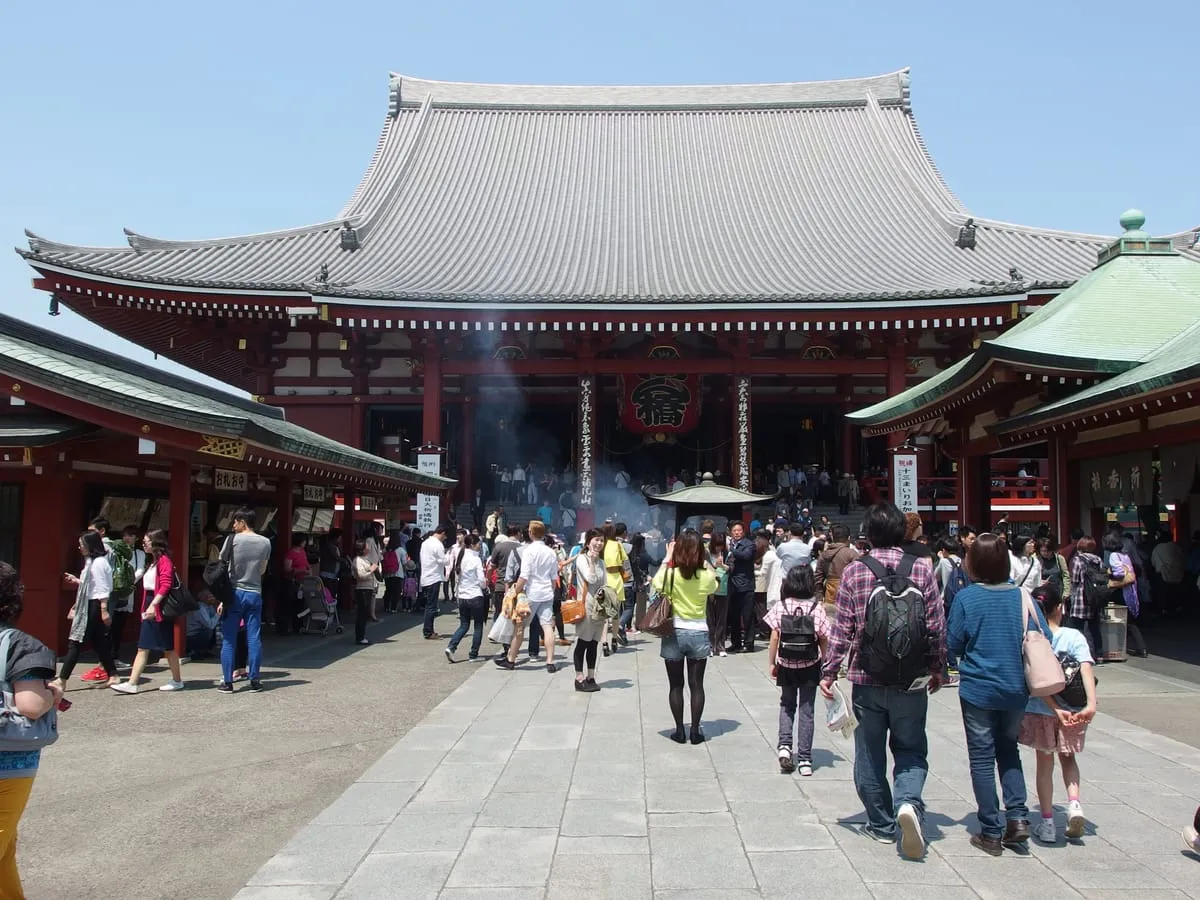
9:00 AM — Senso-ji Temple (Taito Ward) Tokyo’s oldest temple and one of the city’s most visited sites. The goshuin desk is to the right of the main incense urn in front of the main hall. Arrive at 9:00 AM on a weekday for a ten-minute wait; the same visit on a weekend at 11:00 AM can mean forty minutes or more. The walk through Kaminarimon gate and Nakamise shopping street is part of the experience — don’t rush it.
10:00 AM — Asakusa Shrine (Taito Ward) Two to three minutes on foot from Senso-ji’s main hall. The shrine shares the same precinct as the temple: two separate goshuin at one location with essentially zero transit. The shrine is dedicated to the three founders of Senso-ji and hosts the Sanja Matsuri, one of Tokyo’s three great festivals.
10:45 AM — Matsuchiyama Shoten (Taito Ward) Seven minutes north on foot along the Sumida River embankment. This is the main hall of Honryuin Temple, dedicated to a deity of good fortune. The goshuin features a distinctive daikon radish and drawstring purse motif unlike anything else in the city. It’s small, rarely crowded, and worth the detour.
12:00 PM — Lunch and walk toward Yanaka Bus or a twenty-minute walk northeast toward Yanaka. The Yanaka Ginza covered shopping street makes a comfortable lunch stop before continuing into the cemetery district.
1:00 PM — Tennoji Temple (Taito Ward) Located inside Yanaka Cemetery, which is atmospheric in any season. A copper Buddha survived the 1923 Kanto earthquake here; the goshuin desk is at the main hall.
2:00 PM — Nezu Shrine (Bunkyo Ward) Fifteen minutes’ walk south from Yanaka. Famous for its miniature tunnel of torii gates — hundreds of small vermilion gates donated by worshippers, echoing Fushimi Inari at an intimate scale. The shrine’s goshuin features a graceful crane motif; additional stamps are available at subsidiary shrines within the grounds.
3:30 PM — Yushima Tenmangu (Bunkyo Ward) Fifteen minutes’ walk south from Nezu. Dedicated to Sugawara no Michizane, deity of scholarship. Quiet outside exam season, with a plum grove in the courtyard. Stamp desk closes at 5:00 PM — a 3:30 PM arrival gives comfortable margin.
Total: 6 sites, approximately 7 hours including lunch.
Kyoto: Higashiyama–Fushimi Route
Kyoto has Japan’s highest density of significant sacred sites. With an early start, eight to ten goshuin in a single day is feasible — though only outside peak tourist seasons (cherry blossoms in March–April, autumn leaves in November–December), when major sites have thirty-minute to one-hour queues from mid-morning onward.
8:30 AM — Kiyomizudera (Higashiyama Ward) The most famous temple in Kyoto, and the first to fill with tourists. An 8:30 AM arrival on a weekday gives you the famous wooden stage (butai) without the crowds that pack it by 10:00 AM. The main goshuin (Kanzeon Bosatsu) is at the desk right of the main hall; additional goshuin are available at Jishu Shrine, located above the main hall on the same grounds.
10:00 AM — Yasaka Shrine (Higashiyama Ward) Walk from Kiyomizudera along Sannen-zaka and Ninen-zaka — stone-paved lanes lined with craft shops and cafes, about twenty minutes on foot. Yasaka Shrine anchors the Gion district; the main goshuin desk is in the main hall area. Multiple subsidiary shrines within the grounds offer additional stamps.
11:30 AM — Chion-in (Higashiyama Ward) Ten minutes north of Yasaka Shrine. The head temple of Jodo Buddhism in Japan, with the largest wooden sanmon gate in the country. The goshuin is written with the nembutsu phrase Namu Amida Butsu — simple in form, freighted with eight centuries of devotional meaning.
1:00 PM — Lunch near Nanzenji or Heian Jingu Walk north through the Okazaki area. Heian Jingu — built in 1895 to commemorate Kyoto’s founding — is a natural lunch-break detour, with goshuin available at the shrine office.
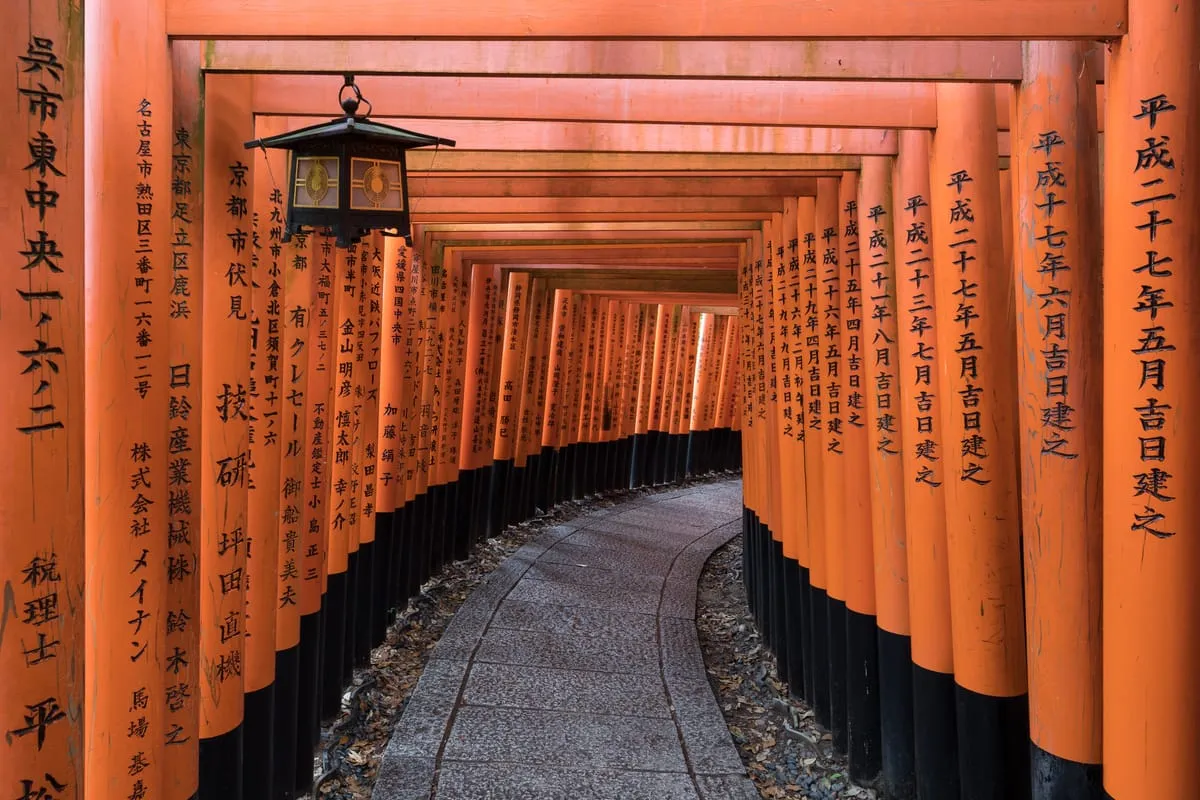
2:30 PM — Fushimi Inari Taisha (Fushimi Ward) Take the Keihan Line south from Higashiyama Station to Fushimi-Inari Station, about fifteen minutes. The head shrine of all 30,000+ Inari shrines in Japan. The famous senbon torii — thousands of vermilion gate tunnels donated by worshippers — begin behind the main hall and extend up the mountain for several kilometers.
The main goshuin desk is at the base. A second goshuin is available at Okusha Hohaijo, the inner sanctuary halfway up the mountain (twenty-minute walk uphill), which closes at 4:30 PM. Arrive by 2:30 PM to collect both stamps with time to spare.
Kamakura: Full-Day Classic Route
Kamakura packs an extraordinary concentration of temples and shrines into a small geographic area. The city is easily navigable by foot between the train clusters.
8:30 AM — Tsurugaoka Hachimangu The spiritual center of Kamakura. Walk the full dankazura approach avenue from the sea to the main steps for the full effect. The main goshuin desk is below the main hall on the left. A second goshuin is available at Wakamiya, the younger shrine within the grounds. Early morning offers the precinct in near-silence.
10:00 AM — Kenchoji (Kita-Kamakura) Twenty minutes north on foot (or a short bus ride). Japan’s first dedicated Zen training monastery, established 1253. The main hall, lecture hall, and Chinese-style gate line up in the classic Zen arrangement. Three to four goshuin are available for different halls within the compound.
11:30 AM — Engakuji (Kita-Kamakura) Fifteen minutes further north, adjacent to Kita-Kamakura Station. Founded 1282 to honor those killed in the Mongol invasions. The National Treasure Shariden relic hall is one of the oldest surviving Chinese-style Zen buildings in Japan.
1:00 PM — Lunch in Kamakura Return to Kamakura Station by train and eat along Komachi-dori shopping street.
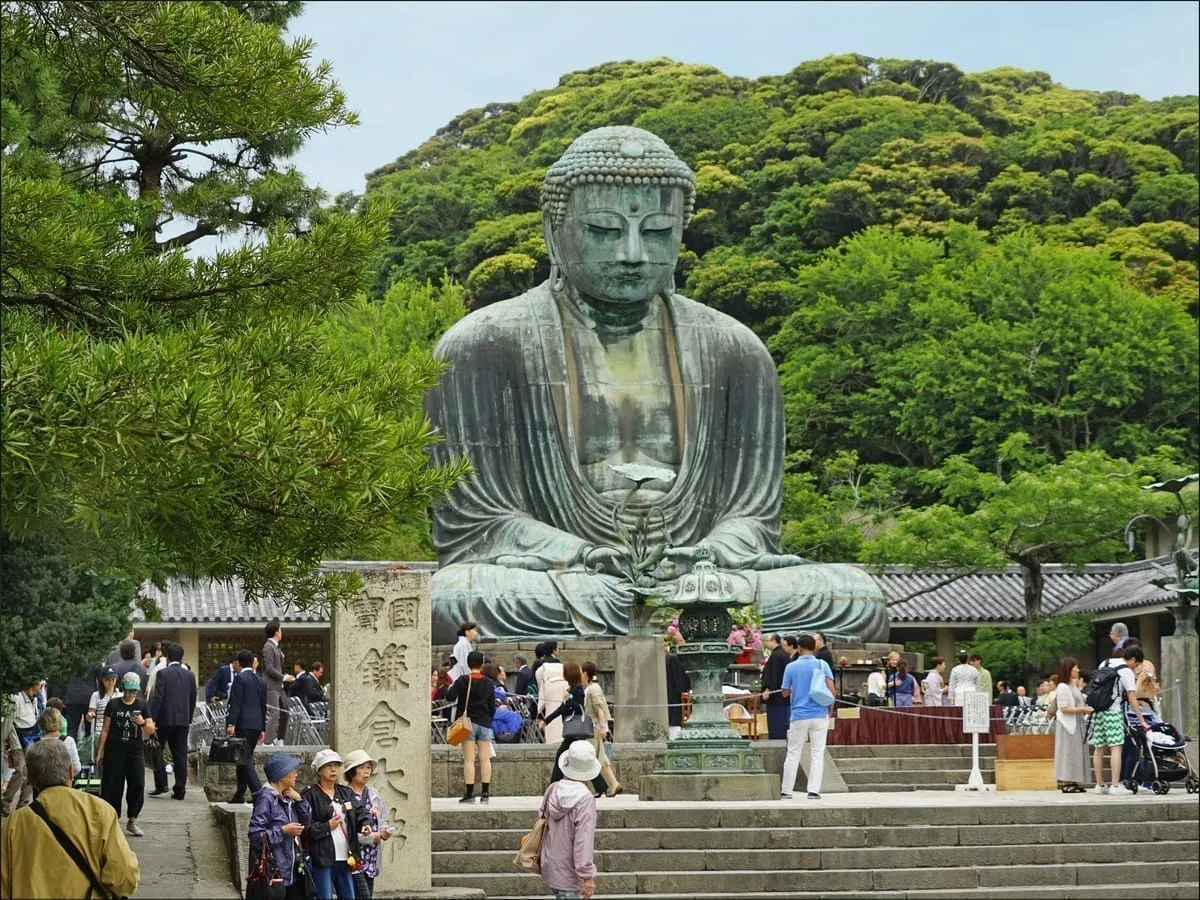
2:00 PM — Kotokuin (Hase) Two stops west on the Enoden Railway. The Kamakura Daibutsu — a thirteen-meter bronze Amida Buddha cast in 1252, sitting in the open air since its hall was destroyed by typhoon in the 15th century — is one of Japan’s most immediately recognizable images. The goshuin (Amida Nyorai) is at the desk near the main gate.
2:45 PM — Hasedera (Hase) Five minutes’ walk from Kotokuin. An eleven-faced gilded Kannon statue is the main object of worship; the terrace above offers views over Yuigahama Beach. The main goshuin is year-round; a rotating monthly seasonal goshuin makes this a destination that rewards return visits.
3:45 PM — Enoshima Shrine (Fujisawa) Two more stops on the Enoden to Enoshima Station, then fifteen minutes on foot to the island. Enoshima Shrine comprises three separate shrines — Hetsu-miya, Nakatsu-miya, and Okutsu-miya — each with its own goshuin. Visiting all three completes the sansha meguri (three-shrine circuit). The Okutsu-miya desk at the far end of the island closes at 5:00 PM; a 3:45 PM arrival gives you comfortable time to walk through all three.
Total: 7–8 sites, approximately 8 hours.
Common Mistakes
Arriving after the stamp desk closes. Many desks close at 4:00–4:30 PM well before the grounds themselves close. Fix: work backward from closing times when scheduling. Put time-sensitive sites in the morning.
Forgetting your stamp book. The most deflating mistake. Fix: develop a pre-departure habit — book goes in the bag before anything else. Most major temples and shrines sell blank books if you do forget; you can also collect kakioki paper slips and glue them in later.
Not handing over your book before praying. At busy sites, the stamp desk operates like a ticket system: submit your book first, get a number, pray while your goshuin is prepared, return when called. Many visitors approach the desk after praying — joining a queue they could have entered thirty minutes earlier. Fix: locate the stamp desk upon arrival and submit your book immediately if there is any queue.
Underestimating transit time. Navigation apps show train time, not total door-to-door time. Fix: double the transit time shown in the app for a realistic planning estimate.
Trying to combine incompatible neighborhoods. Crossing the city between two cluster areas in a single day costs hours in transit for marginal gain. Fix: commit to one area per day, plan a second day in a different area.
Using Apps to Plan Your Route
The practical workflow for designing a goshuin itinerary:
- List all sites you might want to visit in a given area without filtering yet.
- Drop them on a map. The geographic clusters usually become obvious immediately.
- Order by closing time and crowd risk. Most time-sensitive and most popular sites go first.
- Add buffer. For every five sites in your plan, add thirty minutes of unallocated time.
Dedicated goshuin apps add useful features on top of basic mapping: stamp databases with preview images so you know what each site’s goshuin looks like before visiting; stamp-hour information; collection tracking; and nearby discovery — tap the map and see every goshuin-offering site within a short walk. The most practical feature for route planning is saving a site wishlist by area before your trip, so you can adapt on the fly without searching from scratch when you’re already in the neighborhood.
Summary
The principles that separate a satisfying day of goshuin collecting from a frustrating one:
- Target 3–5 sites for a relaxed day, 5–8 for an efficient one. More than eight is rarely worth it.
- Group by geography. One neighborhood per day keeps transit time minimal.
- Schedule time-sensitive sites first. Stamp desks close early; work backward from closing times.
- Carry two books — one shrine, one temple — to avoid refusals.
- Submit your book before praying at busy sites.
- Budget real transit time. Double the app’s estimate for door-to-door reality.
- Mix major anchors with smaller stops for the right balance of depth and discovery.
The route is infrastructure. The reason for the route is to stand in places where people have stood for a thousand years, make a small gesture of respect, and receive in return a few square centimeters of ink and paper that say: you were here.
Image Credits
- Senso-ji Temple, Asakusa, Tokyo: Senso-ji Temple @ Asakusa (14019477806) by Guilhem Vellut from Annecy, France / CC BY 2.0
- Fushimi Inari Taisha torii gate path, Kyoto: Torii path with lantern at Fushimi Inari Taisha Shrine, Kyoto, Japan by Basile Morin / CC BY-SA 4.0
- Great Buddha at Kotokuin Temple, Kamakura: Le Grand Bouddha du Kotoku-in (Kamakura, Japon) (42096289494) by Jean-Pierre Dalbéra from Paris, France / CC BY 2.0


.jpg)

_(42096289494).jpg)