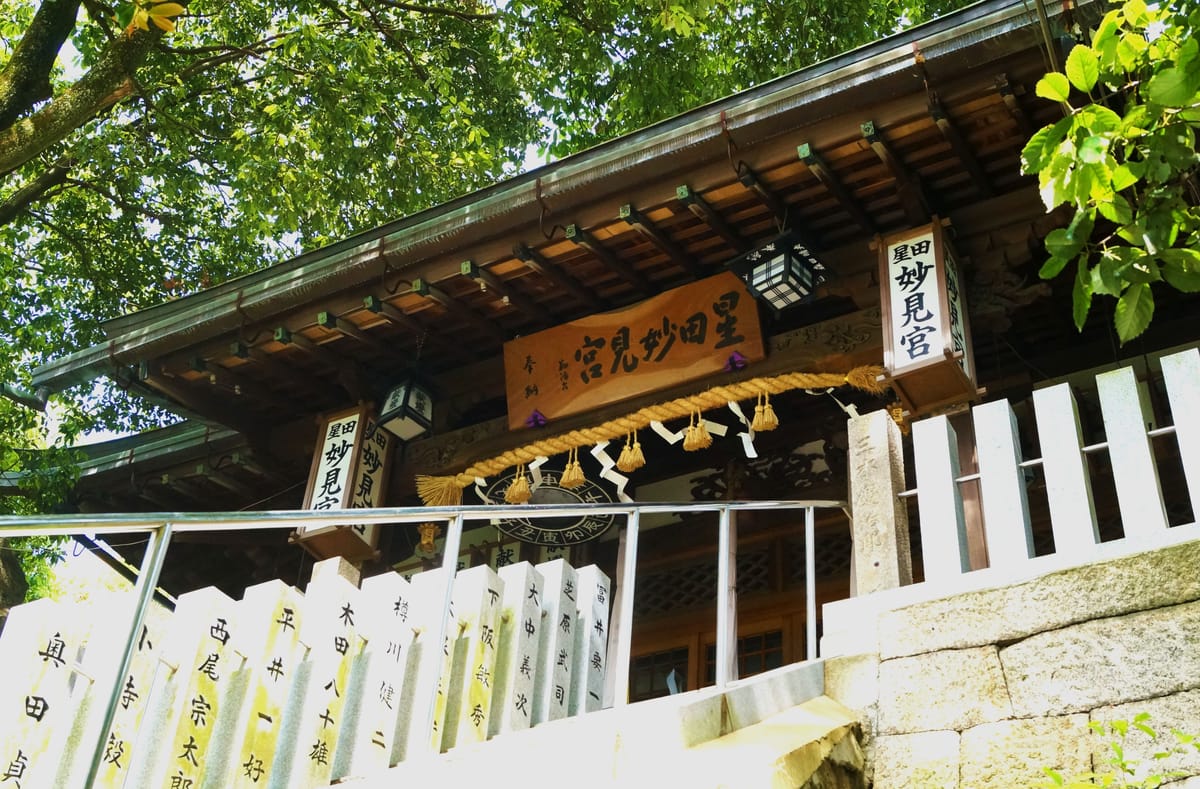
Hoshida Myokengu (星田妙見宮), nestled in the mountains of Katano City, Osaka Prefecture, marks a significant milestone in 2026 (Reiwa 8): 1,210 years since its founding.
Counting back 1,210 years from 2026 lands on 816 — the Konin era, when Kukai (Kobo Daishi) performed secret Buddhist rites at the Shishikutsu cave in Katano. According to tradition, the Big Dipper descended from the heavens and fell to three locations across the land of Katano. The enshrined deity traces its origin to this celestial descent. To mark this milestone year, a Tanabata limited goshuin inspired by Heian-era poetry has been offered from May 1.
Katano and Tanabata: A Deep Connection
The relationship between “Tanabata” and “Katano” is not unique to Hoshida Myokengu.
Katano has ancient ties to star observation and celestial worship. The Man’yoshu and Kokinshu both include poems set in “Katano no Mino” — records show that Heian aristocrats chose Katano as a place to compose verses about the Milky Way on Tanabata evenings. Myoken faith — venerating Myoken Bosatsu, the deified form of the North Star — spread widely in Japan due to its practical applications in navigation, military strategy, and timekeeping. But at Hoshida Myokengu, the character is more direct: this is a place where the stars themselves physically fell.
The idea of a deity descending from the sky is not unusual in myth. What makes this site distinctive is that the stars are said to have remained embedded in the earth. Three points within the shrine grounds are identified as landing sites, one of which is called the “Sanko-seki” (three-light stone). The fact that this story has been passed down for over a thousand years is itself evidence of the continuity of belief here.
1210th Anniversary Commemorative Tanabata Limited Goshuin
| Item | Details |
|---|---|
| Offered | May 1, 2026 – August 19, 2026 (through the traditional lunar Tanabata) |
| Offering fee | ¥1,200 |
| Format | Pre-written slip (書き置き) |
The theme is drawn from “Nisei” (二星), a piece of vocal court music (roei) found in the Wakan Roei-shu compiled by Fujiwara no Kinto in the Heian period. It depicts the moment when Orihime (Vega) and Hikoboshi (Altair) meet for their once-yearly reunion, then part again at dawn.
The offering fee of ¥1,200 is not coincidental — it mirrors the 1,210-year anniversary, with the pricing itself serving as an expression of celebration.
The end date of August 19 also has a reason. The traditional lunar Tanabata falls in mid-August each year; in 2026, that date is August 19. The offering period is designed to span the entire “Tanabata season” — from the solar July 7 through to the lunar date.
May Limited Fresh Green Maple Goshuin
| Item | Details |
|---|---|
| Offered | May 1, 2026 – end of May |
| Offering fee | ¥700 |
| Format | Pre-written slip (書き置き) |
Running concurrently through the end of May, a fresh green maple (aomomiji) limited goshuin is also available. More than 100 maple trees line the approach to the shrine, and May is when the new foliage is at its most vivid. The design features both the green maple leaves and the “Doryu no Taki” (Rising Dragon Waterfall) within the shrine grounds.
A site famous for its autumn red maples repurposed as “aomomiji” — fresh green — for a spring goshuin. This reflects a broader shift in goshuin culture. Goshuin were once primarily proof of pilgrimage; today, the emphasis has moved toward presenting seasonal nature, festivals, and the character of each site as something to be seen and appreciated.
Kukai and the Legend of the Falling Seven Stars
The founding of Hoshida Myokengu dates to the Konin era (810–824 CE).
While Kukai performed the secret practice “Kokuzogumoji-ho” at Shishikutsu cave in Katano, the Big Dipper descended from the heavens and fell in three places across the Katano area. The deity enshrined at those points of descent — Myoken Bosatsu, the divine personification of the North Star — became the origin of Hoshida Myokengu.
The North Star’s significance across ancient civilizations stems from its near-fixed position in the sky. It served as a reference for direction, a guide for navigation, and an axis of time. In China, it symbolized the celestial emperor who governs the center of heaven. In Japan, from the Heian period onward, it attracted devotion from the warrior class and seafarers alike. Myoken faith took root in Japan as a Buddhist interpretation of that same North Star reverence.
Hoshida Myokengu holds the Tanabata Matsuri on July 7 each year, with star-worship festivals continuing throughout the year. The narrative of “the site where seven stars descended” represents a layered sacred character formed by the convergence of Kukai as a historical figure, star worship tradition, and the ancient Katano district’s geographic and cultural identity.
Visitor Information
| Item | Details |
|---|---|
| Official name | Hoshida Myokengu (Komatsu Shrine) |
| Address | 9-60-1 Hoshida, Katano City, Osaka Prefecture |
| Access | Approx. 20 min walk from JR Gakken Toshi Line “Hoshida” Station |
| Goshuin hours | 9:00–16:30 (approximate) |
| Official website | https://www.hoshida-myoken.com/ |
The shrine sits in a mountain setting, and the approach involves steep stone steps. The Doryu no Taki waterfall is along that same path. Those with mobility concerns may want to consider local taxi service.
Image: 星田妙見宮, photo by Sasakiyusuke2003, CC BY-SA 4.0, via Wikimedia Commons