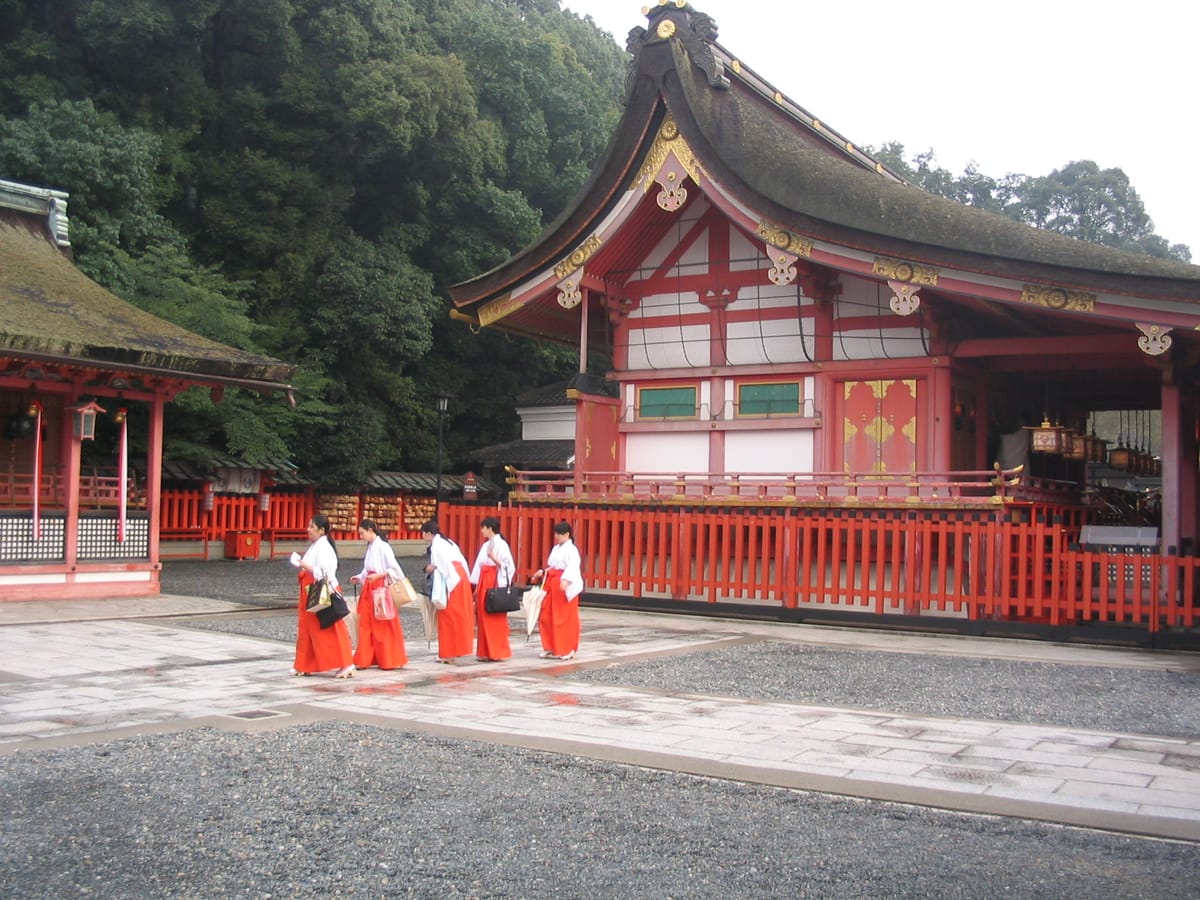
Walking through a Japanese shrine, you might encounter a procession you weren’t expecting: a bride in white silk, a groom in formal hakama, shrine maidens holding lanterns, moving in slow ceremony down the gravel path toward the main hall. If you stop and watch, you’ll be witnessing a shinzen shiki — a Shinto wedding.
It’s one of the most visually striking ceremonies in Japanese culture, and one of the least understood outside Japan. Every element carries meaning rooted in Shinto cosmology: purification, covenant, the presence of the divine as witness.
What Is a Shinto Wedding?
Shinzen shiki (神前式) — literally “ceremony before the kami” — is a wedding conducted in a Shinto shrine or dedicated shrine hall, officiated by a Shinto priest. The couple makes their vows in the presence of the enshrined deity, who serves as the witness and guarantor of the marriage.
This is structurally different from Western religious weddings. The kami is not an abstract universal god but a specific deity enshrined in a particular place: the god of the shrine you chose, who has a name, a history, and a local presence. Saying your vows before the kami at Meiji Shrine is a different act than doing so at a neighborhood shrine — though both are equally valid.
The ceremony is typically private. Unlike church weddings, which may be semi-public, most Shinto weddings admit only immediate family on both sides. If you glimpse one as a passerby, you’re seeing what most visitors never see.
History: A Modern Tradition
Shinto weddings are surprisingly recent. The oldest mention of a Shinto-style wedding in a ceremonial manual dates to 1872, but the practice didn’t gain public attention until 1900, when Crown Prince Yoshihito (later Emperor Taisho) married Princess Kujō Sadako at Hibiya Daijingū (now Tokyo Daijingū). The imperial couple’s Shinto ceremony became a model, and the practice gradually spread among the general population.
Through the Meiji and Taisho eras, shinzen shiki became an established practice in major cities. After World War II — when Japan’s state Shinto system was dismantled and religion was returned to the private sphere — Shinto weddings became accessible to ordinary families rather than being associated primarily with state ritual. By the 1960s and 70s, a Shinto ceremony had become the default wedding style for much of Japan.
Today, Shinto weddings compete with Western-style church ceremonies (Japan’s most common choice, though often officiated by non-clergy) and secular jinzen shiki. The recent revival of interest in wa-kon (Japanese-style weddings) has brought a new generation back to shrine ceremonies.
The Ceremony: Step by Step
The exact order varies by shrine, but the core elements are consistent.
1. Sanshinkō — The Procession
The ceremony begins outside. Led by a Shinto priest and shrine maidens (miko), the couple and their families walk in formal procession from the torii or shrine entrance toward the main worship hall (haiden). The pace is deliberate; the procession is itself a ritual transition — a movement from the ordinary world into the sacred space where the kami dwells.
This is the moment most visible to shrine visitors. Even without knowing you’re watching a wedding, the sight of the white-clad procession crossing the shrine grounds carries an unmistakable solemnity.
2. Shubatsu no Gi — Purification
Inside the hall, the ceremony opens with purification (shubatsu). The priest waves a ōnusa — a wand with paper streamers (shide) — over the couple, their families, and the assembled witnesses. This ritual removes kegare (impurity, pollution) and prepares everyone for the sacred rite ahead.
In Shinto theology, the state of purity (harae) is a prerequisite for any meaningful approach to the divine. The wedding cannot begin until this is accomplished.
3. Norito Sōjō — The Prayer Recitation
The priest faces the altar and recites norito — formal words addressed to the kami. Norito are among the oldest forms of Japanese language, reaching back to the Engishiki (927 CE) and beyond. The specific norito for weddings announces the purpose of the gathering, names the couple, and invites the kami’s blessing on the union.
The cadence of norito is not like everyday speech. It has its own rhythm and register, deliberately archaic — a signal that this language bridges the human and divine worlds.
4. San-san-ku-do — The Triple Cup Exchange
The most famous ritual of the Shinto wedding, and the one that most clearly marks the marriage as binding.
Three lacquered cups — small, medium, and large — are brought forward, each filled with sacred sake (omiki). The bride drinks from the small cup three times; the groom follows; the bride drinks from the medium cup three times; the groom follows; and so on through all three cups. Hence “san-san-ku-do”: three (san) × three (san) = nine (ku), repeated (do).
The number three is auspicious in Shinto; nine, the result of three-times-three, carries compounded good fortune. But the symbolic weight goes deeper than numerology. Sharing sake from the same cup is a covenant act — “drinking together” creates a bond that didn’t exist before. The omiki is also an offering from the kami, so both partners are receiving divine blessing into their bodies simultaneously.
5. Seishi Sōjō — The Vows
The groom reads the seishi — the formal vow — aloud before the kami. The bride follows. The language is typically formal and traditional: a promise to live together, to support one another, to maintain the household.
Like the norito, the vow is addressed to the kami as witness. This isn’t a private exchange between two people; it’s a declaration before a sacred third party who is understood to hear and remember.
6. Tamagushi Hairei — The Sacred Branch Offering
Each partner in turn receives a tamagushi — a branch of sakaki (a sacred evergreen) decorated with shide paper streamers — and carries it to the altar. They bow twice, clap twice, and bow once more (the standard Shinto form of prayer). Both families then follow in the same ritual.
The tamagushi is one of the primary media for human-kami communication in Shinto practice. Presenting it at an altar is the act of addressing the kami directly. At a wedding, it signals that the couple has completed their vow and are now presenting themselves — together — before the divine.
7. Ring Exchange
Most modern Shinto weddings include a ring exchange, though this is not a traditional Shinto element — it was adopted from Western ceremony in the 20th century. Some shrines frame it as yubiwa katame no gi (“ring-binding ceremony”), integrating it into the ritual sequence. Others treat it as a secular addition after the sacred rites are complete.
8. Shinzoku-gatame no Sakazuki — The Family Cup
The ceremony closes with the extended family of both sides sharing sake from the same cups. The act mirrors the san-san-ku-do: the two families, now joined by marriage, make a shared covenant of their own. They are no longer separate households; the cup exchange marks their union.
The Attire
The Bride
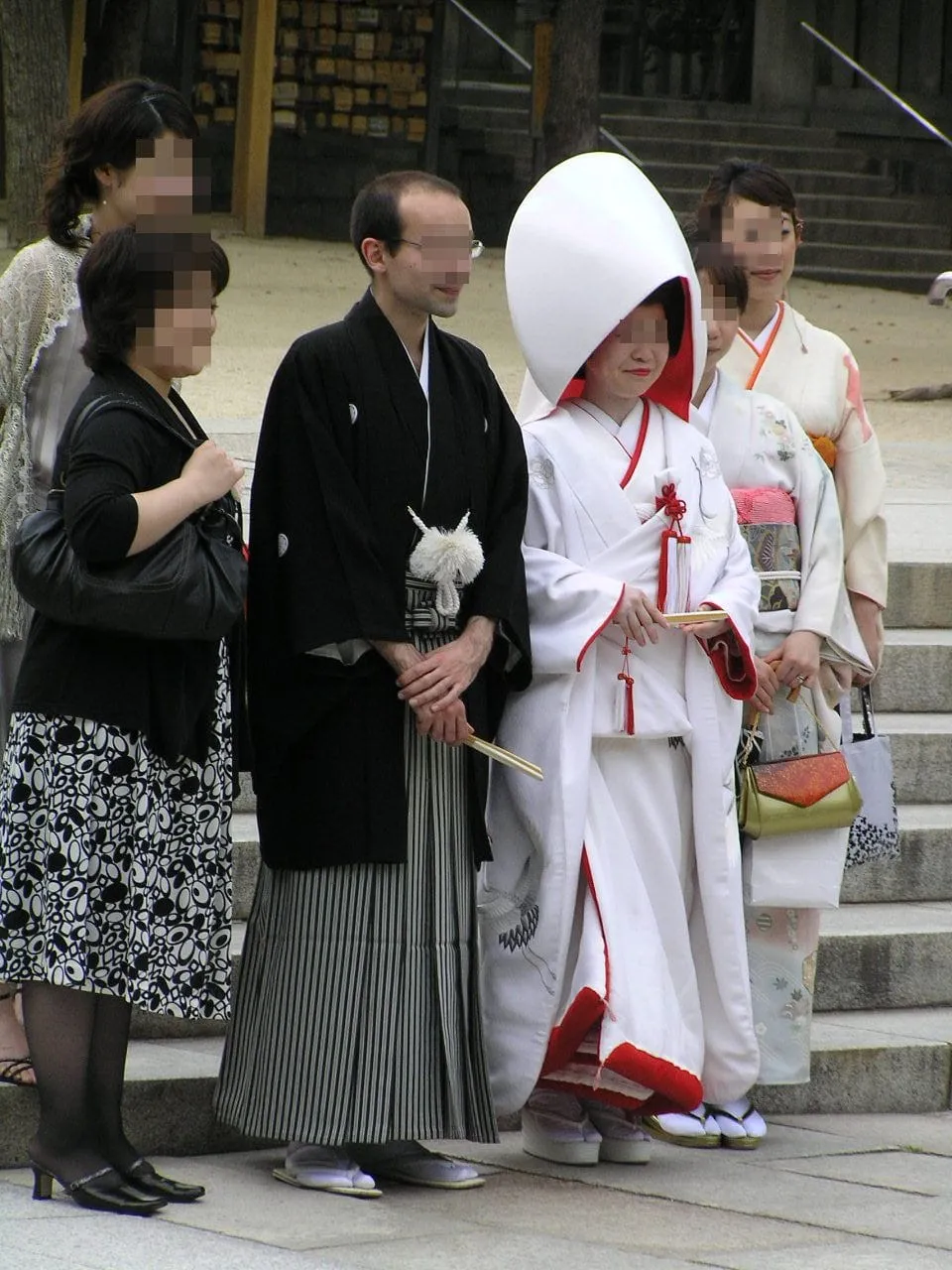
The standard bridal dress for shinzen shiki is the shiromuku (白無垢) — a full white ensemble in which every element, from the outermost kimono to the undergarments, is white. White in Shinto denotes purity and readiness; there is also an old tradition that the white means “not yet colored” — the bride arrives in neutrality and will take on the colors of her new family.
Many brides change into a iro-uchikake (色打掛) — a richly colored overgarment in red, gold, or other formal hues — for the reception afterward. This oiro-naoshi (color change) signals the transition from the sacred ceremony to the celebration of the new union.
The bridal headdress takes one of two forms:
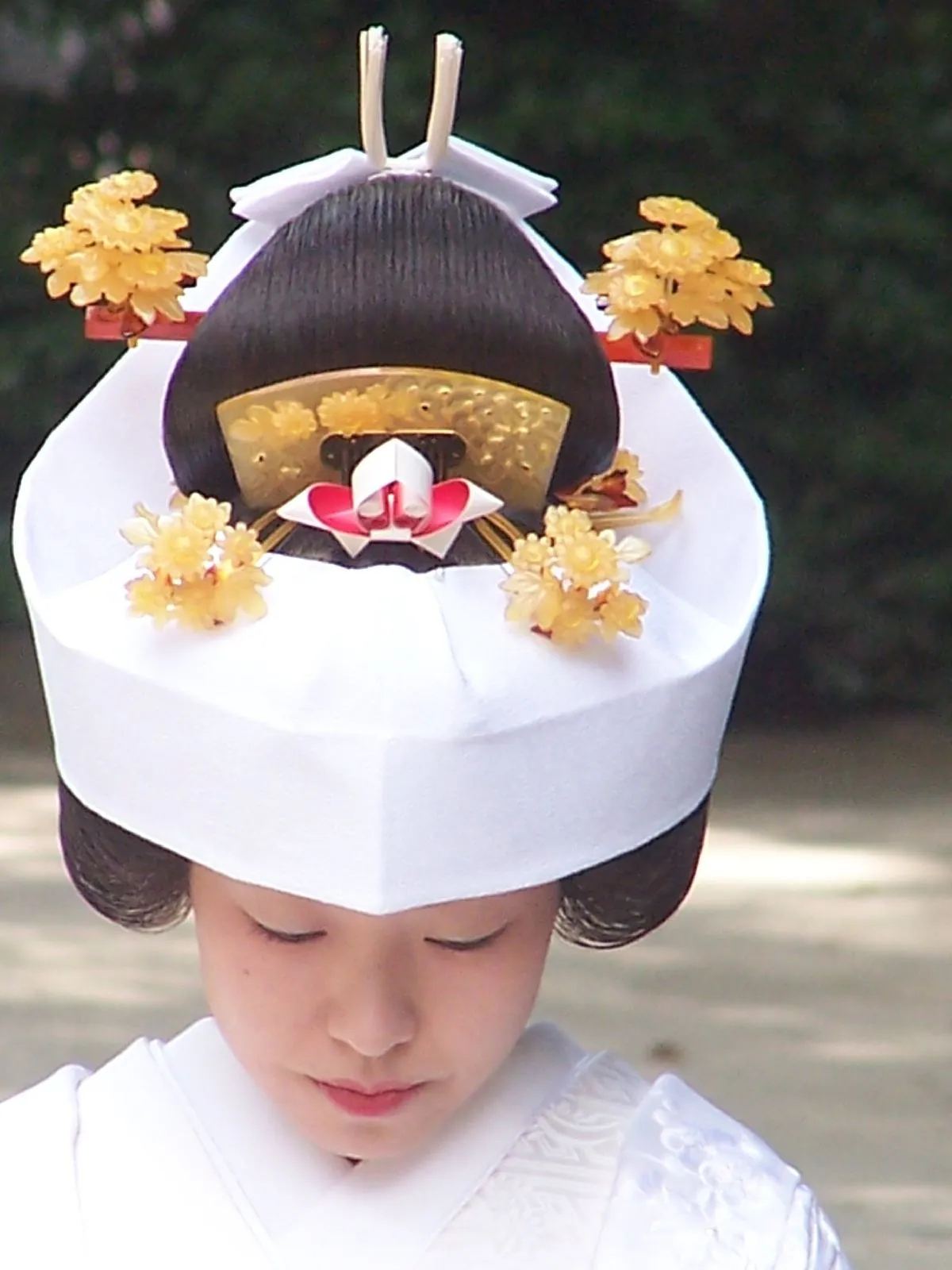
- Wataboshi (綿帽子): a rounded white hood worn only during the ceremony. It is considered the formal headwear of the shiromuku and is removed after the ceremony ends.
- Tsunokakushi (角隠し): a flat white band wrapped around the front of an elaborate wig. The name means “horn hider” — a reference to the idea that it conceals the horns of jealousy and obstinacy that marriage requires suppressing. Unlike the wataboshi, it can be worn through the reception as well.
The Groom
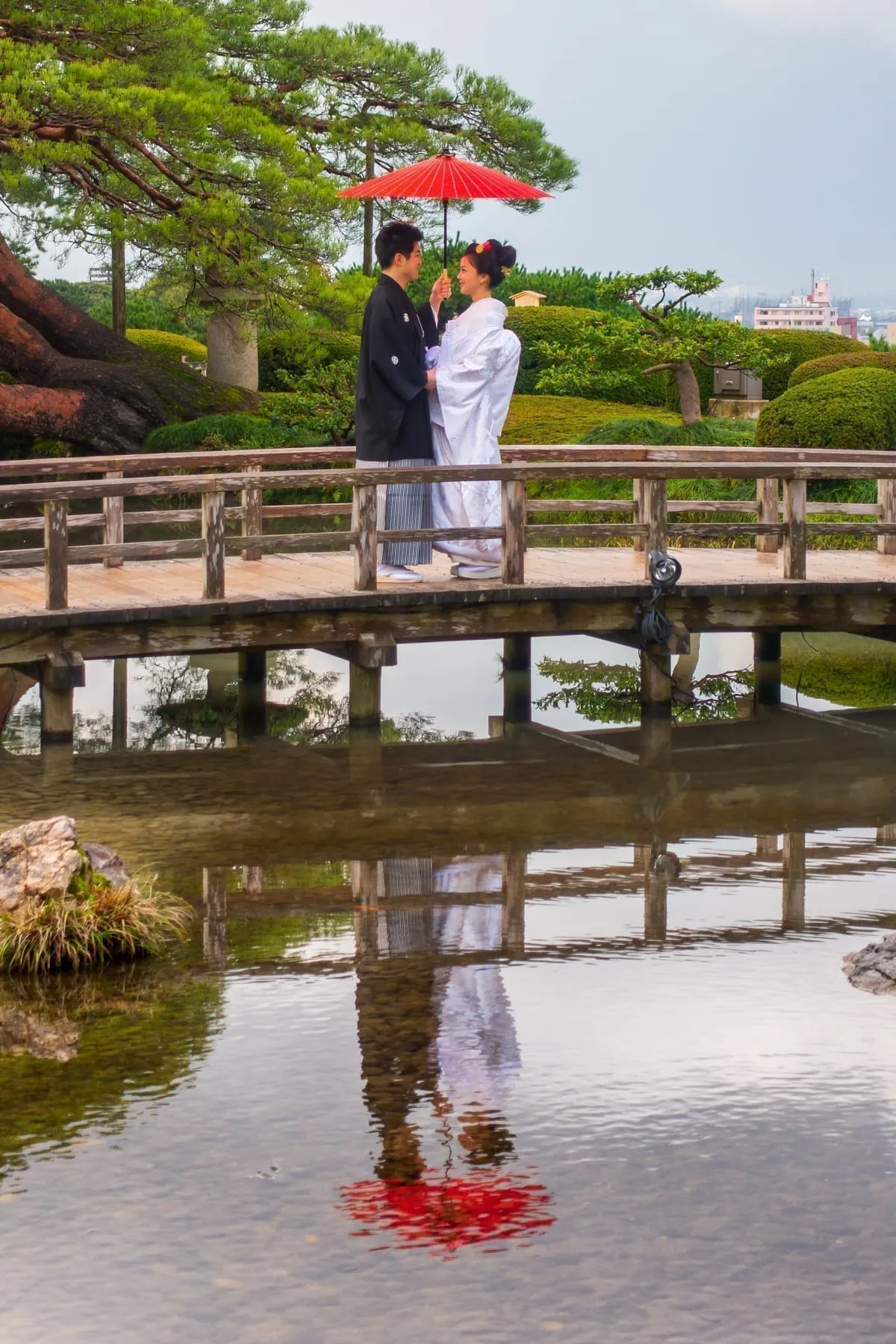
The standard groom’s dress is the montsuki haori hakama (紋付羽織袴): a formal black haori jacket with five family crests (kamon), worn over a kimono with a hakama skirt. The five-crest black ensemble is the most formal possible; three-crest versions also appear at weddings. In recent years, white, gray, or other colored hakama have become more common among grooms seeking a less austere look.
Notable Shrines for Shinto Weddings
Meiji Jingū (Tokyo): The shrine most associated with shinzen shiki in popular culture, and among the most popular venues in Japan. The long, forested approach (sandō) and the scale of the outer precinct create a setting unlike any other.
Izumo Taisha (Shimane): The home of the deity of relationships, Ōkuninushi-no-mikoto. Couples travel from across Japan to be married before the god of bonds. The waiting list can be long.
Sumiyoshi Taisha (Osaka): One of the oldest shrines in Japan with a long history as a site for formal ceremony. The arched sori-bashi bridge and the four-shrine complex create a distinctive environment for the procession.
Meiji Jingū Gaien / Hikawa Jinja (Tokyo): Several Tokyo-area shrines offer streamlined modern shinzen shiki packages that retain the core ceremonies while accommodating non-Japanese speakers.
Shinto Weddings and Goshuin
The shrines where Shinto weddings take place are almost always shrines where you can also receive a goshuin.
Some shrines offer a commemorative goshuin on the day of the wedding — stamped with the date, occasionally with a special design that marks the occasion. The couple’s goshuincho from their wedding day becomes something qualitatively different from ordinary pilgrimage records: the beginning of a shared collection that will grow as they visit shrines together over a lifetime.
Shrines associated with en-musubi (bond-tying) — Izumo Taisha, Tokyo Daijingū, Kawagoe Hikawa Shrine — draw pilgrims who hope to establish the conditions for marriage, and then couples who return after the wedding to give thanks. The goshuin from each visit tells that story silently, in ink and paper.
Related Articles
- Misogi and Harae: The Purification Rituals of Shinto
- An Introduction to the Kami of Shinto: Amaterasu, Susanoo, Inari, and More
- What Is a Shintai? Sacred Objects at the Heart of Shinto Shrines
Image Credits
- Bride at Meiji Shrine, Tokyo (January 2003): Photocapy, CC BY-SA 2.0, via Flickr / Wikimedia Commons
- Bride in wedding kimono at Minatogawa Shrine, Kobe (May 2010): 松岡明芳 (Matsuoka Akiyoshi), CC BY 3.0, via Wikimedia Commons
- Couple in traditional wedding attire, Kenrokuen Garden, Kanazawa (October 2018): Benh LIEU SONG, CC BY-SA 2.0, via Flickr / Wikimedia Commons
- Thumbnail — Shinto wedding at a Tokyo shrine (2006): Tracy Hunter, CC BY 2.0, via Flickr / Wikimedia Commons