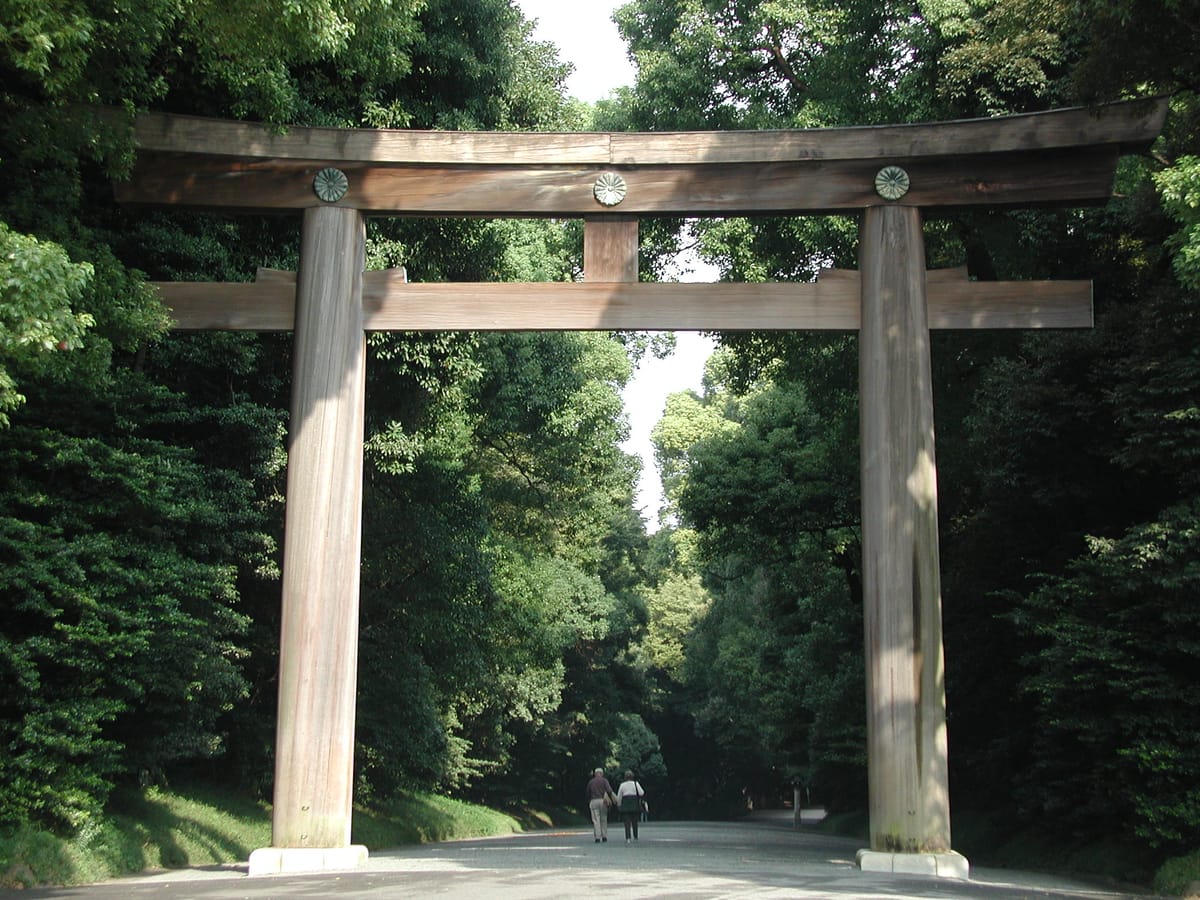
Walk through a torii gate at any Japanese shrine, and before you reach the worship hall, you’ll pass a pair of stone beasts crouching on either side of the path. One has its mouth open. The other has its mouth closed.
Most visitors walk right past them. But these creatures carry over a thousand years of history, a philosophy that spans the beginning and end of the universe, and — once you start looking closely — a surprising amount of regional personality.
What Are Komainu?
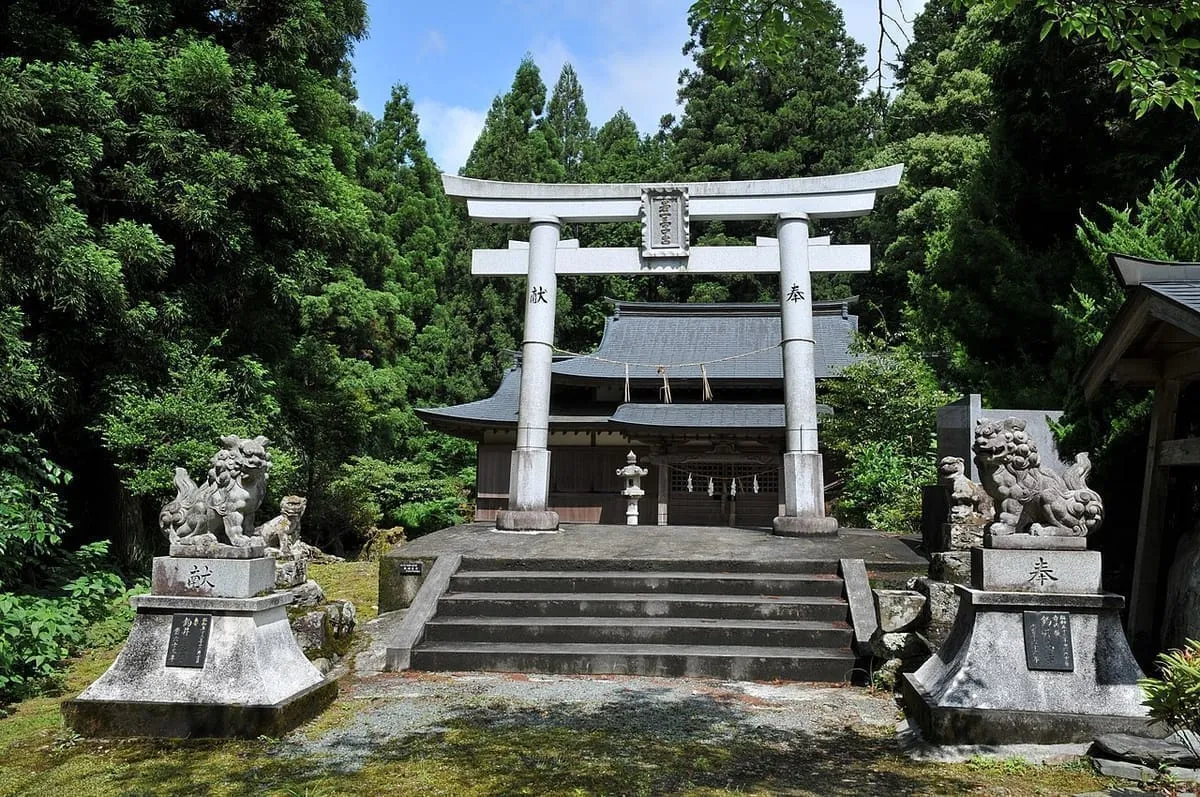
Komainu (狛犬) are paired guardian statues placed along the sandō (approach path) or in front of the honden (main sanctuary) of Shinto shrines. Their job is to ward off evil spirits and protect the sacred space within.
Despite the name — which literally translates as “Korean dog” — komainu are neither dogs nor lions. They’re imaginary sacred beasts, descended from the Chinese guardian lions (石獅子) of the Tang dynasty. The statues traveled the Silk Road through the Korean Peninsula to Japan, picking up new forms along the way. The character 狛 is thought to derive from “Koma” (高麗), an old Japanese name for the Korean kingdom of Goguryeo — hence “Goguryeo dog.”
During the Nara period (710–794), both statues in a pair looked identical — pure lion forms. In the Heian period (794–1185), they began to diverge: one remained a lion (shishi) with an open mouth, while the other became a “komainu” proper — closed mouth, sometimes with a single horn on its head. Over time the distinction blurred, and both figures came to be called komainu regardless of form.
Originally wooden and kept indoors, komainu moved outside in the Kamakura period (1185–1333) and were carved from stone to withstand the weather. By the Edo period (1603–1868), stone komainu flanking shrine approaches had become the standard image we know today.
The A-Un Symbolism: Beginning and End
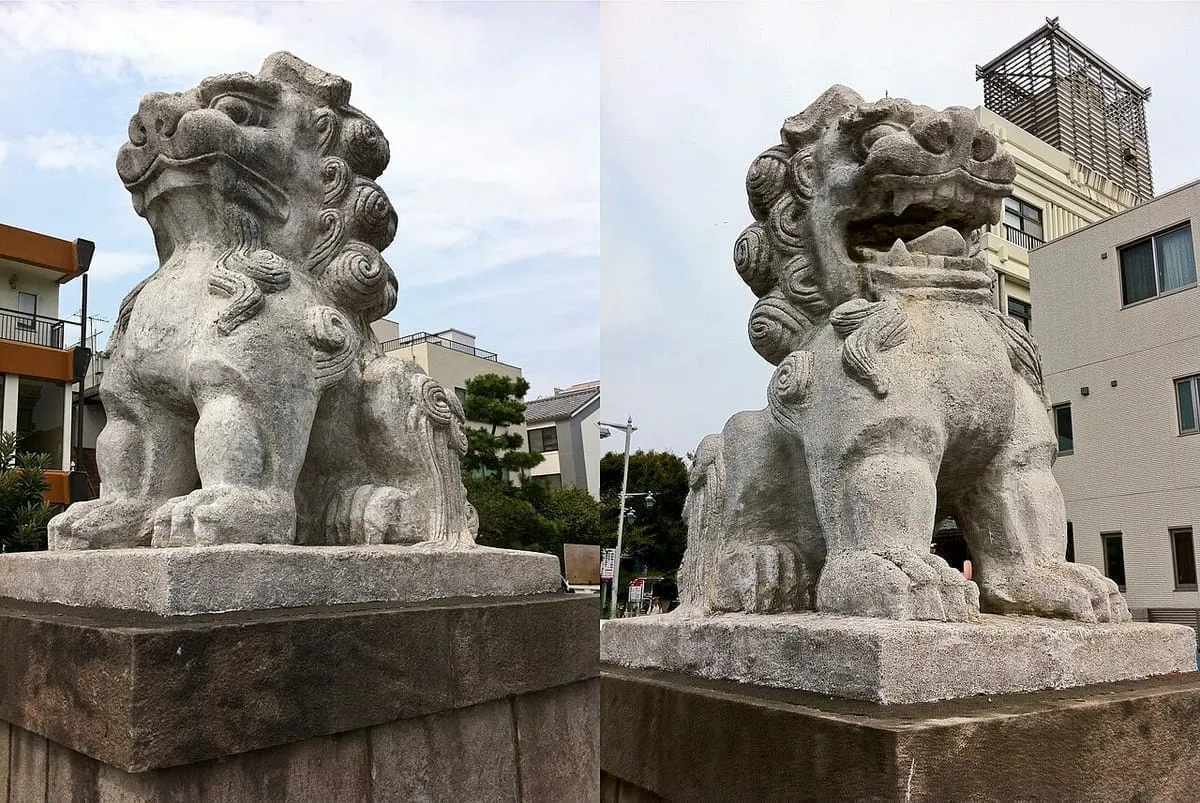
The first thing to look for when you encounter komainu is the shape of their mouths.
The figure on the right has its mouth wide open. This is the a-gyō (阿形) — the “a” form. The one on the left has its mouth firmly shut. This is the un-gyō (吽形) — the “un” form.
“A” is the first sound in the Sanskrit alphabet. “Un” (sometimes rendered “hūṃ”) is the last. Together, they represent the beginning and end of all things — the alpha and omega of the Buddhist cosmos. Combined, the two syllables approximate “AUM” (or “Om”), one of the most sacred sounds in Hinduism and Buddhism alike.
This goes beyond linguistics. In ancient Indian philosophy, the universe itself was born from vibration — from sound. “A” is the first sound a human can make, mouth open, breath released: the moment of creation. “Un” is the final sound, mouth closing, breath returning to silence: dissolution. Between these two syllables lies the entire cycle of existence — birth and death, expansion and contraction, inhalation and exhalation. Two stone figures standing silently at a shrine gate encode nothing less than the life cycle of the cosmos.
This a-un pattern isn’t unique to komainu. You’ll find the same open-closed mouth symbolism on the Niō (仁王) — the fearsome muscular guardians standing at the gates of Buddhist temples. The fact that a Buddhist concept found its way into Shinto shrine guardianship is itself a fascinating piece of Japan’s religious history, where Buddhism and Shinto intertwined for centuries.
How to Tell Them Apart
- A-gyō (right side): Mouth open. Usually positioned on the right as you face the shrine
- Un-gyō (left side): Mouth closed. Usually on the left
- Exceptions exist: Some shrines place them in reverse, or both may have open mouths
There’s a common Japanese expression, a-un no kokyū (阿吽の呼吸), meaning “a-un breathing” — used to describe two people who are perfectly in sync, anticipating each other’s moves without words. The phrase comes directly from these guardian statues.
Materials Through the Ages
Komainu have been made from many materials, each tied to a particular era and setting.
Wooden Komainu (Heian–Kamakura Periods)
The oldest surviving komainu are wooden, meant to be placed inside the honden, directly guarding the enshrined deity. These “jinnai komainu” (陣内狛犬, “interior komainu”) could be elaborately carved because they were protected from the elements. The wooden komainu attributed to the sculptor Unkei at Tōdai-ji’s Nandaimon gate — designated a National Treasure — are among the finest surviving examples.
Stone Komainu (Kamakura Period–Present)
When komainu moved outdoors, stone became the material of choice. Granite is most common, though regional varieties include sandstone and tuff. Different stone types — and different stonemason traditions — gave rise to dramatically different appearances across Japan.
Porcelain Komainu
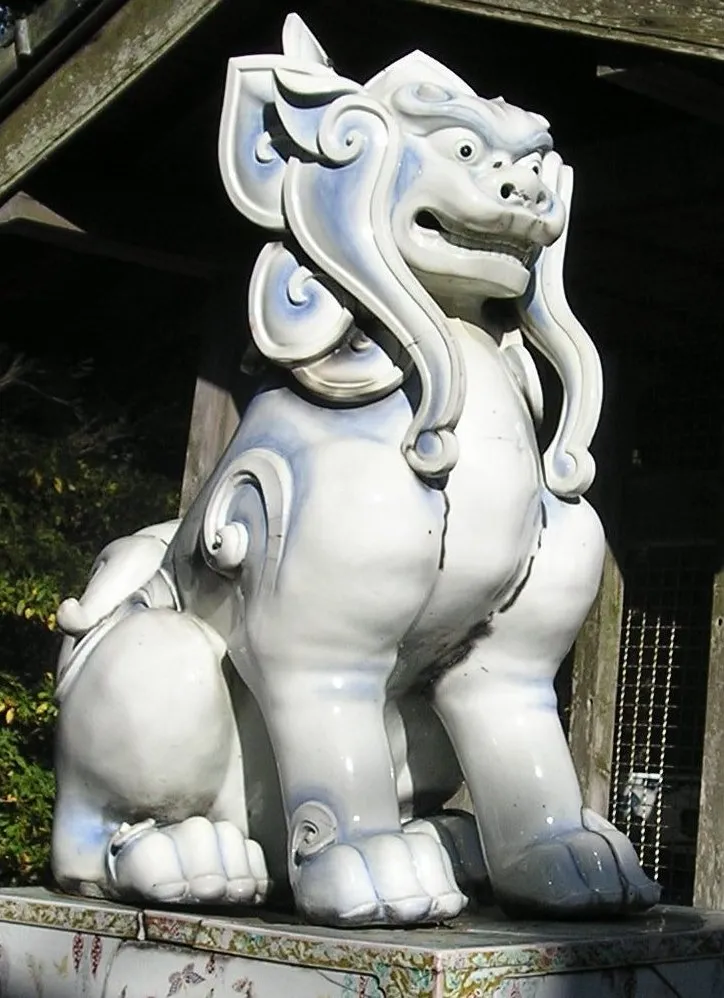
At Tōzan Shrine (陶山神社) in Arita, Saga Prefecture — the birthplace of Japanese porcelain — the komainu are made of white porcelain with blue underglaze painting. Even the torii gate is porcelain. It’s a sight you’ll find nowhere else in Japan, and a perfect example of how local craft traditions shape shrine aesthetics.
Bronze Komainu
Larger or higher-ranking shrines sometimes feature bronze komainu. These have a heavier, more authoritative presence than stone — you’ll find notable examples at Yasukuni Shrine in Tokyo, cast during the Meiji era.
Not Just Lion-Dogs: The Sacred Messengers
At certain shrines, the guardian statues aren’t komainu at all. They’re shinshi (神使) — animals that serve as divine messengers for the enshrined deity. Knowing which animal guards a shrine instantly tells you something about who is worshipped inside.
Foxes at Inari Shrines
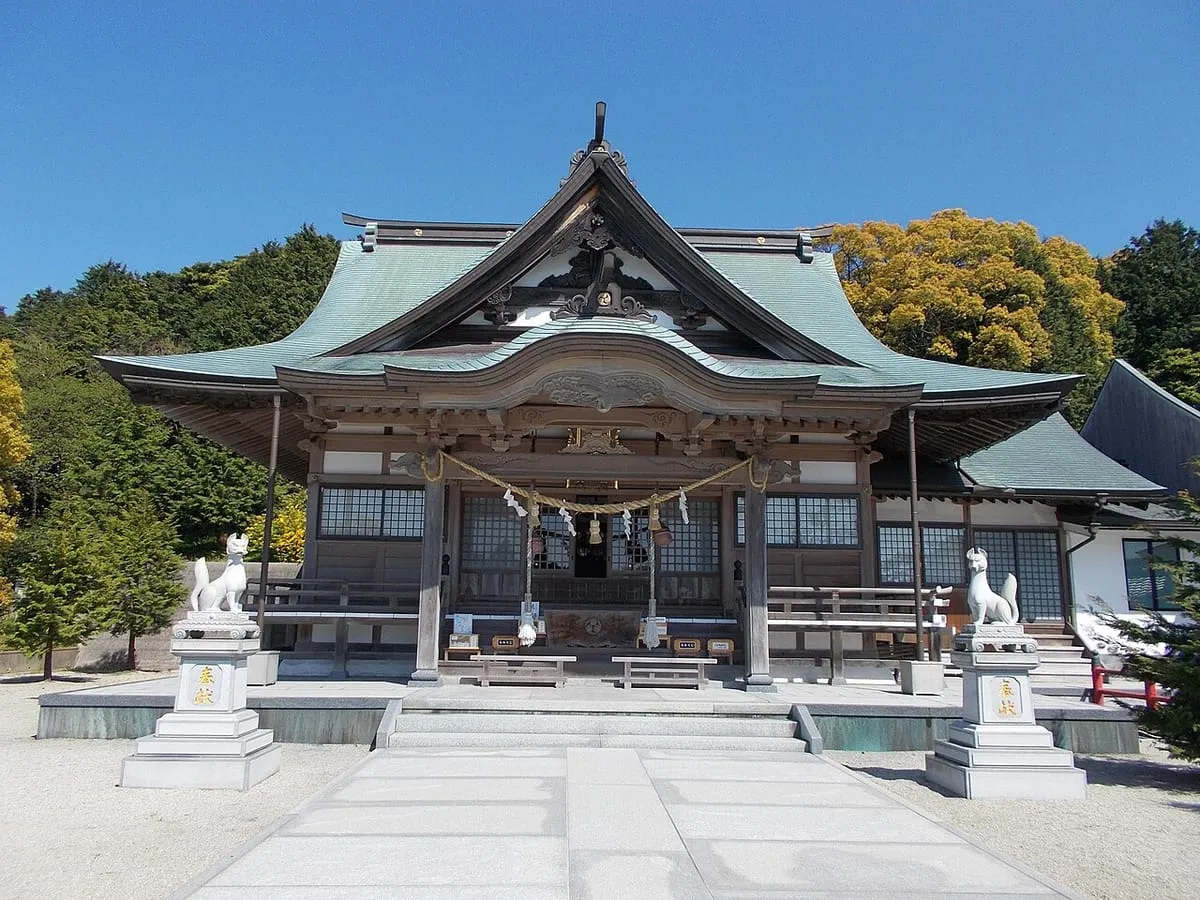
Japan has roughly 30,000 Inari shrines, and every single one is guarded by foxes (kitsune) instead of komainu. These are the white foxes (byakko) — messengers of the Inari deity.
Pay attention to what the foxes are holding in their mouths:
- Hōju (jewel): Symbolizes the spiritual power of Inari
- Key: The key to a rice granary — Inari is the god of harvests
- Rice sheaves: Representing abundant harvests
- Scroll: A Buddhist sūtra, reflecting the Buddhist elements woven into Inari worship
Wild Boars at Wake Shrine
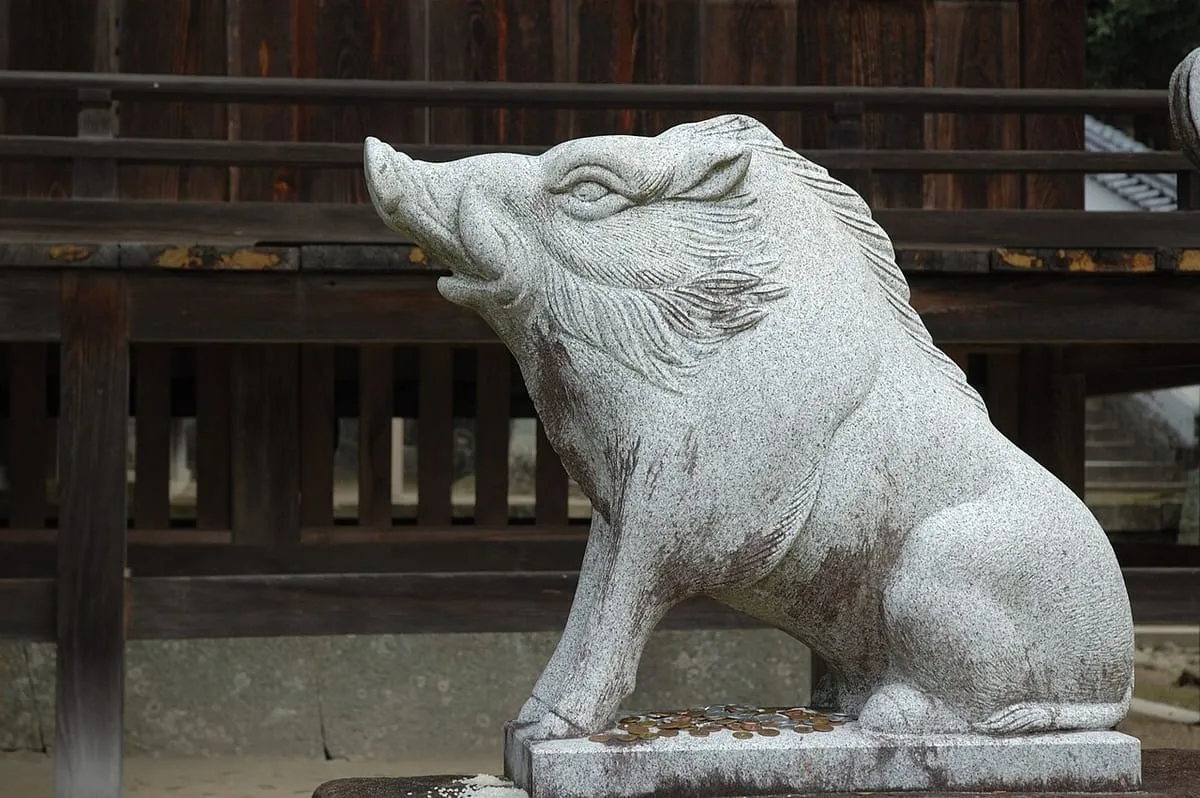
At Wake Shrine (和気神社) in Okayama Prefecture, the guardians are wild boars. The legend goes that when the shrine’s enshrined deity, Wake no Kiyomaro, was exiled due to a political conspiracy in the 8th century, 300 wild boars appeared to protect him on his journey. The shrine honors this story with boar guardians — known as koma-inoshishi (狛猪).
Other Sacred Messengers
Japan’s shrines are home to a remarkable menagerie of divine messengers:
- Deer: Kasuga Taisha (Nara) — legend says the deity arrived riding a white deer from Kashima
- Ox/Bull: Tenman-gū shrines nationwide — associated with Sugawara no Michizane. Visitors rub the bronze bull statues for good luck
- Monkey: Hie Shrine (Tokyo) — messengers of the Sannō mountain deity
- Snake: Ōmiwa Shrine (Nara) — incarnation of the spirit of Mount Miwa
- Rabbit: Shrines connected to the myth of the White Hare of Inaba, associated with Izumo Taisha
- Wolf: Mitsumine Shrine (Saitama) — rooted in mountain dog worship traditions
Once you know which animal to expect, you can read a shrine’s identity before you even reach the worship hall.
Regional Styles: Every Face Tells a Story
Even limiting ourselves to stone komainu, the variety across Japan is staggering. Local stone types, stonemason lineages, and regional aesthetics all leave their mark.
Izumo Style
Found primarily in Shimane Prefecture. The defining feature is the raised tail — these komainu look coiled and ready to pounce, with a dynamic energy that sets them apart from the more static styles elsewhere. They’re often carved from kimachi-ishi (来待石), a local sandstone, which gives them a warm, reddish tone.
Naniwa Style
Centered on the Osaka/Kansai region. Characterized by curly manes with elaborate spiral carvings and rounder, softer faces. These reflect the decorative sensibilities of Edo-period Kamigata (upper Kansai) culture — flamboyant and detail-rich.
Edo Style
Common in the Kantō region around Tokyo. More angular and muscular than the Naniwa style, with tighter features and a sense of restrained power. The influence of samurai culture is hard to miss — these komainu project authority and martial dignity.
Hajime Style
Developed in the late Edo to Meiji periods. The hallmark is a parent lion with a cub — typically the a-gyō has a small lion cub playing at its feet. The motif represents family bonds and prosperity, adding a human emotional dimension to what is otherwise a fierce guardian.
A Komainu-Spotter’s Checklist
Next time you visit a shrine, pause at the komainu and look for these details:
- Mouth shape: A-gyō (open) or un-gyō (closed)? Some pairs break convention
- Horn: Older-style un-gyō may have a single horn on the head
- Material: Stone (what kind?), bronze, wood, porcelain
- Feet: Is there a cub? Is the figure stepping on a ball (tama)?
- Expression: Fierce? Comical? Serene? Regional character comes through strongest in the face
- Held objects: Foxes hold jewels and keys; other animals have their own signatures
- Pedestal inscription: Often carved with the donor’s name and the year of dedication
For photography, a 45-degree angle captures both the mouth difference and the full body sculpture in a single frame.
Komainu and Goshuin
Some shrine goshuin (御朱印, hand-brushed seal stamps) feature komainu in their design — especially at shrines known for unique guardian statues. Inari goshuin frequently include fox imagery; Tenman-gū goshuin often show the ox; Hie Shrine goshuin may depict the monkey.
Knowing the guardian animals adds another layer of meaning to every goshuin you collect. That fox stamp isn’t just decorative — it’s telling you exactly which deity blessed that page.
Next time you walk through a torii gate, look to your left and right before heading for the worship hall. One mouth open, one mouth shut. The beginning and end of all things, standing guard in stone.
Want to preserve your shrine visits digitally? Goshuin Meguri lets you photograph, organize, and map every goshuin in your collection — komainu photos and all. Build your own visual record of Japan’s sacred guardians.
Image credits: Hero image (komainu at Nyakuichiōji-gū) — by Reggaeman (CC BY-SA 3.0), via Wikimedia Commons. A-un pair — by Urashimataro (CC BY-SA 3.0), via Wikimedia Commons. Porcelain komainu (Tōzan Shrine) — by STA3816 (CC BY-SA 3.0), via Wikimedia Commons. Inari fox (Kagamiyama Shrine) — by STA3816 (CC BY-SA 4.0), via Wikimedia Commons. Guardian boar (Wake Shrine) — by Reggaeman (CC BY-SA 3.0), via Wikimedia Commons.