During summer festivals across Japan, you’ll see crowds of bearers in matching happi coats hoisting a golden, roofed structure on long wooden poles, chanting in unison as they carry it through narrow streets. The golden phoenix gleams at the top. Bells ring with every step. The crowd parts and bows.
This is a mikoshi (神輿) — a portable shrine — and the people carrying it are not performing a ceremony for the tourists. They are transporting a god.
What Is a Mikoshi?
A mikoshi is a temporary dwelling for the kami (神) — the divine forces of Shinto — during their periodic excursions outside the shrine grounds.
In normal times, the kami’s spirit resides in the shintai (御神体), the sacred object at the heart of the main hall (honden): typically a mirror, sword, or jewel. On festival days, priests perform a ceremony called shinrei-sen’i (神霊遷移) — the transfer of the divine spirit — ritually moving the kami’s presence from the shintai into the mikoshi.
Once inhabited, the mikoshi ceases to be an object. It becomes the kami itself. The bearers do not merely carry it; they carry a deity through the community it protects. The route is not random — the procession passes through neighborhoods, along river banks, past homes, blessing everything in the deity’s path.
This procession is called togyo (渡御) — literally “divine crossing” or “divine passage.” After the procession, a second ceremony returns the kami’s spirit to the shintai in the inner sanctuary.
Structure: A Miniature Shrine on Poles
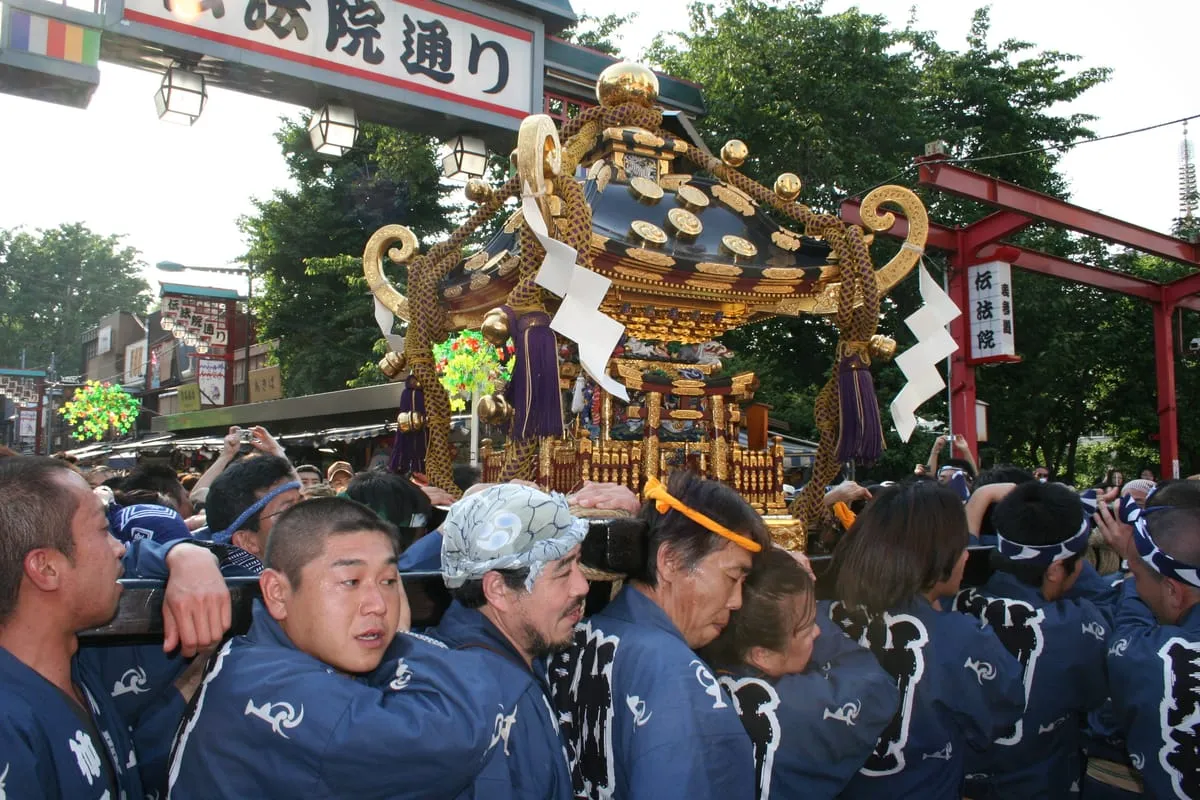
A mikoshi is, architecturally speaking, a compressed version of a shrine’s honden mounted on a carrying frame. Every element of shrine architecture is represented in miniature.
The Body (do)
The central box, typically square or rectangular, contains the temporary sacred space where the kami is housed during the procession. In some mikoshi, a small mirror (ran-kyō) or miniature shrine is placed inside. The exterior is lacquered wood, often gilded, with brass or copper fittings stamped with shrine crests, chrysanthemum patterns, or auspicious motifs.
The Roof
The roof follows shrine architectural styles — usually hōgyō-zukuri (pyramid roof) or irimoya-zukuri (hip-and-gable). Larger, prestigious mikoshi may feature decorative elements from formal shrine architecture: chigi (forked finials) and katsuogi (cylindrical roof logs) that identify the gender and rank of the deity within.
Top-tier mikoshi are covered in gold leaf (kinpaku) or decorated with makie lacquer — the same technique used in the finest Japanese decorative arts.
The Phoenix (hōō)
The most visually striking element: a golden phoenix stands at the apex of the roof. In East Asian iconography, the phoenix (hōō) appears only in the presence of a virtuous ruler or sacred power. Its placement atop the mikoshi declares the sanctity of what is inside. The phoenix also marks the direction the mikoshi faces, orienting the deity’s view during procession.
The Carrying Poles (katsugi-bō)
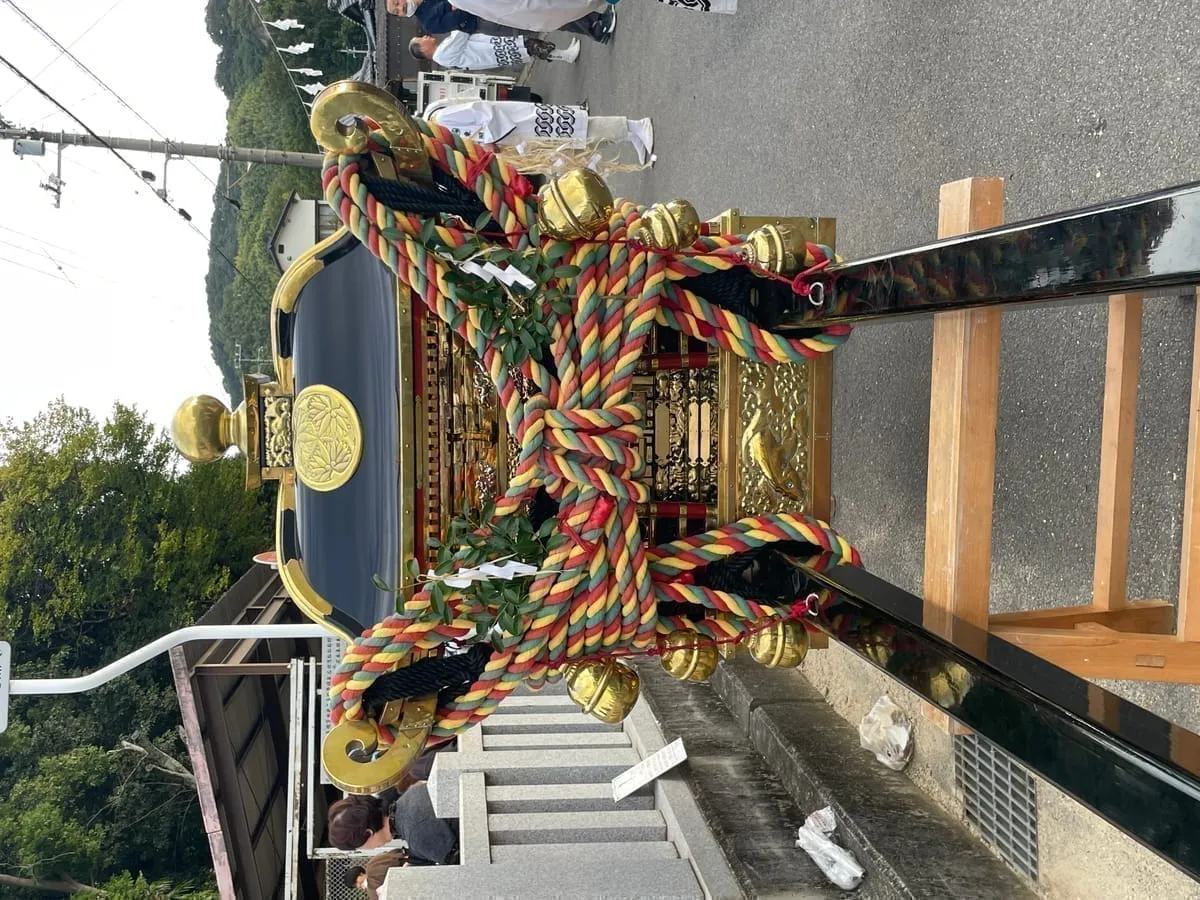
Long wooden poles — typically two to four, depending on size — run beneath the body. Bearers grip these poles and carry the mikoshi on their shoulders. The poles may be lacquered or wrapped in rope, with decorative knob-ends (bō-hana).
A small mikoshi weighs a few hundred kilograms. A full-scale ōmikoshi (large mikoshi) can exceed one ton. The largest festival mikoshi require 50 to over 100 bearers coordinated in rows. Directing this mass of people and weight requires a designated lead caller (ondo-tori) whose chants set the rhythm and direction.
Bells
Dozens of small bells are mounted around the body and poles. As the mikoshi moves, the constant ringing announces the kami’s passage, disperses malevolent spirits, and alerts the community that the divine presence is nearby. The sound of a mikoshi is as distinctive as its appearance.
History
The earliest documented mikoshi procession appears in records from 749 CE (Tenpyō era), when the spirit of Usa Jingu’s deity was carried to Nara to bless the casting of the Great Buddha at Tōdaiji. The logistics of moving a divine presence across long distances required a vessel — and the mikoshi was that vessel.
In the Heian period (794–1185), mikoshi became central to goryō-e (御霊会) — ritual festivals designed to appease the spirits of deceased nobles and calm epidemic diseases. The logic was direct: carry the troublesome spirit through the city on a palanquin, let it circulate, and channel its disruptive power into protection. The Gion Matsuri in Kyoto traces its origins to exactly this practice.
By the Edo period (1603–1868), mikoshi culture had expanded far beyond aristocratic religion. Townspeople (chōnin) organized their own festivals, funded their own mikoshi, and competed in scale and decoration. In Edo (present-day Tokyo), the Kanda Matsuri, Sannō Matsuri, and Sanja Matsuri became “tenkamatsuri” — festivals of national significance attended by the shogun himself. The mikoshi became a vehicle for civic pride as much as divine transport.
Types of Mikoshi
The Main Shrine Mikoshi (hon-mikoshi)
The primary mikoshi owned and housed by a shrine. These are typically the largest, most ornate, and most sacred. They are brought out only for major annual festivals or special occasions.
Neighborhood Mikoshi (machi-mikoshi)
Smaller mikoshi owned by ujiko (parishioner) neighborhoods. During large festivals, multiple machi-mikoshi parade through the streets after the main shrine’s procession — sometimes dozens at once in the larger urban festivals.
Children’s Mikoshi (kodomo-mikoshi)
Scaled for children to carry. A staple of community festivals, used to bring the next generation into direct participation with the tradition.
Famous Mikoshi Festivals
Sanja Matsuri (Asakusa, Tokyo)
Held on the third weekend of May at Asakusa Shrine, the Sanja Matsuri is one of Tokyo’s three great festivals. Three hon-mikoshi process through Asakusa’s neighborhoods before crowds exceeding one million. The distinctive momi style of carrying — in which bearers intentionally rock and shake the mikoshi vigorously — is a defining characteristic of the Asakusa style, and at times a source of controversy between more conservative practitioners.
Kanda Matsuri (Kanda, Tokyo)
Held in odd-numbered years at Kanda Myōjin shrine, the Kanda Matsuri is one of the three great Edo festivals. Two gohōren (a variant form of mikoshi) process through the Imperial Palace East Garden and the surrounding Chiyoda district. The festival’s roots go back to 1616, when Tokugawa Ieyasu’s victory at the Battle of Sekigahara was celebrated at the shrine.
Gion Matsuri (Kyoto)
The Gion Matsuri’s famous yamahoko junko (float procession) takes place on July 17, but the core religious event is the mikoshi procession (shinkō-sai) on the same day. Three mikoshi from Yasaka Shrine travel to the otabisho (temporary dwelling) at Shijō-Kawaramachi, where the kami remains in residence for over a week before the return procession (kanko-sai) on July 24.
Sumiyoshi Taisha Summer Festival (Osaka)
Osaka’s Sumiyoshi Taisha holds its major festival at the end of July. Four mikoshi — representing the three Sumiyoshi deities and Empress Jingū — process from the shrine to the otabisho, following an ancient route through the city.
Bearing Etiquette and Ritual
Participation in carrying a mikoshi is not casual. Bearers are expected to observe kessai (潔斎) — ritual purification — beforehand: no alcohol, no excess, no contact with pollution sources. On festival morning, bearers typically undergo a brief purification ceremony (harae) at the shrine before the procession begins.
The standard bearer’s costume — happi coat, hara-gake (chest covering), momohiki (trousers), tabi (split-toed socks) — is usually provided by the neighborhood or shrine association, with distinctive colors and crests identifying which group each bearer belongs to.
The chant varies by region and shrine. “Wasshoi!” (わっしょい) is the most widely recognized; its etymology is disputed, with theories ranging from a Korean origin to a corruption of “wa, hitotsu” (unity). Other shrines use “soiya!,” “hoisa!,” or stylized versions unique to that community.
Mikoshi and Goshuin
Festival-period goshuin frequently feature mikoshi imagery: a brushed outline of a portable shrine, a phoenix seal, the festival name written in bold calligraphy. These limited-edition goshuin are among the most sought-after in the collector community — they document not just a visit to a shrine but a presence at a specific sacred event.
If you’re visiting a shrine during its festival season, ask at the reception desk whether a togyo procession is scheduled. Shrine staff will often be happy to share the schedule, and witnessing the procession gives a goshuin received on that day an entirely different weight.
The mikoshi is the most direct expression of what a Shinto shrine is for: not a building for humans to pray in, but a dwelling for the kami — and on festival days, the proof that the divine can be carried through the world we actually live in.
Related Articles
- A Map of the Shrine Grounds: Every Building from the Sandō to the Honden
- The Kaguraden and Sacred Dance: Architecture of Ritual Performance
- The Annual Rituals of Shinto Shrines: From Hatsumode to Ōharae
Image Credits
- Mikoshi procession at Sanja Matsuri, Asakusa, Tokyo: Eckhard Pecher (Arcimboldo), CC BY 2.5, via Wikimedia Commons
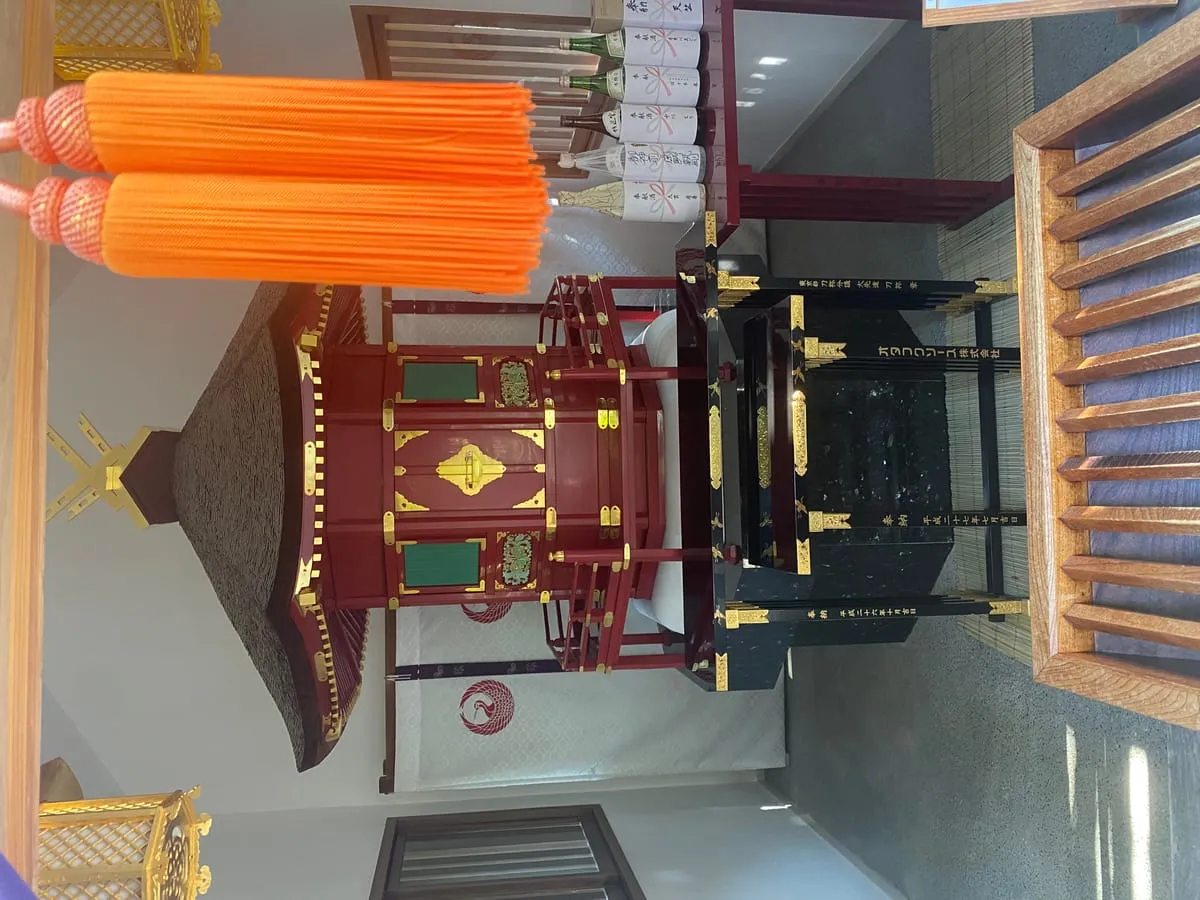
- Mikoshi of the Sarume Shrine at Sarutahiko Shrine, Mie Prefecture: Immanuelle, CC BY 4.0, via Wikimedia Commons
- Grand Mikoshi of Matsuyama Shrine (front view): はわはわ, CC BY 4.0, via Wikimedia Commons