When you rinse your hands at the stone basin before entering a shrine, you’re performing a compressed version of one of Shinto’s most ancient practices. That simple act — water on the hands, a brief pause at the threshold — connects to a ritual tradition that reaches back to Japan’s creation myth.
At the heart of Shinto practice is the concept of kegare (穢れ), and the two central rituals for removing it: misogi (禊) and harae (祓).
Kegare: Ritual Impurity in Shinto
The word kegare is sometimes translated as “impurity” or “defilement,” but those words carry moral weight that the Japanese concept doesn’t necessarily imply.
A better frame: kegare is a kind of spiritual static — something that accumulates through contact with death, blood, disease, or certain life events, and that obscures the connection between a person and the kami (divine forces). One folk etymology breaks the word into ke (life force) and gare (withered) — literally “a withering of the vital spirit.”
In ancient Japan, the law codes listed specific categories of kegare: death pollution (shiei), birth pollution (sanei), illness, and others. People who had encountered these were expected to undergo purification before approaching sacred spaces.
Crucially, kegare is not the same as moral guilt. A midwife who assisted at a difficult birth, a family member who prepared a deceased relative for burial — both would carry kegare through no fault of their own. The solution wasn’t repentance; it was ritual cleansing.
Misogi: Purification by Water
Misogi (禊) is purification through full immersion in water — typically a river, the sea, or a waterfall.
The Mythological Origin
The practice traces to a foundational episode in the Kojiki (712 CE), Japan’s oldest chronicle.
After descending into Yomi — the realm of the dead — to retrieve his dead wife Izanami, the creator god Izanagi found her body rotting and fled in horror. The pollution of death clung to him as he emerged back into the world. To cleanse himself, he plunged into the waters of the Ahaji River in Hyūga province.
As he washed, deities were born from each polluted piece of clothing and body part he shed. When he washed his left eye, Amaterasu Ōmikami (the Sun Goddess) was born. From his right eye came Tsukuyomi (the Moon God). From his nose came Susanoo (the Storm God).
This myth establishes something profound: water doesn’t merely remove impurity — it transforms it. The kegare that falls away from Izanagi doesn’t disappear; it becomes new kami.
Misogi in Practice
Traditional misogi required standing or immersing oneself in moving natural water. The flow of the water was understood to carry kegare away.
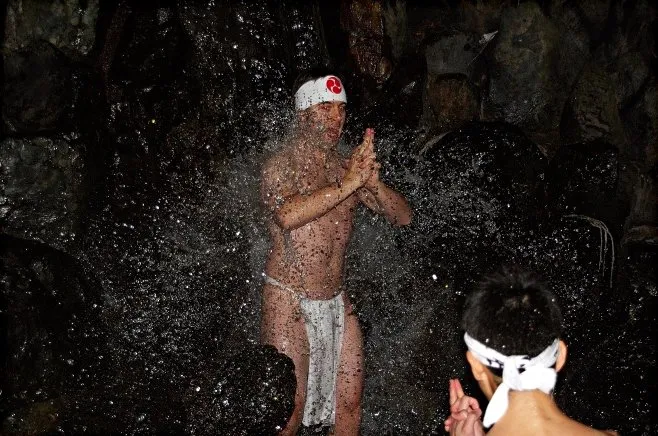
Some shrines still practice formal misogi. Tsubaki Grand Shrine (椿大神社) in Suzuka, Mie Prefecture holds a monthly misogi ceremony on the 11th, during which priests and participants enter a river in white robes, chanting and immersing themselves in the cold water — even in winter.
For most visitors, the closest encounter with misogi today is the temizu (手水) — the hand-washing ritual at the stone basin (chōzuya) at the entrance of every shrine. This is misogi in abbreviated form: you cleanse your hands and mouth before entering the sacred space, acknowledging the transition from the ordinary world into the precincts of the kami.
Harae: Purification by Ritual
Harae (祓) is a broader category of purification performed through ceremony — words, gestures, and ritual objects — typically carried out by a Shinto priest on behalf of an individual or community.
Where misogi is something you do to yourself (entering the water), harae is performed for you by a priest.
The Ōnusa: The Purification Wand
The central tool of harae is the ōnusa (大幣) — a wooden or bamboo wand with white paper streamers (shide) or hemp fibers attached to one end.
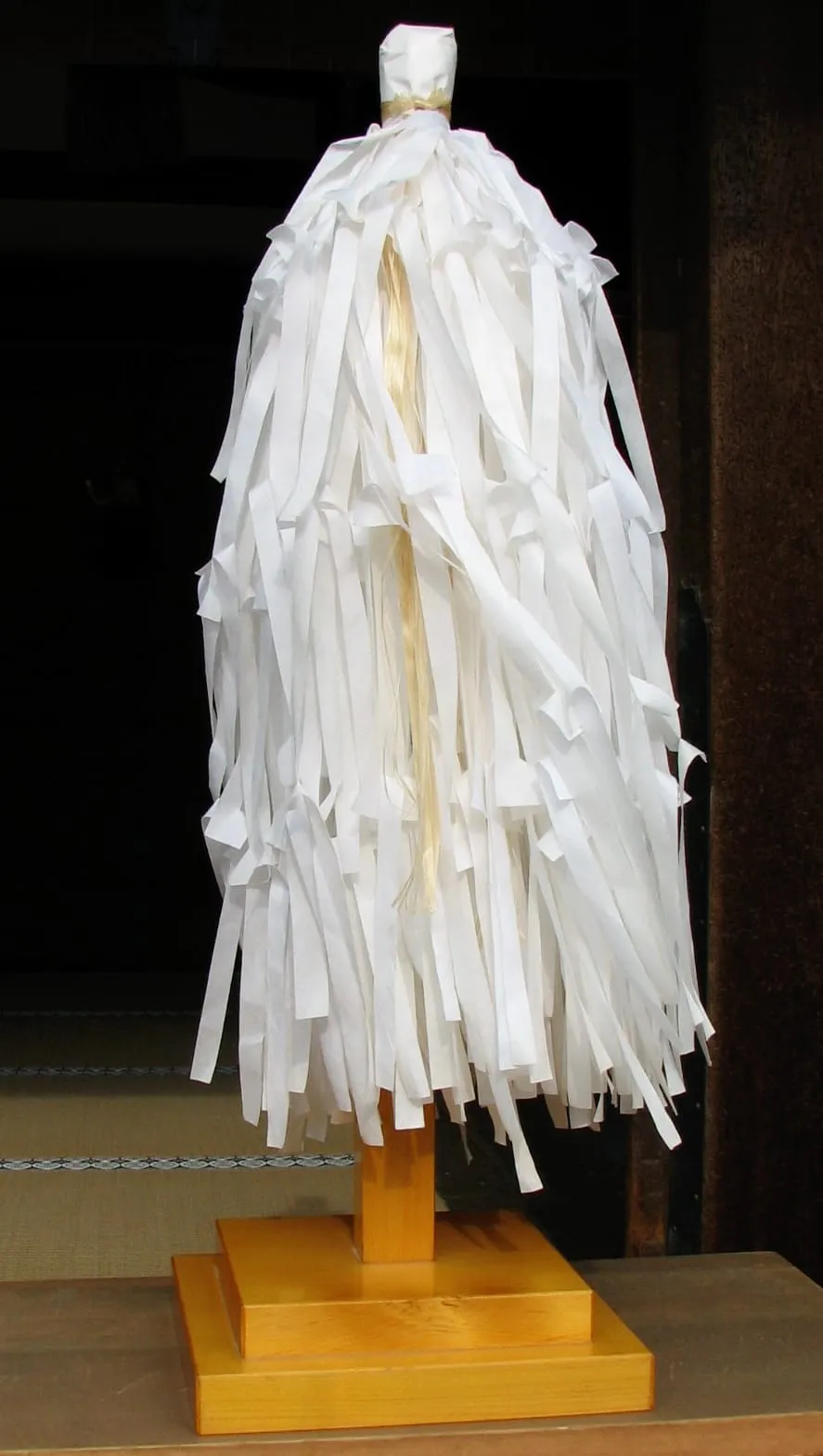
A priest waves the ōnusa over a person, object, or space in a prescribed left-right-left motion to transfer and dispel kegare. You’ll encounter this in contexts ranging from a ground-breaking ceremony for a new building, to a car blessing, to the formal purification at the start of a wedding ritual.
The ōnusa is sometimes called haraigushi (祓串) when attached to a stick, or simply nusa (幣) in more general usage.
The Harae-kotoba
Accompanying the ritual movements is a recitation called harae-kotoba (祓詞) — purification words. The most extensive version is the Ōharae-no-Kotoba (大祓詞), a ritual text that enumerates categories of kegare, then describes how successive layers of kami — sea deities, wind deities, and the gods of the underworld — pass the impurity further and further away until it vanishes entirely.
The Ōharae-no-Kotoba is a remarkable piece of religious poetry, describing a cosmic relay race of purification. Its imagery is of pollution being blown by wind, washed by currents, carried to the sea, and finally dissolved at the root of the world.
Ōharae: The Great Purification
Ōharae (大祓) is a national purification ceremony held twice a year at shrines across Japan: June 30 and December 31.
The institution dates to the Nara period (8th century), when it was a solemn court ritual performed by the emperor to cleanse the entire nation. Today, shrines large and small conduct their own Ōharae ceremonies, and participants are welcome.
Nagoshi no Harae (Summer Purification, June 30)
The Nagoshi no Harae (夏越の祓) clears the accumulated kegare of the first half of the year and prays for safe passage through the heat of summer.
Participants are given a hitogata (人形) — a paper doll in human form — to write their name and birthdate on, breathe on, and rub against their body. This transfers kegare to the paper. The dolls are then collected, and the priests perform a ceremony to dispose of them, often by floating them on water.
Toshikoshi no Harae (Year-End Purification, December 31)
The Toshikoshi no Harae (年越の祓) mirrors the summer ceremony, clearing the second half of the year’s accumulations before the new year begins.
This ceremony on December 31 has deep resonance: attending it means entering January 1 — and the New Year’s visit to the shrine (hatsumōde) — in a purified state. The logic is elegant: don’t carry last year’s spiritual static into the new year.
Chinowa Kuguri: Passing Through the Grass Ring
For the Nagoshi no Harae, many shrines set up a chinowa (茅の輪) — a large ring woven from chigaya grass — at the shrine entrance.
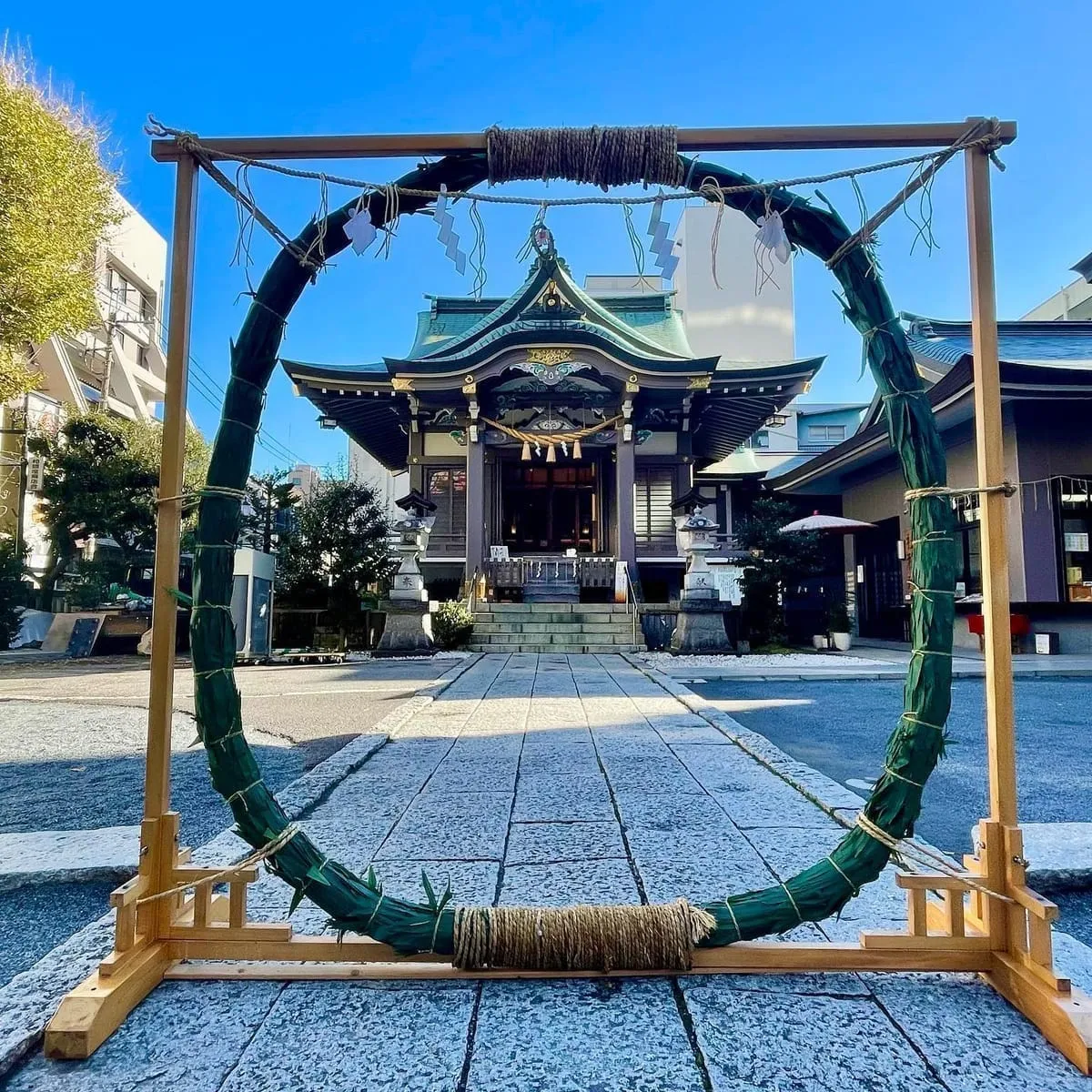
Visitors pass through the ring three times in a prescribed figure-eight pattern: first stepping through to the left, then the right, then left again, while reciting a traditional verse. The passage through the ring is understood to transfer kegare to the grass and purify the walker.
The origin story involves Susanoo and a mortal man named Somin Shōrai. According to legend, Susanoo — disguised as a traveler — was given shelter by Somin, a poor man, while the wealthy refused him. In gratitude, Susanoo told Somin’s descendants to wear a ring of cogon grass at their waists, and they would be protected from plague. The chinowa carries that protection into the present.
Misogi and Harae in Everyday Life
The purification rituals extend far beyond formal ceremonies.
| Everyday practice | Connection to misogi / harae |
|---|---|
| Temizu (hand-washing at shrine basin) | Abbreviated misogi |
| Priest waving ōnusa at a ceremony | Core harae ritual |
| Salt at a doorway or restaurant entrance | Folk extension of purification thinking |
| Shimekazari (New Year’s straw decorations) | Ward off kegare from entering the home |
| Hitogata paper dolls | Harae practice in portable form |
The theology isn’t separate from daily life — it runs through the fabric of it.
Purification and Goshuin
The Ōharae ceremonies in June and December are among the best times to collect seasonal goshuin. Shrines frequently offer limited designs featuring the chinowa ring, summer flowers, or year-end symbolism.
A chinowa-design goshuin from the June 30 Nagoshi no Harae — particularly from a shrine where you actually participated in the ceremony — carries a quality of memory that a tourist visit rarely provides. You stood in the ritual space, passed through the ring, and received the seal. That sequence is the full experience.
If you’re planning a goshuin-collecting trip and want to time it to the rhythm of the Shinto calendar, the two Ōharae dates are worth building around.
Related Articles
- Chōzuya: The Purification Fountain and How to Use It
- The Shinto Calendar: Annual Festivals from New Year to Year-End Purification
- Shrine Ritual Space: A Map of the Sacred Precinct
Image Credits
- Night misogi under waterfall at Tsubaki Grand Shrine, Mie: Darren Stone (Ds13), CC BY-SA 3.0, via Wikimedia Commons
- Ōnusa at Sumiyoshi Taisha, Osaka: nnh, Public Domain, via Wikimedia Commons
- Chinowa at Kashiwa Shrine, Kashiwa, Chiba: ivva, CC BY-SA 2.0, via Wikimedia Commons