Most sacred architecture in the world aspires to permanence. Stone cathedrals, ancient mosques, classical temples — they accumulate centuries as a form of sanctity. Time’s passage is itself the proof of endurance.
Ise Grand Shrine runs on the opposite principle.
Every twenty years, everything is rebuilt from scratch.
Stand at the entrance to the Inner Shrine and you are looking at a building younger than most cars on the road. The pillars were trees thirteen years ago. The thatch was harvested last season. The sacred mirror inside has been worshipped continuously since before recorded Japanese history, but the box around it is, by any meaningful definition, brand new.
This is not a flaw in the system. It is the system. For thirteen centuries Japan has maintained a piece of architecture by refusing to let it grow old — replacing it again and again, identical in form, with new wood and new hands. The 62nd cycle ended in 2013. The 63rd is coming in 2033. What follows is what that means, how it works, and why it is unlike anything else on earth.
What Is Shikinen Sengū?
Shikinen sengū (式年遷宮) is the periodic rebuilding of Ise Grand Shrine (伊勢神宮) — its sanctuaries, sacred implements, and ritual garments — followed by a ceremony in which the divine spirit (the sacred mirror of Amaterasu Ōmikami) is transferred to the newly completed building.
Shikinen (式年) means “the appointed year.” Sengū (遷宮) means “the transfer of the kami to a new shrine.”
The practice encompasses 125 shrines across the Ise complex, including both the Inner Shrine (Naikū, 内宮) and Outer Shrine (Gekū, 外宮). Not only the buildings but 1,576 items of sacred treasures and garments are also renewed in their entirety.
The Origin: 690 CE
The first shikinen sengū was performed in 690 CE, the fourth year of Empress Jitō’s reign.
Emperor Tenmu is credited with conceiving the system. After his death in 686, his consort Empress Jitō carried out the first ceremony. It has continued ever since — with one notable interruption during the Warring States period (roughly 1460–1585), when civil conflict and the collapse of imperial finances halted the cycle for about 120 years.
The 62nd sengū was completed in 2013. The next — the 63rd — is scheduled for 2033.
Why Every Twenty Years?
The twenty-year interval is not arbitrary. Several explanations reinforce each other.
1. Tokowaka: The Philosophy of Perpetual Youth
Central to this practice is the Shinto concept of tokowaka (常若) — “eternal youth” or “ever-new.” The divine is understood to be perpetually fresh, pure, and renewed. An aged building is an unsuitable dwelling for the kami. Therefore: constant renewal.
This is not restoration. It is not preservation. The old building is not celebrated for its patina — it is replaced so the divine home remains young.
This stands in direct contrast to the Western and East Asian aesthetic of depth-through-age. Ise’s beauty is the beauty of the freshly made.
2. Transmitting the Craft
The architectural form of Ise — shinmei-zukuri (神明造) — requires extraordinary skill to build. The style uses untreated hinoki (Japanese cypress) with no nails, no paint, and no metal fasteners in the structural elements. Joining, fitting, and finishing this wood demands decades of practice.
Twenty years maps precisely onto a craftsperson’s career arc:
- The first sengū they work on, they are an apprentice — learning at the feet of masters.
- The second, they are the master — teaching and leading.
The rebuilding cycle is engineered so that craft knowledge never sits in books. It lives inside hands.
3. The Lifespan of Unpainted Cypress
Untreated hinoki — the material used throughout the shrine — has a natural lifespan of approximately 20–30 years when exposed to rain and humidity without protective coating. The twenty-year cycle aligns with the wood’s physical limits.
In Shinto terms, using raw, unpainted wood is not a constraint — it is the point. The natural material connects the built structure to the living world. That connection is renewed with the wood itself.
The Scale of Sengū
The 62nd shikinen sengū (2013) gives a sense of the operation’s scope:
| Item | Scale |
|---|---|
| Structures rebuilt | 65 buildings across Naikū and Gekū |
| Sacred treasures renewed | 1,576 items (100% replacement) |
| Hinoki cypress used | Approximately 10,000 logs (200–300 year old trees from Kiso) |
| Major ritual ceremonies | About 30 |
| Total cost | Approximately ¥55 billion (~$400 million) |
| Craftspeople involved | Thousands |
Funding comes primarily from hōsankin (奉賛金) — voluntary donations from supporters across Japan and abroad.
The 30 Major Ceremonies of Sengū
The rebuilding is not a single event but a sequence of roughly thirty ritual ceremonies stretched across eight years. Each marks a transition in the lifecycle of the wood, from standing tree to enshrined sanctuary. Below are the major stages of the cycle.
Eight Years Before: Mountain Rites
- Yamaguchi-sai (山口祭) — “mountain-mouth festival.” Performed deep in the forest before the first hinoki is felled, this rite asks permission of the mountain kami to enter and take timber. It opens the entire sengū sequence.
- Ko-no-moto-sai (木本祭) — “rite of the tree’s root.” A ceremony at the base of the trees that will become the shin-no-mihashira, the sacred center post. These are the most spiritually charged pieces of timber in the entire shrine.
- Misoma-hajime-sai (御杣始祭) — the formal commencement of felling. The first two sacred trees are cut by hand using a specialized technique called mitsudogiri (三ツ緒伐り), in which three notches are made so the tree falls precisely between two prepared logs.
Six to Four Years Before: Transport and Preparation
- Mikihiki-shiki / Okihiki (御木曳行事) — the public timber-pulling festivals. Logs from the Kiso mountains are floated down rivers and then hauled overland into Ise by tens of thousands of citizens. This is one of the few sengū-related events the general public can participate in directly.
- Chinchi-sai (鎮地祭) — ground-pacifying ceremony. The empty kodenchi (former sanctuary site) is ritually calmed before construction begins on it.
- Risshi-sai (立柱祭) — pillar-raising rite. The first structural pillars of the new sanctuary are set in place.
- Munamochi-bashira-hōken-shiki (棟持柱奉建式) — installation of the great ridge-supporting pillars that define the shinmei-zukuri silhouette.
Two Years Before: Roof and Closure
- Jōtō-sai (上棟祭) — the ridgepole ceremony, equivalent to a topping-out rite. The roof structure is completed.
- Kayabuki-hajime-sai (萱葺始祭) — the start of thatching. The reed roof, harvested from carefully maintained fields, is laid in courses.
- Kichikukyō-sai / Kabukikyō-sai — the closing of the inner doors and sacred screens, preparing the building for occupation.
The Final Year: Treasures and Transfer
- Otaue-hajime-sai (御田植始祭) — first rice-planting rite for the grains that will be offered to the new kami residence.
- Mishōzoku-jingyo-hōsen-shiki (御装束神宝奉遷式) — the formal transfer of the 1,576 sacred treasures and garments, newly made for this cycle, into the new sanctuary.
- Kawara-ōharae (川原大祓) — great purification rite at the Isuzu river bank, performed days before the central ceremony.
- Sengyo-no-gi (遷御の儀) — the central ceremony itself. On a moonless night, the sacred mirror of Amaterasu is carried in procession from the old sanctuary to the new under a white silk canopy. No artificial light. No photographs. The procession moves to the sound of a single drawn-out cry: “kakekō, kakekō.” This is the moment of sengū.
- Mike-den-sai / Daichūsai (奉幣の儀) — offering rites in the days that follow, including the imperial envoy’s offering on behalf of the emperor.
Only after this entire chain is the new shrine considered the active sanctuary. The old one is then dismantled.
The “Empty Plot” Design
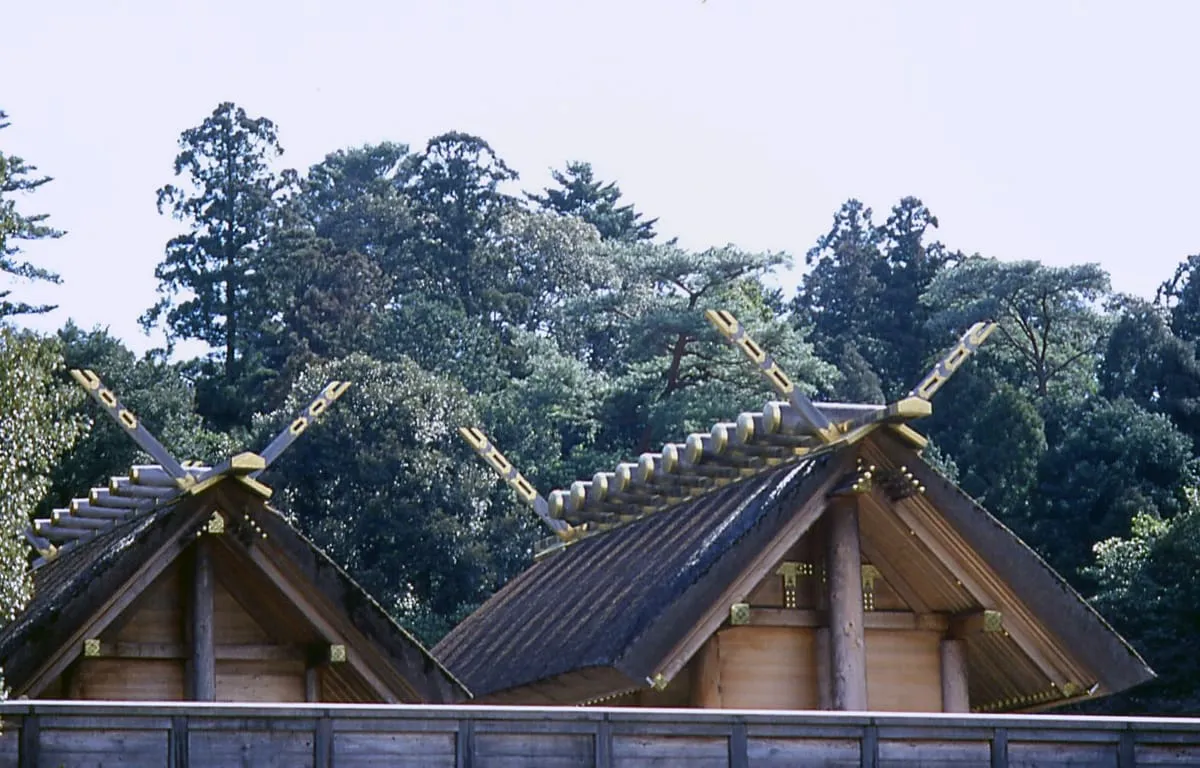
Ise Grand Shrine has always maintained an empty plot beside each of its main sanctuaries.
This plot is called the kodenchi (古殿地) — the “former sanctuary site.” On it stands only a small roofed structure covering a single pillar: the shin-no-mihashira (心御柱), a sacred center post that is never removed.
Every twenty years:
- A new sanctuary is built on the empty kodenchi
- The divine spirit is transferred in ceremony
- The old sanctuary is dismantled
- The old sanctuary site becomes the new kodenchi
The shrine oscillates between two plots in perpetuity. This alternation has been running for over 1,300 years. The ground on which you walk at Ise has been sanctuary, then empty, then sanctuary again — cycling across the centuries.
Shinmei-Zukuri: The Architectural Form
What is being preserved — and perpetually rebuilt — is shinmei-zukuri (神明造), considered Japan’s oldest surviving shrine architectural style.
It predates the introduction of Buddhist architecture from the continent. Its forms trace back to elevated granary construction:
- Elevated floor (takayuka-shiki) — raised on pillars, a direct inheritance from prehistoric storage structures
- Katsuogi and chigi — the log rolls and forked finials on the roof ridge, used to identify the shrine’s deity type
- Unpainted white wood (shiraki) — no lacquer, no pigment, no protection
- Earth-set pillars (hottate-bashira) — structural columns planted directly in the ground, no stone foundations
Rebuilding in shinmei-zukuri every twenty years means this form has never been “preserved” in the conventional sense. It has been continuously made — fresh, complete, and functional — without interruption.
What Happens to the Old Buildings?
The dismantled sanctuaries are not waste. Almost nothing is discarded. The cycle of materials at Ise is as carefully managed as the cycle of buildings.
Redistribution to Other Shrines
When the old sanctuary is taken apart, its timber is sorted and sent out across the shrine network:
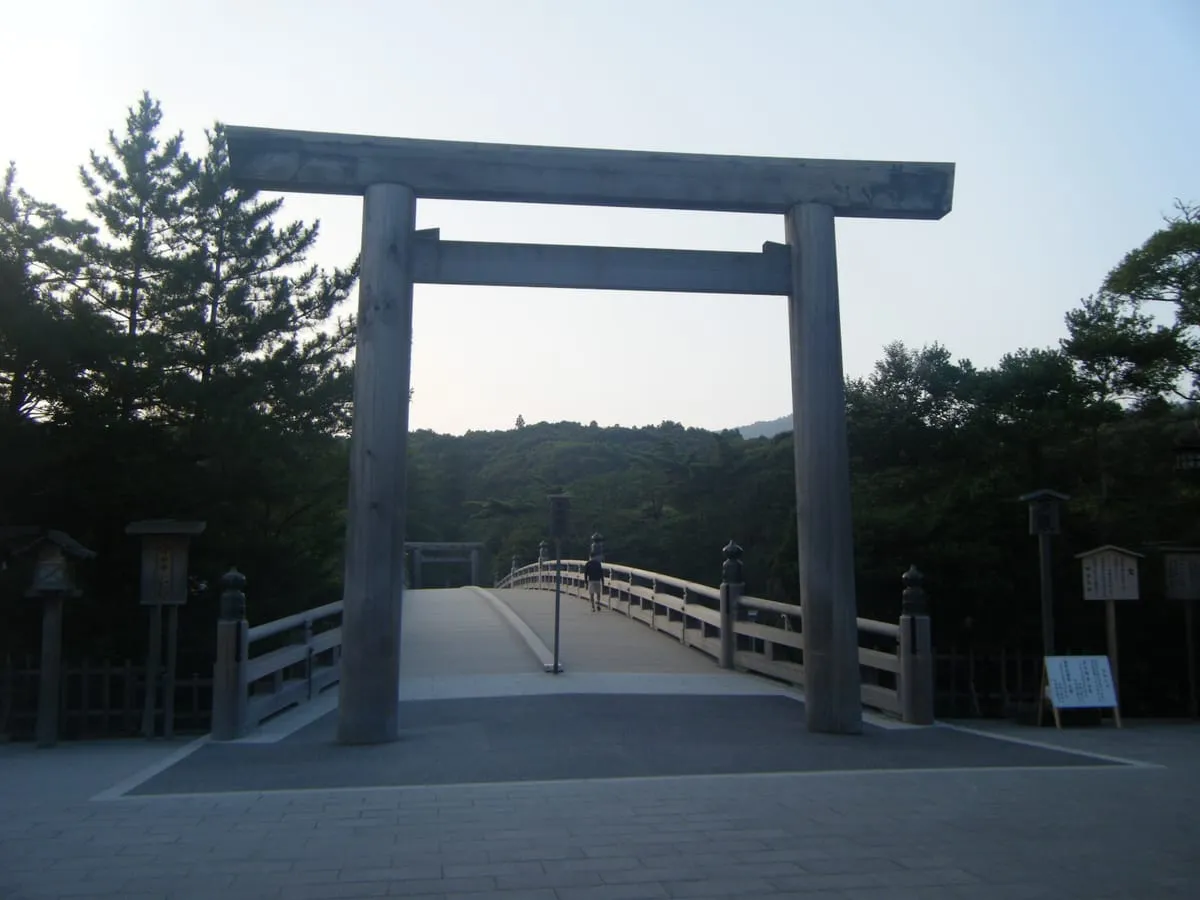
- The old torii of the Naikū’s Uji-bashi bridge are reused — the inner torii of the bridge becomes the outer torii in the next cycle, and the outer torii is sent to the entrance of Sekisho-ato no Ōtorii in the Suzuka pass. After another twenty years, the timber is reused yet again at the Sekisho torii of Kuwana, and eventually fragments find their way to small shrines around the country.
- Major beams and pillars are sent to subordinate shrines (sessha, massha) of the Ise system that are rebuilt on a separate schedule.
- Many of Japan’s regional shrines have, at some point in their long history, received timber from a dismantled Ise sanctuary. To stand inside such a hall is to stand inside the second life of Ise wood.
The Shin-no-mihashira
The shin-no-mihashira — the sacred center post — is treated differently. It is never publicly seen. When a sanctuary is dismantled, its shin-no-mihashira is left in place, then buried at its base beneath a small protective hut on the now-empty kodenchi. The next sanctuary, built on the other plot, has its own newly cut shin-no-mihashira. In this way, the buried posts accumulate — a vertical archive of every cycle, hidden beneath the gravel.
The Cyclical Economy
Looked at across centuries, this is a closed-loop system. Trees grown for two hundred years are felled, become sanctuary for twenty, become outer-shrine torii for twenty, become subordinate-shrine beams for another generation, and eventually return to the earth. Nothing of the divine is treated as disposable. The renewal of the center radiates outward through the entire network of shrines.
Sengū in Other Cultures
It is worth asking why this practice did not arise elsewhere. The answer is partly material and partly philosophical.
Stone Civilizations vs. Wood Civilizations
Most of the world’s classical sacred architecture is in stone. Stone is chosen precisely because it resists time. The Parthenon, the pyramids, Angkor, Karnak — these are bets against decay. When such buildings finally collapse, they collapse into ruins that are then preserved as ruins. The aged, weathered stone becomes itself a form of monument: time made visible.
Japan, by contrast, is a wood civilization. Hinoki, sugi, and keyaki are abundant; the climate is humid; wood will rot in decades without active intervention. A culture that wanted permanent sacred space in such an environment had two choices: import stone construction (which never really took root for shrines), or accept the impermanence of wood and design around it.
Shikinen sengū is the second choice taken to its limit. Impermanence is not endured — it is institutionalized as a sacred act.
The Parthenon Problem
Western preservation logic says: this is the original, therefore it must be protected, however degraded. The Parthenon stands today as a partial skeleton, with missing marbles, eroded reliefs, and bare stone where the polychrome paint has long since flaked away. We have preserved the substance but lost the appearance.
Ise inverts this. The substance changes every twenty years. The appearance is identical to what stood in 690 CE.
Which is the original? The Parthenon as eroded ruin, or the Ise sanctuary as freshly minted reconstruction? Each civilization gave a different answer to the same question.
Other Japanese Examples
The shikinen sengū logic is not unique to Ise. Hōryū-ji, the world’s oldest standing wooden building (and a Buddhist temple, not a shrine), takes the opposite extreme — it has been continuously repaired, with pieces replaced as they fail, but the building as a whole has never been wholesale rebuilt. The two approaches sit a short train ride from each other and together describe the full range of Japanese carpentry philosophy.
The neighboring concepts of mottainai (waste-consciousness) and wabi-sabi (the beauty of aged imperfection) might seem to contradict shikinen sengū. They do not. Wabi-sabi celebrates the aging of secular objects — tea bowls, gardens, scrolls. The kami are categorically different. Their dwelling is the one place where age is not beauty.
Other Shrines That Rebuild
Shikinen sengū is not unique to Ise, though nothing elsewhere matches its scale:
| Shrine | Cycle |
|---|---|
| Izumo Taisha (Shimane) | Irregular (~60 years; most recent: 2008–2013) |
| Kasuga Taisha (Nara) | Every 20 years (shikinen-zōtai; 64th cycle: 2015) |
| Sumiyoshi Taisha (Osaka) | Every 20 years |
| Suwa Taisha (Nagano) | Every 6 years (Onbashira, the sacred pillar ceremony) |
The shared logic: renewal is not a sign of failure, but of continuity.
How to Visit Ise Around Sengū
For travelers, the years immediately surrounding a sengū are the most interesting time to visit Ise. Below is practical guidance for planning a trip around the 63rd cycle in 2033.
The 2033 Schedule
The sengū is not a single date but a sequence of public events spanning the years before and after the central rite. Key moments to watch:
- 2025–2028 — Okihiki timber-pulling festivals in Ise city. Locals and registered participants haul logs through the streets. Open to spectators.
- 2030–2032 — Risshi-sai (pillar-raising), Jōtō-sai (ridgepole), and roof thatching ceremonies. Most are not public, but their schedule is announced.
- Autumn 2033 — Sengyo-no-gi, the night-time transfer of the divine spirit. Closed ceremony, but the surrounding city is at its most active.
- Late 2033 onward — both sanctuaries are visible: the new, freshly built; the old, awaiting dismantling. This is the only window in any twenty-year cycle when both can be seen at once.
Best Time of Year to Visit
The optimal window is October 2033 through spring 2034. The new sanctuaries are brand new — the hinoki has not yet weathered — and the old sanctuaries are still standing on the adjacent plot, side by side. The contrast is unique to this short window. Within a few months the old sanctuaries are dismantled and the empty kodenchi reappears.
In general, late autumn and early spring are the best seasons to visit Ise at any time. The forest is at its clearest, the humidity drops, and the morning light through the cypresses is exceptional.
How to Reach Ise
Ise is in Mie Prefecture, on the Pacific side of the Kii peninsula.
- From Tokyo: Shinkansen to Nagoya (~1h40m), then Kintetsu Limited Express to Ujiyamada or Iseshi (~1h30m). Total: about 3h30m.
- From Osaka: Kintetsu Limited Express direct from Osaka-Namba to Ujiyamada (~1h50m). The direct route avoids Nagoya entirely.
- From Nagoya: Kintetsu Limited Express, ~1h30m.
A useful regional ticket is the Kintetsu Rail Pass, which covers the Kintetsu network and is significantly cheaper than buying single tickets if you plan to visit Nara or Nagoya as well.
What You Can and Cannot See
The Ise complex is unusually restrictive compared to most major shrines:
- Public: the approach paths, the outer torii, the Isuzu river crossing at Uji-bashi, the surrounding forest, the outer pavilions, the Kaguraden where prayers are received.
- Restricted: the inner courtyard and shōden (正殿), the main sanctuary, is not accessible to ordinary visitors. You can only approach the outer fence and bow from the gate. The sacred mirror inside has been seen by almost no one alive.
- Photography: prohibited beyond the outermost steps of the main sanctuary. Cameras must be lowered.
This restriction is itself part of the experience. Ise is not designed to be looked at. It is designed to be approached.
The Sengikan Museum
Adjacent to the Gekū is the Sengikan (せんぐう館) — a museum dedicated entirely to the sengū. It contains:
- A full-size partial reconstruction of the shōden (sanctuary) — the only place you can see the main hall’s interior at scale, since the actual structure is hidden behind fences.
- Original treasures and garments from previous sengū cycles, no longer in active use.
- Detailed models of every stage of construction, from log felling to thatching.
For anyone serious about understanding the sengū, the Sengikan is essential. It opens daily except Tuesdays.
Sengū and Goshuin
Ise Grand Shrine does not issue limited-edition or commemorative goshuin for the sengū. The shrine’s goshuin deliberately maintains a consistent, austere form year-round — no seasonal variations, no special stamps.
But the sengū transforms what a visit to Ise means.
In the months immediately after a rebuilding, the sanctuaries are new. The hinoki smells sharp and clean. Every surface is fresh. The visual effect — new structures against ancient forest — is genuinely unusual, even for those who have visited Ise before.
The next sengū is 2033. Preparations have already begun: hinoki trees are being selected and felled in the Kiso mountains of Nagano, a process that starts eight years before the ceremony.
If you are planning a pilgrimage to Ise, the window just after the 63rd sengū completes may be the most remarkable moment to visit.
Frequently Asked Questions
Why doesn’t Ise have an old, weathered appearance like most ancient shrines? Because, by design, no part of the main sanctuary is ever more than twenty years old. The buildings you see were built between 2005 and 2013. The patina of age that defines most historical sites is precisely what shikinen sengū prevents. The age is in the form, not the material.
Can foreigners attend the sengū ceremonies? The central rite, Sengyo-no-gi, is closed to the public regardless of nationality — only a small number of imperial envoys, shrine officials, and selected priests are present. However, the surrounding public ceremonies (especially the Okihiki timber-pulling festivals) are open to all spectators, and registered foreign residents have occasionally participated in pulling the logs. Visiting Ise during the sengū period is unrestricted.
How much does it cost to support sengū, and can outsiders donate? The 62nd sengū cost roughly ¥55 billion (~$400M), funded almost entirely through hōsankin (奉賛金) — voluntary donations. Anyone can donate, including non-Japanese residents and overseas supporters. Donations are coordinated through the Jingū Shichō (Shrine Office). Suggested amounts range from a few thousand yen for individuals to corporate sponsorship at much larger scales.
Is the new shrine exactly identical to the old one? In form, yes — to within a millimeter. Plans, joinery techniques, dimensions, materials, and treasure designs are all reproduced precisely. The shrine has been built to the same specifications for over 1,300 years. What changes are the trees, the hands, and the era in which the work happens.
What is shin-no-mihashira and why is it kept hidden? The shin-no-mihashira (心御柱), or “heart pillar,” is a small post buried beneath the floor of the sanctuary. It is the most sacred element of the shrine — older in ritual significance than the building itself, and possibly a survival from pre-architectural Shinto when the kami were enshrined directly in the earth. It is never seen, never photographed, and never spoken of in detail. When the sanctuary is dismantled, the shin-no-mihashira is left in place under a small protective hut on the kodenchi.
When was the longest interruption to the sengū? The Sengoku (Warring States) period, roughly 1460 to 1585. Civil war collapsed imperial finances and the cycle stopped for about 120 years. It was restored through the efforts of Buddhist nuns and itinerant fundraisers who travelled the country collecting donations — a remarkable story in itself, given that the sengū is a fundamentally Shinto institution. The cycle has run continuously since.
Are there any rebuilds happening before 2033? Yes. Many of the subsidiary shrines (sessha and massha) within the Ise complex are rebuilt on their own schedules, often a few years offset from the main sanctuaries. In addition, other sengū-practicing shrines — Sumiyoshi Taisha, Kasuga Taisha, and others — operate on independent cycles. Sumiyoshi Taisha in Osaka, for example, is approaching its own next rebuilding.
Is the shrine actually destroyed, or is it preserved? Neither, in the usual sense of those words. The old sanctuary is dismantled, not destroyed — every piece is removed by hand, sorted, and sent to other shrines for reuse. And it is not preserved in the museum sense either. What is preserved is the act of rebuilding. The shrine is, in a phrase, a verb rather than a noun.
Related Articles
- Ise Grand Shrine: Complete Goshuin Guide
- Main Hall Architecture: Comparing Shinmei, Taisha, Nagare, and Kasuga Styles
- Shinto Gods: A Guide to Amaterasu, Susanoo, Inari and the Major Kami
Image Credits
- Naikū (Inner Shrine) of Ise Grand Shrine: Brakeet, CC0 1.0 Public Domain, via Wikimedia Commons
- Ise Grand Shrine Naikū (1999): Bigjap, CC BY-SA 3.0, via Wikimedia Commons