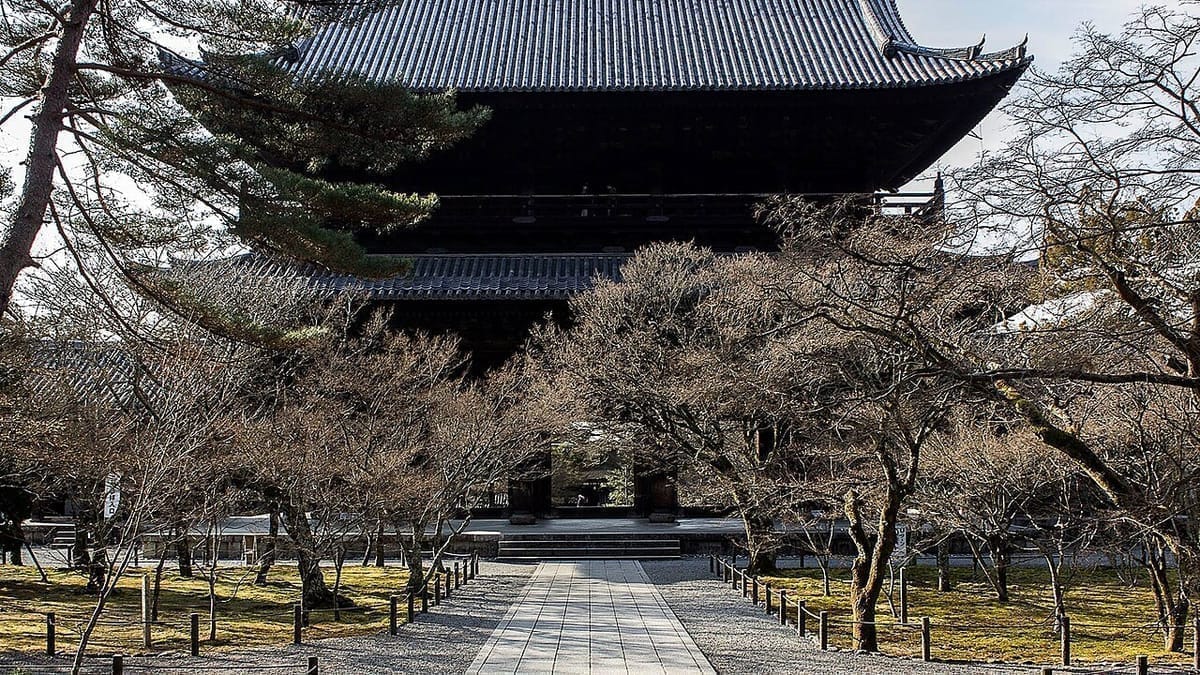
You’re standing in line at a shrine, waiting to receive your goshuin. From the main hall, a voice drifts toward you—low, unhurried, ancient.
If you’re at a Shinto shrine, that’s norito (祝詞). If you’re at a Buddhist temple, that’s a sutra. They sound nothing alike, and understanding why opens a door into the deepest layer of Japanese spiritual culture.
The Core Difference: Direction
The simplest way to grasp the difference:
| Norito (祝詞) | Sutras (お経) | |
|---|---|---|
| Direction | Human → Kami (deity) | Buddha → Human |
| Language | Yamato kotoba (ancient Japanese) | Sino-Japanese readings of Chinese translations |
| Purpose | Addressing the gods—requests, gratitude, reports | Learning the Buddha’s teachings through repetition |
| Who speaks | Priests only | Anyone |
| Rhythm | Flowing, natural speech rhythms | Metronomic, driven by the wooden drum (mokugyo) |
Think of norito as a letter to a god. It has an addressee, a message, and a closing. Think of sutras as reading a textbook aloud—the act of voicing the words is itself the practice.
Which Came First?
Norito. By a long margin.
Before Japan had writing, people were already speaking to the gods. At harvest festivals, before battles, after disasters. These words were passed down orally for centuries before being written down in the Engishiki (延喜式) in 927 CE.
Norito is older than the written word in Japan.
Sutras arrived with Buddhism in the mid-6th century (538 or 552 CE). They came as Chinese translations of Sanskrit originals—sacred words that had already been filtered through one foreign language before reaching Japanese ears, where they were filtered through another. Three layers of transformation.
For the last 1,500 years, these two vocal traditions—one indigenous, one imported—have run in parallel, forming the twin pillars of Japan’s spiritual soundscape.
Why They Sound So Different
Close your eyes and listen.
Norito—
“Kakemaku mo kashikoki Izanagi no ōkami…”
Vowels predominate. A, i, u, e, o flow one into another. Ancient Japanese (Yamato kotoba) ends almost every word with a vowel, so the sound never stops—it streams forward like wind through trees. The priest’s voice rises and falls with natural cadence, stretching syllables long.
Sutras—
“Gyātē gyātē hāra gyātē…”
Hard consonants. Staccato rhythm. Each syllable of the Chinese characters lands like a drumbeat on the mokugyo’s steady pulse. You don’t need to understand the meaning—your body locks into the rhythm. It’s close to a trance state.
This isn’t coincidental. Norito is conversation, so it follows the natural rhythms of human speech. Sutras are practice, so they follow rhythms designed to alter consciousness.
Kotoage: The Taboo of Speaking
This is where it gets fascinating.
Japan has a concept called kotoage (言挙げ)—the prohibition against carelessly uttering words. The reason lies in kotodama (言霊), the belief that words carry spiritual power.
The Man’yōshū (万葉集), Japan’s oldest poetry collection, puts it plainly:
“The land of Yamato is a land blessed by kotodama.”
Words are not just communication tools. Speaking changes reality. A word, once voiced, takes on a life of its own. This is why Japanese culture treats language with such caution.
Why Only Priests Can Speak Norito
Words directed at the gods carry the most potent kotodama. Therefore:
- Every syllable must be exact. A wrong word isn’t just an error—it’s a misdirected spiritual force.
- Only trained priests may recite them. They’ve learned to handle the power of sacred speech.
- Context matters. The right words in the wrong place or time lose their efficacy—or worse, cause harm.
This is fundamentally different from the Western concept of prayer, where sincerity matters more than precision. In Shinto, precision is sincerity.
Why Sutras Are Open to Everyone
Buddhism carries no speech taboo. Quite the opposite—voicing a sutra is itself an act of merit (kudoku, 功徳). Getting the words wrong doesn’t matter. What matters is the intention to engage with the Buddha’s teaching.
The Heart Sutra (Hannya Shingyō) is just 262 characters. You don’t need to understand it. Speaking it aloud is enough. The voice becomes the vehicle for the teaching to enter your body.
Two religions, two completely opposite attitudes toward the spoken word. Both coexisting in the same culture for fifteen centuries.
Kotodama in Modern Japan
This ancient belief isn’t dead. It’s everywhere:
- “Engi demo nai” (縁起でもない) — “Don’t say such unlucky things.” Said instinctively when someone voices something negative.
- “Iwanakya yokatta” (言わなきゃよかった) — “I shouldn’t have said that.” The intuition that words shape outcomes.
- Exam taboos — Before university entrance exams, students avoid words like suberu (slip/fail) and ochiru (fall/fail). Parents avoid saying them too.
- Wedding speech rules — Words meaning “cut,” “separate,” or “end” are strictly forbidden.
These aren’t superstitions in the Western sense. They’re living remnants of a thousand-year-old understanding that language and reality are intertwined.
Can Visitors Participate?
The most practical question for goshuin collectors.
At Shrines
Generally, no. Norito is the domain of priests.
Exceptions:
- Haraekotoba (祓詞) — A short purification prayer that visitors may recite
- Ōharae — The biannual great purification, where visitors sometimes join in
If you hear norito being recited during your visit: bow your head and listen in silence. Simply hearing the words is considered purifying.
At Temples
Yes. You’re encouraged to.
Common sutras visitors can chant:
- Heart Sutra (Hannya Shingyō) — The most widely known, transcending sects
- Namu Amida Butsu — The Pure Land nenbutsu, short and accessible
- Namu Myōhō Renge Kyō — The Nichiren chant
If you encounter a reading in progress: place your palms together (gasshō) and listen. If you know the sutra, join in quietly.
The Voice Preserved in Goshuin
Here’s something most visitors miss: goshuin are voices frozen on paper.
Shrine goshuin contain:
- The deity’s name — the same name invoked in norito
- Hōhai (奉拝) — “reverent worship,” the formal language of Shinto prayer
Temple goshuin contain:
- Bonji (梵字) — Sanskrit characters, traces of the original language of the sutras
- Buddhist names — Namu Amida Butsu sometimes appears directly
- Sutra titles — revealing which teaching the temple holds most sacred
When you look at your goshuin collection, you’re looking at an archive of sacred speech. Each one is a whisper from a tradition that stretches back over a millennium.
Listen, Next Time
Now you know what you’re hearing.
If the voice flows with soft vowels and natural rhythm — that’s norito. A priest speaking to a god.
If it pulses with hard syllables over a steady wooden beat — that’s a sutra. Ancient words designed to change the state of your mind.
And the goshuin in your hand? That’s where the voice becomes ink. Where sound becomes memory.
A thousand years of prayer, captured on paper.
Related Articles
- Shrine vs Temple | How to Tell the Difference
- Shrine Etiquette | What Every Visitor Should Know
- Inari Faith Explained | Why Red Torii and Fox Statues?
Image Licenses
- Sumiyoshi Festival: Ogiyoshisan, CC BY-SA 4.0, via Wikimedia Commons
- Sengakuji Temple: Daderot, Public Domain, via Wikimedia Commons