Walk through any Japanese city during New Year’s, and you’ll see banners reading “Shichifukujin Meguri” — Seven Lucky Gods Pilgrimage. Visit seven temples and shrines, collect a stamp at each one. Sounds like a stamp rally. But look at who these seven gods actually are, and you’ll find something far more interesting: the DNA of Japanese religion itself.
Of the seven, only one was born in Japan. Three came from India. Two are Chinese Taoist immortals. One was a real person. A Shinto god, Hindu deities, Buddhist guardians, a Zen monk, and Taoist sages — all riding the same boat. No one sees a contradiction. That’s Japan.
What Are the Seven Lucky Gods?
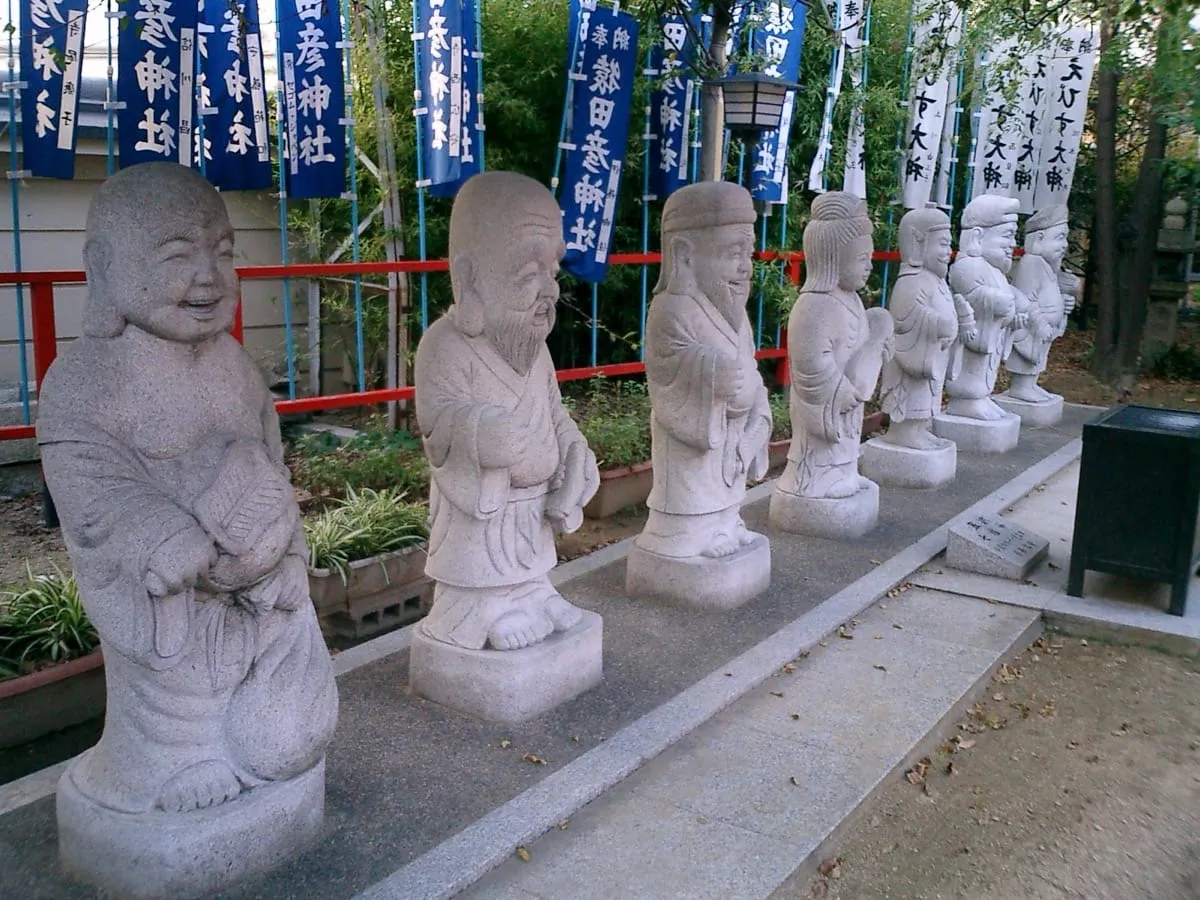
The Shichifukujin (七福神) are seven deities believed to bring good fortune:
- Ebisu (恵比寿) — god of commerce and fishing
- Daikokuten (大黒天) — god of wealth and harvest
- Benzaiten (弁財天) — goddess of arts, music, and financial fortune
- Bishamonten (毘沙門天) — god of warriors and victory
- Hotei (布袋) — god of contentment and generosity
- Fukurokuju (福禄寿) — god of happiness, wealth, and longevity
- Jurōjin (寿老人) — god of longevity and wisdom
The group coalesced in the late Muromachi period (late 15th century) from popular belief in Kyoto and exploded in popularity during the Edo period (1603–1868).
Legend credits the monk Tenkai — advisor to Shogun Tokugawa Ieyasu — with formalizing the group by mapping each god to one of seven virtues essential for good governance: benevolence, justice, courtesy, wisdom, loyalty, trust, and filial piety. This political framing helped the Seven Lucky Gods gain acceptance from samurai and commoners alike.
Meet the Seven
Ebisu — The Only Japanese Native
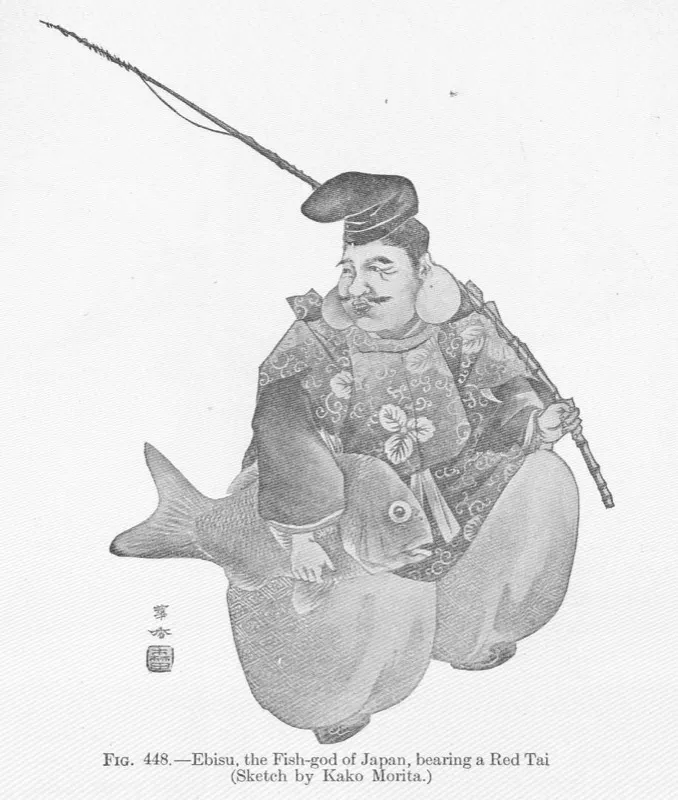
Ebisu is the only purely Japanese deity among the seven. His origin is debated: some traditions identify him with Hiruko (蛭子), the first child of the creator gods Izanagi and Izanami; others connect him to Kotoshironushi, a son of the great deity Ōkuninushi.
He’s always shown with a fishing rod in his right hand and a large sea bream (tai) under his left arm. Originally the patron of fishermen, he gradually expanded his portfolio to include merchants and business prosperity. The expression “ebisu-gao” (Ebisu face) means a broad, beaming smile — he’s the most approachable of the seven.
The sea bream isn’t just about the pun on “medetai” (auspicious). Tai has been offered to the gods in Shinto rituals since antiquity — it’s a sacred fish.
Blessings: Business prosperity, abundant catches, good harvests
Daikokuten — From Destroyer to Kitchen God
Daikokuten’s true identity is Mahākāla — literally “Great Black One” — a wrathful manifestation of the Hindu god Shiva. In India, he was a fearsome deity of combat and death. By the time he reached Japan via China, he had undergone a complete personality transplant.
In Japan, Daikokuten merged with Ōkuninushi (大国主命), the great earthly deity of Izumo mythology. The connection was phonetic: “Daikoku” (大黒, “great black”) sounds identical to “Daikoku” (大国, “great country”), Ōkuninushi’s alternative name. From terrifying destroyer to jovial harvest god — all because of a homophone.
He wears a hood, carries a large sack on his back, and holds a magic mallet (uchide no kozuchi) that grants wishes. He stands on bales of rice. You’ll often find him paired with Ebisu — “Ebisu-Daikoku” is one of the most common deity pairings in Japanese folk religion, and many businesses display figures of both at their entrance.
Blessings: Abundant harvests, business prosperity, marriage ties
Benzaiten — The Only Woman
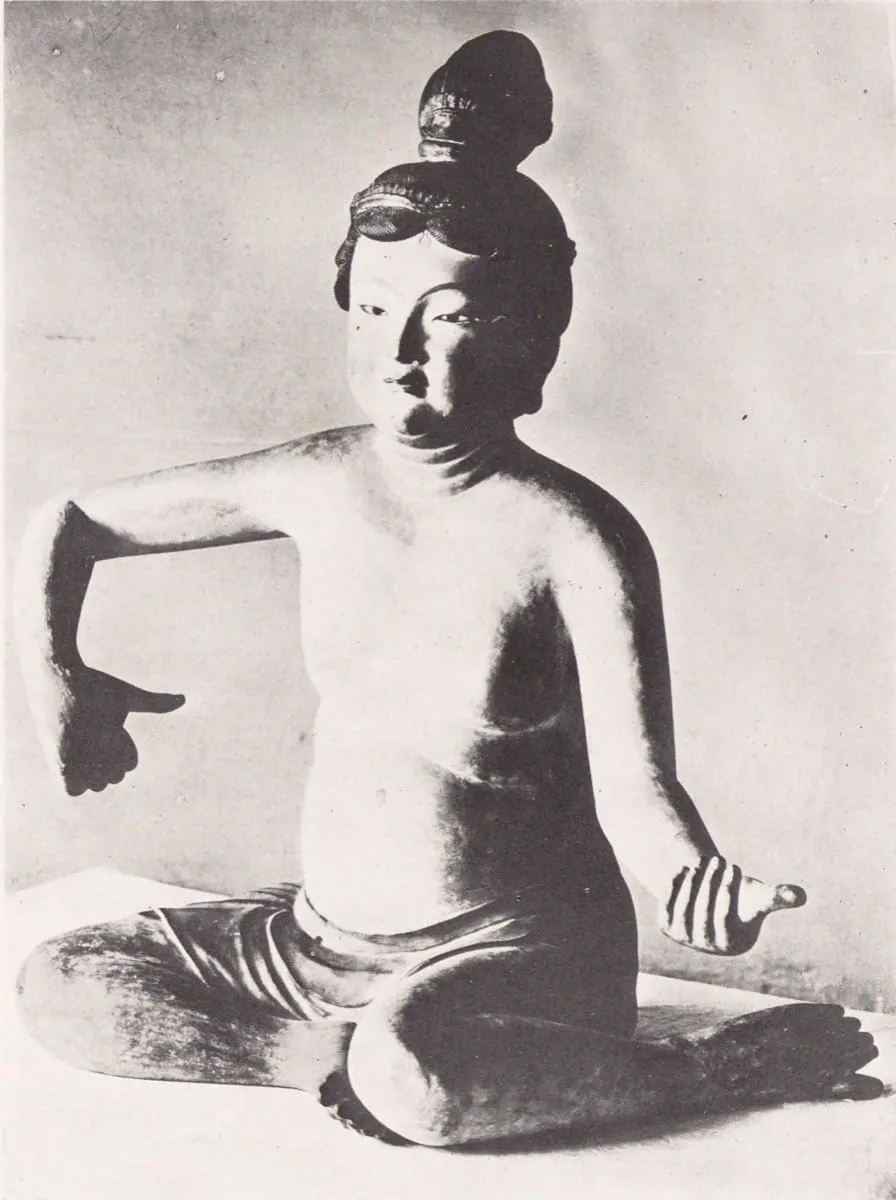
The sole female deity among the seven. Her origin is the Hindu goddess Sarasvatī, deity of rivers, music, eloquence, and knowledge.
In Japan, she’s depicted as a beautiful woman holding a biwa (Japanese lute). Her name exists in two written forms: 弁才天 (emphasizing talent and the arts) and 弁財天 (emphasizing financial fortune). Over time, the “wealth” spelling became dominant, and her role as a money goddess grew.
Benzaiten is almost always enshrined near water — often on islands. The “Three Great Benzaiten” of Japan are Enoshima Shrine (Kanagawa), Itsukushima Shrine (Hiroshima), and Hōgonji Temple on Chikubushima Island (Shiga).
She has a deep connection with snakes. Serpents are considered her messengers, and visiting a Benzaiten shrine on a Mi no Hi (Day of the Snake in the zodiac cycle) is believed to bring especially strong blessings.
Blessings: Artistic skill, academic success, financial fortune, good relationships
Bishamonten — The Warrior Guardian
Bishamonten is Vaiśravaṇa, one of the Four Heavenly Kings of Buddhism and guardian of the North. He’s the most martial of the seven, depicted in full armor, holding a pagoda in one hand and a spear (or halberd) in the other.
His most famous devotee in Japanese history was the warlord Uesugi Kenshin, who considered himself Bishamonten’s living incarnation and flew a battle banner bearing the single character “毘” (Bi). For Sengoku-era warriors, Bishamonten was the ultimate symbol of victory.
He’s often shown standing on a demon (jaki), symbolizing the suppression of evil. Beyond military prowess, he’s also a granter of wealth — his name “Tamon-ten” (多聞天, “He Who Hears All”) hints at his aspect as a deity of wisdom and omniscience.
Blessings: Military fortune, competitive success, protection from evil, wealth
Hotei — The Real Person
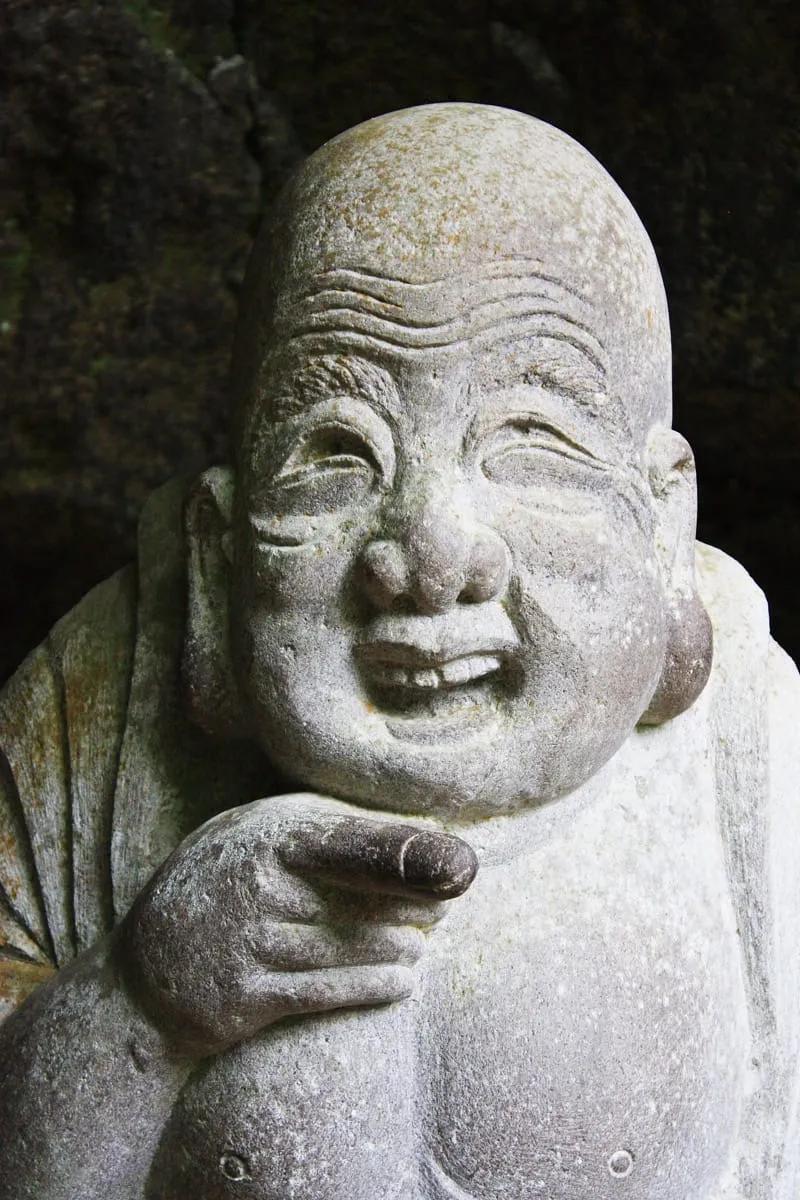
Hotei is the only member of the seven based on a historical figure. He’s modeled on Qìcǐ (契此), a Chinese Zen monk who lived during the late Tang to Five Dynasties period (around the 10th century). Qìcǐ wandered from town to town carrying a large cloth sack (nunobukuro), giving gifts to children and offering cryptic Zen wisdom to anyone who’d listen.
His protruding belly and perpetual grin embody the Zen ideal of freedom from attachment. In Chinese Buddhism, he’s sometimes identified as an incarnation of Maitreya — the Future Buddha. The idea that the Buddha of the future is already here, laughing and carrying a sack, is peak Zen humor.
Blessings: Harmonious relationships, generosity of spirit, fertility, good health
Fukurokuju — Three Blessings in One Name
Fukurokuju is a Taoist immortal, said to be the personification of the Southern Pole Star. His name encodes his gifts: fuku (福, happiness), roku (禄, wealth), and ju (寿, longevity).
He’s recognizable by his extremely elongated head and long beard. He’s often accompanied by a crane or tortoise — both symbols of longevity. Sometimes he carries a staff with a scroll attached, said to contain the record of every living being’s lifespan.
Fukurokuju is frequently confused with Jurōjin — understandably, since both are Taoist longevity gods with similar appearances. During the Edo period, some traditions actually treated them as the same deity and substituted Kichijōten (the goddess of beauty and fortune) or the mythical creature Shōjō as the seventh member.
Blessings: Happiness, wealth, longevity, personal magnetism
Jurōjin — The Sage with a Deer
Jurōjin is another Taoist immortal, the personification of Canopus (the Southern Pole Star, also called the “Old Man Star”). He shares mythological roots with Fukurokuju but specializes more narrowly in longevity.
Short-statured with an elongated head, he leans on a staff and is accompanied by a deer — an ancient symbol of long life. He sometimes carries a peach (the fruit of immortality in Chinese mythology).
He may be the quietest member of the seven, but health and long life is perhaps the most universal human wish — which is exactly why no version of the Shichifukujin leaves him out.
Blessings: Longevity, good health, wisdom
The Treasure Ship
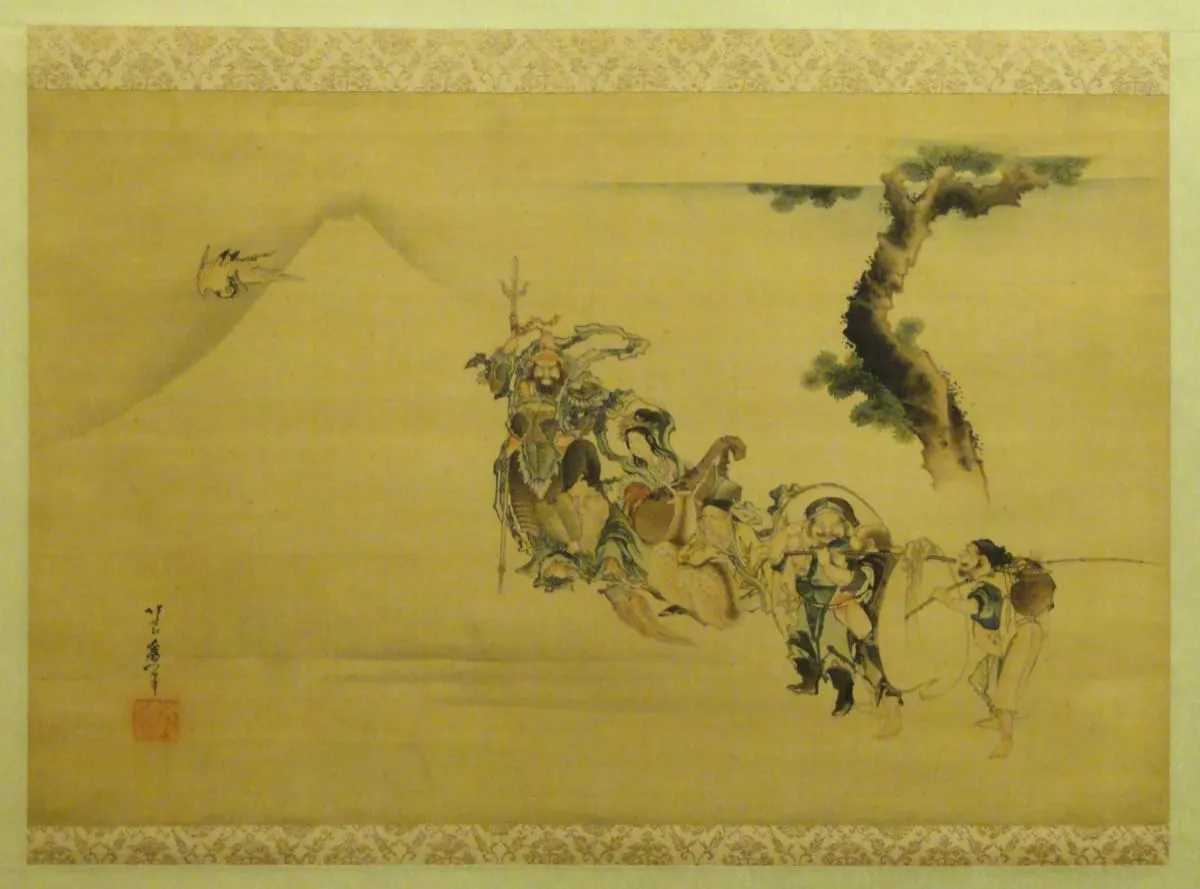
No image of the Seven Lucky Gods is more iconic than the Takarabune (宝船) — the Treasure Ship. The seven deities aboard a vessel overflowing with riches, sailing across the sea — this image has been painted, printed, and carved since the late Muromachi period as a New Year’s good-luck charm.
The treasures aboard include the “hidden straw raincoat” (kakuremino), “hidden hat” (kakuregasa), “magic mallet” (uchide no kozuchi), money bags, wish-granting jewels, cloves, and scrolls. These items belong to the takarazukushi (宝尽くし) — a set of auspicious symbols used across Japanese decorative arts, from kimono patterns to lacquerware.
During the Edo period, people placed a picture of the Treasure Ship under their pillow on the night of January 2nd to ensure a good hatsuyume (first dream of the New Year). If the dream turned out badly, the picture was floated down a river the next morning to wash away the ill fortune.
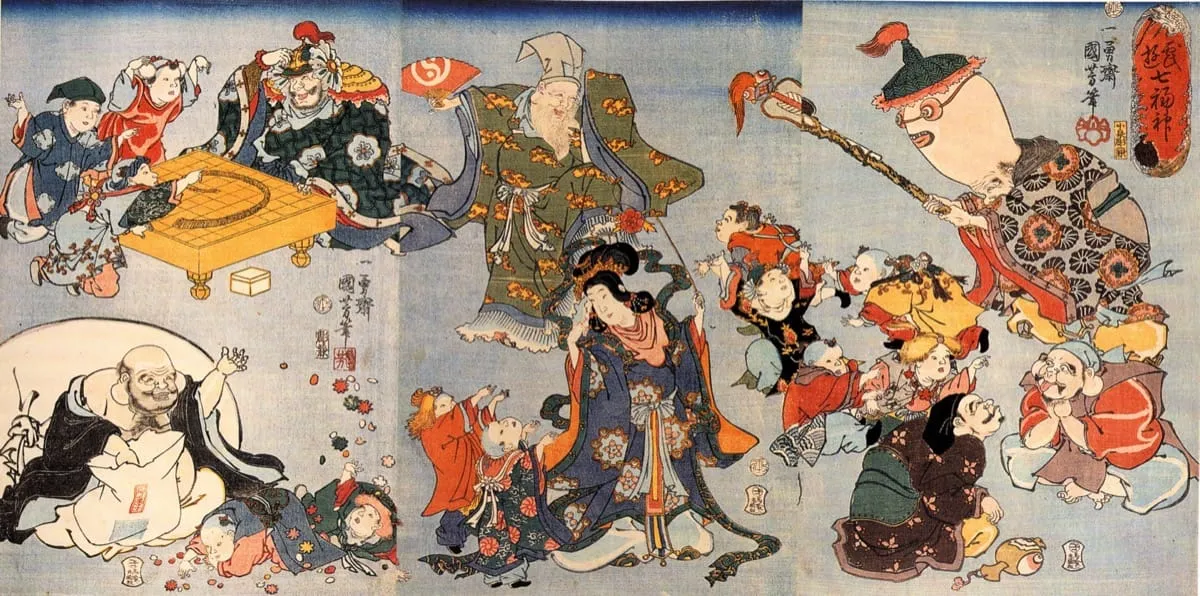
The great ukiyo-e masters — Hokusai, Kuniyoshi, Toyokuni — all painted their own versions of the Treasure Ship, competing to create the most elaborate depiction. Seven faiths and countless lucky symbols packed into a single image — it may be the most “maximalist” genre in all of Japanese art.
How to Walk a Shichifukujin Pilgrimage
A Brief History
The Shichifukujin pilgrimage tradition dates to the mid-Edo period. Around the Genroku era (1688–1704), Edo’s townspeople began visiting seven temples and shrines during New Year’s to pay respects to each of the Lucky Gods.
Edo was one of the world’s largest cities, dense with religious institutions. Seven temples within walking distance of each other was easy to find. The practice blended devotion with leisure — and it’s a direct ancestor of modern goshuin collecting.
Practical Tips
There are no strict rules for a Shichifukujin pilgrimage, but here’s what’s useful to know:
- Timing: Most pilgrimage routes operate during New Year’s (January 1–7 or through January 15). Some accept visitors year-round
- Order: Generally flexible. Pamphlets usually suggest a recommended route
- Goshuin: Many routes offer a dedicated shikishi (decorative card) or ema (wooden plaque) with spaces for all seven stamps. You can also collect stamps in a regular goshuinchō
- Duration: 2–4 hours. Routes typically cover 3–10 km on foot
- Cost: ¥300–500 per stamp. Shikishi typically cost ¥1,000–2,000 separately
Famous Pilgrimage Routes
Yanaka Shichifukujin (Tokyo)
Considered the oldest Shichifukujin pilgrimage in Edo. A roughly 5 km walk from Ueno to Tabata through charming shitamachi neighborhoods. Open January 1–10.
Nihonbashi Shichifukujin (Tokyo)
Concentrated in the Nihonbashi business district — one of the shortest and fastest routes. Unusually, all seven stops are Shinto shrines (most routes mix temples and shrines).
Miyako Shichifukujin (Kyoto)
Kyoto’s premier pilgrimage, visiting renowned institutions including Ebisu Shrine, Matsugasaki Daikokuten, and Tō-ji temple. Covers significant distance — buses and trains are the practical choice.
Kamakura Shichifukujin (Kanagawa)
A historically rich route through Kamakura’s ancient temples, stretching from Kita-Kamakura to Enoshima. Benzaiten is enshrined at Enoshima Shrine, dramatically set on a rocky island.
Seven Lucky Gods and Goshuin
Shichifukujin goshuin have some distinctive features that set them apart from regular shrine and temple stamps.
Dedicated Shikishi and Ema
Most pilgrimage routes sell special shikishi — large decorative cards with seven pre-printed frames. As you visit each institution, the priest or monk stamps the corresponding space. A completed shikishi, framed and hung on a wall, is a beautiful souvenir of the pilgrimage.
God-Specific Stamps
The goshuin at each stop typically features the image or symbol of the enshrined deity. Ebisu gets a sea bream and fishing rod, Daikokuten gets a magic mallet, Benzaiten gets a biwa — you can identify which god you’re looking at just from the stamp design.
Treasure Ships and Zodiac Animals
Many shikishi feature a printed Treasure Ship as the background image. Some routes also add the zodiac animal of the year, making each year’s shikishi unique — which is why many collectors return annually.
Digital Records
Paper shikishi are beautiful but fragile. Photographing each goshuin with a collecting app preserves them permanently. Viewing all seven stops plotted on a map shows the route you walked — turning a spiritual pilgrimage into a visible, shareable journey.
What the Seven Lucky Gods Teach Us
Look at where these gods come from:
- Ebisu is a Shinto deity
- Daikokuten, Benzaiten, and Bishamonten are Indian (Hindu/Buddhist)
- Hotei was a Chinese Zen monk
- Fukurokuju and Jurōjin are Taoist immortals
Three religions. Three countries. Seven gods on one boat. No one asks whether this is theologically consistent. Does it work? Does it bring good fortune? That’s what matters. This pragmatic, syncretic approach to religion runs deep in Japanese culture.
And the Shichifukujin pilgrimage is one of the few ways you can experience this syncretism with your own feet. Next New Year’s — or today, if you prefer — walk the route. Collect a stamp from a Shinto god, then an Indian goddess, then a Chinese monk. Press your hands together at each one in exactly the same way. The fact that this feels completely natural is, perhaps, the most Japanese thing about it.
Want to record your Shichifukujin goshuin digitally? Goshuin Meguri lets you photograph, organize, and map every stamp in your collection. Seven gods, one app, a pilgrimage preserved forever.
Image credits: Hero image (Shichifukujin statues at Kaijinja Shrine) — by Tomomarusan (CC BY-SA 3.0), via Wikimedia Commons. Ebisu illustration — NOAA (public domain), via Wikimedia Commons. Benzaiten statue (Tsurugaoka Hachiman-gū) — public domain, via Wikimedia Commons. Hotei statue (Jōchi-ji temple) — by clio1789 (CC BY 2.0), via Wikimedia Commons. Mount Fuji and the Seven Gods of Good Fortune — by Katsushika Hokusai (public domain), via Wikimedia Commons. Seven Gods of Good Fortune — by Utagawa Kuniyoshi (public domain), via Wikimedia Commons.