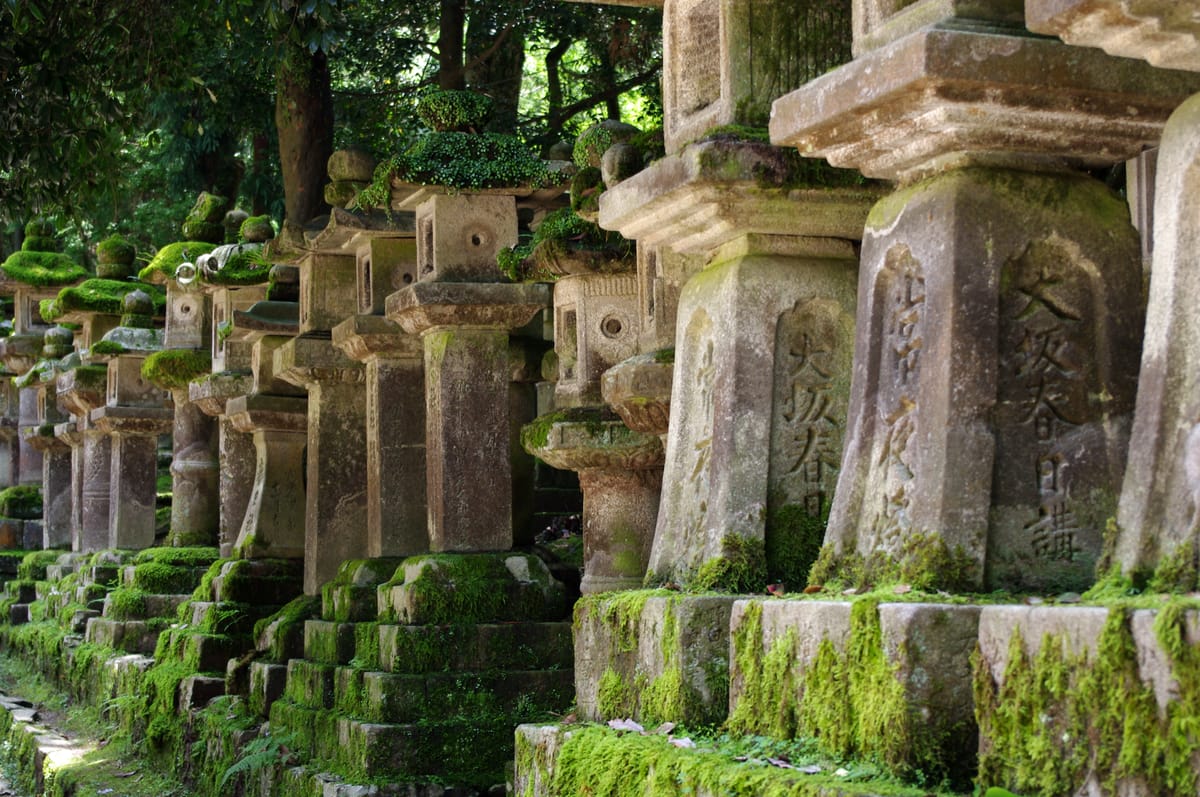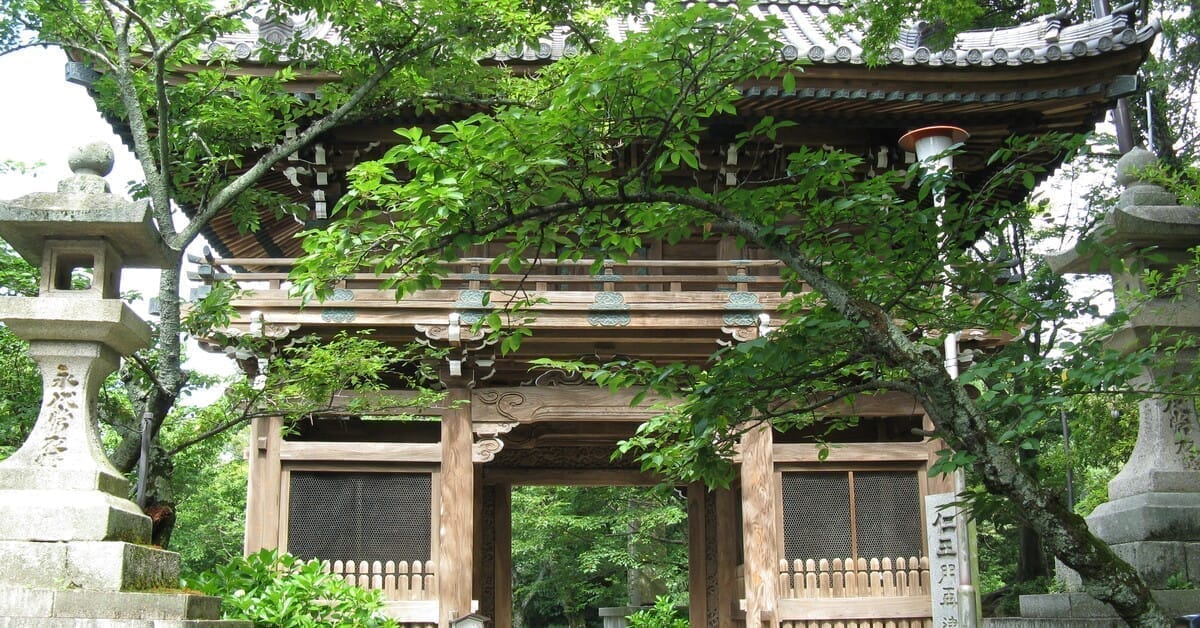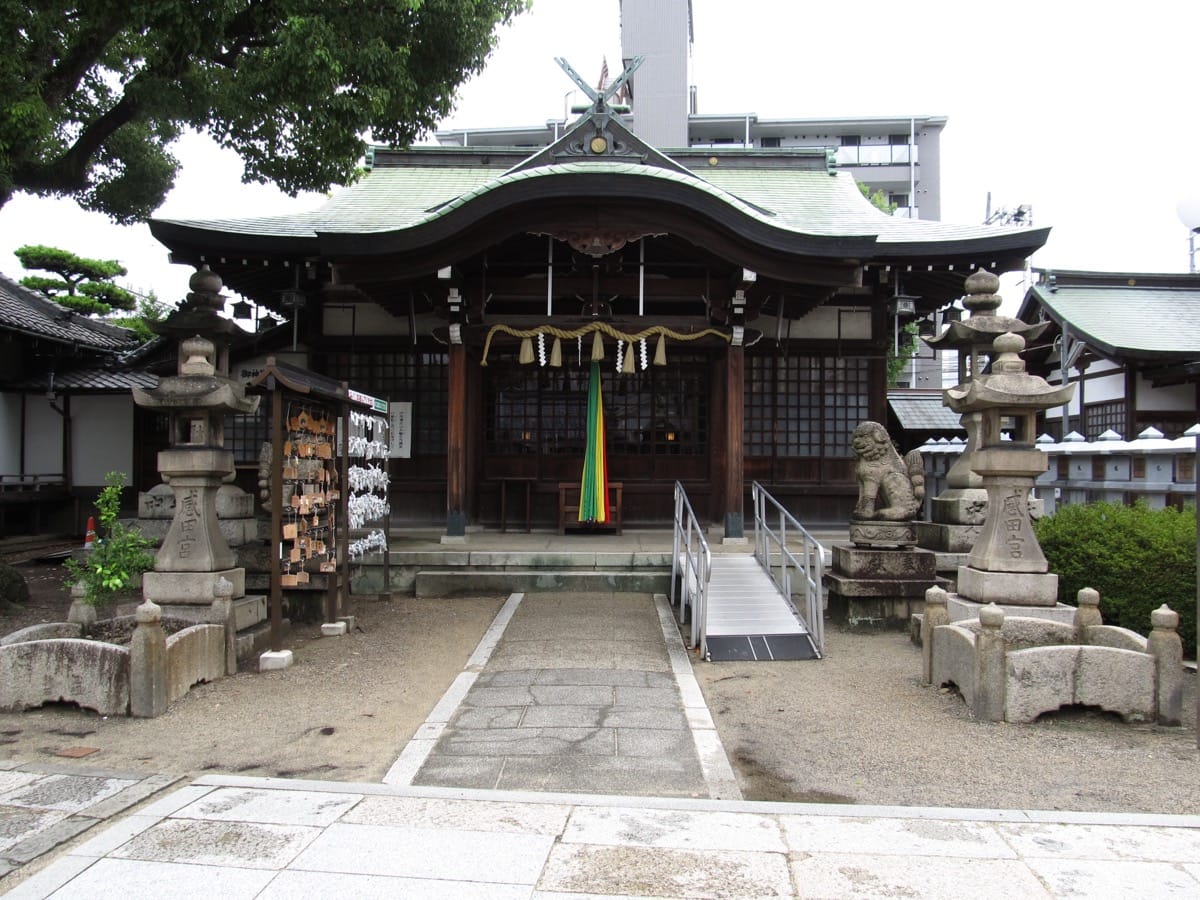
Beyond the torii, there is another boundary.
When you visit a Japanese shrine, the iconic torii gate marks your first crossing from the everyday world into sacred space. But at many shrines, a second and far more substantial threshold awaits: the mon (門), or gate. Where the torii draws a symbolic line in the air, the gate presents a physical wall—a structure of timber, tile, and sometimes centuries of history—that encloses the innermost sanctum of the shrine.
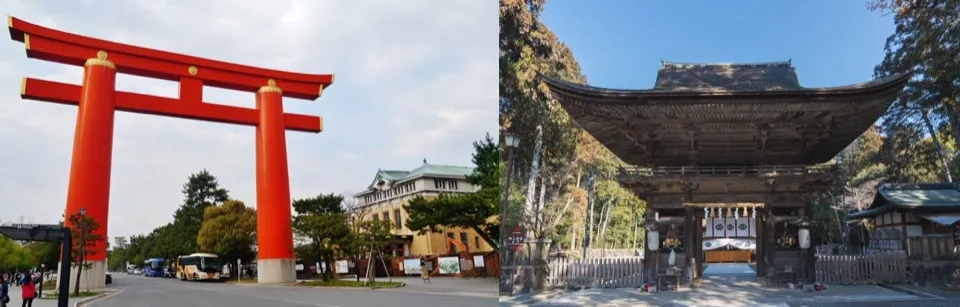
For goshuin collectors visiting shrines across Japan, these gates are among the most visually striking and architecturally fascinating structures you’ll encounter. From the towering vermilion romon of Fushimi Inari Taisha to the zuijin warrior-guardians of Kanda Myojin, every gate tells a story about the shrine’s history, its deities, and the Japanese understanding of sacred space.
This guide explores the world of shrine gates—their types, their guardians, their architectural details, and what they mean for visitors seeking to deepen their appreciation of Japanese shrine culture.
What Is a Romon? | The Tower Gate
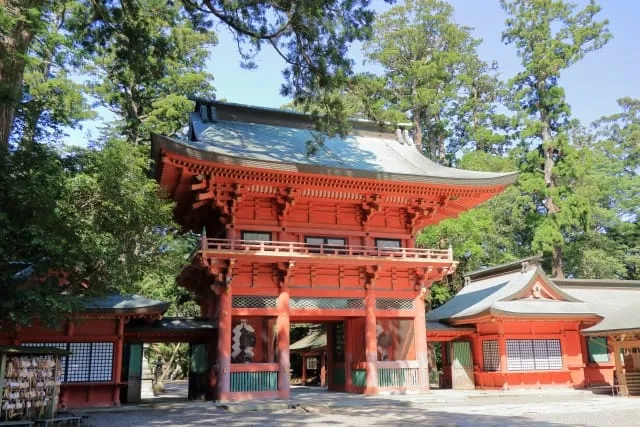
The romon (楼門, literally “tower gate”) is the most visually commanding type of gate found at Japanese shrines. Rising two stories high with sweeping eaves and an ornate upper balcony, a romon announces that you are about to enter a place of great spiritual significance.
Structure and Design
Despite its impressive two-story appearance, the romon has a distinctive structural quirk: the upper story is inaccessible. There are no stairs leading up to the second floor, and the space behind the elegant railed balcony is purely decorative. This makes the romon fundamentally different from a functional two-story building—it’s architecture designed to inspire awe rather than serve a practical purpose.
Key structural features of the romon include:
- Single roof: Unlike the similar nijūmon (二重門, double-roofed gate), the romon has only one roof crowning the upper story. The lower level has no separate roof; instead, a shallow balcony with a balustrade (高欄, kōran) encircles the upper story
- Hip-and-gable roof (irimoya-zukuri): Most romon feature this compound roof style, combining a triangular gable on the front and back with sloping hip sections on the sides
- Three-bay configuration (sanken ikko): The standard layout has three bays across the front, with the central bay serving as the passageway
- Bracket complexes (tokyō): Elaborate wooden bracket sets support the overhanging eaves, with three-stepped brackets (mitesaki) being the most common. At the upper story, these support the roof; at the lower level, they carry only the balcony
- Decorative windows: The upper story behind the balustrade may feature latticed windows (連子窓, renjimado), or the side bays may be covered with white plaster
Romon vs. Nijūmon: Spotting the Difference
Visitors sometimes confuse the romon with the nijūmon (二重門), or “double-gate.” The distinction is straightforward when you know what to look for:
| Feature | Romon (楼門) | Nijūmon (二重門) |
|---|---|---|
| Roofs | Single roof at top | Two roofs (one at each story) |
| Between stories | Shallow balcony with railing | Pent roof (mokoshi) |
| Accessibility | Upper story inaccessible | Upper story sometimes accessible |
| Common at | Shinto shrines | Buddhist temples |
If you see a pent roof (a small, sloping roof) between the first and second stories, it’s a nijūmon. If the transition between levels is marked only by a balcony, it’s a romon.
Historical Development
The romon originated in Buddhist architecture, where it evolved from the Chinese-influenced nijūmon. During the Nara period (710–794 CE) and Heian period (794–1185 CE), Buddhist temples adopted increasingly elaborate gate designs as expressions of institutional prestige and spiritual authority.
The critical turning point came during the era of shinbutsu-shūgō (神仏習合)—the syncretism of Shinto and Buddhism that characterized Japanese religious life for over a millennium. As Buddhist and Shinto institutions became intertwined, architectural forms flowed freely between them. Temples adopted torii gates; shrines adopted romon.
When Buddhist temples housed niō (仁王) guardian statues in their gates, shrines responded by placing zuijin (随神)—warrior-guardians derived from the imperial court—in theirs. This adaptation gave birth to the zuijinmon, which we’ll explore in the next section.
After the Meiji government’s shinbutsu bunri (神仏分離, separation of Shinto and Buddhism) decree of 1868, many shrines underwent significant changes. Buddhist imagery was removed, niō statues were replaced with zuijin figures, and explicitly Buddhist decorative elements were stripped away. However, the romon architectural form itself was retained—a reminder that buildings often outlast the ideological shifts that reshape them.
Famous Romon Gates in Japan
Fushimi Inari Taisha (伏見稲荷大社) — Kyoto
The romon of Fushimi Inari Taisha is one of Japan’s most photographed shrine gates. Built in 1589 (Tenshō 17), it was commissioned by Toyotomi Hideyoshi as an offering of gratitude after his mother, Ōmandokoro, recovered from illness. Hideyoshi had pledged a donation of 10,000 koku of rice if his prayers were answered—and the magnificent gate that resulted stands as testimony to both his gratitude and his political ambitions.
The gate features brilliant vermilion lacquer, a cypress-bark (hiwadabuki) roof, and the imposing scale befitting the head shrine of all 30,000 Inari shrines across Japan. It is designated an Important Cultural Property of Japan.
Kashima Jingū (鹿島神宮) — Ibaraki
The romon of Kashima Jingū was donated in 1634 by Tokugawa Yorifusa, the first lord of the Mito domain and son of Tokugawa Ieyasu. Painted in deep vermilion with a commanding presence among the tall cedars of the shrine grounds, it is considered one of Japan’s Three Great Romon (日本三大楼門) and is designated an Important Cultural Property.
Kashima Jingū is the ichinomiya (premier shrine) of Hitachi Province and is dedicated to Takemikazuchi-no-Kami, the god of martial arts and thunder. The gate’s impressive scale reflects the shrine’s historical importance as a guardian of Japan’s eastern frontier.
Aso Jinja (阿蘇神社) — Kumamoto
The romon of Aso Jinja, rebuilt during the Tenpō era (1835–1850), is also counted among Japan’s Three Great Romon. This gate suffered catastrophic damage in the 2016 Kumamoto earthquakes, collapsing almost entirely. Its painstaking restoration, completed in 2023, became a symbol of regional resilience and the deep community bonds that sustain Japan’s shrine culture.
The gate’s reconstruction used traditional techniques wherever possible, demonstrating that the craft traditions behind these structures remain very much alive in modern Japan.
Other Notable Romon
- Hakozaki-gū (筥崎宮, Fukuoka): One of the three great Hachiman shrines, with a romon dating to the Muromachi period
- Kitano Tenman-gū (北野天満宮, Kyoto): Dedicated to Sugawara no Michizane, the god of learning, with a striking romon that leads into the main precinct
- Miyajidake Jinja (宮地嶽神社, Fukuoka): Known for its “Path of Light” sunset phenomenon, with a beautiful romon overlooking the sea
What Is a Zuijinmon? | The Guardian Deity Gate
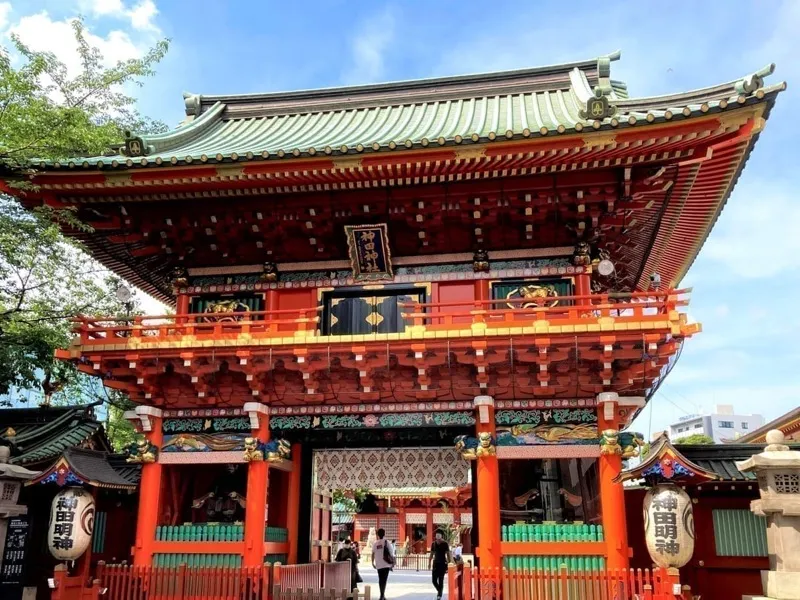
While “romon” describes a gate’s architectural structure (two-story, single roof), zuijinmon (随神門 or 随身門) describes what’s inside the gate. Specifically, a zuijinmon is any shrine gate that houses zuijin (随神/随身)—warrior-guardian figures dressed in the court attire of the Heian period.
This means a gate can be both a romon and a zuijinmon simultaneously. The romon at Kashima Jingū, for example, houses zuijin figures in its side bays. The famous zuijinmon at Kanda Myojin in Tokyo is structurally a romon. The terms describe different aspects of the same gate: one its form, the other its function.
Who Are the Zuijin?
The word zuijin (随身) originally referred to real people—bodyguards from the Konoe-fu (近衛府, the Headquarters of the Inner Palace Guards) during the Heian period (794–1185 CE). These elite warriors accompanied nobles whenever they left their residences, serving as armed escorts through the streets of the capital.
Over time, under the influence of honji-suijaku doctrine (which identified kami as manifestations of Buddhist deities), these human guardians were elevated into spiritual sentinels. Their images were placed in shrine gates as Kado-Mori-no-Kami (門守りの神)—literally “gods who watch over the gates.”
The zuijin thus represent a fascinating blend of historical reality and mythological reimagining: real court officials transformed into divine protectors.
The Two Zuijin: Yadaijin and Sadaijin
Every zuijinmon houses a pair of zuijin figures, one on each side:
Yadaijin (矢大臣) — “The Minister with Arrows”
- Positioned on the observer’s left
- Mouth is closed (un-gyō, 吽形)
- Despite the name “daijin” (minister), the figure represents a zuijin (attendant), not an actual minister
- Mythologically associated with Amenooshihi-no-Mikoto, one of the divine warriors who led the descent of Ninigi-no-Mikoto (the grandson of Amaterasu) to earth
Sadaijin (左大臣) — “The Left Minister”
- Positioned on the observer’s right
- Mouth is open (a-gyō, 阿形)
- Associated with Amatsukume-no-Mikoto, another divine warrior of the Tenson Kōrin (heavenly descent) narrative
The A-Un Symbolism
The open-and-closed mouth pairing of the zuijin mirrors the famous a-un (阿吽) concept borrowed from Buddhist tradition:
- A (阿): The first sound, mouth open — representing the beginning of all things
- Un (吽): The last sound, mouth closed — representing the end of all things
This same symbolism appears in the niō guardians at Buddhist temples and in komainu (guardian lions/dogs) at shrine entrances. Together, the pair encompasses the totality of existence—alpha and omega, birth and death, the first breath and the last.
Attire and Equipment of the Zuijin
When you look closely at zuijin statues, you’ll notice specific elements of Heian-period court dress:
- Kenei-no-kanmuri (巻纓の冠): A formal court headdress with trailing ribbons, fitted with oikake (wing-like ornamental accessories)
- Ketteki-no-hō (闕腋の袍): A formal robe with open side seams, designed for warriors who needed freedom of movement
- Tachi (太刀): A long sword worn at the waist
- Yumi and Ya (弓矢): A large bow and arrows—the zuijin’s primary weapons and most distinctive attributes
This courtly attire distinguishes zuijin sharply from the muscular, semi-naked niō guardians of Buddhist temples. Where niō project raw physical power, zuijin project authority, order, and imperial dignity.
Famous Zuijinmon
Kanda Myōjin (神田明神) — Tokyo
The zuijinmon of Kanda Myōjin (also known as Kanda Jinja) is one of Tokyo’s most recognizable shrine gates. Rebuilt in 1975 to commemorate the 50th anniversary of Emperor Shōwa’s enthronement, it features brilliant vermilion lacquer, polychrome carvings, gilt lion sculptures, and an overall design that evokes the opulence of the Edo-period gongen style favored by the Tokugawa shoguns.
Kanda Myōjin is one of Tokyo’s most important shrines, historically protecting the city’s commercial center and beloved by Edokko (native Tokyo residents) for centuries.
Ōmiya Hikawa Jinja (大宮氷川神社) — Saitama
As the ichinomiya (premier shrine) of Musashi Province, Hikawa Jinja’s gate houses zuijin figures of considerable artistic quality. The shrine’s 2-kilometer-long sandō (approach road) lined with zelkova trees leads dramatically to this gate.
Tsurugaoka Hachiman-gū (鶴岡八幡宮) — Kamakura
The zuijinmon of this shrine, founded by Minamoto no Yoritomo (the first Kamakura shogun), reflects the martial spirit of its patron. The gate serves as the threshold between the bustling Dankazura approach and the solemn inner precinct.
Other Types of Shrine Gates
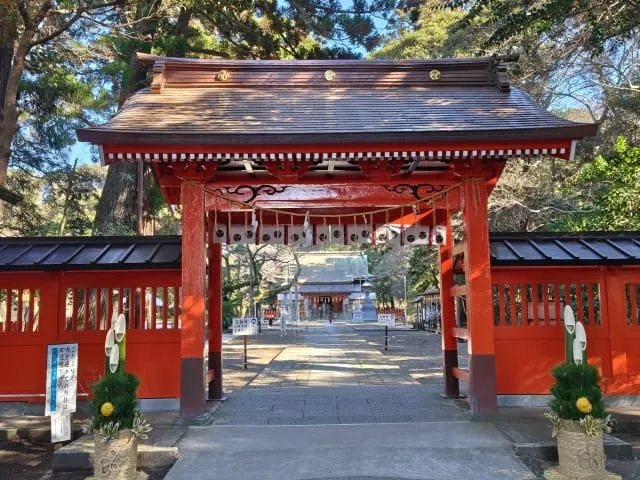
Beyond the romon and zuijinmon, Japanese shrines employ several other gate types, each with its own character and purpose.
Shinmon (神門) — The Sacred Gate
The shinmon (神門, literally “deity gate”) is a general term for any gate marking the entrance to the sacred inner precinct of a shrine. Shinmon are typically single-story structures and often deliberately simpler than romon, reflecting an aesthetic preference for purity and restraint.
This simplicity can be seen at Japan’s highest-ranking shrines:
- Ise Jingū (伊勢神宮): The inner and outer shrines use austere wooden gates within their successive fences (tamagaki), embodying the Shinto ideal of sacred simplicity
- Meiji Jingū (明治神宮): The Minami Shinmon (South Sacred Gate) is a dignified cypress-wood structure bearing the imperial chrysanthemum crest—restrained in decoration but unmistakably authoritative
- Izumo Taisha (出雲大社): The shinmon beyond the bronze torii maintains the shrine’s distinctive architectural character
The prevalence of simple shinmon at prestigious shrines illustrates an important principle in Japanese sacred architecture: restraint can convey greater authority than ornament.
Hakkyakumon (八脚門) — The Eight-Legged Gate
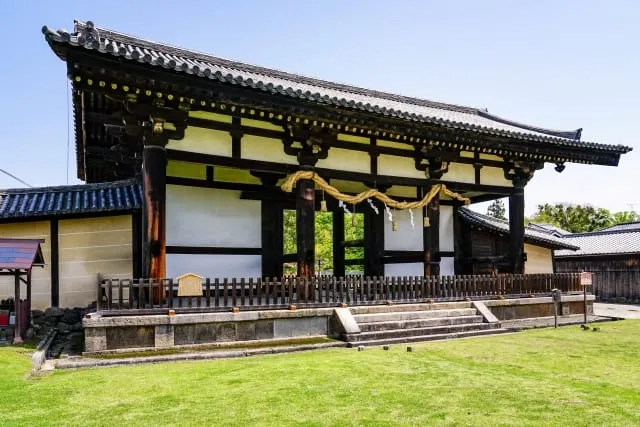
The hakkyakumon (八脚門, “eight-legged gate”) takes its name from its eight secondary pillars (控柱, hikaebashira), which support the four main pillars standing beneath the ridge beam. In total, the gate has twelve pillars, though only the eight secondary ones give it its name.
This gate type originated in ancient temple architecture—the Chūmon (Central Gate) of Hōryū-ji is one of the oldest surviving examples. In shrine contexts, hakkyakumon often serve as the primary gate for high-ranking shrines.
The most famous shrine hakkyakumon is arguably the Omote-mon (Front Gate) of Nikkō Tōshō-gū, which, while structurally an eight-legged gate, is lavished with the polychrome carvings and gold leaf that characterize the Tōshō-gū complex.
Shikyakumon (四脚門) — The Four-Legged Gate
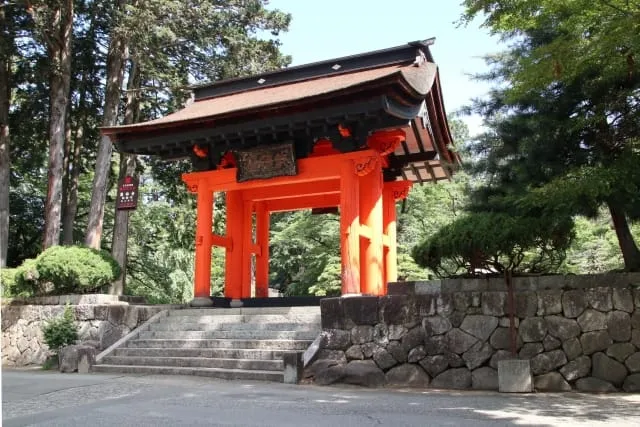
The shikyakumon (四脚門, “four-legged gate”) is a simplified version of the hakkyakumon, with only four secondary pillars supporting two main pillars—six pillars total. Despite its smaller scale, the shikyakumon can convey considerable dignity.
These gates are commonly found:
- At smaller shrines as the main entrance
- At larger shrines as secondary or side gates
- At important sub-shrines (sessha/massha) within larger shrine complexes
Their manageable scale made them practical for communities with limited resources, while their clean proportions ensured they maintained appropriate spiritual gravity.
Sanmon (山門) — Echoes of Buddhist Heritage
The sanmon (山門/三門) is technically a Buddhist temple gate term—the most important gate of a Zen or Jōdo Buddhist temple. However, due to the centuries of shinbutsu-shūgō, some shrines that were once part of temple-shrine complexes retain gates that carry this name or reflect sanmon design principles.
After the Meiji-era separation of Shinto and Buddhism, some of these gates were reclassified or renamed, but their architectural DNA—often featuring the imposing scale and formal symmetry of temple architecture—remains visible to the trained eye.
Niō vs. Zuijin: Two Traditions of Gate Guardians
Understanding the difference between niō and zuijin is key to reading shrine and temple gates correctly—and it illuminates one of the most important fault lines in Japanese religious architecture.
Niō (仁王) — Buddhist Warrior Kings
The niō (仁王, also known as Kongōrikishi / 金剛力士) are the fearsome guardian figures found at Buddhist temple gates. Their characteristics include:
- Muscular, semi-naked physique: Displaying supernatural physical power
- Wrathful expressions: Designed to intimidate evil spirits
- A-un pairing: One with mouth open (阿形, a-gyō), one closed (吽形, un-gyō)
- Weapons: Typically a vajra (thunderbolt weapon) or bare fists
- Origin: Derived from Hindu and Buddhist mythology, protectors of the Buddha
The most celebrated niō in Japan are the 8-meter-tall guardians at Tōdai-ji’s Nandaimon (Great South Gate) in Nara, carved by the master sculptors Unkei and Kaikei in 1203. These are masterworks of Kamakura-period sculpture.
The Kaminarimon (雷門, Thunder Gate) of Sensō-ji in Asakusa, Tokyo, while famous for its enormous red lantern, actually houses statues of Fūjin (Wind God) and Raijin (Thunder God) rather than traditional niō—though it functions similarly as a guardian gate.
Zuijin (随神) — Shinto Court Warriors
In contrast to the niō’s raw power, the zuijin embody courtly authority and divine order:
- Court dress: Formal Heian-period robes and headdress
- Dignified posture: Seated or standing in formal poses
- A-un pairing: Same open/closed mouth symbolism as niō
- Weapons: Bow, arrows, and sword
- Origin: Based on historical imperial bodyguards, elevated to divine status
The Great Separation
Before 1868, it was not uncommon for the same gate to house both niō and zuijin figures, or for a shrine to have niō at its gate despite being a Shinto institution. The Meiji government’s shinbutsu bunri (separation of Shinto and Buddhism) decree changed this dramatically:
- At shrines: Niō were removed and replaced with zuijin
- At temples: Zuijin figures were removed
- Mixed institutions: Were forced to choose one identity—shrine or temple
This historical sorting means that today, the rule of thumb is generally reliable:
- Niō = Buddhist temple
- Zuijin = Shinto shrine
However, exceptions persist at sites where the separation was incomplete or where local communities resisted changes. Finding these anomalies is one of the pleasures of goshuin collecting—each exception tells a story about a community’s relationship with its religious heritage.
Reading Shrine Gate Architecture
Armed with knowledge of gate types and their guardians, you can “read” shrine gates like a book. Here are the key architectural elements to observe.
Roof Styles
The roof often reveals a gate’s age, status, and regional character:
- Irimoya-zukuri (入母屋造): Hip-and-gable roof, the most common for romon. Combines a triangular gable on the front/back with sloping hips on the sides. Signals high status
- Kirizuma-zukuri (切妻造): Simple gable roof, common on shikyakumon and simpler gates. Clean, austere aesthetic
- Hiwadabuki (檜皮葺): Cypress-bark roofing, layered in overlapping shingles. Found at the most prestigious shrines and indicates considerable investment in maintenance (bark must be regularly replaced)
- Copper plate (銅板葺): Develops a beautiful green patina (verdigris) over time. Became popular in the early modern period as a durable alternative to organic materials
- Thatch (茅葺, kayabuki): Rare on gates but spectacular when found, creating a rustic, ancient atmosphere
Structural Elements
- Tokyō (斗栱): The bracket complexes that transfer the weight of the roof to the pillars. More elaborate bracket sets indicate higher status and more sophisticated carpentry traditions
- Kaerumata (蟇股): Frog-leg-shaped support pieces placed atop beams. Often elaborately carved with plant motifs, animals, or mythological scenes. Named for their resemblance to a frog sitting with legs splayed
- Kōran (高欄): The railed balcony of a romon’s upper story, typically featuring hōju-bashira (宝珠柱)—posts capped with jewel-shaped finials
Decorative Details
Gate decorations often encode information about the shrine’s identity:
- Chrysanthemum crest (菊花紋章): Imperial association
- Tomoe (巴紋): Comma-shaped pattern, associated with Hachiman shrines and warrior culture
- Dragon and phoenix carvings: Celestial guardians, common on elaborate gates
- Color choices: Vermilion (朱) is strongly associated with Shinto; unpainted wood suggests the influence of Ise Jingū’s austere style
- Shimenawa (注連縄): Sacred ropes draped across gate beams confirm Shinto identity
Cultural Significance | Crossing the Threshold
The Spatial Sequence of the Sacred
Japanese shrine architecture creates a carefully orchestrated progression from the mundane to the sacred:
- Torii → Marks the boundary; the first signal that you’re entering sacred space
- Sandō (参道) → The approach path; psychologically prepares the visitor
- Chōzuya (手水舎) → The purification fountain; ritually cleanses the visitor
- Mon (門) → The gate; physically and psychologically completes the transition
- Haiden (拝殿) → The worship hall; where human devotion meets divine presence
- Honden (本殿) → The main sanctuary; where the kami resides
The gate occupies a crucial position in this sequence. If the torii announces the beginning of the sacred boundary, the gate marks its completion. Passing through the gate, you enter the innermost sacred precinct—the space where the kami’s presence is most directly felt.
Liminality and Threshold Experiences
Anthropologists describe the gate as a liminal space (from Latin “limen,” meaning threshold)—a zone that belongs neither to the world outside nor to the sacred space within. In this in-between moment, visitors undergo a subtle psychological transformation.
Notice how passing through a shrine gate changes your sensory experience:
- Sound: The noise of the street or parking lot fades; gravel crunches underfoot
- Light: Shade from the gate’s structure and surrounding trees creates a different quality of light
- Air: In forested shrine precincts, temperature and humidity shift noticeably
- Behavior: People naturally lower their voices, slow their pace, and straighten their posture
This transformation is not accidental. Shrine architects and planners have understood for centuries that architecture shapes consciousness. The gate is the architectural instrument of this transformation.
Open Gates, Open Hearts
One remarkable feature of most shrine gates is that they cannot be fully closed. Many lack doors entirely; others have doors that remain perpetually open. This is deeply symbolic.
The gate does not exist to exclude. It exists to distinguish. Anyone may enter, but the act of passing through the gate changes one’s awareness. The boundary is real but permeable—marked by architecture rather than enforced by locks.
This philosophical approach to boundaries—present but welcoming, meaningful but not restrictive—reflects something essential about Shinto’s relationship with the divine: the kami are not hidden behind walls. They are present, accessible, and the gate simply helps you notice the transition into their domain.
Practical Tips for Goshuin Collectors
When visiting shrine gates during your goshuin-collecting journeys, keep these tips in mind:
Before Entering
- Pause at the gate: Take a moment to observe before passing through. Note the gate type, any guardian figures, and decorative elements
- Bow once: As at the torii, a slight bow before entering shows respect
- Walk to the side: The center of the gate (正中, seichū) is considered the path of the kami. Walk to either side
What to Photograph
- The full gate: Step back for a complete view showing the roof, structure, and setting
- Guardian figures: Zuijin and niō are fascinating photographic subjects. Note which has its mouth open and which closed
- Architectural details: Bracket complexes, roof materials, carvings, and painted decorations
- Name plaques: Many gates bear plaques (扁額, hengaku) with the shrine’s name in calligraphy
Gate-Related Goshuin
Some shrines offer goshuin designs that feature their gates. Fushimi Inari Taisha’s goshuin, for example, may include imagery of its famous romon. Ask at the shrine office (社務所, shamusho) about any special gate-themed goshuin or seasonal designs that highlight the shrine’s architectural heritage.
Conclusion | Gates as Storytellers
The next time you visit a Japanese shrine, take a moment before collecting your goshuin to truly look at the gate.
Is it a romon or a shinmon? Single-story or double? Does it house zuijin or niō—or no guardian figures at all? What does the roof tell you? The decorations? The state of preservation?
Every gate is a document written in wood and stone. It records the shrine’s history, the community’s values, the craftspeople’s skills, and the theological ideas of the era in which it was built. A vermilion romon commissioned by Toyotomi Hideyoshi speaks of political power expressed through religious patronage. A modest cypress shinmon speaks of a different kind of authority—one that finds power in simplicity.
Gates are silent guardians, but they speak volumes to those who know how to listen. The architectural techniques, the depth of faith, the passage of time—all are inscribed in these structures that have stood for centuries, welcoming generation after generation of worshippers into the presence of the divine.
As you walk through the torii, along the sandō, past the chōzuya, and through the gate, you participate in a choreography of the sacred that the Japanese people have refined over more than a thousand years. Let the gate mark your own transition—from tourist to pilgrim, from observer to participant, from the everyday world to the realm where the ordinary and the divine quietly meet.
Carry the goshuin home in your book, and carry the gate’s story in your memory. Both are gifts from the shrine, and both connect you to something larger than yourself.
References and Image Sources:
- Kashima Jingū Romon — Wikimedia Commons
- Fushimi Inari Taisha Romon — Wikimedia Commons
- Kanda Myōjin Zuijinmon — Wikimedia Commons
- Rōmon (Wikipedia) — Architectural definitions and structural details
- Mon (architecture) (Wikipedia) — Gate type classifications
- Zuijin (Wikipedia) — Guardian deity descriptions
- Additional images sourced from Wikimedia Commons under appropriate Creative Commons licenses