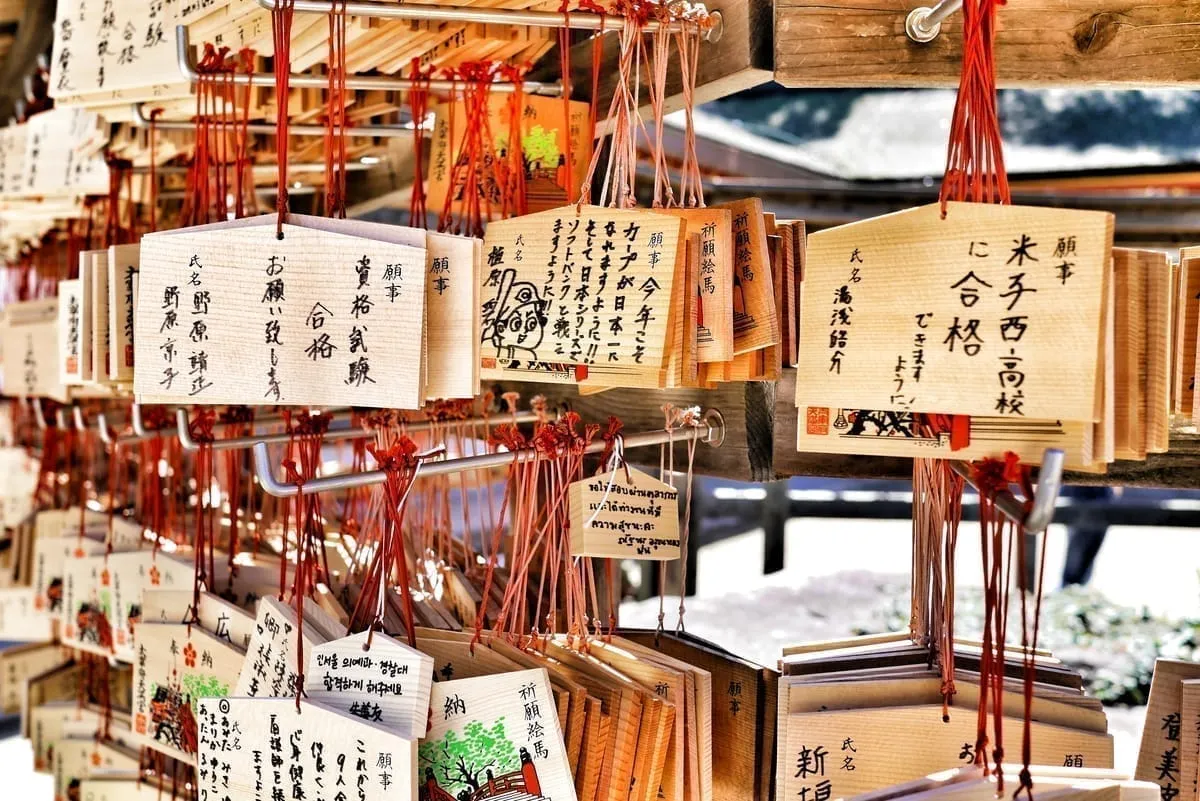
There is a place at most Japanese shrines where the air feels different.
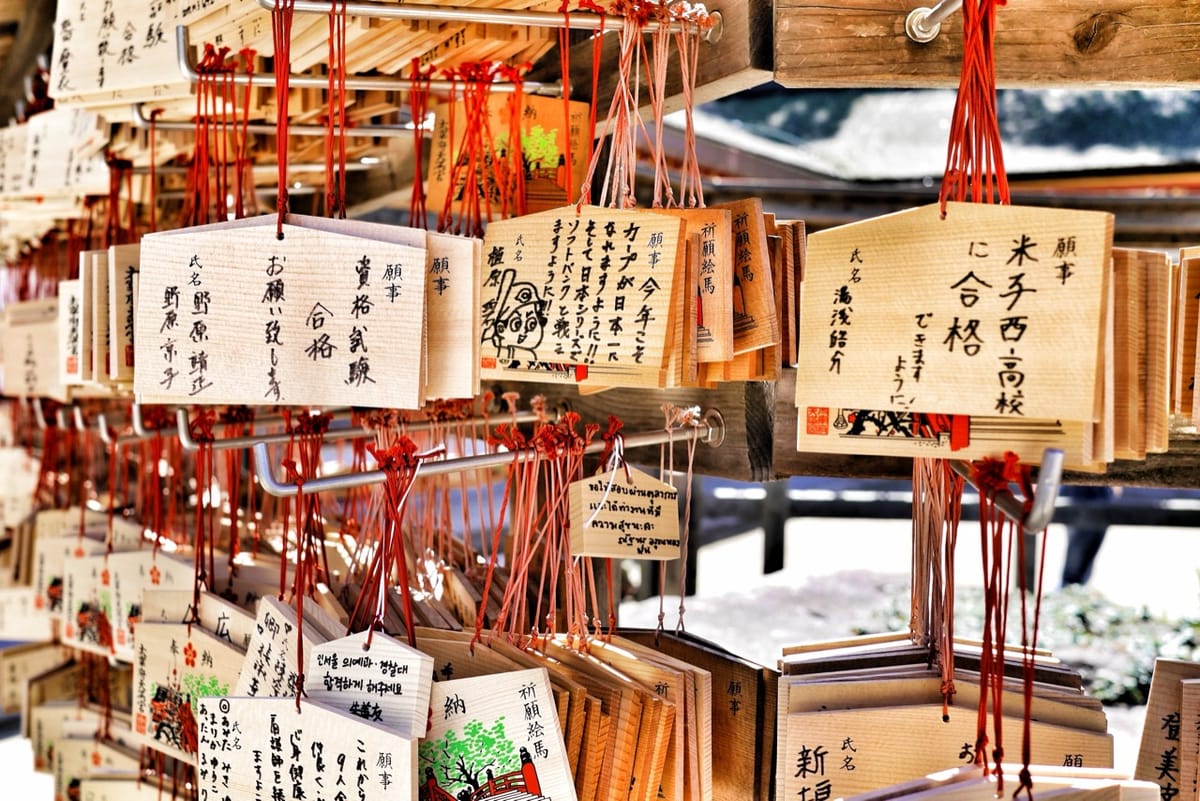
It is usually open-sided, roofed to keep off the rain, and hung on every surface — every horizontal rod, every wooden beam — with small wooden plaques. They are pentagonal, roughly the size of a paperback book, each painted with a different image on the front and covered in handwriting on the back. The handwriting is always in ink. The words are always a wish.
These plaques are called ema (絵馬). The word translates literally as “picture horse,” and that etymology is not decorative — it is the entire history of the object in two characters.
When you look at a modern ema hanging in the wind, slightly weathered, you are looking at the latest iteration of a practice that began with actual horses. The object changed over a thousand years. The impulse behind it — to give a wish a physical form and place it before a god — has not changed at all.
The Horse at the Center
To understand ema, you need to start with horses.
In ancient Japan, horses were sacred animals. They appeared in the mythology recorded in the Kojiki and Nihon Shoki as the vehicles of the gods — the means by which divine beings moved between realms. For an agricultural society whose survival depended on rain, the horse was especially significant: rain deities were believed to travel on horseback, and offerings of horses were understood as a way of persuading the gods to act.
The records of the Nara and Heian periods (710–1185 CE) are specific about this. When communities prayed for rain, they offered black horses. When they wanted rain to stop, they offered white horses. Shrines with strong connections to water — Niukawakami Shrine in Nara Prefecture and Kibune Shrine in Kyoto are prominent examples — maintained stables on their grounds specifically to receive these equine offerings. The horse was not a symbol. It was the actual gift.
The problem was obvious: horses were expensive. A horse in pre-modern Japan could be worth the equivalent of several acres of farmland. Common farmers, artisans, and merchants had no realistic way to offer a horse every time they needed to ask a deity for something. The pressure to find an equivalent — something that carried the same meaning at a fraction of the cost — produced a remarkable series of substitutions over the following centuries.
The Substitution Line: Clay to Wood to Paint
The first documented substitutes appeared in the Asuka period (roughly 593–710 CE). Archaeologists excavating sites from this era have found clay horses (土馬, tsuchima) — small, hand-formed figures in fired or unfired clay that were deposited at ritual sites or buried in association with prayer. The clay horse did not look like a real horse. It did not need to. What it carried was the idea of a horse.
By the Nara period (710–794), wooden horses (木馬, mokuma) appeared — carved from timber, more durable than clay, sometimes painted. These sat on altar stands or in front of shrine buildings.
The transition from three-dimensional object to flat painting happened gradually through the Heian period (794–1185). An 11th-century document uses the term itadachima (板立馬), meaning a horse-image on a standing board — the immediate ancestor of the modern ema. The format made practical sense: a painted board is lighter, cheaper to produce, easier to store, and — crucially — a flat surface can carry not only the horse image but other images as well.
Once ema became boards with painted surfaces rather than sculpted objects, their visual potential expanded enormously.
The practice spread from aristocrats and warriors down through society during the Kamakura period (1185–1333). By the Edo period (1603–1868), ema were a firmly established part of popular religious life. Ordinary people bought them at shops near shrine gates, wrote their wishes on the blank reverse, and hung them in the shrine’s ema hall. The basic form that exists today was set.
The Shape: Why a Pentagon?
Walk into almost any Japanese shrine and the ema you find will be the same basic shape: a rectangle topped with a triangular peak, forming a five-sided figure. This is not the only possible shape — shrines experiment with circles, fans, animal silhouettes — but the peaked pentagon is the standard, recognizable immediately as ema even to visitors who have never seen one before.
The most widely repeated explanation connects this shape to the roof of a horse stable (厩, umaya). A stable with a traditional gabled roof looks, from the front, like a rectangle with a triangle on top — exactly the silhouette of an ema. The offering, in this reading, is shaped like the place where the sacred animal lived.
A second interpretation emphasizes the symbolic boundary between the triangular upper portion and the rectangular lower portion. The triangle, in Japanese sacred architecture, is associated with the divine: you see it in the chigi ornaments at the ridge of shrine roofs, in the pointed tops of torii gate posts, in the gabled haiden (worship halls) that face the main sanctuary. The rectangle is the human domain — the space where wishes are written. The ema, on this reading, places human intention directly beneath divine attention.
Both explanations have some merit. The shape has become so naturalized that most people who hang ema give it no thought at all — which is its own kind of evidence that the form has succeeded.
The Image: A Thousand Years of Design
The first ema featured horses. Then the visual field opened.
As shrines developed distinct identities through their enshrined deities and associated mythology, their ema began to reflect those identities. The image on the front of an ema became a visual statement about what this particular shrine was for.
Tenmangū shrines — dedicated to Sugawara no Michizane, the 9th-century scholar-official who became the god of learning — developed an iconography around oxen and plum blossoms. The ox was the animal that carried Michizane’s coffin when he died in exile; the plum was the tree he famously loved. Today, at Dazaifu Tenmangū in Fukuoka, the most important Michizane shrine in Japan, these two motifs appear on ema in dozens of variations. The association is so established that a plum blossom or a bovine figure on an ema is immediately readable as “this is a shrine for students and scholars.”
Inari shrines use the white fox (kitsune), the messenger of the grain deity Inari. The fox often appears carrying a key — to the rice storehouse, or to hidden wisdom, depending on the tradition — against a background of vermillion torii gates. Fushimi Inari Taisha in Kyoto codified this iconography, and it spread to the roughly 30,000 Inari shrines across Japan.
Hachiman shrines feature doves (the birds associated with the god of archery and war) and the bow-and-arrow motif. Sumiyoshi shrines, whose three deities are connected to the sea, use nautical imagery. Shrines dedicated to specific mountains use the mountain’s silhouette.
The result is a distributed visual language: once you learn the iconographic vocabulary, you can read a shrine’s ema from a distance and know something about who is enshrined there. The ema becomes a billboard for the divine, hanging in the same space as private wishes.
Zodiac Ema
The zodiac ema (eto-ema, 干支絵馬) is the most universally practiced form of ema design. Each year brings a new zodiac animal — rat, ox, tiger, rabbit, dragon, snake, horse, goat, monkey, rooster, dog, or boar — and shrines across Japan commission or create ema depicting that year’s creature.
The designs vary enormously. Conservative shrines produce classical ink-brush paintings of the animal in a traditional East Asian style. More contemporary shrines commission illustrations that approach modern graphic design or character art. Some shrines have the animal rendered as a netsuke-like sculptural object that the ema’s pentagonal board simply frames.
Since the zodiac ema changes every year, they attract collectors who visit the same shrine annually to add the new design to their collection. Over twelve years — a full zodiac cycle — a collection of zodiac ema from a single shrine traces both the animal cycle and whatever stylistic changes the shrine’s aesthetic has undergone. When the cycle completes and the same animal returns, comparing the new version with the old one twelve years later tells you something about how the shrine has changed.
Large Ema: Votive Painting as Fine Art
The ema most people encounter — the small, purchasable wooden plaques in the social area — are only one half of the tradition. The other half is the large votive ema (大絵馬, ōema): substantial painted works commissioned or produced by skilled artists and offered to shrines as major gifts.
Large ema were a vehicle for the finest painters of their era. Warriors who survived battles brought professional artists to document the engagement in paint and offered the resulting panel to the shrine where they had prayed before setting out. Merchants whose ships returned safely commissioned seascapes. Communities grateful for good harvests offered paintings of agricultural abundance.
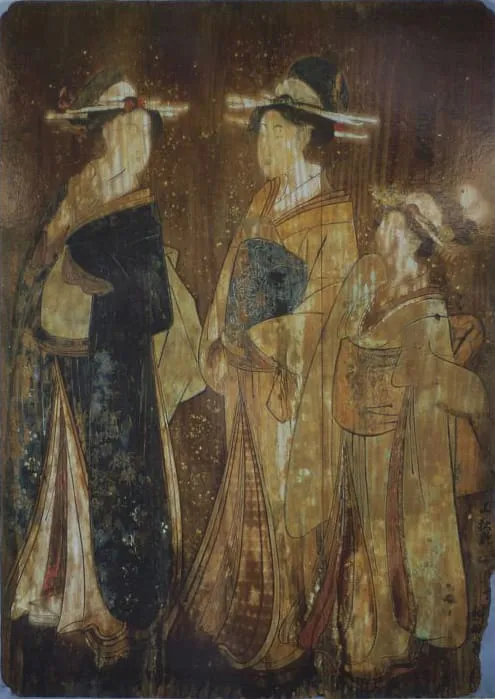
The Edo period produced some of the most accomplished examples. As the ukiyo-e woodblock print tradition developed, the same artists who produced prints were sometimes commissioned for large ema. The image above — a large ema depicting beautiful women in the style of bijinga (beauty paintings) — was created by the ukiyo-e master Utagawa Kunitsune and offered to Hibita Shrine in Isehara, Kanagawa, in 1802. The painting is unambiguously in the visual idiom of its era: commercial print culture translated into a sacred context. No one found this incongruous.
That point is worth dwelling on. In 1802, the cutting-edge visual language of the day — the same aesthetic that was selling prints to urban consumers — was considered an appropriate offering to bring before a deity. The shrine accepted it. The artwork, still extant more than two centuries later, is now a historical document of Edo aesthetics.
This pattern of “the most current art as the most appropriate offering” is the key to understanding everything that comes later, including phenomena the contemporary eye might find strange.
Large ema from the Edo and Meiji periods survive in significant numbers at shrines across Japan. Fujisan Hongu Sengen Taisha in Shizuoka and Kibitsu Shrine in Okayama are among the best-known repositories. These collections function as a kind of distributed art history — a record of regional painting traditions, evolving technique, and the aesthetic priorities of communities across four centuries.
Regional Variation: The Local God in Local Images
Every region of Japan has adapted ema design to local conditions, local deities, and local visual culture.
In fishing communities along the coast, ema depicted ships — sometimes with extraordinary detail, showing rigging and sails accurate enough to date the vessel’s design. In farming villages, rice cultivation appeared in panels offered at the agricultural deity’s shrine. In castle towns under powerful daimyo, ema incorporated family crests and military iconography that would have identified the donor’s allegiance immediately.
Contemporary shrines carry on this regionalism. In Okinawa, shrine ema sometimes incorporate imagery drawn from Ryukyuan decorative traditions — the shīsā guardian lion, the deigo flame tree — rather than mainland Japanese iconography. In Hokkaido, shrines established as recently as the Meiji period as part of the settlement frontier sometimes reference Ainu visual culture or the landscape of the northern island rather than the classical shrine imagery of Honshu.
Shrines that celebrate very specific events produce ema specific to those events. Suwa Taisha in Nagano, whose festival cycle is organized around the Onbashira — a ceremony held every seven years in which massive logs are dragged from the mountains and raised as sacred pillars — produces Onbashira ema available only in those years. To own one is to own a material record of having been present at or near one of Japan’s most dramatic religious events.
Itaema: When Pop Culture Meets the Sacred
In the early 2000s, something new appeared in the ema halls of certain shrines.
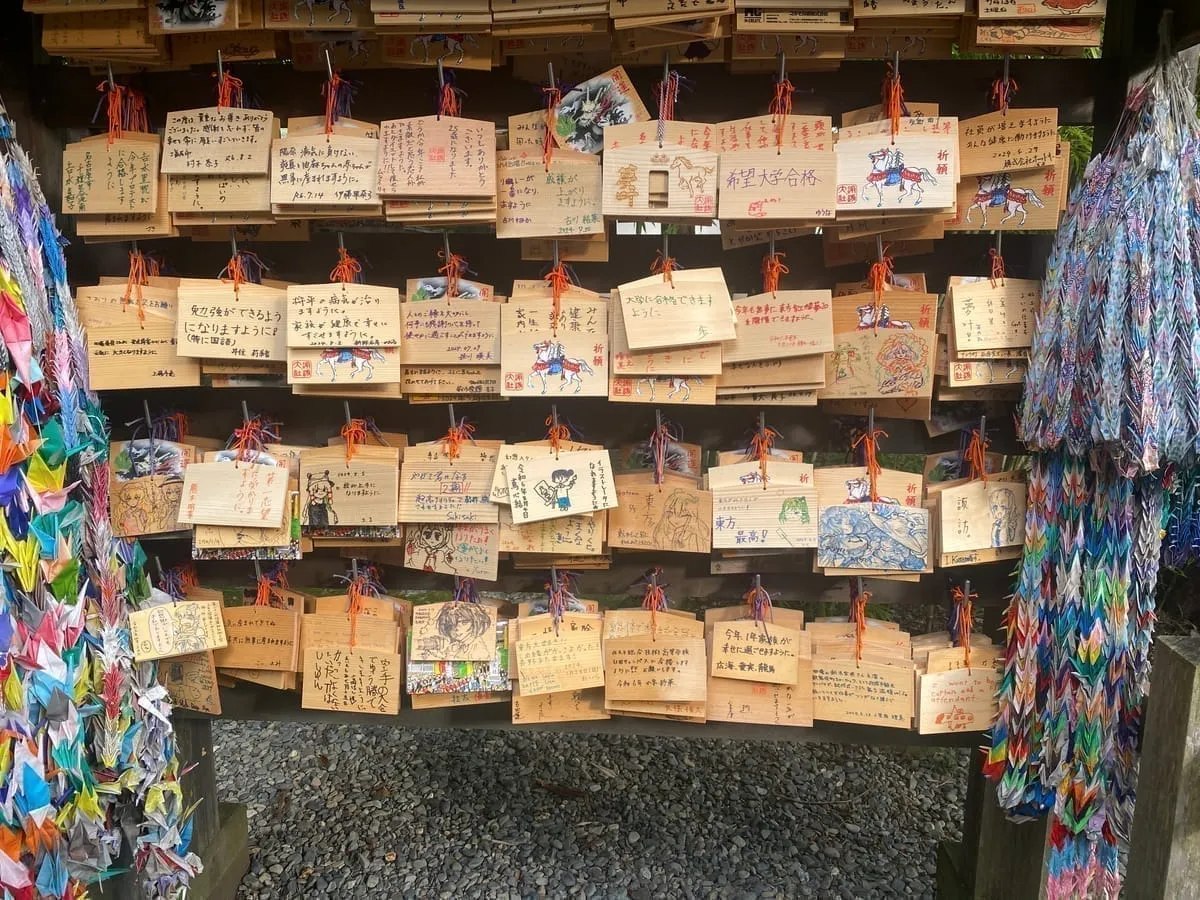
Among the ordinary ema with ordinary wishes, there were boards where someone had drawn — in careful, detailed, often technically impressive line work — an anime character. Not just drawn: the character was framed, posed, and attributed with a wish written in the text space. “Please let [character name] be happy.” “Please let this couple end up together.” “Please let there be a season three.”
These became known as itaema (痛絵馬). The prefix ita (痛) in this usage is otaku slang — the same prefix in “itasha” (a car decorated with anime character wrap decals) — meaning roughly “excessive,” “embarrassing,” or more charitably, “passionately committed.” It is self-deprecating and affectionate simultaneously.
The shrines where itaema first appeared were those that had become pilgrimage sites for anime and game fandoms — places where a popular story was set, or that were name-checked in a show, or that had some thematic connection to a beloved property. Kanda Myōjin in Tokyo, near the Akihabara electronics and otaku district, was an early example. As anime “pilgrimages” to real locations became a recognized phenomenon, the concentration of itaema at certain shrines grew dramatically.
How the Shrines Responded
The initial response from some shrines was discomfort. A few posted rules specifying that only official shrine ema were permitted, or that images considered inappropriate would be removed. The category of “inappropriate” was never precisely defined, which created its own complications.
But the general trajectory over the following years was toward acceptance. The theological argument for acceptance is actually quite simple: an ema is a private transaction between the petitioner and the deity. The shrine hangs the board, but the conversation on the board is not the shrine’s business. Whether the image depicted is a horse, a plum blossom, or an anime character does not change the sincerity of the wish written on the other side.
Some shrines moved further, from tolerance to active participation. Official collaboration ema — produced by game companies in partnership with specific shrines, depicting game characters alongside the shrine’s iconographic elements — became available for purchase in shrine shops. These were marketed to fans precisely as a way to combine pilgrimage and fandom. Some sold out immediately.
The criticism that this represents commercialization of sacred space has genuine force. So does the counter-argument: that ema have always been commercial objects. You buy them in shops. The shops have always been near the shrine gates, sometimes run by the shrine itself. The economics of ema have never been pure.
What is more significant is the continuity with the longer pattern. In 1802, Utagawa Kunitsune offered a painting in the most contemporary commercial visual idiom of the day. In 2010, an anime fan offered a board painted with the most contemporary popular visual culture of their day. The shrine accepted both. The structure of the gesture — the most current art as the most sincere offering — repeats.
Future folklorists who examine the ema halls of the 2020s will find itaema among the ordinary ema of students and patients and lovers. What they will learn is what the people of this era cared about most intensely — which is precisely what ema have always communicated.
The Ema Hall as Social Archive
Reading the ema at a shrine is a form of social research.
In the weeks before university entrance examinations, the ema halls at Tenmangū shrines fill with specific wishes: “Keio University,” “Waseda University,” “National Medical School.” The names are written in full, without embarrassment. This combination of very public aspiration and very personal prayer is characteristic of ema culture — the wish is private in content but public in placement.
Shrines associated with romantic partnership produce a different archive. “Please let me find the person I’m meant to be with.” “Please let things work out with [name].” “Please give him the courage to confess.” These are rarely written in the flat language of bureaucratic requests; they are often written with a distinctive emotional register, the kind that people save for prayers and letters.
Shrines associated with illness and recovery carry the heaviest ema halls to read. Many of the boards are not written by the patient but by a family member: “Please let my mother recover.” “Please give my father strength.” The distinction between praying for oneself and praying for another person is nowhere more visible than in the ema of a health-focused shrine.
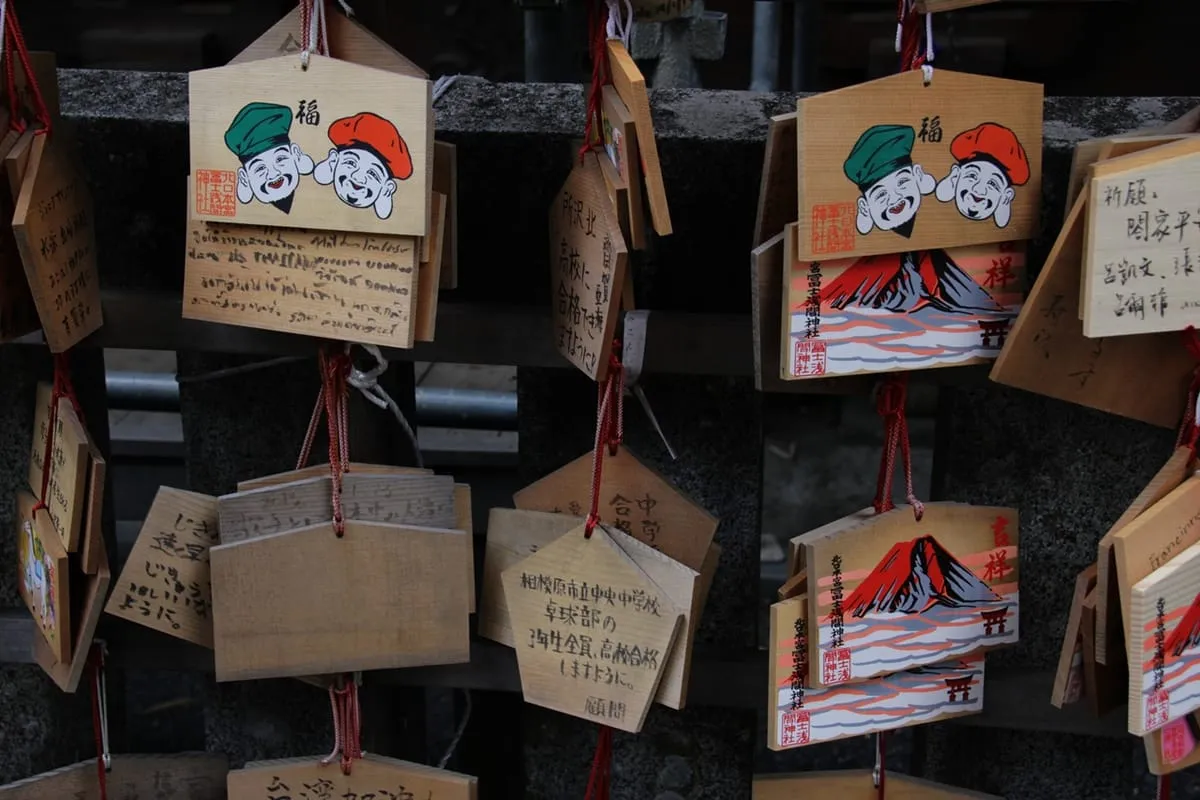
The ema hall is not a place that invites lingering the way a garden or a landscape does. The air is usually quiet. The boards creak slightly. What you read there is not representative — it is a self-selected sample of the people who pray aloud, who commit a wish to writing, who are willing to let strangers read what they hope for. But within that sample, the range of human concern is on full display.
Ema and Goshuin: Two Traditions at the Same Window
Most visitors who receive goshuin (the red-ink seal stamps kept in accordion-fold books as a record of shrine visits) collect them from the same administrative office — the shamusho or juyusho — that sells ema. The two practices are often conducted simultaneously: you hand over your goshuin book at the window and while waiting, you browse the ema selection displayed nearby.
Both goshuin and ema express the visual identity of a specific shrine. The design of a shrine’s ema and the design of its goshuin are often in dialogue with each other — sharing motifs, referencing the same deity, responding to the same seasonal occasions. Shrines that issue limited-run goshuin for the plum-blossom season often sell plum-motif ema at the same time.
Collecting both creates a layered record of a visit. The goshuin documents the fact of having been there: the date, the shrine’s visual identity, the calligrapher’s hand. The ema documents the act of having prayed, the wish that existed at that moment. Together they constitute a more complete archive than either does alone.
Among dedicated collectors, the relationship between goshuin and ema is sometimes extended into a twelve-year project: gathering both from the same shrine each year, through one full zodiac cycle, tracking how both traditions evolve over time. The goshuin books stack up. The ema — or photographs of them, since the originals stay at the shrine — accumulate in a separate album. At the end of twelve years, the collection is a document of a specific human life in relation to a specific sacred place.
Hanging One Yourself
If you want to participate, the process is straightforward.
Ema are available for purchase at the shrine’s office or shop (shamusho / juyusho). Prices typically range from ¥300 to ¥1,000 for standard sizes; special or large ema cost more. Some shrines sell ema only during specific periods — limited seasonal designs or ema tied to particular festivals — so checking the shrine’s website before visiting is useful if you are looking for something specific.
Write on the undecorated back surface with a permanent marker or ink pen. Pencil fades outdoors; a permanent-ink implement will keep your wish legible longer, which matters since ema typically hang exposed to the elements for months before being ritually burned.
The writing convention is “please let [wish] happen” (〜しますように), though some people write in the form of a declaration or commitment: “I will [goal].” There is no authoritative ruling on which is correct. Fill in the name, address, and date fields if you wish; leaving them blank is also acceptable. Wishes written anonymously are received the same as those with names attached.
Hang the finished ema in the ema hall, on one of the horizontal rods or hooks provided. Some traditions hold that the decorated side should face the sanctuary — but conventions vary by shrine. When in doubt, look at how other ema in the hall are hung and follow the pattern.
The ema will remain in the hall until the shrine conducts a ritual burning (otakiage), usually annually, through which the wishes rise as smoke. The fact that the object is made to be destroyed is built into its design. An ema is not a souvenir. It is a message addressed to somewhere the sender is not going.
A Long Line of Wishes
From a clay figurine buried in Asuka-period soil to a hand-drawn anime portrait hung on a Shinjuku shrine gate — the lineage of ema covers fourteen centuries and an enormous range of human expression.
What changed: the materials, the imagery, the scale, the people who made and received and sold them. What remained: the act of making a wish tangible, giving it weight and surface and specificity, and placing it in a location that has been designated — by architecture, by tradition, by collective agreement — as a place where such things are heard.
The next time you pass through the wooden frame of an ema hall, look at a few of the boards before you reach for a blank one.
Read what other people have written. Look at the imagery the shrine has chosen to represent itself. Find the oldest board you can — weathered gray, the ink faded to near-illegibility — and try to make out what it says. Someone stood where you are standing now and wrote that. The wish was real. The god, according to the logic of the place, received it.
The blank board you are about to write on is the same kind of object it has always been: an interface between what you want and what is possible, in a form that fits in your hands.
Related Articles
- Ema Halls and Ema Plaques | The Architecture and History of Written Votive Offerings
- Reading Shrine Roofs | What Chigi and Katsuogi Tell You About the Deity Inside
- Goshuin as Art | Appreciating the Design of Shrine Seal Stamps
Image Licenses
- Ema hanging at a Japanese shrine: Ema plaques in Japan (travel oriented / CC BY-SA 2.0), via Wikimedia Commons
- Ema by Utagawa Kunitsune at Hibita Shrine, 1802: Public Domain, via Wikimedia Commons
- Suwa Taisha Ema: (Immanuelle / CC BY 4.0), via Wikimedia Commons
- Ema at Mt. Fuji pilgrim path: Japan - Fujisan - Ema (Vanvelthem Cédric / CC BY-SA 4.0), via Wikimedia Commons