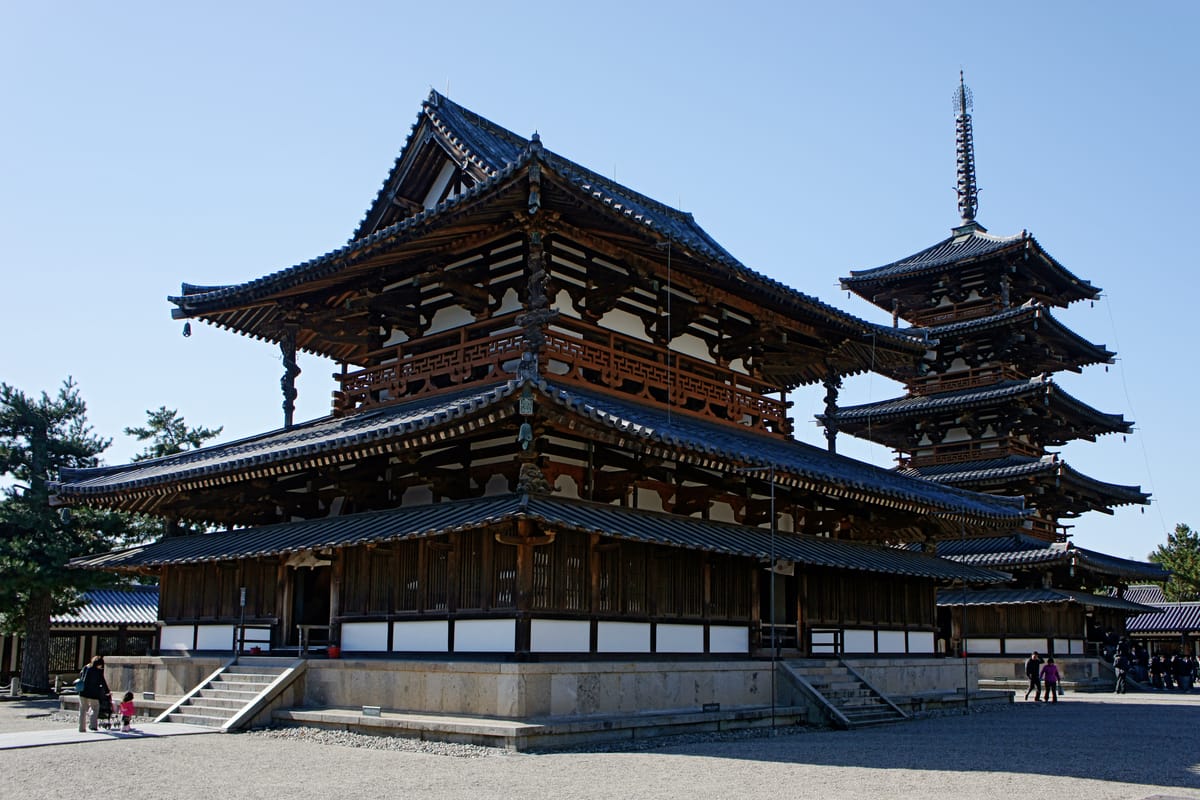
In the history of Japanese Buddhism, few figures changed more than Hōnen (法然, 1133–1212). Before him, Buddhist salvation was in practice the reward of rigorous monastic training: years of meditation, mastery of doctrine, strict observance of precepts. The vast majority of people — farmers, warriors, fishermen, women — existed at the margins of a religious system accessible mainly to monks and aristocrats.
Hōnen changed the terms entirely. After three decades of the most demanding Buddhist study available in Japan, he concluded that it all pointed toward one answer: anyone, without exception, could be saved by sincerely calling the name of Amida Buddha — “Namu Amida Butsu.” Not as a supplement to other practices, but as the one sufficient act. This teaching, which he called senju nembutsu (exclusive nembutsu), founded the Jōdo-shū (Pure Land School) in 1175 and reshaped Japanese religious life for centuries.
His life was not serene. He watched two disciples executed by imperial order. He was exiled at seventy-four. He spent his last year in Kyoto knowing his movement was still formally suppressed. He died at eighty having spent his final day writing a single sheet of paper that compressed his entire teaching into a few dozen words. That document — the Ichimai Kishōmon — is held at Chion-in temple in Kyoto as a national treasure.
Birth and a Father’s Dying Words
Hōnen was born in 1133 in Mimasaka Province (present-day Okayama Prefecture), the son of a local warrior-class landowner named Uruma no Tokikuni. The year falls near the beginning of the long disintegration of the Heian court order: the Hōgen Rebellion (1156) was coming, then the Genpei War, then the Kamakura shogunate. The Buddhist concept of mappō — the final age of the Dharma, when teachings persist but practice can no longer lead to awakening — was felt with growing urgency throughout this period.
In 1141, when Hōnen was nine years old, his father was killed in a night attack by a rival warrior. According to tradition, Tokikuni’s dying words to his son were: “Do not seek revenge. Take the Buddhist path, and seek salvation for me and for all beings.” Whether or not these exact words were spoken, they resonate unmistakably with the trajectory of Hōnen’s entire life — a turn away from the logic of retaliation and toward universal compassion.
The following year, Hōnen left home to begin monastic life under his uncle Kanshaku at Bodaiji temple. He was ten years old.
Thirty Years on Mt. Hiei — The Limits of Effort
At fifteen (1147), Hōnen ascended Mt. Hiei and entered Enryakuji, the great Tendai temple complex at the center of Japanese Buddhist intellectual life. The monks who would define Kamakura Buddhism — Shinran, Eisai, Dōgen, Nichiren — all trained here. For three decades, so did Hōnen.
His primary teacher was Eikū (叡空), who gave him the dharma name “Hōnen-bō” — “one who follows the natural law of the Dharma.” Tendai’s root teaching held that all sentient beings possess Buddha-nature. In principle, rigorous shikan practice could bring any monk to realization. In practice, Hōnen found that even the most intense effort did not resolve the fundamental problem of desire and delusion. Records indicate he read key Pure Land texts — Genshin’s Ōjōyōshū, Chinese nembutsu treatises — dozens of times over, seeking a path adequate to the mappō age.
The question that formed over thirty years was structural: if salvation requires conditions most human beings cannot meet, it is not universal salvation. What would a Buddhist path look like that was genuinely available to everyone — farmers, women, sinners — as the real path, not a diminished substitute?
The Line That Changed Everything
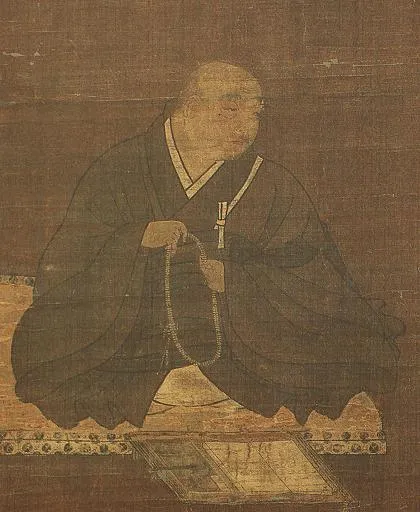
Hōnen’s answer came not from a living teacher but from a text. The Chinese Pure Land master Shandao (善導, 613–681) had written a monumental commentary on the Contemplation Sutra (Kanmuryōjukyōsho). In it, Hōnen found this line:
“With one mind, exclusively recite the name of Amida; whether walking, standing, sitting, or lying down; regardless of how long, moment by moment without ceasing — this is called the act of right determination, because it accords with the Original Vow of that Buddha.”
The key term is shōjōgō — the act that guarantees birth in the Pure Land. Shandao identified it as the nembutsu alone. Not visualization practice (which requires sophisticated mental capacity), not sutra recitation (which requires literacy), not monastic precepts (which require ordination) — but the spoken name, accessible to any human being with a voice and a sincere mind.
Amida’s Original Vow — the eighteenth of forty-eight vows made before becoming Amida Buddha — promised to welcome into the Pure Land all who sincerely called his name. Shandao’s commentary confirmed that this vow was the doctrinal foundation for understanding nembutsu as the one sufficient practice.
This realization is traditionally dated to 1175, when Hōnen was forty-three. Jōdo-shū counts this as its founding year.
The intellectual path matters. Hōnen was not simplifying because he lacked the capacity for complexity. He simplified because thirty years of maximum complexity had led him to see that the complex path served only those capable of following it — and that Amida’s vow, taken literally, had no such restriction.
Yoshimizubō — The Hermitage Where Everyone Arrived
After descending Mt. Hiei, Hōnen established himself at a hermitage in Yoshimizu, Kyoto, and began teaching. People came from every direction and every social stratum.
Kujō Kanezane (九条兼実), one of the most powerful aristocrats in Japan — regent to the Emperor — became a devoted follower and later commissioned Hōnen’s major doctrinal work. Monks came, some to argue, some to convert. And farmers, women, warriors, and people whose livelihoods involved killing — the hunters, fishermen, and butchers that traditional Buddhist ethics placed at a moral disadvantage — came too.
The nembutsu’s power lay precisely in its lack of prerequisites. No literacy required. No monastic setting. No ritual implements. No ordained teacher. No requirement to have already cleaned up one’s moral record. Only sincere calling of the name. In mappō, Hōnen argued, this was the one practice appropriate to the capabilities of the age.
Among those who came was the young Shinran (親鸞, 1173–1263). After years on Mt. Hiei, Shinran had reached the same impasse Hōnen had. Hōnen’s answer unlocked something he would spend the rest of his life extending further. Shinran later wrote that without Hōnen, he would have wandered in delusion until death. Teacher and disciple — each destined to found a denomination still active today — represent one of the most consequential encounters in Japanese Buddhist history.
The Senchakushū — Hōnen’s Major Work
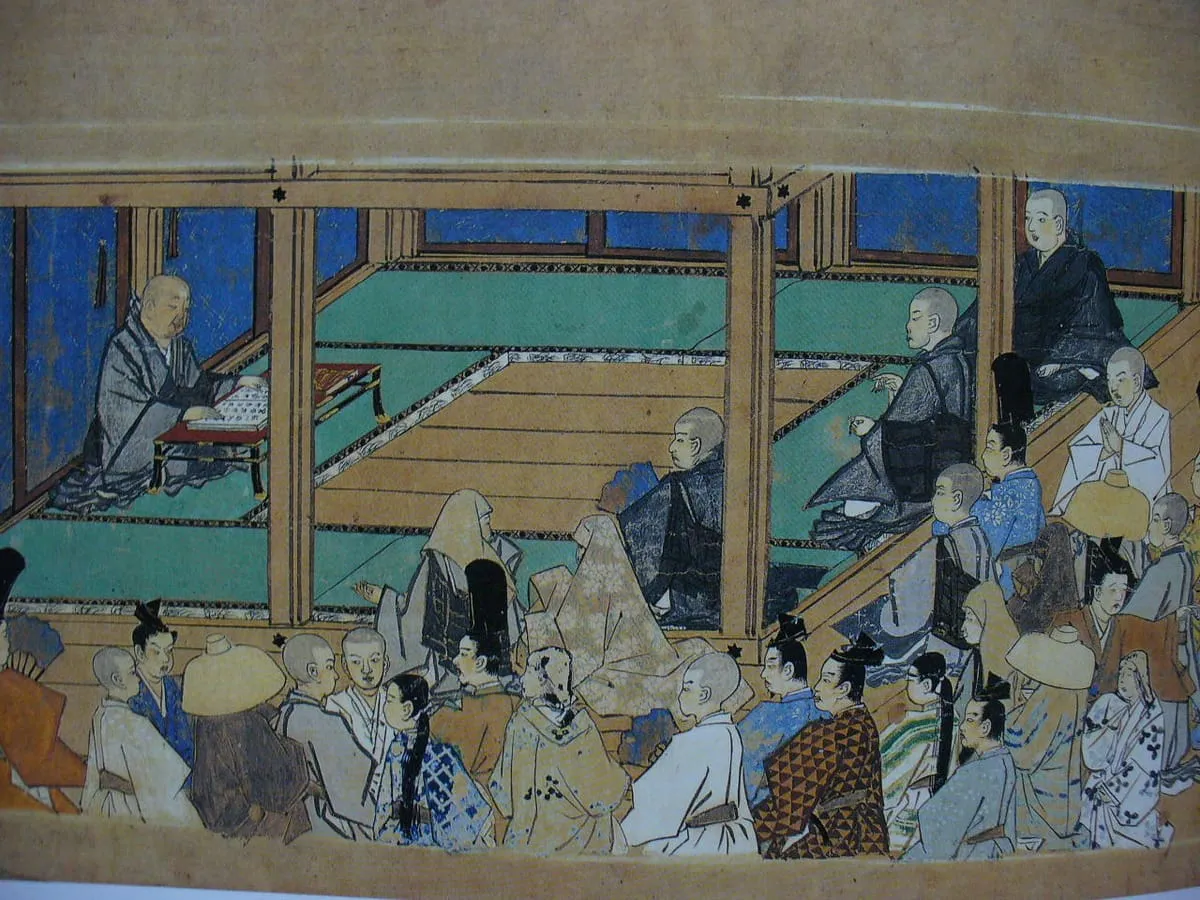
In 1198, at sixty-six, Hōnen wrote the Senchakushū (選択本願念仏集, “Collection on the Choice of the Nembutsu of the Original Vow”) at Kujō Kanezane’s request. The title encodes the central argument: Amida chose (senchaku) the nembutsu as the practice most suited to saving all beings.
The text divides Buddhist practices into shōgyō (right practice — the nembutsu) and zōgyō (mixed practices — everything else), arguing one should abandon the mixed and focus exclusively on the right. This infuriated the Buddhist establishment. To claim that sutra chanting, meditation, precept observance, and ritual were not valid paths to salvation undercut the foundations of every other Buddhist school. Hossō, Tendai, Shingon — all found their core practices implicitly devalued. The criticism was fierce.
Hōnen did not publish the Senchakushū widely during his lifetime — it circulated in manuscript among close disciples. After his death it spread broadly and is now held at Chion-in as a national treasure.
The Jōgen Persecution — Exile at Seventy-Four
In 1207, the imperial court moved against Hōnen’s movement in what is known as the Jōgen Persecution (承元の法難). The proximate cause was a scandal: two disciples were accused of misconduct with court ladies-in-waiting. Retired Emperor Go-Toba ordered both disciples executed, stripped Hōnen of his monastic status, and exiled him to Tosa Province (present-day Kōchi). Hōnen’s disciple Shinran was simultaneously exiled to Echigo Province (present-day Niigata).
Hōnen was seventy-four. He was given the secular name Fujii Motohiko — “not a monk” by imperial decree — and sent to a remote coastal province. Behind the surface scandal lay years of accumulated pressure from the established schools, whose representatives had long petitioned the court against the exclusive nembutsu movement.
What is striking in the historical record is the absence of bitterness in Hōnen’s response. He reportedly told his disciples that the nembutsu could be practiced anywhere — in exile as well as in Kyoto, without a temple as well as with one. The practice was, by definition, one that no institution could take away.
The exile lasted four years. In 1211, Go-Toba lifted the ban and permitted Hōnen to return to Kyoto. He was seventy-nine.
The One-Sheet Document — His Final Word
Back in Kyoto at Ōtani (near present-day Chion-in), Hōnen spent his last months receiving visitors. The records describe a steady stream: monks, aristocrats, farmers, warriors, and women arriving to hear the nembutsu teaching from the old man in his final year.
On January 24, 1212 — one day before his death — Hōnen’s disciple Genchi asked him to write a summary of his teaching. The result was the Ichimai Kishōmon (一枚起請文, “One-Sheet Document”):
“The nembutsu I have in mind is neither the contemplative practice that the Chinese and Japanese masters have elaborated, nor the nembutsu arising from deep study and understanding. It is simply: for the sake of birth in the Pure Land, recite ‘Namu Amida Butsu’ with the settled conviction that you will be born there, without any doubt. The three minds and four practices are all contained within this conviction. If I had any deeper insight than this, I would be departing from the compassion of Amida and Śākyamuni, and falling outside the Original Vow. Anyone who believes in the nembutsu, even if they have studied all Buddhist teachings thoroughly, should become like an ignorant person — like a nun or lay practitioner with no learning — and simply chant the nembutsu wholeheartedly.”
The document is a paradox written by the most learned Buddhist in Japan: the scholar who spent thirty years on Mt. Hiei says that learning is not the point. The one who knows more than almost anyone says the answer requires knowing almost nothing.
Hōnen died on January 25, 1212. He was eighty years old.
The Disciples and the Institutions That Followed
After Hōnen’s death, his disciples developed his teaching in diverging directions.
Shinran pushed the exclusive nembutsu to its logical extreme: if self-power is to be entirely abandoned, then even the act of chanting must be understood as Amida’s gift rather than the practitioner’s contribution. Even faith itself is given by Amida, not generated by the human being. From this position, Shinran developed the teaching of akunin shōki (evil persons are precisely those Amida saves) and founded Jōdo Shinshū — now the largest Buddhist denomination in Japan.
Shōkō (聖光) became the key figure in institutional continuity, systematizing the Chinzei branch of Jōdo-shū, which continues as mainstream Jōdo-shū today.
The disciple Genchi established a memorial hall at Ōtani after Hōnen’s death. This became the seed of Chion-in. The complex grew substantially under Tokugawa patronage — the shogunate took Jōdo-shū as its denominational affiliation, and the current main hall was built in 1639. The Sanmon gate, built in 1621 by Tokugawa Hidetada, stands twenty-four meters tall and fifty meters wide — among the largest wooden gates in Japan, and a national treasure.
Visiting Jōdo-shū Temples for Goshuin
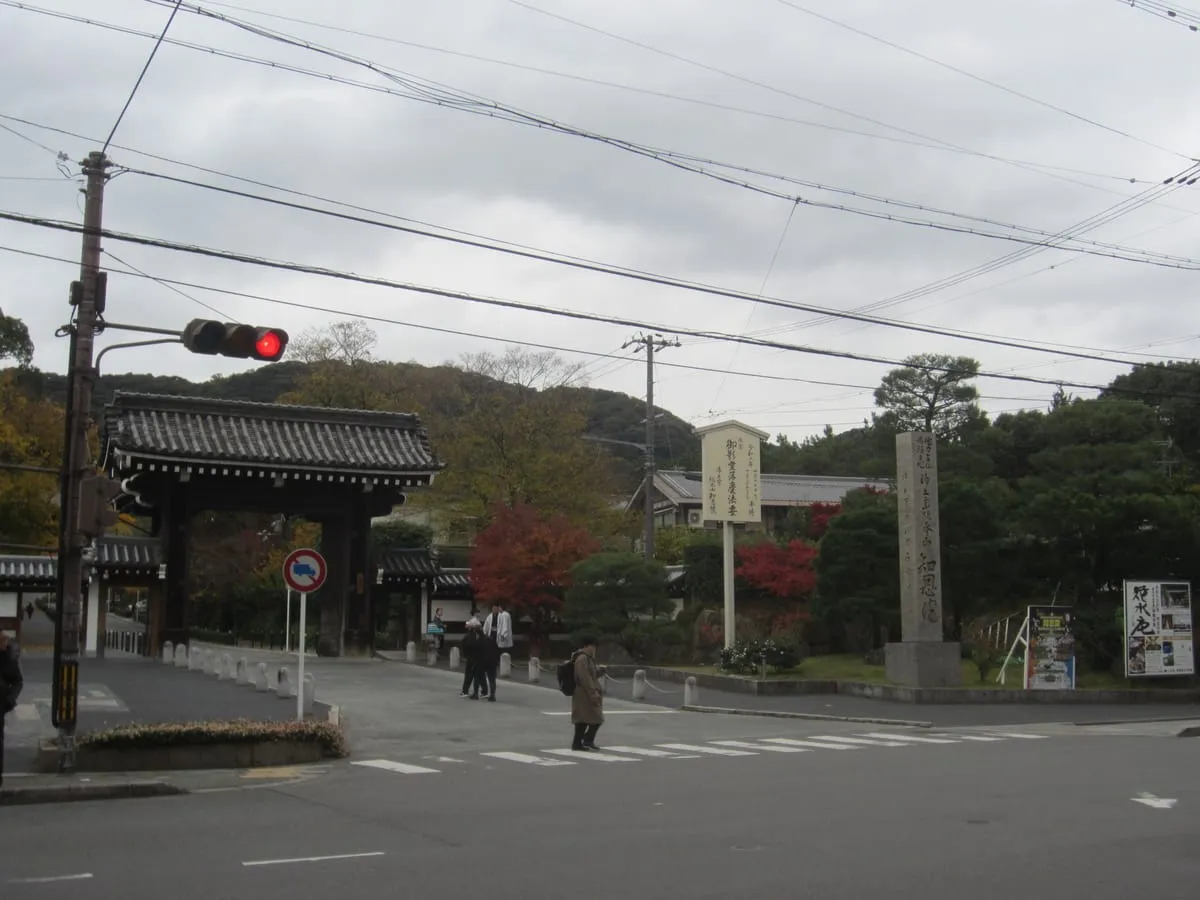
Chion-in (Kyoto, Higashiyama Ward) The head temple of Jōdo-shū, built on the site where Hōnen lived and died. The Sanmon gate and the vast Miedō (main hall) are national treasures. Goshuin typically feature “Hōnen Shōnin” and “Seishi Bosatsu.” The anniversary of Hōnen’s death (January 25) brings the annual Gyoki Daie ceremony, one of the most important annual events in Jōdo-shū.
Zōjōji (Tokyo, Minato Ward) Grand head temple of Jōdo-shū and the mortuary temple of the Tokugawa shoguns, located beside Tokyo Tower. Goshuin typically feature “Namu Amida Butsu” in bold calligraphy.
Kōmyōji (Nagaokakyo City, Kyoto Prefecture) One of Jōdo-shū’s grand head temples, associated with sites where Hōnen preached and where some of his remains were enshrined. Famous for its autumn maple corridor (Momiji Sandō), among the most celebrated in the Kansai region. Goshuin center on “Hōnen Shōnin.”
Zenkōji (Nagano City, Nagano Prefecture) Jointly administered by Tendai and Jōdo-shū. Its absolute secret Buddha — the “Ikō Sanzon Amida Nyorai,” said to be the oldest Buddhist image in Japan — has never been publicly displayed. Goshuin include “Enri Issai Ku” and “Amida Nyorai.”
The goshuin of Jōdo-shū temples often feature the six characters of the nembutsu — 南無阿弥陀仏 — in strong, direct calligraphy. When you receive such a goshuin, the brushwork connects directly to the teaching Hōnen left on one sheet of paper the day before he died: that those six syllables, recited sincerely, are all that is necessary.
Hōnen’s life spans nearly a century of transformation — from the late Heian court order through the establishment of the first warrior government. His teaching emerged from the most intensive Buddhist education available and arrived at the most accessible conclusion possible: anyone can be saved by sincere nembutsu, without exception. The Jōdo-shū today maintains roughly 7,000 temples; Jōdo Shinshū — founded by Hōnen’s disciple Shinran — adds another 22,000. Together the Pure Land lineages tracing to 1175 constitute a defining strand of Japanese Buddhist life.
What Hōnen left behind, beyond institutions and texts, is a question embedded in Japanese religious culture: what does it mean for salvation to be genuinely universal? His answer — that it must require nothing beyond human capacity — reshaped the entire landscape of what Japanese Buddhism could be.
Walking through the Sanmon gate at Chion-in, it is possible to feel both the institutional weight of eight centuries and the strange lightness of what the man who started it all actually taught: that the gate to salvation needs no gate at all.
Image Credits
- Portrait of Hōnen (Takanobu-no-miei.jpg): Attributed to Fujiwara Takanobu (1142–1205), Public Domain, via Wikimedia Commons
- Hōnen Shōnin Eden scene (Honen_shonin_eden_-_Honen_establishes_Jodo_shu.jpg): Unknown artist (14th century), Public Domain, via Wikimedia Commons
- Chion-in Sanmon gate (Gate_of_Chion-in_Temple.jpg): Another Believer, CC BY-SA 4.0, via Wikimedia Commons