Jodo Shinshu — the True Pure Land School of Buddhism — is today the largest Buddhist denomination in Japan by number of temples (roughly 22,000) and affiliated households (over 8 million). Its founder, Shinran (1173–1263), lived ninety years across one of the most turbulent eras in Japanese history, and the ideas he developed during that long life continue to shape Japanese culture, philosophy, and architecture to this day.
Shinran’s story is stranger than most religious biographies: a monk who spent twenty years failing to find peace through rigorous practice, who was exiled by imperial order, who married and had children in defiance of clerical convention, and who believed that evil people are more suited to salvation than the virtuous — not despite this but because of it.
Understanding his life transforms a visit to any Jodo Shinshu temple. The six characters of “Namu Amida Butsu” carry a meaning impossible to grasp without knowing what Shinran had suffered and what he ultimately believed.
Birth and a Childhood Defined by Loss
Shinran was born in 1173 in Kyoto. His father, Hino Arinori, came from a minor aristocratic lineage tracing back to the Fujiwara clan. His mother likely died when Shinran was very young. The year of his birth was itself a hinge in Japanese history: the Taira-Minamoto war was building, and by 1185 one clan would be annihilated, with the Kamakura shogunate emerging shortly after to permanently shift political power away from the Kyoto imperial court. Into this fracturing world — where the Buddhist concept of mappō (the age of the Dharma’s decline) felt increasingly literal — Shinran grew up.
At age nine, he entered Shōren-in, a temple at the foot of Mt. Hiei, to become a Buddhist monk. His tonsure was performed by Jien (1155–1225), the head of Shōren-in, who would later write the Gukanshō, one of the great historical chronicles of Japan. The child who climbed into the monastic world in 1181 would not come back down until he was twenty-nine.
Twenty Years on Mt. Hiei — The Failing of Effort
Mt. Hiei, rising above northeastern Kyoto, was then the home of Enryakuji, the great Tendai temple complex founded by Saichō in 788. It was the center of Japanese Buddhist life — the institution from which Honen, Eisai, Dogen, and Nichiren all emerged. Its root teaching, drawn from the Lotus Sutra, held that all sentient beings possess Buddha-nature: the potential for awakening. Its meditative system, shikan, aimed to cultivate both stillness and insight simultaneously.
Shinran practiced there for approximately twenty years. And by his own later account, he found no resolution. He emerged from two decades of Tendai training with one dominant conviction: that saving oneself through one’s own effort is fundamentally incoherent. The more carefully you practice, the more clearly you see the depth of your own desires, resentments, and delusions. Self-power (jiriki) is a path that reveals its own impossibility the further you travel it. In 1201, at twenty-nine, Shinran descended from the mountain.
The Meeting with Honen — A Door Opens
After a hundred-day retreat at Rokkakudō temple in Kyoto (during which he reportedly received a dream revelation directing him toward the nembutsu path), Shinran went to Yoshimizubō, where Honen (1133–1212) was teaching.
Honen had reached a similar impasse through similar logic. His answer: the nembutsu — “Namu Amida Butsu” — was not merely a supplementary practice but the one and only practice adequate to the current age of mappō. Amida’s Original Vow, the eighteenth of forty-eight vows attributed to the bodhisattva Dharmākara before becoming Amida Buddha, promised to bring to the Pure Land all who sincerely called his name. Honen took this literally: not only monks who also practiced the nembutsu, but anyone who wholeheartedly called the name.
Shinran spent six years as Honen’s disciple (1201–1207). He later wrote that without Honen, he would have wandered in delusion until death. Honen told him that worthiness was not the criterion. Amida’s Vow had already resolved the problem. From this foundation, Shinran went further than his teacher.
Persecution and Exile — Neither Monk nor Layman
In 1207, the imperial court moved against Honen’s movement. Two disciples were accused of misconduct with court ladies-in-waiting. Honen was exiled to Tosa Province; Shinran was exiled to Echigo Province (present-day Niigata) on the Sea of Japan coast.
Stripped of his monastic status by imperial decree and given a secular name, Shinran reframed his situation with characteristic directness: he declared himself hisō hizoku — “neither monk nor layman.” He adopted the self-designation “Gutoku Shaku no Shinran” — roughly, “the foolish, shaved-headed Shinran.” Gutoku is self-deprecating: foolish and bald. He made it a lifelong identity.
By refusing to identify with either institutional category, Shinran located himself in the gap between them — precisely where, he believed, the unconditional grace of Amida’s Vow becomes most visible. The institutions of Buddhism classified and ranked people. Amida’s Vow, in Shinran’s understanding, made no such distinctions.
Life in Echigo — Marriage and a New Kind of Buddhism
During exile (1207–1211), Shinran married Eshinni. A monk marrying publicly was formally a violation of the precepts — not unheard of in practice, but rarely acknowledged openly. Shinran not only acknowledged it but made it part of his theological position. If the path of rigorous monastic purity leads only to a clearer view of one’s own impurity, then celibacy is not the mechanism of salvation. Those in the secular world — with all its attachments — are not disqualified from Amida’s grace. Quite the opposite.
The practical consequence played out across centuries: Jodo Shinshu became the Buddhist denomination most associated with married clergy, with temple families passing responsibilities from parent to child. The in-ke (hereditary temple household) system that characterizes much of Japanese temple culture today has its distant origin in Shinran’s Echigo decision.
Eshinni’s letters — the Eshinni Monshō — survived and are housed in the Kyoto National Museum. They are among the most important primary sources for Shinran’s early life, describing his dream at Rokkakudō, his discipleship with Honen, and everyday aspects of their life together.
Akunin Shōki — Evil People Are Saved First
The teaching most closely associated with Shinran — and most consistently misunderstood — is akunin shōki: “evil people are the right persons for Amida’s salvation.”
The logic: A “good person,” in Shinran’s sense, is someone who believes they can accumulate merit and thereby earn salvation. This person still relies on jiriki, self-power. Because they trust their own efforts, they cannot fully open themselves to tariki — the working of Amida’s Vow. Their very goodness keeps them at a distance from the unconditional grace on offer.
A “bad person” is someone who cannot pretend to have earned their way to salvation — who knows they have killed, stolen, desired, deceived, and cannot stop. This person, encountering Amida’s Vow, has nowhere else to place trust. Complete inability to maintain any pretense of self-sufficiency is exactly the right condition (shōki) for receiving Amida’s gift.
The famous line from the Tannishō (Chapter 3):
Zennin naho mote ōjō o togu, iwan ya akunin o ya. “Even a good person attains birth in the Pure Land — how much more so an evil person.”
Shinran knew this would be misread as permission to sin. The Tannishō addresses it directly: using the Vow as a license for wrongdoing is still self-assertion — still relying on one’s own manipulation of cosmic rules. Recognizing the depth of one’s evil without self-deception is the condition for receiving grace.
Akunin shōki also carried a social dimension. Fishermen, hunters, and others whose livelihoods involved killing were considered ritually impure and largely inaccessible to conventional Buddhist salvation. Women were similarly ranked below monks in the existing hierarchy. Shinran’s declaration that these were the most appropriate targets of Amida’s saving work was a direct challenge to the class structure embedded in established Buddhist practice.
Tariki Hongan — The Power That Is Not Yours
“Tariki hongan” appears in modern Japanese as a phrase meaning “relying on someone else to do your work.” This is the opposite of its Buddhist meaning.
Tariki is “other power” — the power of Amida Buddha, not the practitioner. Hongan is “original vow” — specifically Amida’s eighteenth vow to bring to the Pure Land all who call his name with sincere faith. “Tariki hongan” means entrusting oneself completely to Amida’s vow — not outsourcing work to another person, but releasing the project of self-salvation entirely.
Where Honen located the cause of birth in the Pure Land in the act of calling the nembutsu, Shinran argued the nembutsu was the expression of an already-accomplished salvation, not the cause. The true cause is shinjin: a deep dispositional faith — not an act one performs but a condition one receives. And crucially: even this faith is not something the practitioner generates. Shinjin is itself Amida’s gift. The nembutsu that follows is gratitude (hōon), not payment.
This — shinjin shōin, shōmyō hōon (faith as the true cause, nembutsu as gratitude) — is what distinguishes Jodo Shinshu from Jodo Buddhism: Honen centered practice; Shinran centered receiving.
The Kanto Years and Return to Kyoto
After receiving a pardon in 1211, Shinran moved around 1214 with his family to the Kanto region (Hitachi Province, present-day Ibaraki Prefecture) and taught among farming communities for roughly twenty years. He wrote wasan — hymns in Japanese rather than classical Chinese — making his teachings accessible to people who could not read the scriptures. The Jōdo Wasan, Kōso Wasan, and Shōzōmatsu Wasan remain part of Jodo Shinshu liturgy today.
His major systematic work, the Kyōgyōshinshō (Teaching, Practice, Faith, and Attainment), was drafted during this period — dense and scholarly, citing extensively from Indian and Chinese Buddhist sources to support radical conclusions. Shinran did not position himself as an innovator; he positioned himself as one who had finally understood what the tradition was pointing toward all along.
During the Kanto years he also disowned his son Zenran, who had been claiming special secret authority from his father and sowing discord in the communities. For Shinran, the integrity of the teaching outweighed family loyalty.
Around 1235 he returned to Kyoto, spending his final decades writing, revising, and corresponding with Kanto followers by letter.
The Tannishō and Shinran’s Voice
The Tannishō (Lamenting the Deviations) is among the most widely read texts in the Japanese literary canon. Compiled by Yuien, a disciple who traveled from Kanto to confirm Shinran’s teaching firsthand, it records Shinran’s actual words — direct, sometimes startling prose that reads like a man who has completely thought through a position and states it without equivocation.
The opening: “When the thought arises to call the nembutsu, trusting that we will attain birth in the Pure Land through the inconceivable working of Amida’s Primal Vow, at that very moment we receive the benefit of being embraced and never abandoned.”
Rennyo, the eighth Honganji head who transformed Jodo Shinshu into a mass movement, reportedly restricted the Tannishō’s circulation as a text too dangerous for general distribution. It only reached wider audiences in the Edo period. Its modern rehabilitation is credited to the philosopher Kiyozawa Manshi (1863–1903), who read it as a document of total honesty about human limitation. It has since been translated into dozens of languages.
Death, Legacy, and the East-West Split
Shinran died on January 9, 1263, at ninety. His last recorded words: “Just call the nembutsu and be saved by Amida.”
He never claimed to be founding a new sect. He consistently identified himself as a disciple of Honen and established no formal institutional structures. The organization of Jodo Shinshu as a distinct denomination was the work of his great-grandson Kakunyo (1270–1351), who formally established Honganji in 1321.
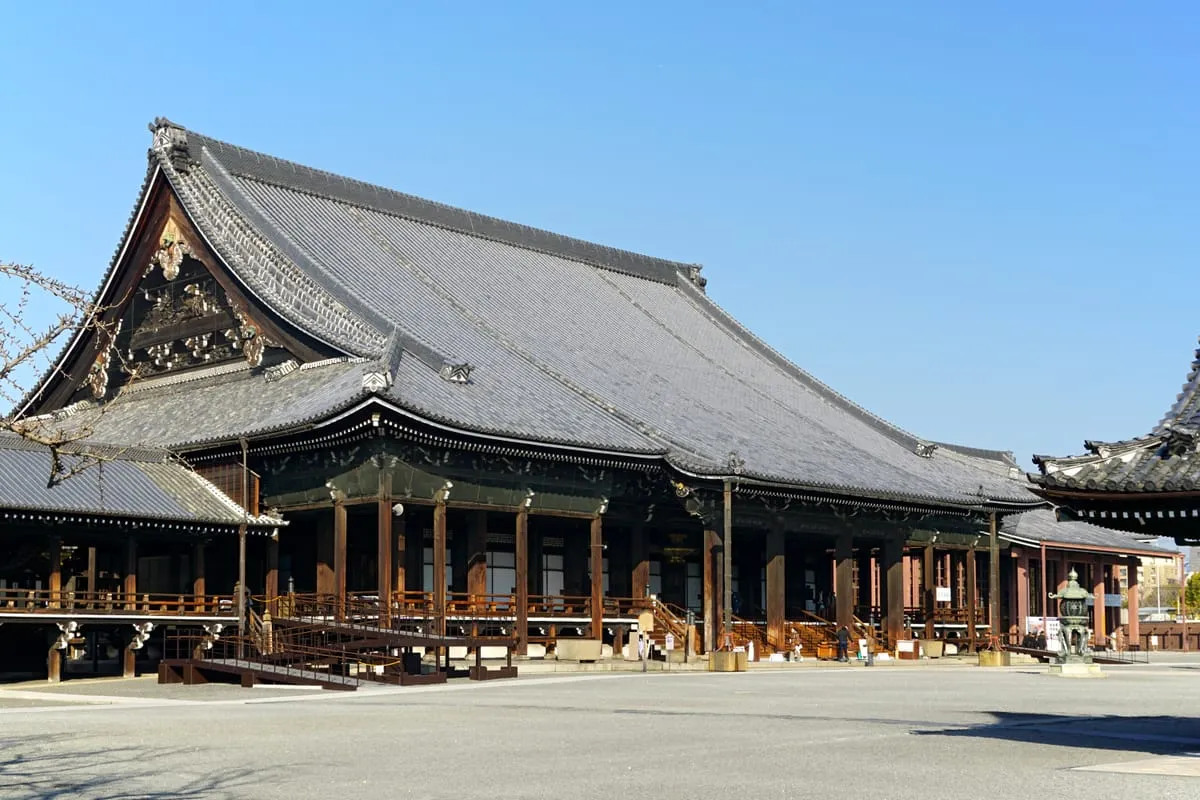
By the sixteenth century, Honganji had become one of the most powerful institutions in Japan — capable of mobilizing armed uprisings (ikkō ikki) and sustaining a decade-long military resistance to Oda Nobunaga (the Ishiyama War, 1570–1580). After Honganji vacated its fortress at Ishiyama (present-day Osaka), Toyotomi Hideyoshi granted it land at Shichijō-Horikawa in Kyoto — where Nishi Honganji stands today.
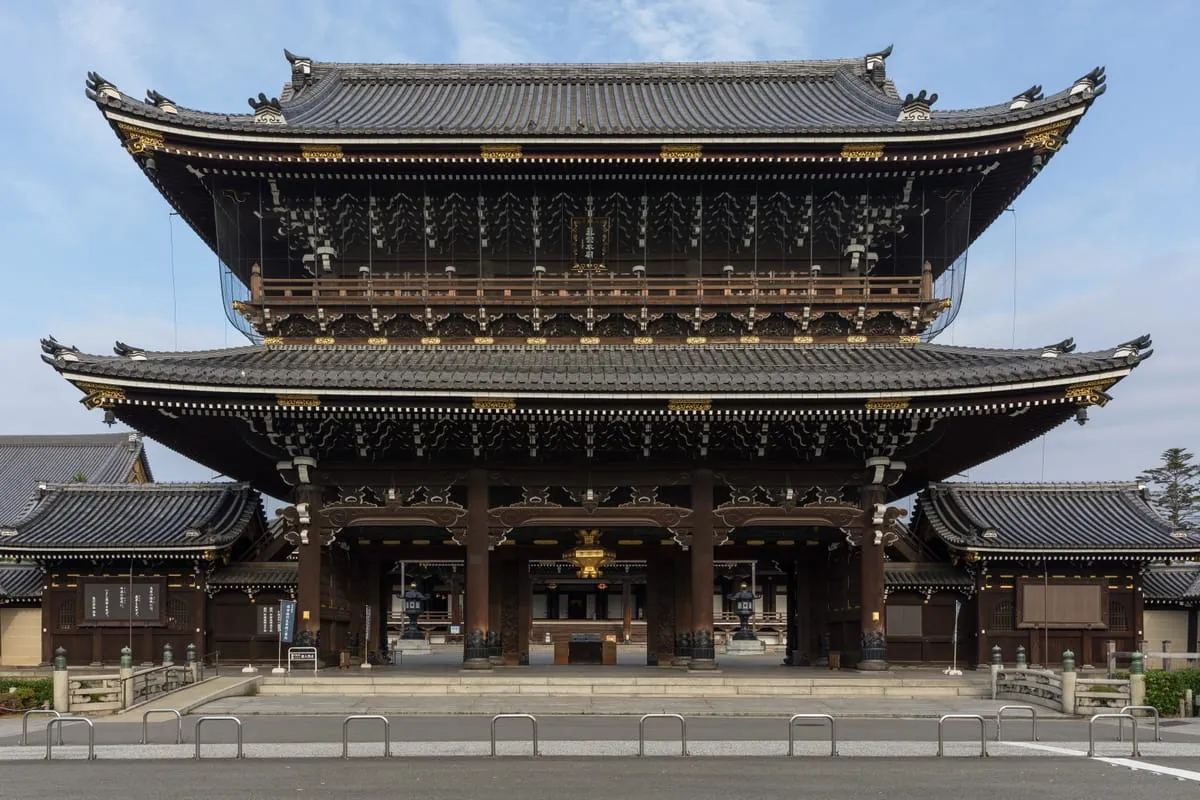
In 1602, Tokugawa Ieyasu supported the establishment of a second Honganji temple nearby — Higashi Honganji — to divide the institution’s political power. The two Honganji temples have operated as separate denominations ever since: Jōdo Shinshū Honganji-ha (Nishi Honganji) and Shinshū Ōtani-ha (Higashi Honganji). Both claim Shinran as their common ancestor.
Collecting Goshuin at Jodo Shinshu Temples
The relationship between Jodo Shinshu and goshuin is worth understanding before visiting. Jodo Shinshu has historically been cautious about practices implying merit accumulation — ideas that sit uncomfortably with Shinran’s teaching that nothing one does can earn salvation. Some temples reframe what they offer as a sanpai kinenin (remembrance seal) rather than a traditional goshuin.
In recent years, most major Jodo Shinshu temples do offer inscribed stamps. The calligraphic content centers on Shinran’s teaching: “Namu Amida Butsu” or “Kimyō jinjippō mugekō nyorai” (the ten-character name of Amida). The aesthetic is austere: strong, direct brushwork.
Nishi Honganji (Kyoto, Shimogyo Ward) — UNESCO World Heritage Site. The goeidō (Founder’s Hall) and Amida-dō stand in a vast precinct; the National Treasure Karamon gate is among the most ornate structures in Kyoto. Goshuin available.
Higashi Honganji (Kyoto, Shimogyo Ward) — The goeidō is the largest wooden structure in the world still in regular use. The Goeidōmon (Founder’s Hall Gate) stands 27 meters tall and 31 meters wide. Goshuin available.
Senjuji (Tsu, Mie / Moka, Tochigi) — Head temple of Shinshū Takada-ha, historically linked to Shinran’s Kanto mission. National Treasure halls at the Tsu branch.
Ōtani Mausoleum, Higashi Ōtani (Kyoto, Higashiyama) — Site of Shinran’s interment, near Kiyomizudera. Sacred to all Jodo Shinshu denominations and a natural final stop after the Honganji temples.
When you receive an inscription at these temples, let it mean what Shinran intended: not an accumulation, not a credential. A record of having been present — received, already, before you arrived.
Shinran spent ninety years discovering that effort is not the answer — and then spending those same years making sustained effort to explain why. There is something in that paradox that the Tannishō catches and refuses to resolve neatly. Whether you come to Nishi Honganji with a goshuin book or a philosophical question or both, the invitation is the same.
Image Credits
- Portrait of Shinran Shonin (ShinranShonin.png): Public Domain, via Wikimedia Commons
- Nishi Honganji, Amida Hall, Kyoto (170216 Nishi Honganji Kyoto Japan05n.jpg): 663highland, CC BY-SA 3.0, via Wikimedia Commons
- Founder’s Hall Gate, Higashi Honganji (Founder’s Hall gate of Higashi-Honganji Temple, Kyoto, Japan.jpg): Basile Morin, CC BY-SA 4.0, via Wikimedia Commons