
Every summer in Japan, food stalls crowd the approach to shrines. Taiko drums roll through neighborhoods. Men in happi coats hoist a gilded palanquin onto their shoulders and carry it through the streets, shouting “wasshoi.” The glow of lanterns turns an ordinary path into something else.
Most people call this a matsuri — and they’re not wrong. But this image of festival Japan tells only the surface of a long story.
The first matsuri held on the Japanese archipelago involved no crowds. No stalls. No drums. What it involved was silence, fear, and the urgent need for rain to fall and rice to grow.
Over fifteen centuries, the Japanese festival has changed almost beyond recognition. From agricultural supplication to political theater, from village rite to urban carnival, from religious ceremony to tourism product. This article traces that journey: where matsuri came from, why they changed, and what has remained constant.
The Word Itself: Matsuru
The word matsuri (祭り) comes from the verb matsuru (祀る), which carries two meanings ancient Japanese did not separate.
The first: to enshrine or serve a deity — to present offerings, perform reverence, make oneself available to the divine. The second: to govern — to administer a country. These meanings share a word because, in ancient Japan, they described the same act. Governance and ritual were not two spheres that overlapped. They were one thing.
The Kojiki (712 CE) and Nihon Shoki (720 CE) describe the imperial line as descendants of Amaterasu, the sun deity. The emperor’s right to rule came from his ability to intercede with the divine on behalf of the people. The word matsurigoto (政事), meaning “political affairs,” is the same word as “festival matters.” You can still read 政 as matsuri-goto in classical Japanese.
When you attend a matsuri today — even a modern summer fair with no apparent religious content — you participate in something whose deepest structure is the management of the relationship between humans and the sacred. The food stalls came later. The structure beneath them is ancient.
The Agricultural Foundation
Japan’s festival calendar was, for most of its history, a calendar of agricultural anxiety.
Rice cultivation became the foundation of Japanese civilization during the Yayoi period (roughly 300 BCE to 300 CE). The fortunes of farming communities depended entirely on weather: drought, flood, or a late typhoon could destroy an entire harvest.
The oldest surviving matsuri reflect this directly. The Kinensai (祈年祭, “Prayer Festival for the Year”) — still performed on February 17th at shrines nationwide — opens the agricultural year with prayers for a good harvest. The Niinamesai (新嘗祭, “Festival of the New Taste”) — held every November — has the emperor offer freshly harvested rice to the gods and consume it himself. This ceremony dates to at least the 5th century CE and continues unbroken today. (The November 23rd public holiday “Labor Thanksgiving Day” has roots in this harvest rite.)
The agricultural cycle followed a clear rhythm: spring prayers before planting; summer supplications to ward off pestilence and drought; autumn thanksgiving. “Summer matsuri” in their original form were not celebrations — they were preventive spiritual management, attempts to protect crops in the dangerous months between planting and harvest.
There was also the concept of the ta no kami (田の神, “rice paddy deity”), understood as the same being as the yama no kami (山の神, “mountain deity”) in different seasonal guises. In winter, the deity withdraws to the mountains; in spring it descends to the fields. The festivals marking this transition are among the most ancient ritual structures in Japan, preserved in many local spring and autumn festivals even when the agricultural meaning has faded.
The Deity Visits: What a Mikoshi Actually Is
Central to Japanese matsuri is a specific idea about how deities work.
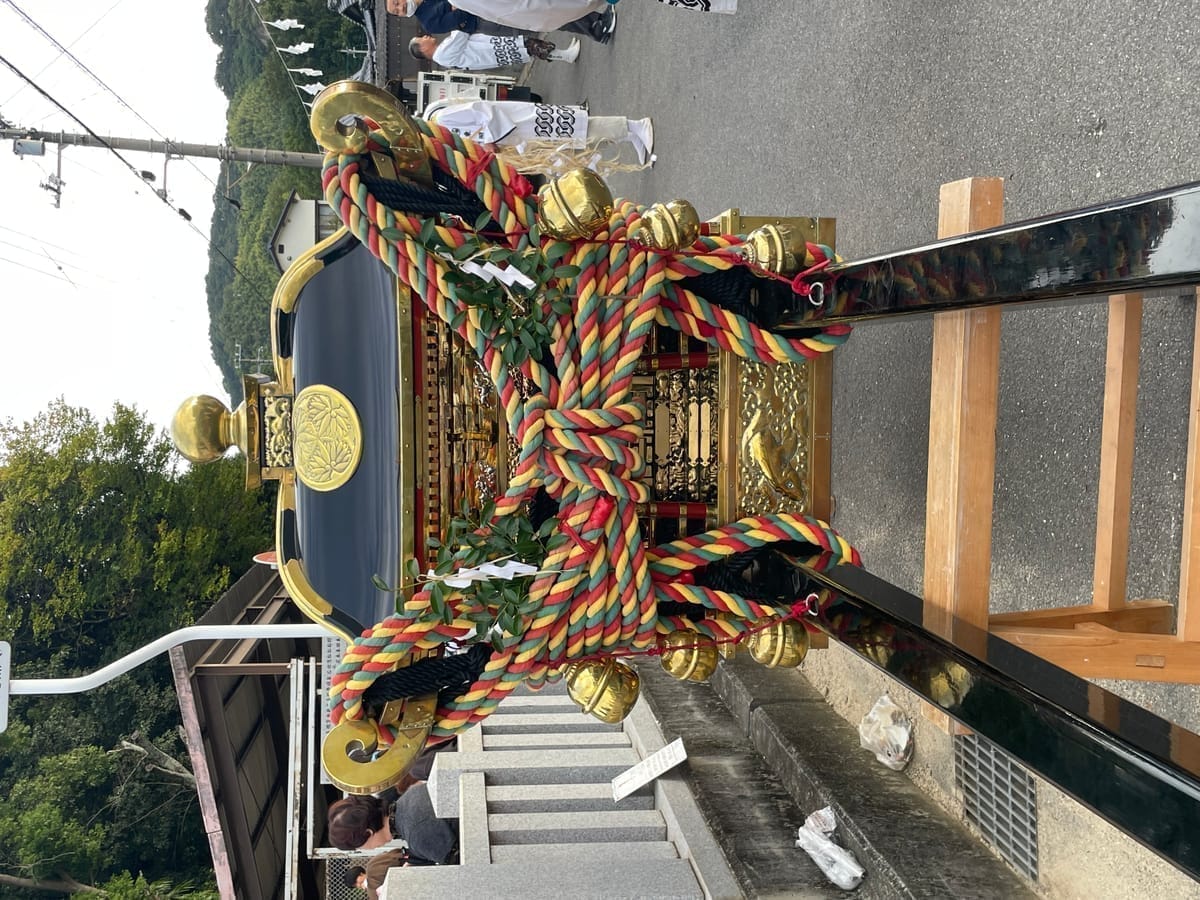
Japanese gods (kami) are not omnipresent. They dwell in specific locations and descend when properly summoned. A shrine’s main hall (honden) is where the deity ordinarily rests quietly. During a matsuri, the deity is transferred from this fixed residence into a mikoshi (御神輿) — a portable, ornate palanquin — and carried through the streets of the parish.
The mikoshi is not symbolic. According to Shinto understanding, the deity genuinely inhabits it, making an actual procession through the community. The music, dance, and food offered along the route are not entertainment — they are offerings to the deity in transit, performances meant to please the divine visitor.
The bearers of a mikoshi are not just muscle. The deity’s power passes through the palanquin into the bodies of those who carry it, blessing and renewing them. When neighborhoods competed for the honor of carrying the mikoshi, they competed for the physical transfer of divine blessing. The cry of “wasshoi!” expresses unity between carriers and the divine presence they transport.
Goryō-e: When Fear Became Festival
In 863 CE, the imperial court convened a goryō-e (御霊会, “Spirit-Calming Assembly”) at Shinsen-en garden in Heian-kyō (present-day Kyoto). The target of appeasement: powerful vengeful spirits. Chief among them was Prince Sawara, the emperor’s brother, who had died in forced exile after being implicated in a plot he may not have been part of. His ghost, and those of others who met violent political ends, were blamed for waves of pestilence and court deaths.
This event established goryo belief (goryō shinkō, 御霊信仰) as a social institution. Suddenly, festivals were not only about petitioning nature gods for good harvests — they also managed the dangerous energy of the politically murdered dead. If you properly honored an angry spirit through music and ritual, its hostility might convert to protection.
Six years later, in 869 CE, an epidemic prompted the court to dispatch sixty-six spears into Shinsen-en in a ritual meant to trap the pestilence spirit. This Gion Goryo-e is the direct ancestor of the Gion Festival (祇園祭) — now the largest and most famous matsuri in Japan, with its thirty-three floats, some standing over twenty-five meters tall, processed through Kyoto’s streets every July.
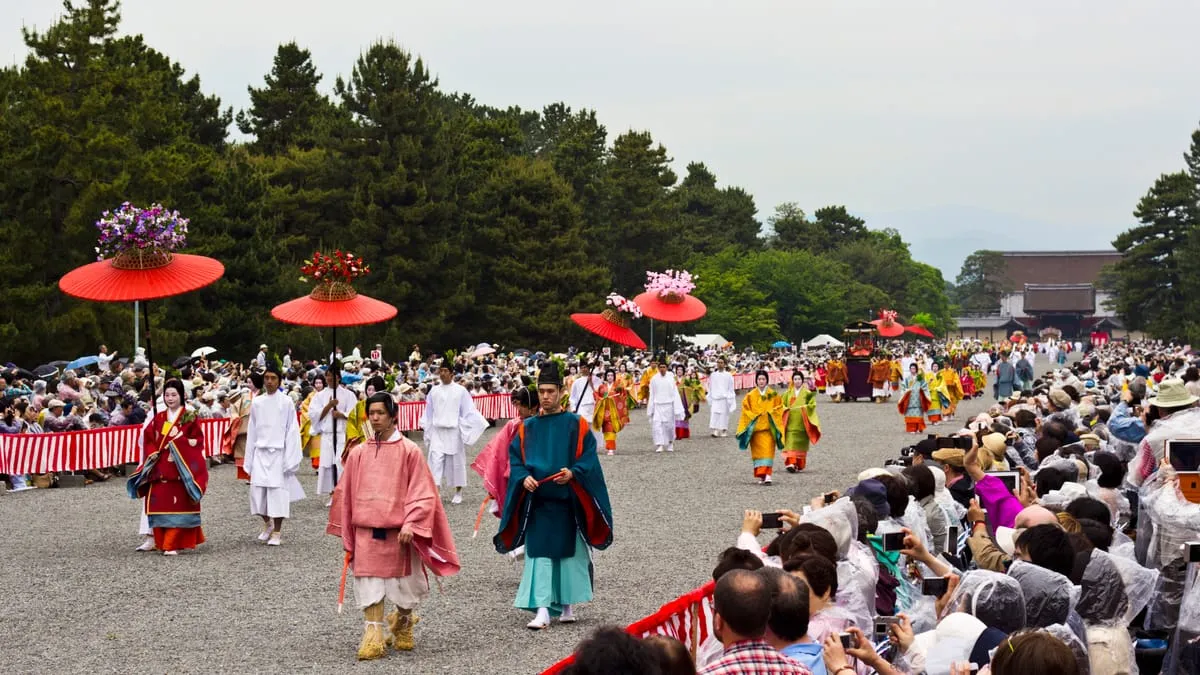
Aoi Matsuri (葵祭, “Hollyhock Festival”) at the Kamo shrines was so central to Heian aristocratic life that “the festival” — matsuri with no modifier — meant this one alone. Held May 15th, five hundred participants in Heian court dress walk an 8-kilometer route from the Imperial Palace to both Kamo shrines. The festival has continued for over 1,200 years.
For Heian aristocrats, matsuri were inseparable from politics. Dispatching an imperial messenger to a major shrine festival was a statement of national intent. Maintaining right relationship with the gods was not piety separate from governance — it was governance.
Edo: When Townspeople Took Over
Through the medieval and early modern periods, the social center of gravity in Japanese festival culture shifted decisively — from imperial courts and aristocratic sponsors to merchants, craftsmen, and laborers.
The Edo period (1603–1868) brought this transformation to its peak. The Kanda Matsuri (神田祭) and Sannō Matsuri (山王祭) became the Tenka Matsuri (“Festival Under Heaven”) — the only festivals permitted to process through Edo Castle’s gates for the shogun’s viewing. Neighborhoods competed fiercely over float craftsmanship; metalworkers, puppet-makers, lacquerers, and carpenters vied to outdo each other. The festival became the arena where a neighborhood displayed its pride.
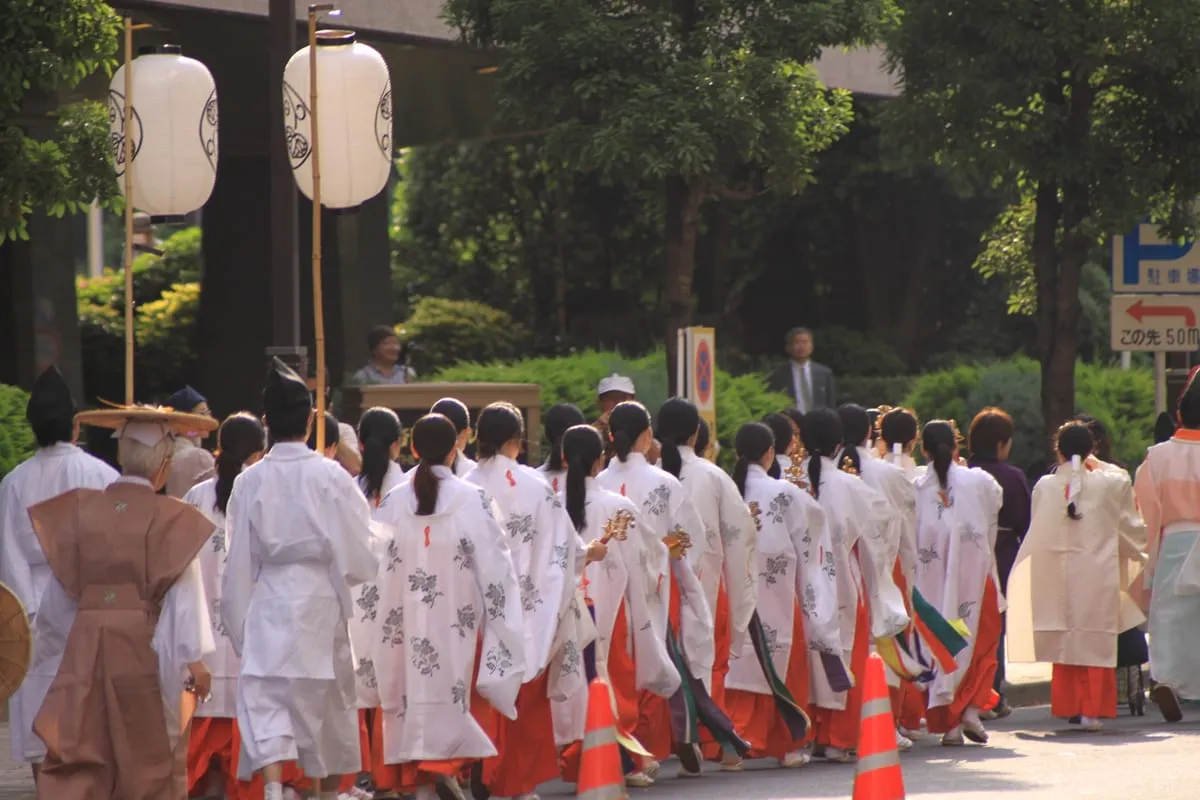
The right to carry the mikoshi was explicitly not for samurai, who were expected to bow before the gods, not shout and sweat. Mikoshi-carrying became the cultural property of the tobishoku (鳶職) — the scaffold-builders and construction workers — and of the working-class townspeople generally. The festival loosened the social hierarchy; a craftsman could take a role denied him every other day.
Edo-era festivals had everything their modern descendants have: competing floats, lively food stalls, vast crowds. But at their center was always the shrine — the deity’s festival, not the neighborhood’s fair.
Meiji: Festivals Become National Property
In 1868, the new Meiji government issued the Decree on the Separation of Shinto and Buddhism (Shinbutsu Hanzenrei). For Japanese festivals, this was a rupture.
Through most of Japanese history, religious life was defined by shinbutsu-shūgō — the syncretic fusion of Shinto and Buddhism. Shrine and temple complexes often shared grounds. Festival rites incorporated Buddhist elements alongside Shinto ceremony. The Gion Matsuri, in its pre-Meiji form, was a joint production of Yasaka Shrine and neighboring Buddhist temples.
The separation decree removed Buddhist elements from shrines by force. In what became known as haibutsu kishaku — “abolish Buddhism, smash Shakyamuni” — Buddhist statues were destroyed, priests were compelled to convert to Shinto roles, and centuries of syncretic practice were erased.
Simultaneously, the Meiji state incorporated festivals into its political apparatus. National holidays were defined as Shinto ritual occasions. Local shrine festivals fell under administrative oversight of what became, effectively, a state religion. The damage to living festival culture was significant and in some cases permanent. The forced separation cut through practices that had evolved together organically over a millennium.
Postwar: Sacred Empties Out, Tourism Moves In
Japan’s defeat in 1945 brought another rupture. The Allied occupation dismantled “State Shinto,” separating shrine institutions from the government and stripping the emperor’s divine status. The ideological apparatus that had given festivals their national-religious dimension collapsed.
High economic growth (1955–1973) accelerated demographic change: rural depopulation emptied the villages whose communities had sustained local festivals for generations. Ujiko — parishioners who traditionally bore obligations to their local shrine — aged and shrank. The young people who would have carried the mikoshi had moved to cities.
Throughout rural Japan, festivals went quiet. Mikoshi stayed locked in storehouses. In some places, the palanquin was placed on a cart rather than carried — fewer bodies available, the tradition technically preserved. In others, festivals simply ended.
What happened in cities was different: festival was discovered as a brand.
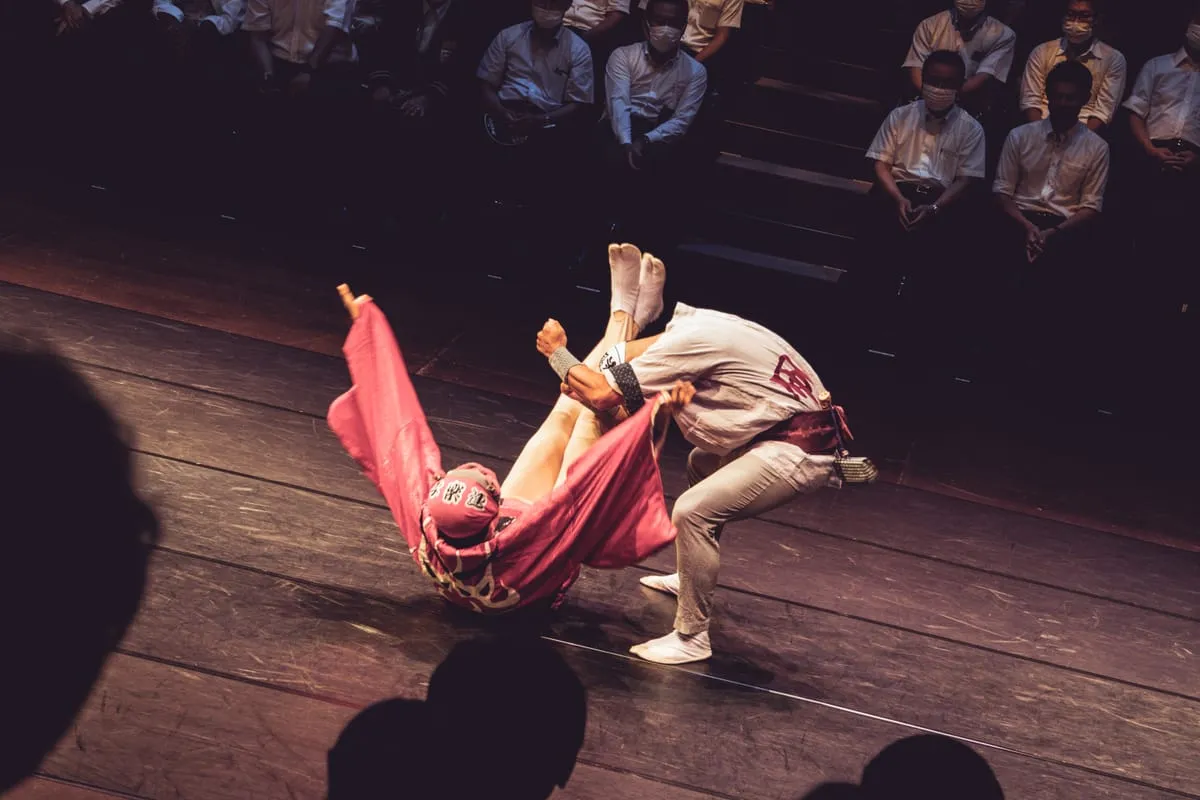
The Gion Festival’s floats became the anchor of Kyoto’s summer tourism economy. Television coverage turned regional festivals into national spectacles. The Nebuta Matsuri in Aomori — massive illuminated papier-mâché figures pulled through the streets — drew tourists from across Japan. The Awa Odori in Tokushima was repackaged as a participatory dance festival whose chant captures the new logic perfectly: “the fool who dances and the fool who watches are both fools; if you’re going to be a fool, you might as well dance.”
In 2016, UNESCO inscribed thirty-three of Japan’s float-procession festivals as Intangible Cultural Heritage — including Gion Matsuri, the Chichibu Night Festival, Takayama Festival, and Hakata Gion Yamakasa. This recognition brought new attention and, with it, new tensions: whether UNESCO designation protects traditions or transforms them into tourist performances is a question host communities continue to negotiate.
The Goshuin Connection
For those who collect goshuin, matsuri offer a particular category of experience.
Many shrines issue limited goshuin (gentei goshuin, 限定御朱印) available only on festival days or during specific ritual periods. The logic is direct: if a goshuin is proof of pilgrimage — that you were present before the deity — then the most meaningful time to receive one is when the deity is most actively present. Festival days are when the deity fully descends, when the ritual apparatus operates at full capacity, when the shrine’s sacred character peaks.
Kitano Tenmangu distributes special goshuin on the 25th of each month — the day associated with Sugawara no Michizane’s birth and death. Kasuga Grand Shrine offers distinctive seals during the Kasuga Matsuri in March. Sumiyoshi Grand Shrine has special stamps for its summer festival period.
On festival days, shrine precincts are transformed. Music flows from the kaguraden (神楽殿, dance hall). Priests conduct rites in formal dress. The food offerings are arrayed on altar tables. The space between sacred and ordinary narrows.
Receiving a goshuin in this atmosphere is different from a weekday stamp in an empty shrine. The page carries not only ink but the memory of music heard while waiting in line, the rumble of the approaching mikoshi, the smell of incense from an open ceremony. The seal anchors a texture of experience that cannot be replicated.
What Has Not Changed
Japanese matsuri have been through agricultural anxiety, imperial politics, townspeople’s pride, Meiji nationalism, postwar commercialization, and UNESCO designation. Through all of it, the structure beneath has not changed: something is called into presence, and people gather around it.
Whether that “something” is an ancient rice-paddy deity, the restless ghost of a wrongly exiled prince, the collective pride of a neighborhood, or a quality of attention people bring when participating in something larger than themselves — is genuinely unclear, and has always been unclear.
The word matsuri meant both “to enshrine the sacred” and “to govern the community” because these were once the same act. At their best, festivals still perform both.
Farmers praying for rain called this matsuri. Heian courtiers propitiating vengeful ghosts called it matsuri. Edo townspeople competing with their floats called it matsuri. The woman in yukata watching fireworks over a river this August calls it matsuri.
The word has held, across all that distance.
Image Credits
- Aoi Matsuri procession: Japanexperterna (Japanexperterna.se), CC BY-SA 3.0, Wikimedia Commons
- Tokyo mikoshi parade (June 2010): Hetarllen Mumriken, CC BY-SA 2.0, Wikimedia Commons
- Awa Odori Dance: Yevtushuk Victor, CC BY-SA 4.0, Wikimedia Commons
- Cover (Sanja Matsuri, Asakusa): Eckhard Pecher, CC BY 2.5, Wikimedia Commons


.jpg)

