
When rain is in the forecast, the instinct is to reschedule. The goshuincho feels fragile, stone steps look slippery, and a shrine visit seems like the kind of activity that belongs in better weather.
But there’s something about a Japanese shrine in the rain that can’t be found on a clear day. The crowds disappear. The sound of your shoes on gravel fills the whole approach. The cedar trees deepen to a darker green, the moss on stone lanterns begins to glow, and the vermilion of a torii gate intensifies as it absorbs the water.
The goshuin you collect on a rainy day records more than a visit. It records a sensory experience: the smell of wet stone, the percussion of rain on umbrella fabric, the silence of a courtyard usually full of voices. That page is often the one you’ll remember most clearly years later.
This guide covers the practical side — how to protect your goshuincho, what to wear, how to photograph wet shrines — and offers ten shrines that reward a rainy visit with something sunshine can’t replicate.
Why Rain Makes Shrines Different
The crowds leave. On rainy days, shrines that would otherwise host hundreds of visitors become nearly private. Queues at stamp offices disappear. Shrine priests have time for brief conversations that would be impossible on a busy afternoon.
The surfaces transform. Moss, which looks flat in dry conditions, becomes vivid green immediately when it rains. Gravel darkens. Wooden pillars get a richer tone as they absorb water. Surfaces you barely notice on a sunny day assert themselves in rain.
The atmosphere deepens. There is a Japanese aesthetic concept called yūgen (幽玄) — a profound sense of mystery in the universe. Mist in a cedar grove, a stone path dissolving into fog, a torii gate half-visible through rain — these evoke a quality of presence that clear sunny days work against. Rainy shrines have yūgen in abundance.
Rain is ritually appropriate. Shinto places a high value on purity (kiyome). Rain is a form of misogi, the purification ritual of immersion in water. Walking into a shrine through rain means entering an exceptionally clean environment by Shinto logic. There is no prohibition against rainy-day worship; some of Japan’s most significant festivals take place in autumn rain.
Gear and Preparation
Protecting Your Goshuincho
The stamp book is the priority. Ink inscriptions are vulnerable to moisture — water causes them to bleed irreversibly.
Use a waterproof sleeve. A ziplock bag in the right size works perfectly. Keep the book sealed until you’re about to hand it over, and seal it again immediately after receiving it back.
Don’t open your bag in the rain. Establish a sequence: step under the eave of the stamp office, close the umbrella, then retrieve the stamp book. This eliminates most moisture risk.
Ask for a kakioki. Most shrines maintain pre-written goshuin on washi paper for inclement weather. Kakioki are proper goshuin, not a lesser form. Some shrines offer rain-specific kakioki with water motifs — these make memorable rainy-day souvenirs.
Footwear and Clothing
Wear shoes with traction. Shrine approaches feature mossy stone, rain-slicked gravel, polished bridges, and — at mountain shrines — steep stone steps that become treacherous when wet. Rubber-soled sneakers are sufficient for most urban shrines; waterproof hiking shoes are better for mountain approaches.
Bring a proper umbrella. A small folding umbrella fails in wind. A full-size 65–70cm umbrella keeps you drier and more stable in heavier weather.
Consider a rain jacket for mountain shrines. Umbrellas become awkward on steep steps where both hands are sometimes needed. A quality waterproof shell jacket is more practical than an umbrella for approaches like Haguro-san or Fushimi Inari’s summit path.
Safety on Wet Shrine Grounds
Stone steps become genuinely dangerous. Moss on steps can have nearly zero friction when wet. Use handrails wherever they exist. Descend diagonally — angling your body and taking steps sideways — rather than facing directly downward on steep sections.
Wooden structures are slippery. The approach deck to a haiden, wooden bridges, and gallery floors all become mirror-slick in rain. Test each step before committing full weight.
Get inside when lightning appears. Mountain shrines are exposure points. If you hear thunder, move inside a building. Don’t shelter under tall isolated trees.
Photography in the Rain
Look for reflections. Water pooling on stone creates mirrors. Hold your phone near ground level and aim slightly upward to increase the mirror effect beneath a torii or lantern.
Let fog provide depth. Focus on a foreground element and let the background dissolve into grey. The mist acts as a natural background blur that clear-sky photography lacks.
Adjust exposure upward. Add +0.5 to +1 EV in pro mode. Rainy scenes meter as underexposed; a small boost brightens the image while retaining the grey tones that make wet shrine photos distinctive.
Photograph surface details. Water drops on moss. Darkened grain of a wooden gate post. Rivulets on stone steps. These details tell the story of the rain without needing to capture the whole scene.
Ten Shrines That Are Exceptional in the Rain
1. Fushimi Inari Taisha — Kyoto
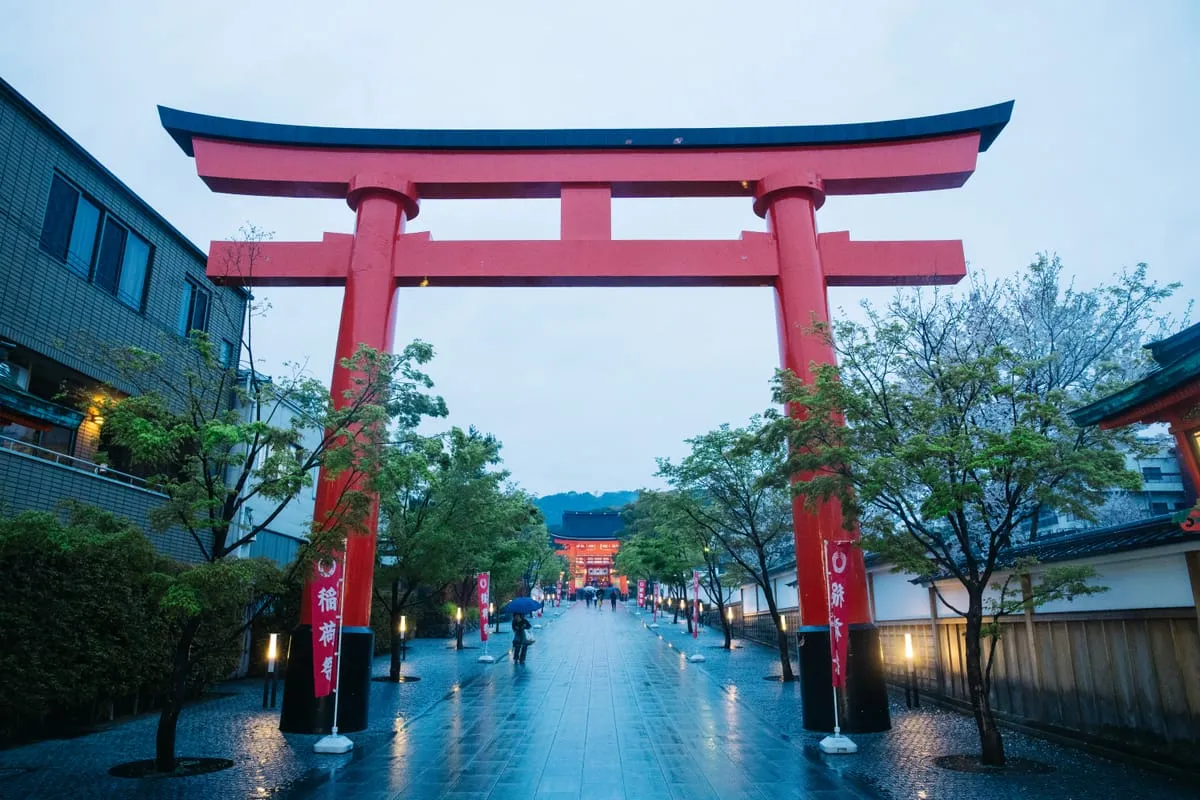
Thousands of vermilion torii gates line a mountain path from base to summit. In rain, the crowds thin dramatically. When mist develops between the gates — which happens regularly during and after rain — the view through a long corridor of red and orange dissolves into white. The effect is closer to disorienting than picturesque: you are standing inside a painting that hasn’t been finished yet. The approach from JR Inari Station takes a few minutes; the main stamp office is near the main hall.
2. Kifune Jinja — Kyoto
Dedicated to the deity of water and rain, Kifune Shrine sits in a narrow mountain valley north of Kyoto alongside a stream. In rain, the Kifune River rises audibly beside you as you walk the stone-paved approach. The row of stone lanterns from the main torii to the main hall takes on quiet gravity against a grey sky. Visiting a water deity in water has a kind of perfect logic to it. Access requires the Eiden line to Kibune-guchi Station, followed by a 20-minute walk.
3. Kasuga Taisha — Nara
The moss on Kasuga Taisha’s three thousand stone lanterns — accumulated over centuries — illuminates to vivid green the moment it rains. Old cryptomeria trees darken and deepen. The whole forest precinct becomes more saturated. For a place this significant — UNESCO World Heritage — the rain makes it surprisingly accessible, as crowds drop sharply. The walking approach from Nara city center takes about twenty-five minutes through Nara Park.
4. Hakone Jinja — Kanagawa
The Heiwa no Torii (Gate of Peace) stands in Lake Ashi, rising from the water. On clear days it’s photogenic; on misty days it becomes something more — appearing to float in white, its upper beam disappearing into cloud, the mountain backdrop gone entirely. The approach through cedar forest on stone steps is walkable in moderate rain and is one of the more dramatic shrine approaches in Kanagawa.
5. Itsukushima Jinja — Miyajima, Hiroshima
The shrine built over the sea at Miyajima operates differently in rain. Mist blurs the line between sea and sky, and the shrine’s galleries appear to float in fog. Rain on the shrine’s wooden roofs mixes with the sound of ferries. In clear weather, thousands of visitors walk to the floating torii gate at low tide; in rain, the high-tide view from the covered galleries offers a scene with no equivalent in good weather.
6. Dewa Sanzan Jinja — Haguro-san, Yamagata
The 2,446-step cryptomeria-lined stairway up Haguro-san is one of Japan’s great mountain approaches. When mist rises between the enormous trunks, the National Treasure five-story pagoda midway up emerges from fog. Water drips from giant branches, runs in rivers down the stone steps, fills the forest with constant sound. Descend slowly — the steps are mossy and uneven in wet conditions. Budget more time than the trail sign suggests.
7. Kirishima Jingu — Kagoshima
The name means mist island shrine. At over 700 meters on a mountain plateau in Kagoshima, Kirishima Jingu is built for fog. Its bright vermilion buildings against grey-white mist create a contrast almost difficult to photograph accurately. The forest around the main hall generates its own weather; rain here often combines with ground fog for a complete atmospheric immersion. Covered walkways around the main hall make this one of the more comfortable mountain shrines to visit in rain.
8. Kumano Nachi Taisha — Nachisan, Wakayama
Nachi Falls, at 133 meters the tallest single-drop waterfall in Japan, flows beside Nachi Taisha and has been worshipped as a deity for centuries. After significant rain, the waterfall’s volume increases; the sound becomes physical, less like water and more like sustained thunder. The approach — stone steps through the Kumano Kodo forest — becomes deep green in rain, moss and old stone and dripping trees combining into something that fits the scale of the site. The Hiro Jinja at the falls’ base also offers a goshuin. Receiving a stamp from a shrine dedicated to a waterfall on a rainy day has a kind of complete logic.
9. Suwa Taisha Honmiya — Nagano
The Upper Shrine at Suwa sits on a hill above Lake Suwa in a region where fog and rain are frequent. On mornings when mist drifts in from the lake, the shrine’s offering hall and four-legged gate dissolve in and out of visibility. The trees on the shrine grounds spread low and horizontal in the way of trees shaped by centuries of weather; in fog, they produce silhouettes that look like landscape ink paintings.
10. Isonokami Jingu — Nara
Along the Yamanobe no Michi, one of Japan’s oldest roads, Isonokami Jingu occupies a forest position with unusual depth. Its most memorable feature for first-time visitors in rain: chickens. Sacred fowl live freely in the precinct and wander in all weather. On rainy days, wet chickens picking their way across dark stone provide unexpectedly compelling company. Beyond the birds, the shrine holds a National Treasure gate and a forest that deepens considerably in wet conditions. When visitors are few and rain replaces crowd noise, the weight of this place’s history — it preserves the Futsu no Mitama, the sacred sword of the earliest chronicles — becomes more present.
Rain and the Goshuin Experience
Stamp offices may switch to pre-written only. In wet conditions, direct inscription in your book becomes impractical — rain causes ink to run. Pre-written kakioki are the standard fallback and are goshuin in the traditional sense.
Wait times often drop to zero. The rainy-day crowd reduction directly benefits the goshuin process. A 30-minute queue on a fine autumn Saturday becomes no wait at all.
Dry your goshuincho after the visit. Open the book and let it breathe in a dry area — standing the pages open, separated. Don’t use a hair dryer; heat warps paper. For accordion-fold goshuincho, interleave thin paper between pages while drying to prevent adjacent pages from sticking together if any ink remains slightly damp.
Rainy Day Visits by Season
Spring (late March–April): Petals land on stone paths and float in puddles. The combination of sakura, mist, and shrine gates produces scenes of improbable beauty. Cherry blossom crowds drop significantly in rain.
Rainy season (June–July): When moss is richest and hydrangea shrubs bloom. Kamakura — shrines and temples within short walking distance — is a particularly good destination. The combination of hydrangea, old stone, and soft rain is one of the most distinctively Japanese visual experiences available to a visitor.
Autumn (October–November): Wet red maple leaves on stone steps, lanterns in grey mist, the smell of wet earth under cedar. Nikko and Kyoto in light autumn rain, on weekdays, offer access to world-class shrine architecture without fine-weather crowds.
Winter (December–February): The quietest visits of all. Leaves gone, structure visible through bare branches, rain the only sound in an empty precinct. Staff at stamp offices are often willing to talk. The pre-New Year period in December is an underrated, uncrowded time to collect goshuin.
Summary
A rainy day is not a reason to postpone. It’s a different kind of shrine visit — quieter, more atmospheric, and, with appropriate preparation, more comfortable than it might initially seem.
The practical steps are simple: waterproof your goshuincho, wear shoes with grip, bring a proper umbrella or rain jacket, move slowly on wet stone. With those basics in place, rain becomes an advantage. The crowds are gone. The stamp office has no queue. The shrine is showing you a face it keeps hidden from the majority of the people who see it.
The goshuin you collect on a rainy day records a decision: to go despite the forecast, to walk through the wet rather than wait for the dry. When you open that page years later, you won’t just see the ink. You’ll hear the rain.
Image Credits
- fushimi-inari-rain.jpg: “Torii, Fushimi Inari Grand Shrine, Kyoto - Apr 14, 2019” by Dick Thomas Johnson, CC BY 2.0, via Wikimedia Commons
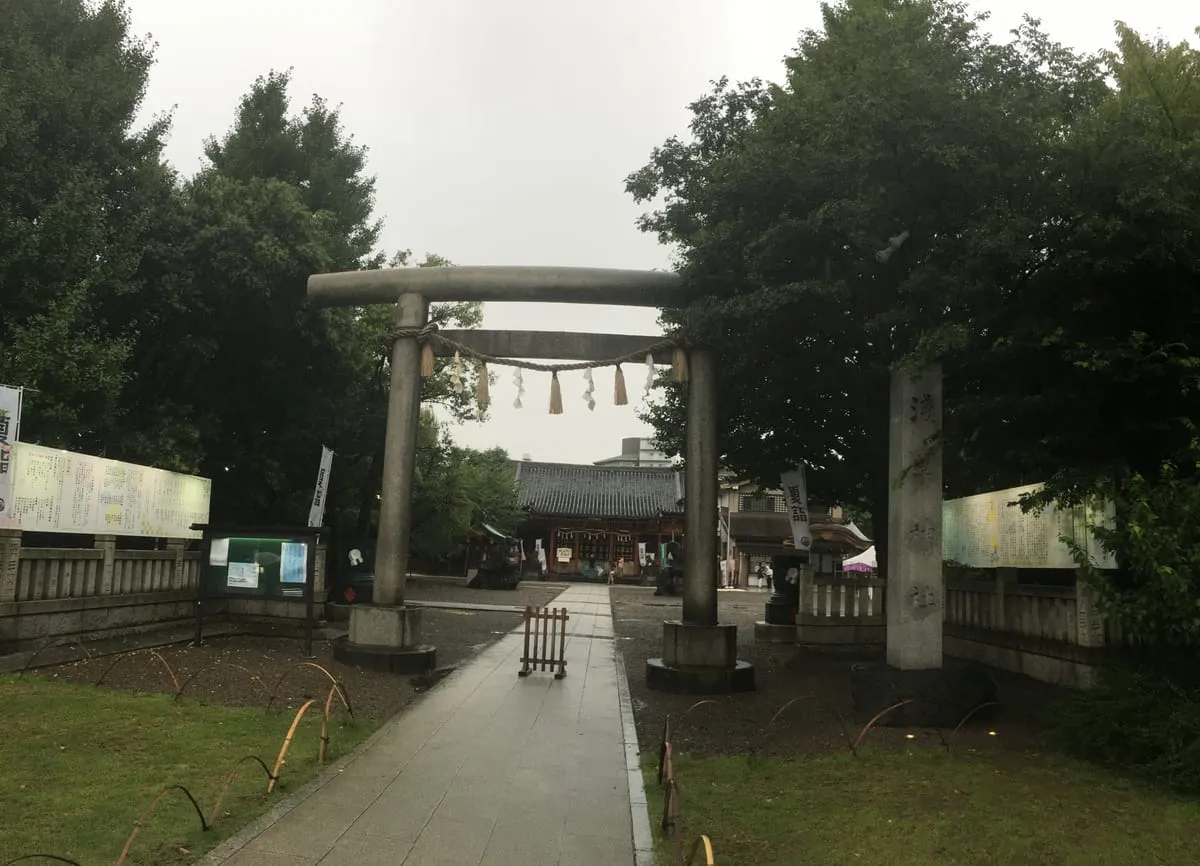
- asakusa-shrine-rain.jpg: “Asakusa Shrine Aug 14 2021 rainy day” by Nesnad, CC BY 4.0, via Wikimedia Commons
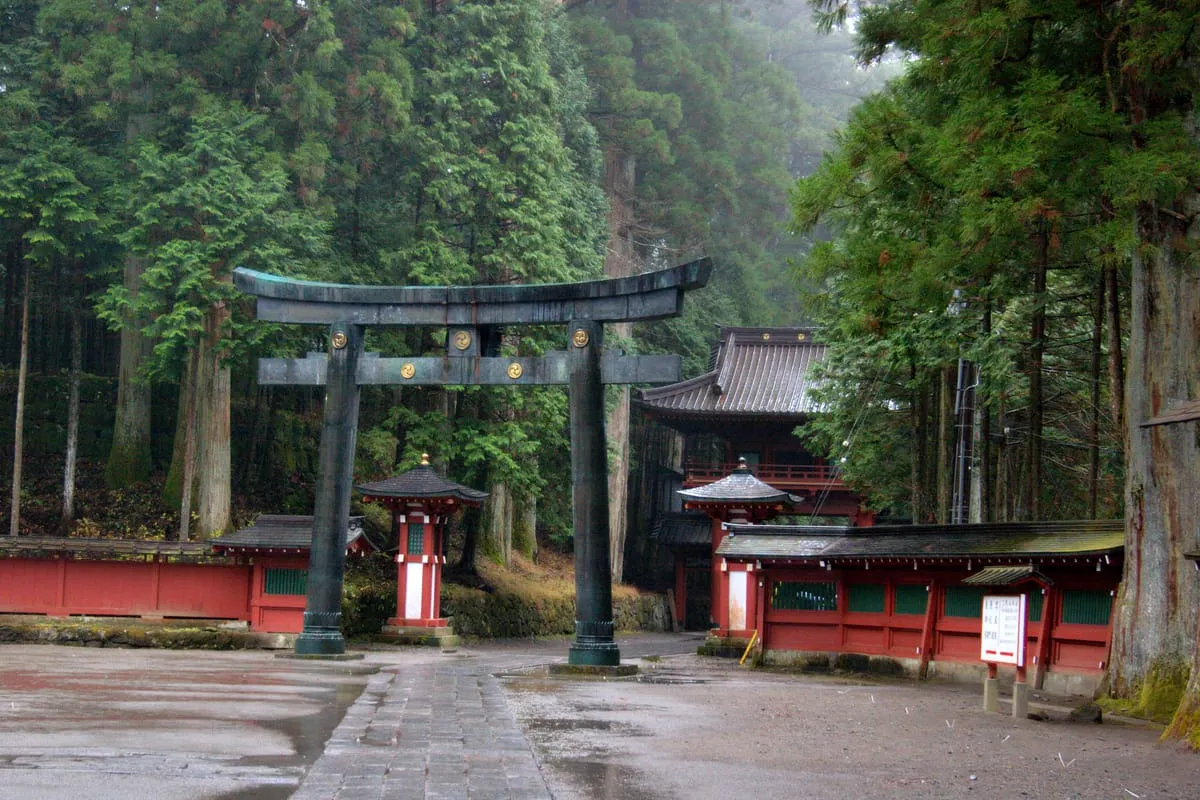
- futarasan-jinja-rain.jpg: “Futarasan-jinja in rain” by Kimon Berlin, CC BY-SA 2.0, via Wikimedia Commons


