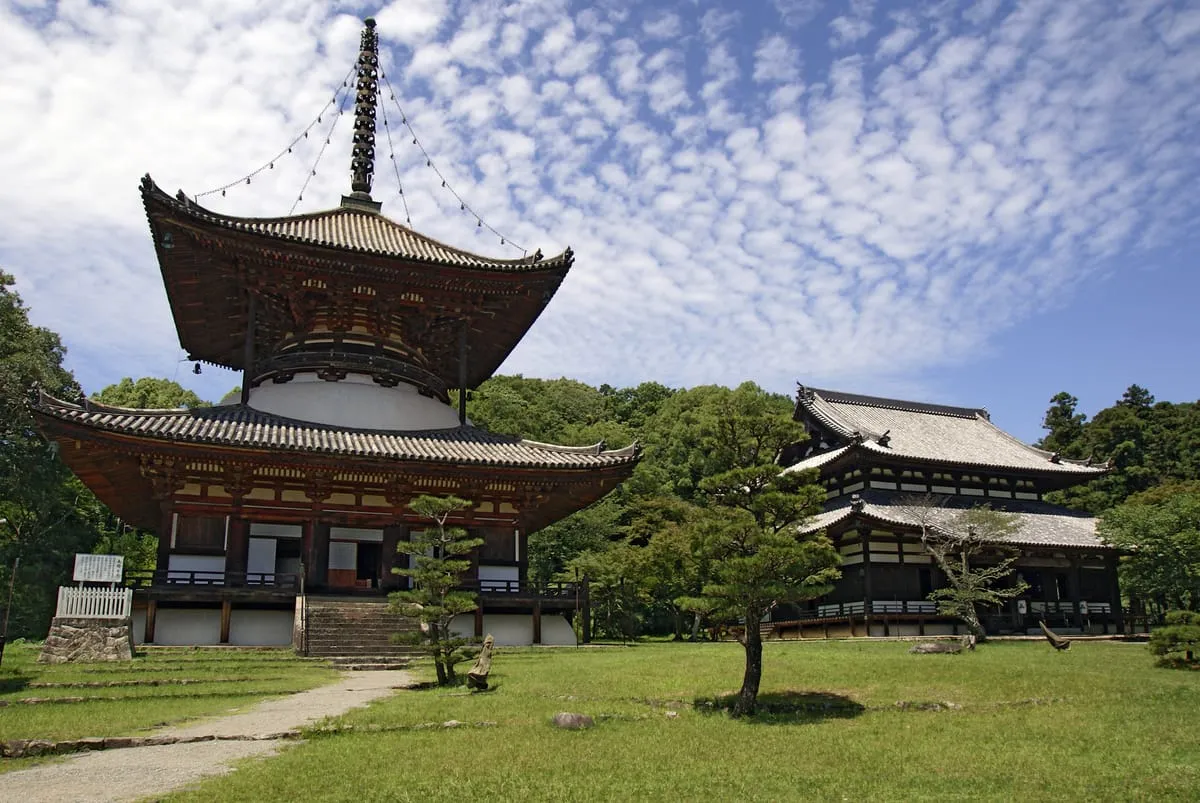
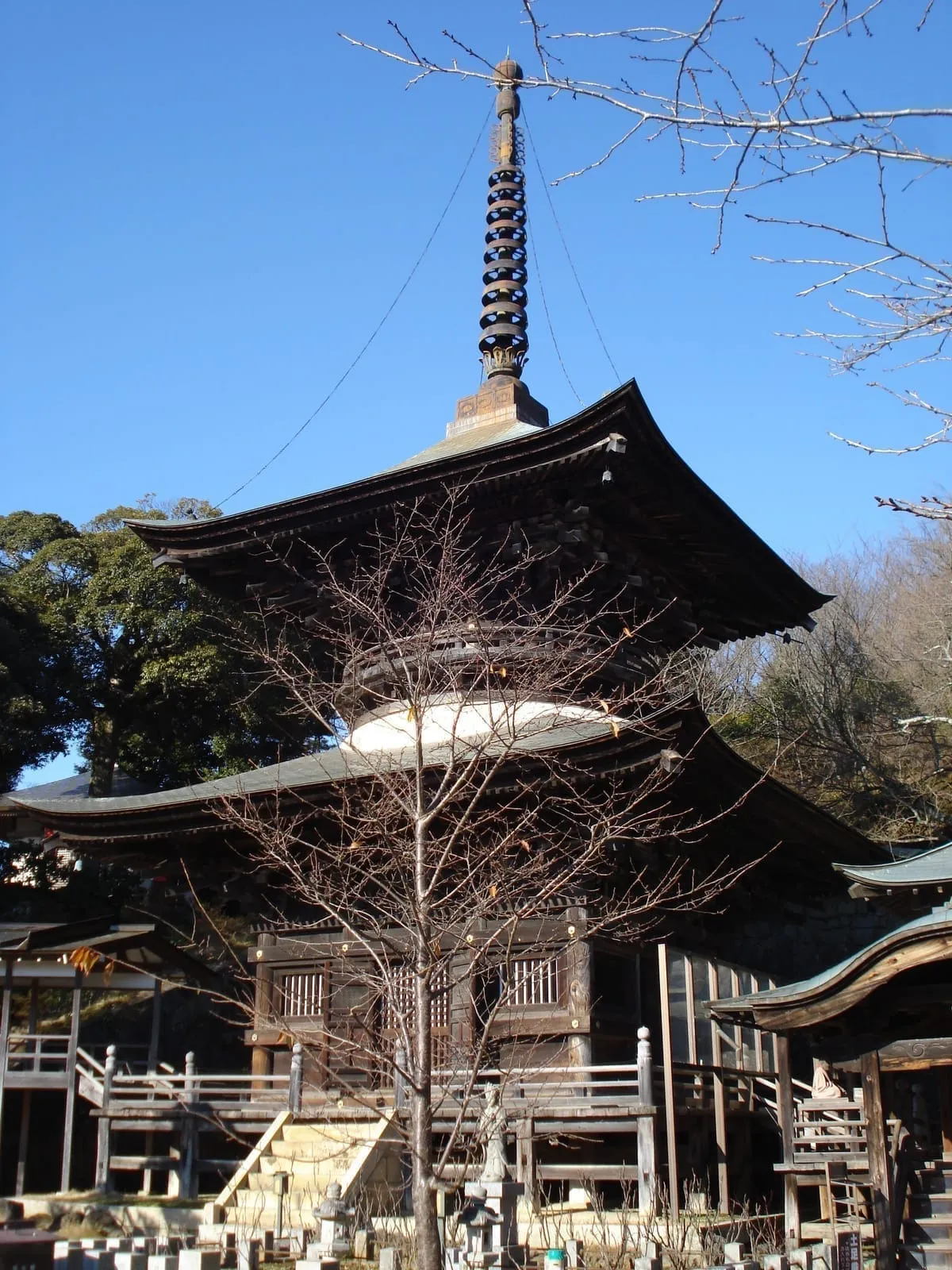
Walk far enough into the grounds of Ishiyama-dera in Shiga Prefecture and you will round a corner to find a tower unlike any you have seen. It stands roughly thirteen meters tall. The lower story is cylindrical — a ring of wooden columns surrounding a circular interior, with a narrow covered walkway running around the outside. Between the two stories sits a rounded, white-plastered dome that looks like an upturned bowl. The upper story rises from that dome as a neat four-sided structure, crowned by a pyramidal roof from which a slender metal finial reaches toward the sky.
This is a tahōto (多宝塔) — literally “many-treasure pagoda” — and nothing else in Japanese Buddhist architecture quite resembles it. Built in 1194, the Ishiyama-dera tahōto is one of the oldest surviving examples in Japan, now designated a National Treasure. But its significance is not merely one of age. The circular lower story, the distinctive plastered dome, the square upper story, the pyramidal roof: each carries a layer of Buddhist symbolism developed over centuries of esoteric practice.
About four hundred tahōto survive across Japan today. Almost all belong to Shingon or Tendai temples — the two traditions that brought esoteric Buddhism (mikkyō) to Japan in the ninth century. When you encounter a tahōto in a temple precinct, it is an architectural signal: this is a place shaped by esoteric thought.
What Is a Tahōto?
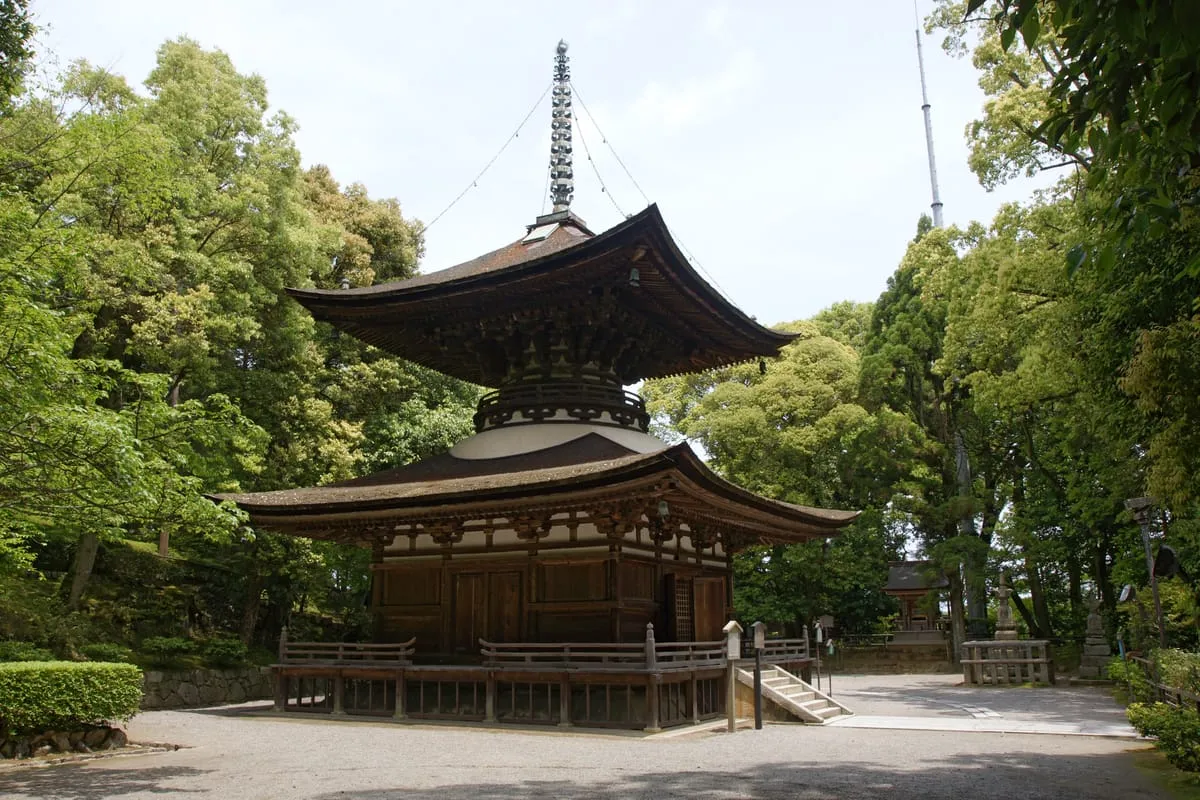
A tahōto is a two-story pagoda in which the lower story is circular in plan and the upper story is square. This combination is unique in world Buddhist architecture. Pagodas elsewhere — in China, Korea, Vietnam, Myanmar — maintain a consistent plan from base to top. Only Japan developed the tahōto’s radical shift in geometry between stories.
The name derives from “Many Treasures Tower” (tahō, 多宝塔) — a specific tower from Chapter 11 of the Lotus Sutra. The same towers are also called dainichiтō (大日塔, “Dainichi Tower”) in esoteric Buddhist contexts, because the circular lower story is read as a diagram of the Taizōkai (Womb World) mandala and the square upper story as the Kongōkai (Diamond World) mandala. The tahōto is, in essence, a three-dimensional mandala of the esoteric universe.
The Lotus Sutra and the Tower of Many Treasures
The theological origin of the tahōto lies in Chapter 11 of the Lotus Sutra, “The Emergence of the Treasure Tower.” The scene is unlike almost anything else in Buddhist literature.
Shakyamuni is teaching on Vulture Peak in India when, without warning, a gigantic tower rises from the earth — adorned with seven precious materials and extending to a vast height. This is the tower of Prabhūtaratna (多宝如来, Tahō Nyorai), a buddha who passed into parinirvāṇa long ages ago but left a vow: “Wherever the Lotus Sutra is taught, my tower shall appear and bear witness to its truth.” From within, the voice of Prabhūtaratna confirms Shakyamuni’s words: “All you say is true.”
Shakyamuni then opens the tower and the two buddhas sit side by side within it — Prabhūtaratna and Shakyamuni sharing a single throne. This “two buddhas seated together” (nibutsuhyōza) image became one of the most influential in Japanese Buddhist art.
The physical tahōto is understood as a manifestation of that scriptural tower. In esoteric interpretation, the circular lower story represents the Taizōkai mandala — infinite compassion, encompassing potential. The square upper story represents the Kongōkai — adamantine wisdom, precise and indestructible. Together they form the complete esoteric cosmos. The tahōto does not merely house these ideas; it is them, translated into wood and plaster.
Anatomy of a Tahōto
The tahōto’s form results from the layering of distinct structural elements. Here is how to read each when you stand in front of one.
The lower story consists of a ring of columns arranged in a circle. Between the outermost columns and the cylindrical inner wall, a covered walkway (mokoshi, 裳階) runs all the way around. This gallery allows worshippers to circumambulate the tower — the Buddhist practice of walking clockwise around a sacred object while chanting.
The kamebara (亀腹, “turtle’s belly”) is the rounded white-plastered dome between the two stories and the detail that immediately identifies a tahōto. Structurally it is the platform on which the square upper story rests; visually it translates the curve of the lower into the geometry of the upper. The white plaster of the kamebara stands out sharply against the red lacquered columns, making it visible from a distance.
The upper story is square in plan, with plank doors or latticed windows on each face. Inside, the primary devotional image — usually Prabhūtaratna or Dainichi Nyorai (Vairocana) — is enshrined on a raised altar. The upper story is almost always closed to the public except during special-exhibition events.
The pyramidal roof (hogyōzukuri, 宝形造り) crowns the upper story. All four faces slope to a single apex — a true pyramid. This convergence to one point is the key symbolic gesture of the roof: it embodies the concentration of the entire cosmos into the single figure of Dainichi Nyorai. The same roof form appears on small shrines, bell towers, and tearooms throughout Japan, always carrying a quality of focused finality.
The finial (sōrin) rises from the pyramid’s apex through a stack of disk, bowl, lotus base, nine rings (kurin), flame-shaped water clouds (suien), and a jeweled sphere (hōju). The nine rings represent the levels of the Buddhist cosmological universe. Taken together, the finial is a vertical diagram of the Buddhist world order pointing at the sky.
History: From the Lotus Sutra to the Temple Precinct
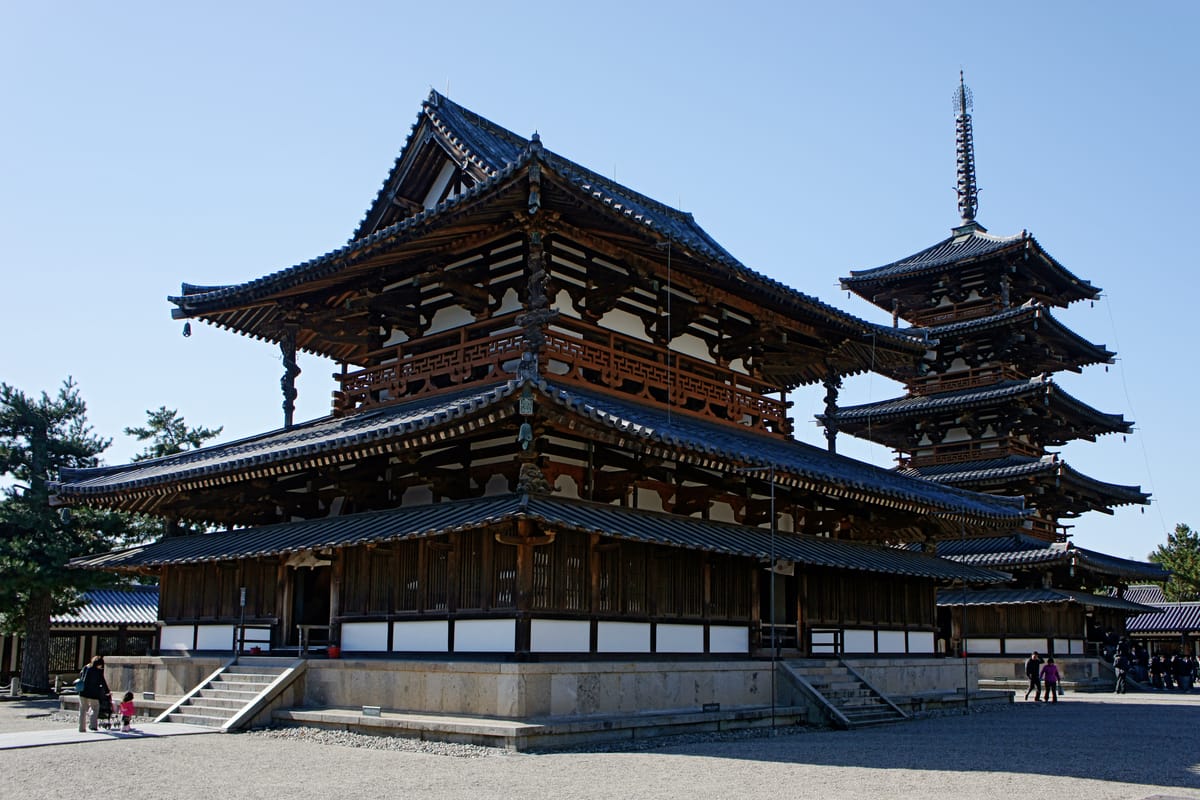
The tahōto’s remote ancestors are the Indian stupa — dome-shaped reliquary mounds built over the remains of the Buddha. As Buddhism spread into China, the stupa evolved into multi-story square pagodas. Japan adopted this Chinese model in the seventh century: Hōryū-ji’s five-story pagoda (ca. 607 CE) and Yakushi-ji’s three-story pagoda (ca. 730 CE) follow the Chinese square-platform tradition throughout.
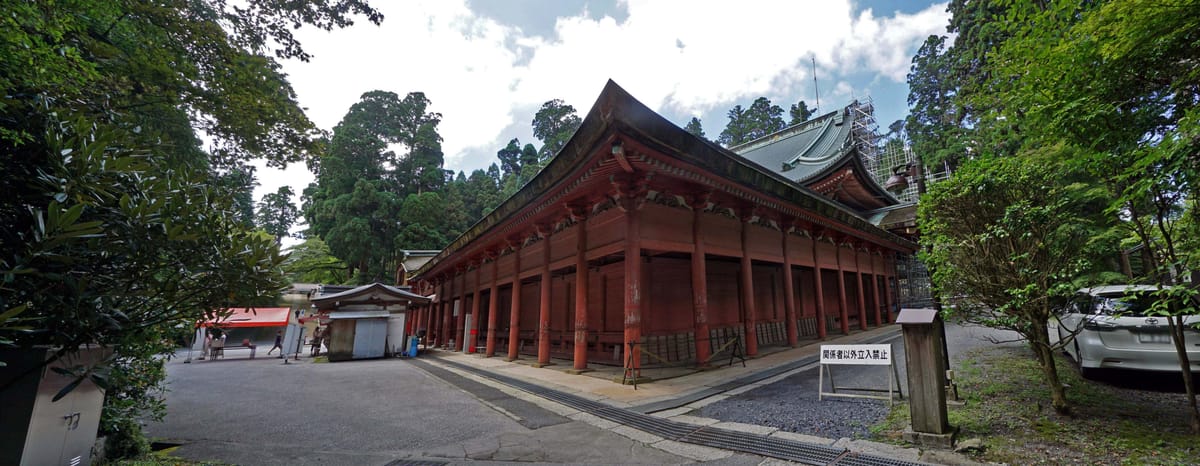
The tahōto emerged later and separately. It appears in Japanese precincts during the late Heian period (tenth to twelfth centuries), tied directly to the arrival of esoteric Buddhism. In 804, both Saichō (767–822, founder of Tendai) and Kūkai (774–835, founder of Shingon) crossed to Tang China and returned with mikkyō. The rituals of esoteric Buddhism — elaborate fire ceremonies, mandala-based visualizations, secret initiations — required dedicated architectural spaces. The tahōto, as a physical mandala, answered that need. Enryakuji on Mt. Hiei and Kongōbuji on Mt. Kōya became the centers from which tahōto architecture spread.
The Kamakura period (1185–1333) was the golden age of tahōto construction. The surviving National Treasure examples from this era — Ishiyama-dera (1194), Kaijūsan-ji (1214), Kongōsanmai-in (1223) — show a mastery of proportion and craftsmanship that defines the form’s aesthetic peak. Kamakura patrons, including members of the Hōjō regent family, funded these towers as acts of devotion and memorials for the warrior dead.
Later periods brought both loss and renewal. The Ōnin War (1467–1477) destroyed many structures in Kyoto. Warlords of the Sengoku period (1467–1615) sometimes rebuilt; sometimes razed. The great Daito of Negoro-ji was completed in 1547 and became the only structure at Negoro-ji to survive Toyotomi Hideyoshi’s burning of the temple in 1585 — a survival attributed variously to favorable wind direction, Hideyoshi’s respect for the tower, or simple chance. It still stands today as the tallest tahōto in Japan.
Notable Tahōto
Ishiyama-dera (Ōtsu City, Shiga) — National Treasure
Built: 1194 (Kenkyū 5) · Height: approx. 13 m
The tahōto at Ishiyama-dera stands on a shelf of rock above the main hall, its white kamebara and red columns set against mossy hillside behind. Built in 1194, the year of the Kamakura shogunate’s early consolidation, it represents the transition from Heian refinement to Kamakura structural clarity. The upper story enshrines Prabhūtaratna and Dainichi Nyorai.
Ishiyama-dera is also the temple where the Lady Murasaki is said to have conceived the Tale of Genji in 1004, gazing at moonlight on Lake Biwa. The goshuin offered here span several deities; on special opening days, the tahōto’s interior may be viewed.
Negoro-ji Daito (Iwade City, Wakayama) — National Treasure
Built: 1547 (Tenbun 16) · Height: approx. 40 m
Japan’s tallest tahōto stands at the head temple of the Shingishingon-shū school, a Shingon branch founded by the priest Kakuban (1095–1143). The Daito’s scale is difficult to convey in photographs: standing beneath its mokoshi eaves, the structure fills the sky. Wide-spreading lower eaves give it a horizontal authority that most tahōto — lighter and more slender — do not possess.
When Hideyoshi burned the temple in 1585, everything except this tower was destroyed. Whether preserved by wind, by Hideyoshi’s admiration, or by chance remains unknown. The tower’s survival across five centuries of destruction and survival gives it a resonance beyond its considerable architectural merit. Goshuin typically carry the inscription Dainichi Nyorai.
Kongōsanmai-in (Kōya-chō, Wakayama) — National Treasure
Built: 1223 (Jōō 2)
Built at the behest of Masako Hōjō — widow of Minamoto no Yoritomo — as a memorial for her husband and son, this tahōto stands within one of Mt. Kōya’s many sub-temples. The mountain itself, founded by Kūkai in 816, is the heartland of Shingon Buddhism and a goshuin destination of singular depth. Kongōsanmai-in’s tower is compact but architecturally precise: the kamebara proportions, the mokoshi eave depth, and the upper-story slenderness are textbook Kamakura quality.
Kaijūsan-ji (Kizugawa City, Kyoto) — National Treasure
Built: 1214 (Kenryaku 4)
Kaijūsan-ji requires a short uphill walk through cedar forest to reach — which also means it receives relatively few visitors. The tahōto’s proportions (slender upper story, precisely curved kamebara, elongated sōrin) are considered among the best-preserved examples of early Kamakura design. Goshuin center on Jūichimen Kannon (Eleven-faced Kannon). Nearby Gansenji holds both a tahōto and a three-story pagoda, making this corner of Kizugawa City a productive destination for pagoda comparison.
Gokoku-ji (Bunkyō-ku, Tokyo) — Important Cultural Property
Built: 1938 (Shōwa 13)
The tahōto at Gokoku-ji in central Tokyo was built in 1938 — recent by the standards of the form — and has received Important Cultural Property designation as an example of early Shōwa traditional-style architecture. It stands in a complex that includes several Edo-period structures, making Gokoku-ji one of the most accessible places in the Tokyo area to see layered temple architecture. The temple was founded in 1681 by the fifth Tokugawa shogun at the request of his mother. Goshuin here typically carry Nyoirin Kannon.
Receiving Goshuin at Tahōto Temples
A visit to a tahōto temple for goshuin deepens when approached with awareness of what the tower represents.
Choose deliberately. Shingon temples often offer multiple goshuin — one for the main hall’s deity, others for secondary enshrined figures. If a temple has a tahōto enshrining Dainichi Nyorai or Prabhūtaratna, a specific goshuin may be available for that figure. Asking the attendant at the stamp office (jusha) which goshuin connects to the tahōto often opens a brief, informative exchange.
Time visits around special openings (tokubetsu kaichō). Major esoteric temples periodically open their normally sealed spaces — tahōto interiors, hidden Buddhist images, closed sanctuaries. These events are announced on temple websites and scheduled around annual festival dates. Ishiyama-dera and Negoro-ji both hold such events. Timing a visit to coincide with an opening allows you to see the enshrined images inside the tower directly.
Walk the circumambulation gallery. At temples where the mokoshi gallery is accessible, circling the lower story clockwise while facing inward connects you to the tradition of uniyo — the practice of circumambulating a sacred object as veneration. The act slows time. The tower’s physical presence, its proportions and textures, becomes something felt rather than merely observed.
Consider Mt. Kōya as an extended itinerary. Kōya-san contains Kongōsanmai-in and dozens of other sub-temples, each with its own goshuin. Spending a night on the mountain — staying at a shukubō (temple lodging) — allows early-morning participation in goma fire rituals, walking the Okunoin cemetery path in pre-dawn silence, and collecting goshuin across an unhurried day.
The tahōto is neither Japan’s tallest pagoda nor its oldest. What makes it singular is the argument embedded in its form: that the circle and the square, the fluid and the precise, the encompassing and the definitive, belong together in a single structure. The Lotus Sutra’s tower of Prabhūtaratna appears to certify truth; the esoteric mandala maps the cosmos onto a diagram; the tahōto holds both at once — in a shape that can be walked around, looked up at, and imprinted on a goshuin page.
The four hundred surviving examples are still sites of active Buddhist practice: fire rituals, sutra chanting, morning prayers of resident priests. The goshuin you receive at these temples is a mark from a place where esoteric Buddhism is still practiced — where the circle and the square still meet, as they have for eight hundred years, in the form of a tower.
Image Credits
- Negoro-ji Daito (Negoroji01s3200.jpg): 663highland, CC BY-SA 3.0, via Wikimedia Commons
- Ishiyama-dera Tahōto (Ishiyamadera29n4272.jpg): 663highland, CC BY-SA 3.0, via Wikimedia Commons
- Rakuhō-ji Tahōto (Rakuhoji_temple_Tahoto_Tower.jpg): Kiku-zou, CC BY-SA 3.0, via Wikimedia Commons