Before you reach the main hall of a Japanese Buddhist temple, you almost always pass through a gate flanked by two colossal figures. One holds its mouth wide open; the other holds its mouth firmly shut. Both are muscular to a degree that strains credibility — veins like ropes, sinews like cables, bare feet planted in a fighter’s stance. These are the Niō (仁王), and their gate is the niōmon (仁王門).
The word niōmon literally means “gate of the two kings.” It marks the boundary between the secular world and the sacred precinct of a Buddhist temple compound. For goshuin collectors — visitors who collect the stamped devotional seals that Japanese temples issue — the niōmon is an unavoidable first threshold. Most people glance up and walk through. But the gate rewards a longer look.
This guide explains who the Niō are, where they came from, what their paired forms mean, how the gate that houses them was built, which examples are most worth seeing, and what to look for when you stand before them.
Who Are the Niō? Origins from Ancient India
The Niō are formally known as Kongōrikishi (金剛力士) — “Diamond-Thunderbolt Strength Warriors.” The word kongō (金剛) translates the Sanskrit vajra: thunderbolt and the hardest of all substances combined into one symbolic object. A rikishi is a warrior, a man of great strength. The full name means the warrior who wields the indestructible thunderbolt.
Their origins trace to the Indian deity Vajrapāṇi — literally “thunderbolt in hand” — one of the oldest figures in Buddhist iconography. From the very beginning of Buddhist art, Vajrapāṇi appears as the Buddha’s personal bodyguard, a powerful deity who follows the Enlightened One wherever he travels. In the Gandhara school of sculpture (present-day northern Pakistan and Afghanistan), Vajrapāṇi was depicted with the physique of Heracles — a direct influence from the Hellenistic culture left behind by Alexander the Great’s campaigns into Central Asia.
As Buddhism traveled through Central Asia into China, Vajrapāṇi merged with Chinese traditions of guardian deities and door gods. The single guardian became a pair. This pairing is fundamental: the Niō are never one; they are always two. The tradition reached Japan via Korea in the sixth and seventh centuries CE, arriving with Buddhist architecture and bringing the sculptural conventions that define the niōmon today.
Agyo and Ungyō: The Cosmic Pair
The most immediately obvious thing about the Niō is the difference in their mouths. One holds its mouth wide open: agyō* (阿形). The other holds its mouth firmly closed: ungyō (吽形).
The letters a (阿) and un (吽) are the first and last letters of the Sanskrit alphabet. A is the first sound the human mouth makes — an open vowel. Un is the last — a nasal closure. Together they span the entire alphabet, and by extension, all of existence: beginning to end, birth to death, genesis to dissolution.
The phrase a-un no kokyū (阿吽の呼吸) — “breathing of a and un” — is a standard Japanese idiom for perfect wordless coordination between partners. Its origin is precisely this Niō symbolism. In Buddhist cosmology, a represents the source of all phenomena, and un represents their ultimate resolution. By placing these two figures at the gate, the temple frames its entire compound as the space between: where practice, devotion, and the path to awakening unfold.
The standard placement puts the agyō* on the visitor’s right and the ungyō on the left when facing the gate from outside. But exceptions are common — Hōryū-ji famously reverses the positions. What matters is not left-right placement but the pair: a and un always stand together.
Body color varies across temples and centuries. Some figures were painted red and green, others red and blue. Many have lost their pigment entirely and now appear in the natural tones of aged wood. Traces of original color often survive in protected recesses: inside folds, behind ears, in the creases of the face.
From Nara to Kamakura: A History of Niō Statues
The oldest surviving Niō statues in Japan are the pair at Hōryū-ji (法隆寺) in Nara, created in 711 CE and designated National Treasures. These are sōzō (塑像) — clay-core sculptures built up over a wooden armature, a technique imported directly from Tang China. The clay medium allows extraordinarily fine surface modeling: surfaces can be smoothed and blended almost like skin. The Hōryū-ji figures stand approximately 3.4 meters tall. Their placement is reversed from the standard convention — the open-mouthed figure stands on the visitor’s left rather than the right.
That they remain in the same positions after more than 1,300 years is remarkable. The gate they occupy — Hōryū-ji’s Chūmon, the Central Gate — dates to the Asuka period (sixth and seventh centuries), roughly a century older than the statues. Wire mesh now protects the figures; close inspection requires patience and a good angle.
During the Nara period, Niō statues spread across Japan as Buddhism deepened its institutional roots. Nara-period figures tend to be static — bodies facing forward, arms close to the body, expressions powerful but controlled. The Heian period (794–1185) brought esoteric Buddhism and its associated wrathful iconography, and Niō figures became more dynamic: bodies more contorted, expressions more fierce, musculature more articulated.
Unkei and Kaikei: Japan’s Greatest Niō Statues
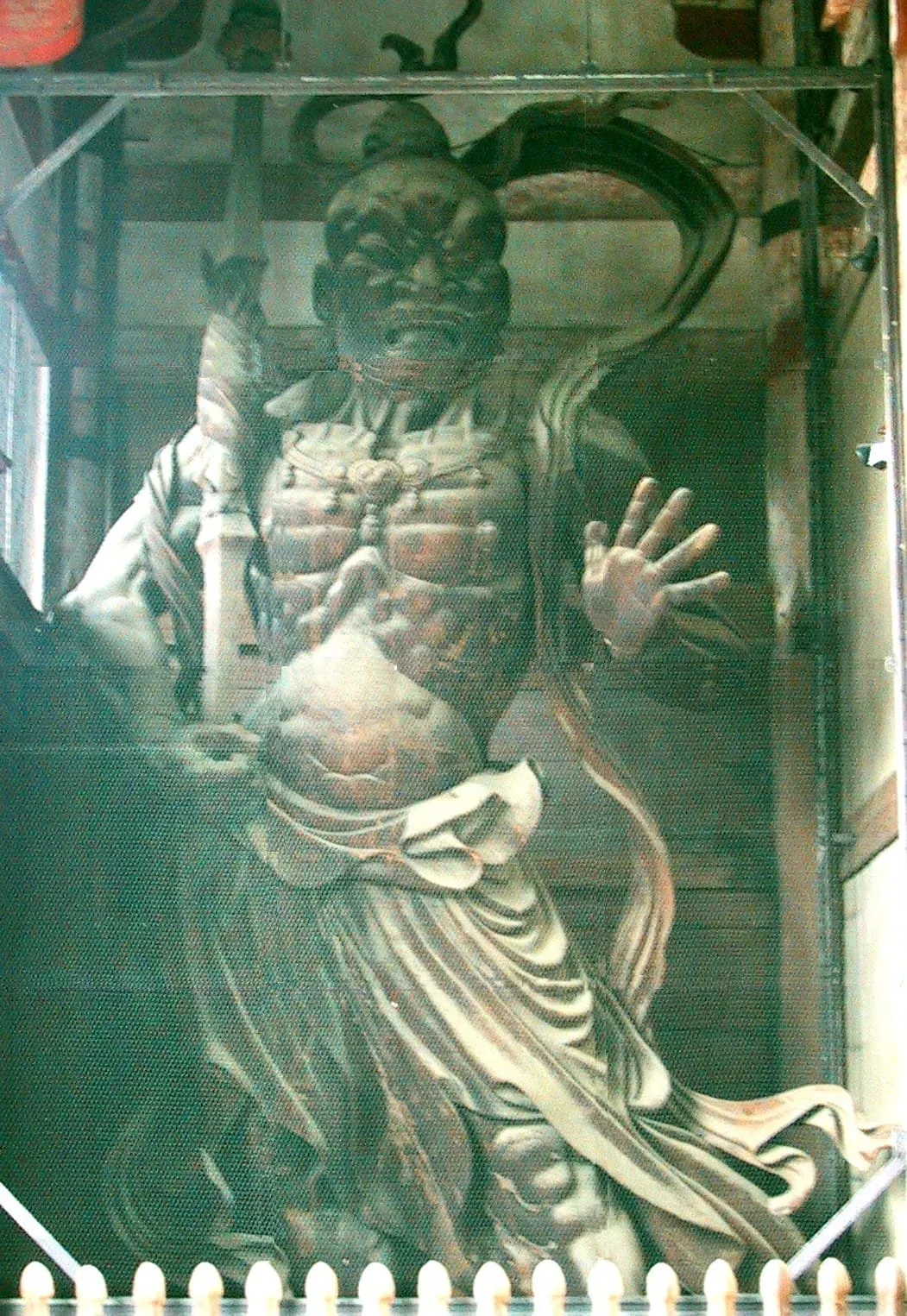
In 1203, sculptors Unkei (運慶) and Kaikei (快慶) — with their workshops — completed a pair of Niō figures for the Nandaimon (South Great Gate) of Tōdai-ji in Nara. They remain the most celebrated Niō statues in Japan.
The agyō* stands approximately 8.4 meters tall; the ungyō stands 8.35 meters. Both were made using yosegi-zukuri (寄木造) — the block-assembly technique in which dozens of separately carved wood pieces are fitted together into a unified figure. The method allows monumental scale and parallel workshop production: different sections of a figure can be carved simultaneously in different workshops, then assembled on-site. Records claim the figures were completed in roughly two months, which makes sense for an assembly phase, assuming component carving happened in advance.
What distinguishes Unkei’s work is its anatomical precision. Tendons strain. Forearms bulge. Jaw muscles flex visibly as the open mouth widens. This technique — called nikubari (肉張り), flesh pushing against skin — is a signature achievement of the Kamakura-period Kei school to which both sculptors belonged. Nothing like it exists in earlier Japanese Buddhist sculpture. When you stand in front of the Nandaimon and look up, the effect of these figures within their five-bay gate is genuinely overwhelming.
The Architecture of the Niōmon
The gate itself is as worth examining as the statues it contains.
The most common form is the rōmon (楼門) — a two-story gate with a passageway on the ground level and a roofed upper story that provides architectural mass. The Niō statues stand in the left and right ground-level bays, flanking the central opening. Upper stories sometimes house Buddhist images or bronze bells, though many are primarily decorative.
Smaller temples use simpler single-story forms. The number of bays signals prestige: three-bay gates (sanken) are standard; five-bay gates (goken) indicate major institutional standing. Tōdai-ji’s Nandaimon is a five-bay example. Building materials are typically hinoki (Japanese cypress) or keyaki (zelkova), and roofs are covered in ceramic tile, cypress bark, or copper sheet.
Niōmon versus Sanmon
Sanmon (三門) — “gate of three” — is associated primarily with Zen Buddhism. The “three” refers to the three gates of liberation: emptiness, formlessness, and desirelessness. A Zen sanmon typically does not house Niō figures; it may shelter Arhat statues or the historical Buddha, and it functions as a symbol of liberation theology rather than protective threshold.
When visiting any large temple, look carefully at the gate. Two muscular warrior figures facing outward: you are looking at a niōmon. Seated Buddhist figures, or no statuary at all: likely a sanmon or generic sōmon. The distinction reflects the temple’s sect: niōmon are common in Tendai, Shingon, and Pure Land establishments; sanmon characterize Zen compounds.
Notable Niōmon Around Japan
Hōryū-ji (Nara): The oldest surviving Niō statues (711 CE, National Treasure). Clay-core construction in a gate that predates the figures by about a century. The most historically significant site for this type of sculpture, though wire-mesh protection limits close viewing.
Tōdai-ji Nandaimon (Nara): Unkei and Kaikei (1203 CE, National Treasure). Japan’s largest Niō statues in one of Japan’s largest wooden gates. Approach from the main avenue to experience the progressive reveal of the figures through the columns.
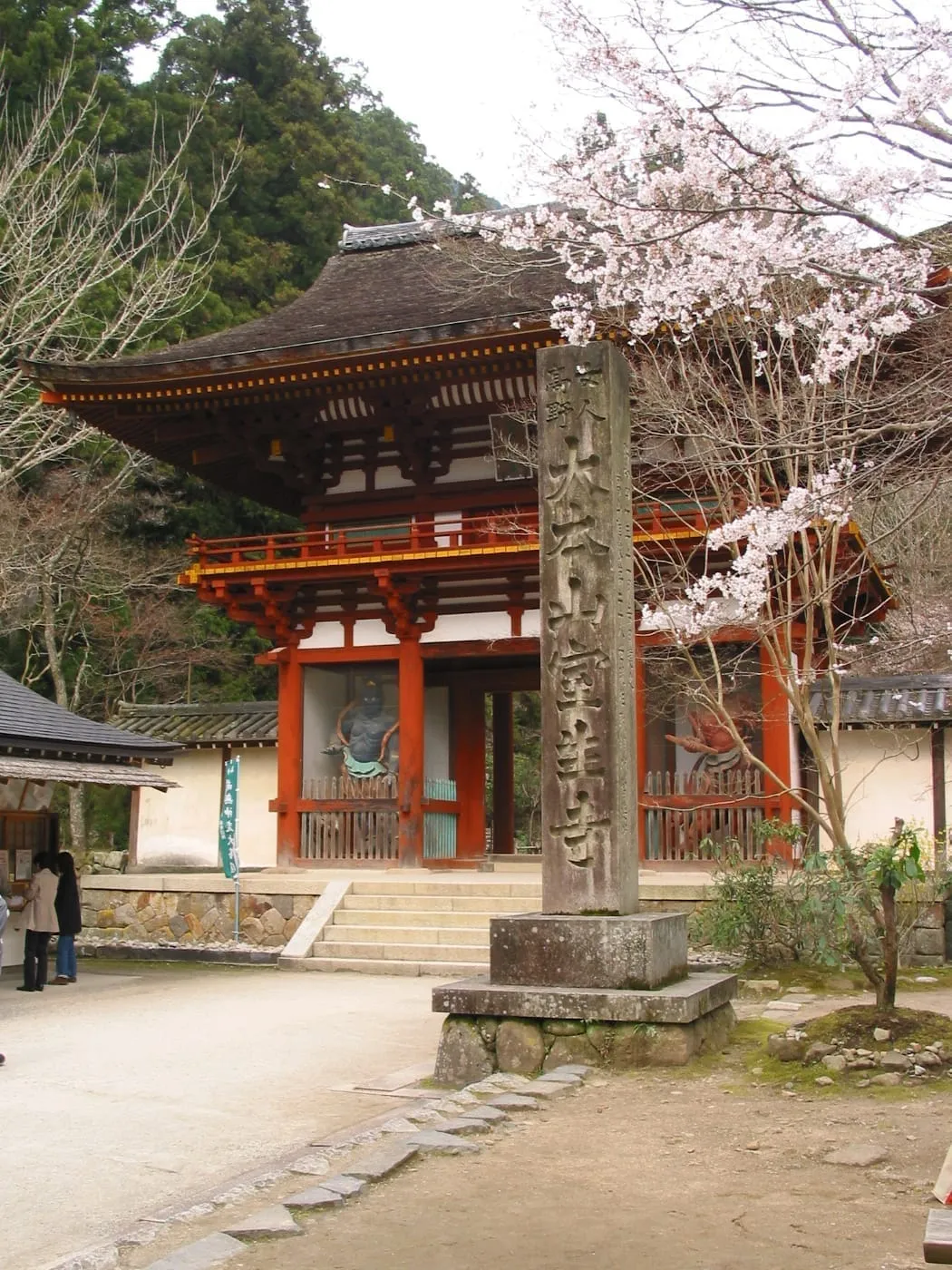
Murouji (Nara): A smaller, more intimate niōmon set among cedar forest and moss-covered stone steps. Known as the “Women’s Kōya” for its acceptance of female pilgrims during centuries when Kōya-san maintained strict prohibition. The atmosphere here is entirely different from Nara’s civic grandeur — quieter, darker, more enclosed.
Ninnaji (Kyoto): The two-story niōmon (National Treasure, 1641) donated by the Tokugawa shogunate. The figures inside stand approximately 4.5 meters tall; the gate’s commanding position on the main approach makes it one of the most visited in Kyoto.
Kiyomizudera (Kyoto): A gate from around 1510 on the main approach before the temple’s famous wooden terrace. Often passed quickly in the rush to reach the view, but worth a pause.
What to Look For When You Visit
Slow down at the niōmon. Specific things to observe:
Mouth: Which side is agyō* (open) and which is ungyō (closed)? Is the placement conventional (open on visitor’s right) or reversed?
Body movement: Does the figure lean, twist, or lunge? Kamakura-period statues tend toward dynamic postures; Nara-period figures are more static. Watch for a stepped-forward foot or a sharply twisted torso.
Musculature: The degree of anatomical realism varies enormously across periods. Unkei-school figures have visible veins; Nara-period surfaces tend toward more schematic forms.
Pigment traces: Look in protected recesses — inside folds, behind ears — for surviving paint. Red, green, and black are common; gold leaf sometimes survives on armor elements.
The gate from inside: After passing through, turn and look back. The interior face of the niōmon is often quite different — figures lit from a different direction, the architectural framing changed. Some of the most interesting views are from the inside looking out.
Side profiles: If the gate permits it, view the figures from the side. Three-dimensional sculpture reveals details that disappear head-on — the depth of a stance, the relationship between feet and body weight, how the sculptor handled the back of the head.
The Niōmon and Goshuin
The niōmon is the first significant structure you encounter at any temple. For goshuin collectors, this gives it particular weight.
The conventional sequence is: enter through the gate, purify at the temizuya (手水舎, purification basin), approach the main hall, make an offering and pray, then receive a goshuin. The seal records this complete act of pilgrimage. Collecting one before the circuit inverts its meaning.
Some temples issue goshuin specifically associated with the Niō — with characters for Niō or Kongōrikishi in the center. These are rarer than main-hall seals but worth asking about at temples with particularly significant guardian figures.
The deeper value of knowing the niōmon is perceptual rather than strategic. Temple visits accumulate, and what distinguishes them is the quality of attention you bring. Knowing that the open-mouthed figure encodes the beginning of the Sanskrit alphabet, that its anger faces outward to protect rather than threaten — this changes what you see. Not by slowing you down, but by adding depth to the moment you pass through.
Why the Niō Wear Anger
The Niō’s expression is called funnō (忿怒) — wrathful countenance: brows compressed, eyes wide, teeth bared. The direction of this anger matters.
The Niō face outward, toward the secular world the visitor has just left. Their ferocity guards the sacred precinct against malevolent forces. Once you pass through the gate, you are behind their gaze. You are being protected.
This inversion — the fierce guardian as protector rather than threat — runs through much of Buddhist iconography. The wrathful face is not aimed at you. It is aimed on your behalf.
Standing inside the compound, looking back at the two figures you just passed between, this distinction shifts from intellectual to felt. Their gaze is somewhere behind you now. You are in the place they are guarding.
Summary
The niōmon is the architectural embodiment of a Buddhist threshold. Its guardian pair — agyō* and ungyō, open and closed, beginning and end — frames the temple compound as the space between extremes: where practice and devotion take place.
From the clay-core Nara-period figures of Hōryū-ji to the eight-meter wooden giants of Unkei and Kaikei at Tōdai-ji, Niō statues span 1,300 years of Buddhist sculptural history. Each pair is different. Each gate is different. And each time you pass through a niōmon, you repeat an act that hundreds of millions of people have made before you, in the same direction, toward the same kind of space.
Take a moment at the threshold. Look at who is standing there. Then walk through.
Image Credits
Images in this article are from Wikimedia Commons.
- Header image: Niōmon of Chōgosonshi-ji / KENPEI, CC BY-SA 3.0
- Niō Guardian (Agyō) by Unkei, Tōdai-ji Nandaimon / Chris 73, CC BY-SA 3.0
- Kongōrikishi of Hōryū-ji / 663highland, CC BY-SA 3.0
- Niōmon at Murouji / Tawashi2006, CC BY-SA 3.0