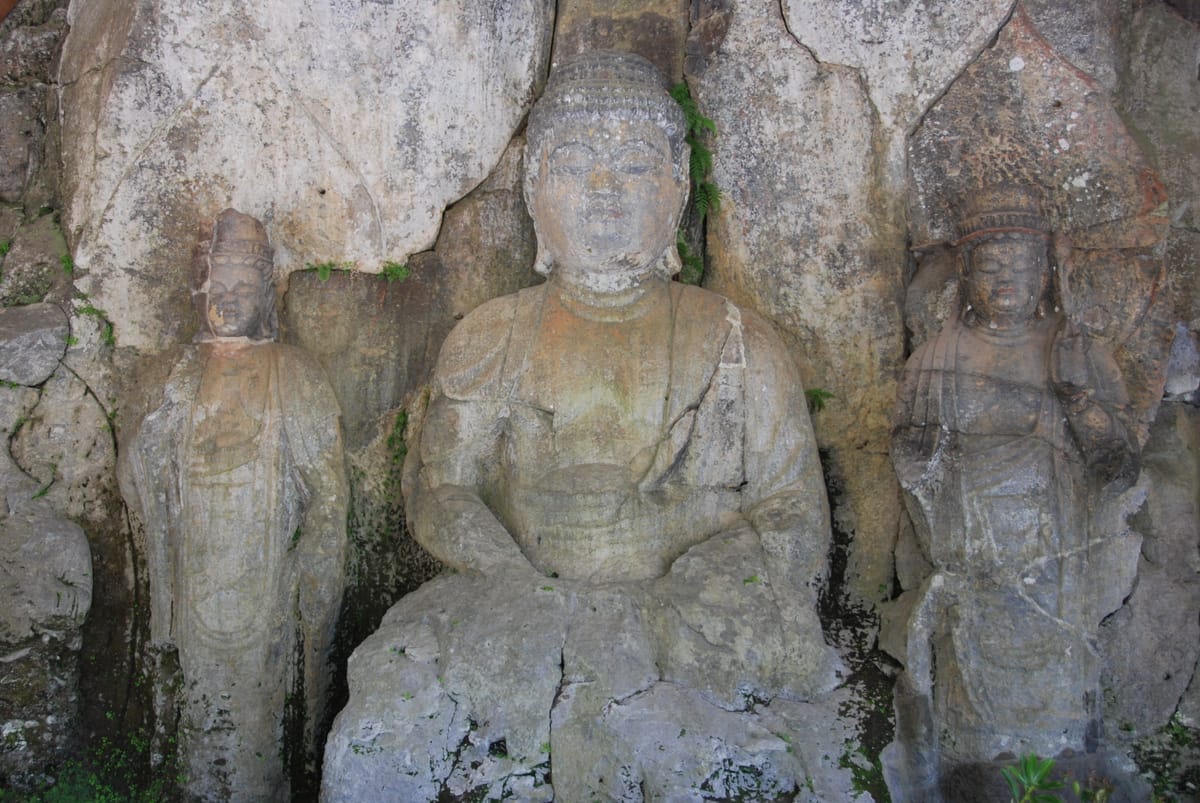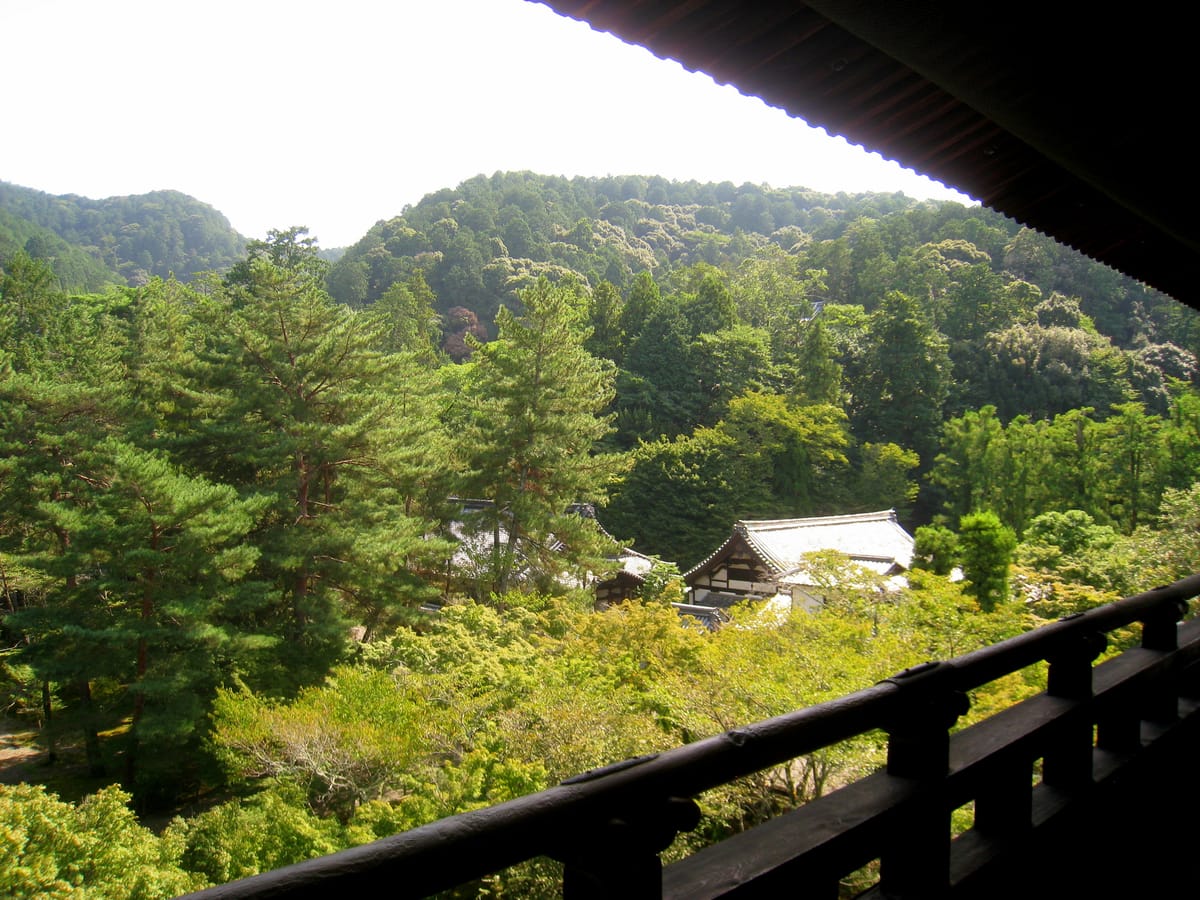
Stand in the grounds of almost any significant Japanese temple and you will see a tower rising above the treeline. Three stories, five stories — each tier slightly smaller than the one below, topped by a slender metal finial that catches the light and points toward the sky. The Japanese call these towers tō (塔), and they are the most visible symbol of Buddhism in the Japanese landscape.
Most visitors photograph pagodas before they have any idea what they represent. That is natural — the towers are extraordinary objects. But the experience deepens once you understand what you are looking at. Why odd numbers? What is that strange assembly of rings and finials at the top? Why does the seven-century-old pagoda at Hōryū-ji still stand perfectly straight after fourteen hundred years of earthquakes? And how does the pagoda connect to the goshuin collected at the temples where it stands?
Origins: From an Indian Burial Mound to the Sky
The pagoda’s story begins with death.
When the historical Buddha died at Kushinagar around 480 BCE, his cremated remains (sarira in Sanskrit, shari 舎利 in Japanese) were divided among eight clans, each of which built an earthen mound — a stūpa — to enshrine its portion. The stūpa was a tomb in origin, but a sacred tomb: the physical remnant of an enlightened being rendered permanent in architecture. At its apex, a pole carrying a series of ceremonial umbrella discs pointed toward the sky. This pole is the direct ancestor of the Japanese sorin finial.
The most famous early stūpa is the Great Stupa at Sanchi, central India, built during the reign of Emperor Ashoka (third century BCE). As Buddhism spread northeast through Central Asia into China in the first century CE, the dome-shaped Indian stūpa merged with native multi-story wooden watchtower architecture. The result was the pagoda as we know it: a wooden, multi-story tower with bracketed eaves at each level and a reliquary at its core. The Chinese called it ta (塔), a compression of stūpa, and this word passed directly into Japanese as tō.
Buddhism reached Japan in the mid-sixth century CE via Korean monks carrying sutras, images, and architectural knowledge. Within decades, a wave of temple construction began. The result — visible at Hōryū-ji, Yakushi-ji, and dozens of Nara-period sites — established the specifically Japanese pagoda form: large wooden structures of three or five stories, with deep eaves, a prominent sorin finial, and a hidden reliquary at the foundation.
Why Odd Numbers?
Walk through the list of famous Japanese pagodas: three stories, five stories, three, five. There are historical records of seven-story and nine-story pagodas, but none survive. No two-story or four-story wooden pagoda of note exists.
This reflects Chinese cosmological thinking absorbed alongside Buddhism. In the yīn-yáng framework, odd numbers are yang — associated with heaven, light, and auspiciousness. Even numbers are yīn — associated with earth and passivity. A tower reaching toward heaven should employ yang numbers.
The individual numbers also carry Buddhist meaning. Three (san, 三) most commonly represents the Three Worlds (sanze, 三世) — past, present, and future — the complete span of time in Buddhist cosmology. Alternatively, it represents the Three Jewels (sanbō, 三宝): the Buddha, the Dharma, and the Sangha. A three-story pagoda is an architectural declaration of the faith’s core commitments.
Five (go, 五) connects to the Five Elements (godai, 五大) of esoteric Buddhist cosmology: earth, water, fire, wind, and kū (空) — emptiness or sky. Each story corresponds to one element, and the tower becomes a vertical diagram of the cosmos, ascending from material density at the base to pure emptiness at the apex. In Shingon Buddhism, this is not metaphor but doctrine: the five-story pagoda is a three-dimensional mandala of the cosmic Buddha Dainichi Nyorai (Mahāvairocana), the universe rendered in timber and stone.
Structure: The Engineering of Sacred Space
The Sorin: Reading the Finial
The metal assembly at the top of every pagoda — the sorin (相輪) — is among the most symbolically dense elements of Japanese Buddhist architecture. From bottom to top:
Roban (露盤): a square metal base platform.
Fukubachi (伏鉢, “inverted bowl”): a shallow dome sitting on the roban. This is the vestigial stūpa — the last trace of the Indian hemispherical burial mound, reduced to a small metal curve at the pagoda’s apex.
Kurin (九輪, “nine rings”): nine metal discs on a central pole. Nine is the largest single-digit odd number; it represents the fullness of the Buddha’s virtues, and in some traditions corresponds to nine levels of Buddhist heaven.
Suien (水煙, “water flame”): an openwork metal flame-shape above the rings. Despite the word “water,” it appears as flame — the paradox is deliberate: the water of Buddha’s teachings extinguishes the fire of desire. These are often pierced with images of celestial beings in flight.
Hōju (宝珠, “wish-granting jewel”): a sphere at the very tip — the cintāmaṇi of Indian mythology, the jewel that grants all wishes. Placing it at the apex declares the tower to be a source of inexhaustible benefit.
The Shinbashira: Why Pagodas Don’t Fall
The most remarkable feature of a wooden pagoda is invisible: the shinbashira (心柱, “heart column”). A single massive timber — sometimes a single tree trunk — runs through the pagoda’s center from bottom to top. At Hōryū-ji, this column is a camphor trunk approximately 28 meters tall.
The crucial detail is that the shinbashira is not attached to the individual floors. Its base is suspended just above the foundation stone. In an earthquake, the outer framework and the heart column respond at different frequencies — slightly out of phase with each other — and this phase difference dissipates seismic energy before it builds to a collapse. The tower wobbles; it does not fall.
This principle was rediscovered by modern structural engineers and deliberately applied in the design of the Tokyo Skytree (completed 2012), where a concrete shinbashira serves as a seismic damper for the world’s second-tallest structure. A seventh-century carpenter’s solution became a twenty-first-century engineering principle.
Hōryū-ji: The World’s Oldest Wooden Pagoda
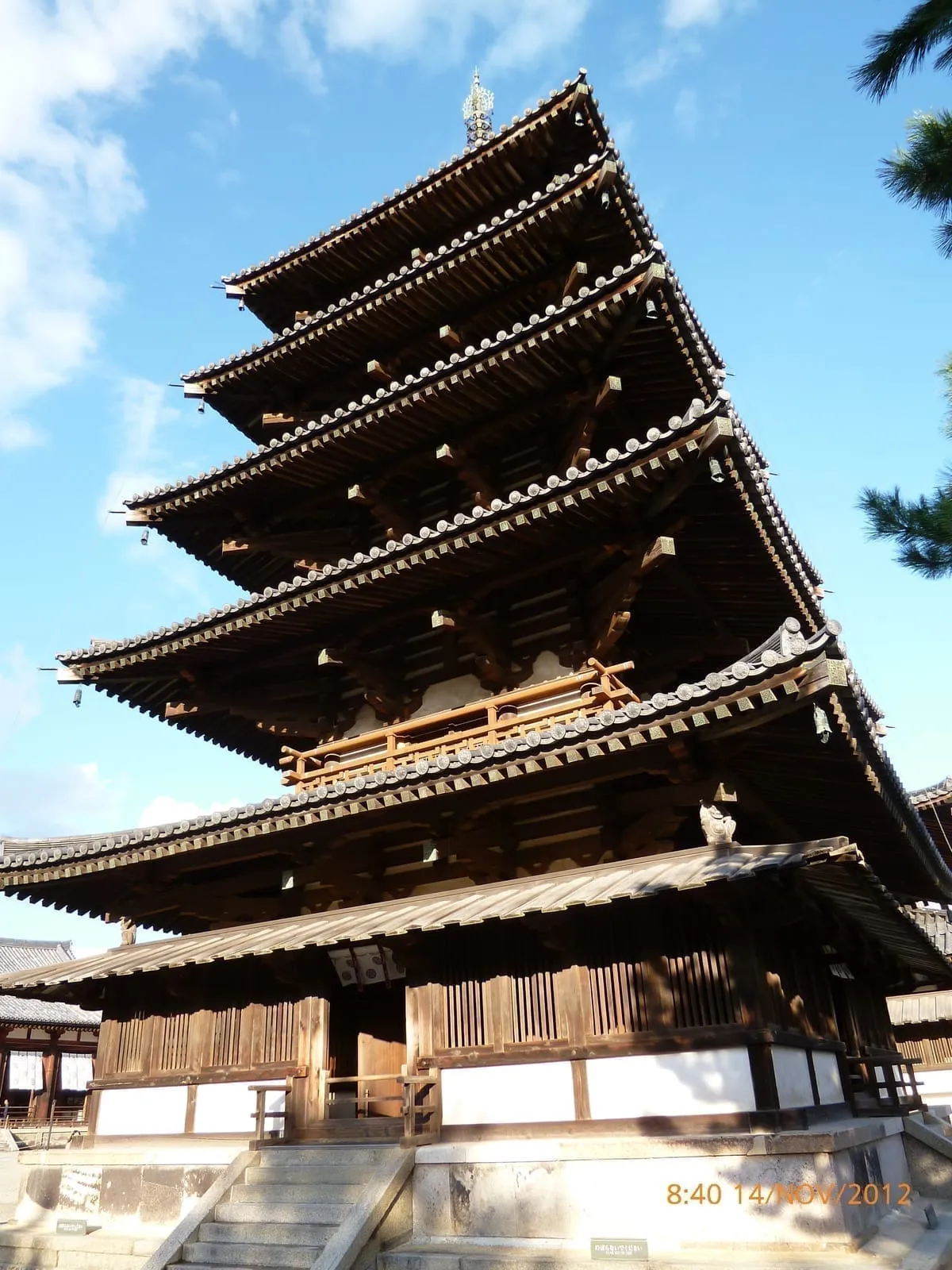
In Ikaruga, Nara Prefecture, Hōryū-ji (法隆寺) has stood since the reign of Prince Shōtoku (574–622), its traditional founder. Registered as a UNESCO World Heritage Site in 1993, its five-story pagoda at 32.45 meters is among the oldest surviving wooden structures on Earth.
The current pagoda postdates the original: records indicate a fire around 670 CE destroyed the first buildings, and the present West Compound (Saiin Garan) was rebuilt in the decades that followed. Wood samples from the main structural members have been dated by dendrochronology to the late seventh century. The pagoda and the adjacent Kondō main hall together constitute the oldest surviving complex of wooden buildings anywhere in the world.
The architecture belongs to the Asuka style, showing direct continental influence: entasis columns (slightly convex in profile), bracket forms characteristic of Korean intermediary transmission, and proportional systems borrowed from Tang-dynasty Chinese prototypes. At the base, a reliquary chamber holds shari. The interior of the first story houses four clay sculptural tableau groups on the four sides of the central column — scenes from the Buddha’s death, the distribution of relics, the Maitreya paradise, and the debate of Vimalakīrti — visible through lattice openings from outside (the interior is not accessible). These sōzō clay sculptures are among the most important examples of early Japanese Buddhist art, and their subject matter reinforces the pagoda’s identity: not merely an architectural monument but a narrative environment surrounding the relic within.
Tō-ji: Japan’s Tallest Wooden Tower
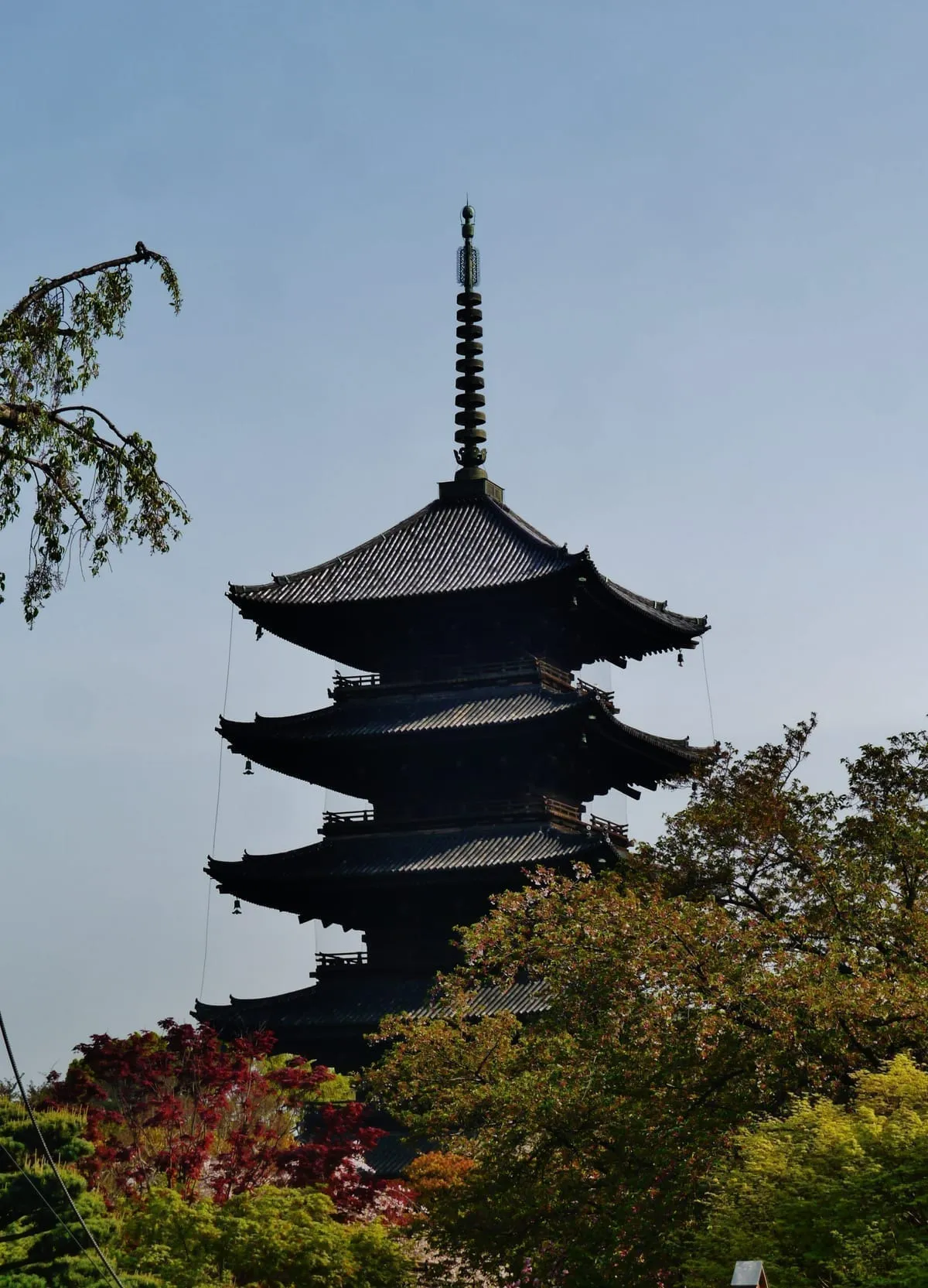
The five-story pagoda of Tō-ji (東寺) in Kyoto stands 54.8 meters — the tallest surviving wooden structure in Japan. For more than a millennium it has anchored the southwestern horizon of the city, and arriving by train into Kyoto Station you can see it through the windows before you reach the platform.
Tō-ji was founded in 796 CE as one of two guardian temples of the new Heian capital. In 823, Emperor Saga gave it to the monk Kūkai (空海, 774–835) — Kōbō Daishi — who had studied esoteric Buddhism in Tang China and made it the headquarters of the Shingon sect. The temple remains the head institution of the Tō-ji school of Shingon to this day.
The present pagoda is the fifth on this site; four predecessors burned. It was rebuilt in 1644 under the third Tokugawa shōgun Iemitsu. The interior, opened during special viewing periods in spring and autumn, contains a three-dimensional Shingon mandala (rittai mandara, 立体曼荼羅) — Dainichi Nyorai and four attendant Buddhas at the cardinal points of the first story, surrounding the shinbashira which hangs free of the foundation stone. This arrangement is unique to Tō-ji and represents Kūkai’s vision of the cosmos made spatial. Standing before it, the phrase “the pagoda is a three-dimensional mandala” stops being a description and becomes an experience.
On the 21st of each month — the anniversary of Kūkai’s death — a large outdoor market, Kōbō-ichi (弘法市), fills the temple grounds with hundreds of stalls selling antiques, plants, and street food. The atmosphere of incense, bargaining, and the pagoda rising overhead is entirely unlike anything else in Kyoto.
Muro-ji: The Smallest Outdoor Pagoda
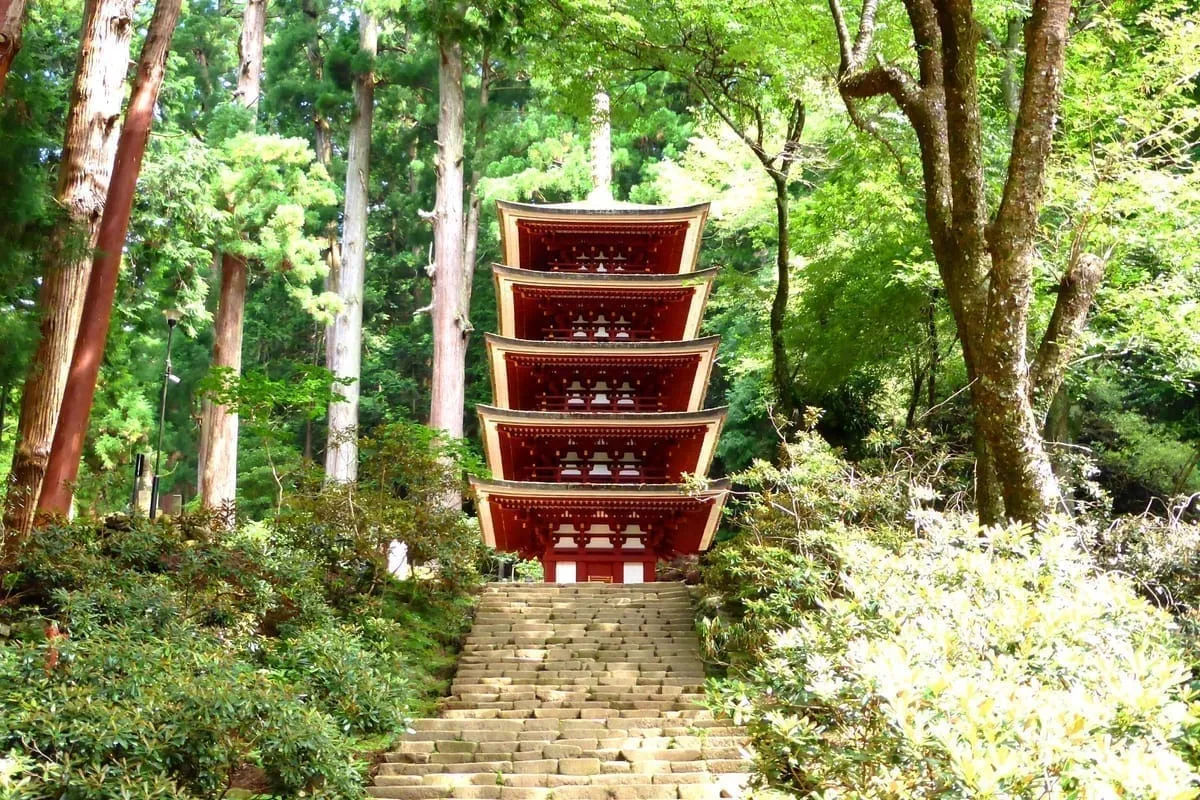
Deep in the Uda mountains of Nara Prefecture, Muro-ji (室生寺) houses the smallest outdoor five-story pagoda in Japan: just 16 meters, barely a third of Tō-ji’s height. Yet visitors who have seen both often describe Muro-ji’s as the more affecting of the two.
The reason is setting. Tō-ji’s pagoda commands an urban sky; Muro-ji’s sits at the foot of a stone staircase amid ancient cedars, its proportions intimate, its surfaces darkened with centuries of mountain rain and moss. As you climb toward it through the trees, the tower appears and disappears between the trunks — a glimpse, then a full view, then you are close enough to read the grain in the old wood.
Muro-ji was founded in the late Nara period and historically admitted female pilgrims at a time when Kōya-san, the great Shingon mountain temple, excluded women. For this it became known as Nyonin Kōya (女人高野), “Women’s Kōya-san,” accumulating associations with women’s faith that give the temple a different emotional register from the grand institutions of Nara and Kyoto.
In September 1998, Typhoon No. 7 felled a cedar tree onto the pagoda, destroying the upper story and sorin finial. Reconstruction was completed in 1999, partly funded by the Matsushita Memorial Foundation. The repair is seamless; the pagoda has regained its original appearance.
The Tahōtō: Esoteric Buddhism’s Distinct Tower
Alongside the three- and five-story towers of the Nara and Heian periods, esoteric Buddhism produced a completely different pagoda form: the tahōtō (多宝塔). Its lower story is square, its upper story cylindrical — a combination found nowhere else in East Asian Buddhist architecture.
The form derives from the Lotus Sutra’s “Emergence of the Treasure Tower” chapter: while Shakyamuni preaches the sutra, a jeweled tower erupts from the earth, and within it an ancient Buddha named Many-Treasures (Tahō Nyorai) appears beside Shakyamuni to certify the teaching. The tahōtō building represents this moment — two Buddhas seated together in a structure that is simultaneously square (earth, Shakyamuni’s world) and circular (the cosmic, the eternal).
The finest surviving example is the Great Pagoda (Daitō) at Negoro-ji (根来寺) in Wakayama Prefecture — a National Treasure of roughly 40 meters, built in the early fourteenth century and one of the few structures at Negoro-ji to survive Toyotomi Hideyoshi’s assault in 1585. The Daitō at Kōya-san’s Kongōbu-ji (金剛峯寺), rebuilt in 1937 in striking vermilion and gold, houses a complete three-dimensional mandala in its interior, with the walls painted with deities from the Womb Mandala.
The Pagoda and the Goshuin
The goshuin you receive at a temple with a pagoda carries an extra layer of meaning.
At Tō-ji, the principal stamp commemorates Kūkai, and the pagoda’s silhouette appears on the most popular goshuinchō sold there. At Hōryū-ji, the stamps include the seal of the West Compound where the world’s oldest wooden pagoda stands. At Muro-ji, the stamp includes the temple’s name amid a design evoking the mountain setting.
Consider spending time with the pagoda before and after collecting your stamp. The pagoda is not the building where stamps are issued — that happens at the main hall — but it is often the building that most fully embodies the temple’s identity. Hōryū-ji without its five-story pagoda would be unrecognizable; Tō-ji without its tower would lose its meaning as a Kyoto landmark.
A practice worth cultivating: stand before a pagoda and locate the sorin. Follow it upward — roban, fukubachi, nine rings, water-flame — to the wish-granting jewel at the very tip. Then lower your gaze through all five stories to the ground. You have just traced the path from earth to heaven and back. That is the movement the tower was built to embody.
Conclusion
The Japanese pagoda is a story told in wood and metal across two and a half millennia and three continents. It began as an earthen mound over a handful of cremated bones in northern India. It traveled the Silk Road, absorbing the architectural vocabulary of Gandhara and China. It arrived in Japan via Korean craftsmen and was rebuilt, refined, and endured — through fires, earthquakes, and centuries — into the towers that still stand in Nara, Kyoto, and mountain forests like Muro-ji’s.
The odd number of stories is a cosmological statement. The sorin finial is a compressed diagram of Buddhist symbolism. The shinbashira is an earthquake-isolation system more than a thousand years old. When you next stand before a pagoda with a goshuinchō in hand, you are standing at the convergence of all of that history. The jewel at the tip marks where it ends — at the precise boundary between the building and the sky.
Image Credits
- Five-Story Pagoda, Hōryū-ji: Vesna Vujicic-Lugassy / UNESCO, CC BY-SA 3.0 IGO, via Wikimedia Commons
- Five-Story Pagoda, Tō-ji: Zairon, CC BY-SA 4.0, via Wikimedia Commons
- Five-Story Pagoda, Muro-ji: ttshr1970, CC BY 3.0, via Wikimedia Commons