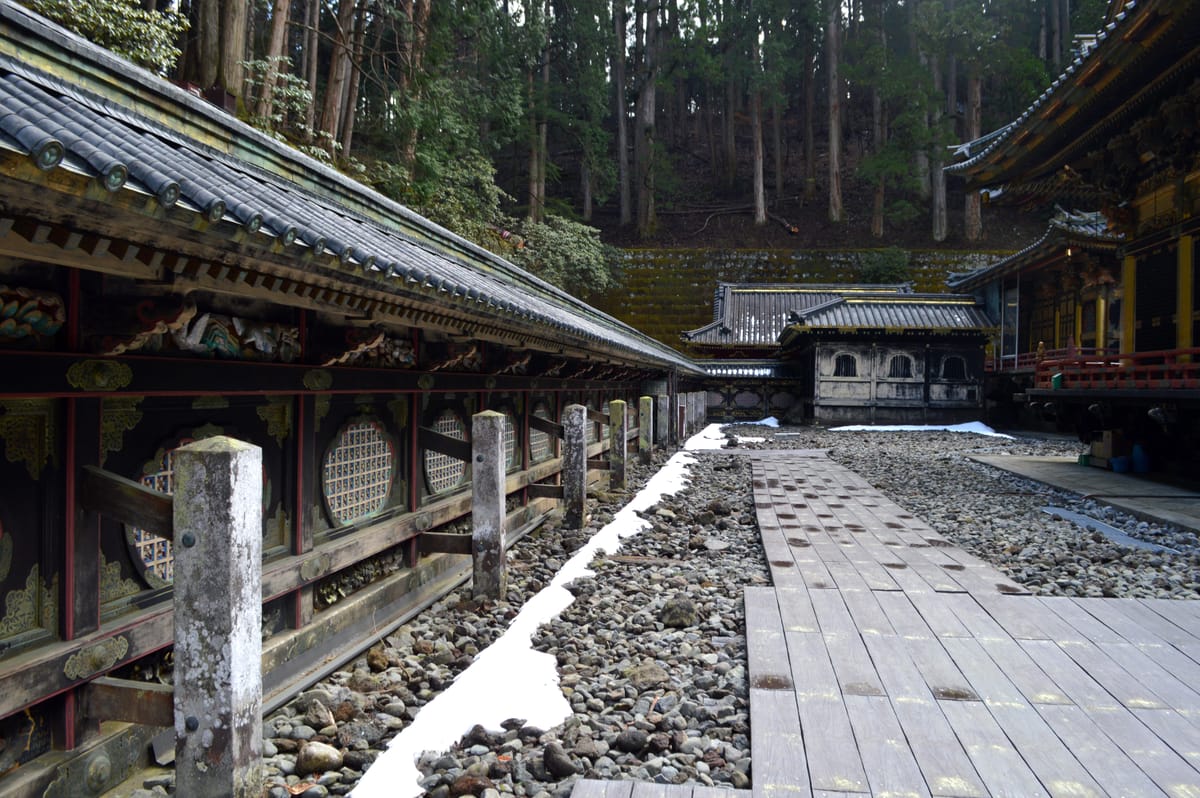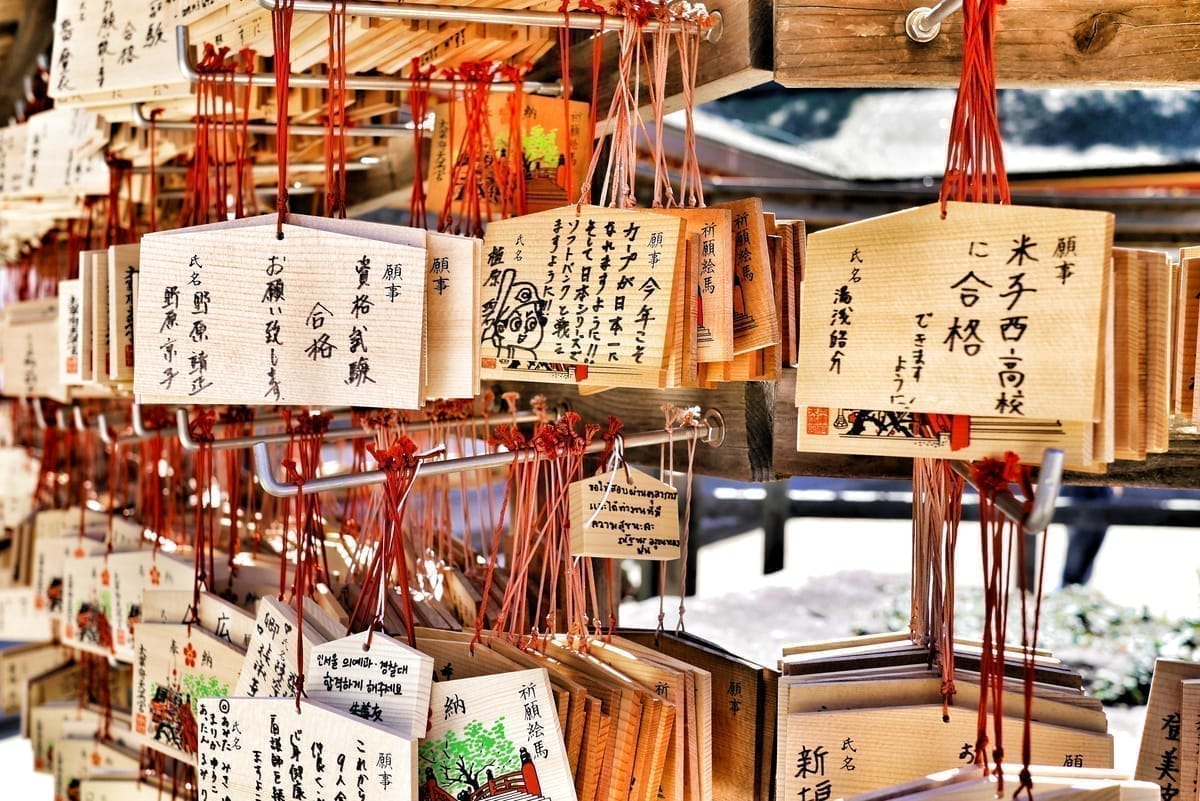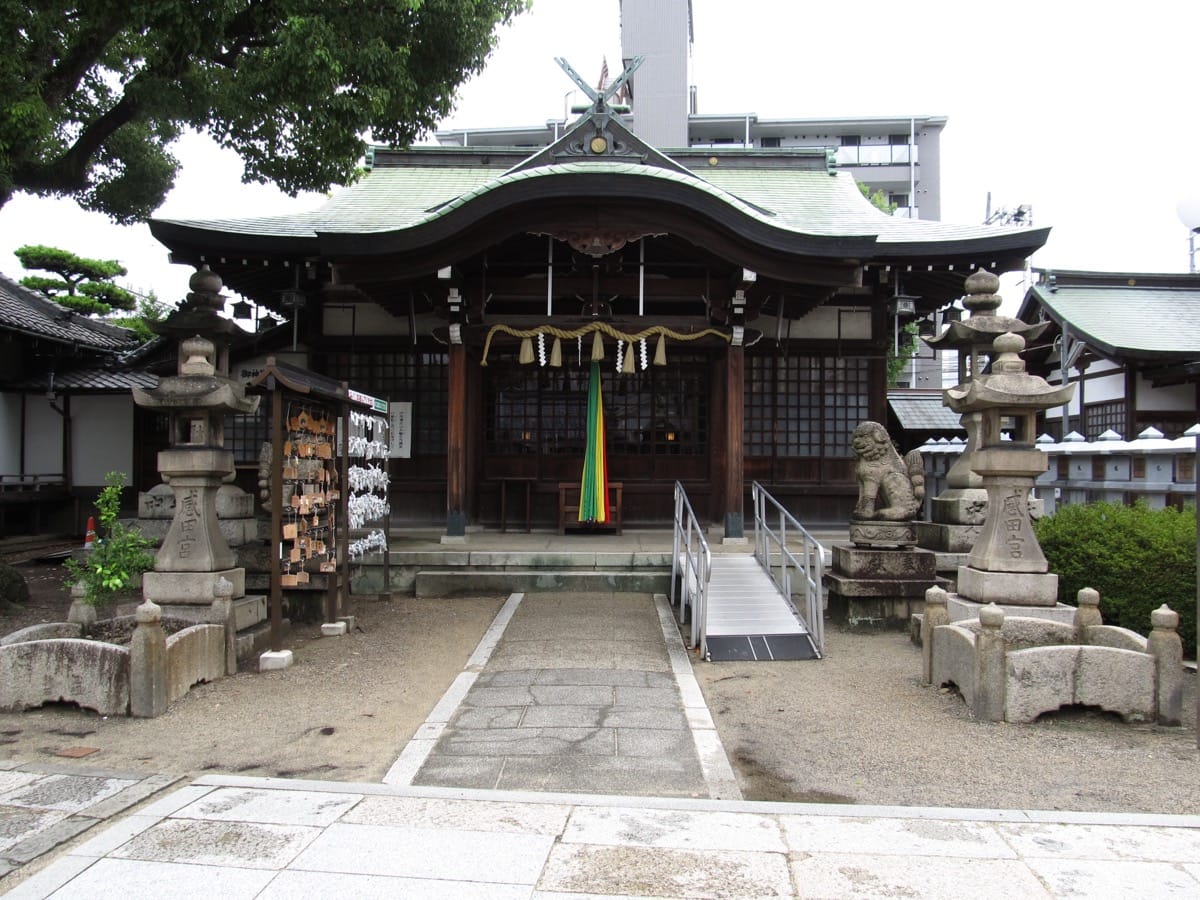
There is almost always water at the entrance to a Japanese shrine.
Sometimes it is a pond. Sometimes a stream. Sometimes just the stone basin of the chōzuya where you rinse your hands before approaching the deity. But often — in shrines large enough to have a proper approach — the water is arranged so that you must cross it. A bridge stands between you and the inner precinct.
That bridge is rarely flat.
The most iconic form arches steeply upward, reaching a peak at the center before descending again toward the sanctuary. The incline can be severe: at Sumiyoshi Taisha in Osaka, the bridge rises at roughly 48 degrees, and you grip the railing to pull yourself up. At the top, you pause — the city below, the shrine ahead, water on both sides — and then you descend.
This is not poor engineering. A flat bridge would have been easier to build and easier to cross. The arch is a choice, and the choice carries meaning.
The Names and Forms of Shrine Bridges
Japanese has several terms for the arched bridges found at shrines.
Taiko-bashi (太鼓橋, “drum bridge”) refers to the shape of the cross-section: the curve of the arch resembles the body of a taiko drum, and when the bridge is reflected in still water, the reflection and the bridge together form a perfect circle — a drum, or a moon.
Sori-bashi (反橋, “bent bridge”) describes the same form from a different angle — the bridge as something that bends or curves away from the horizontal. This is the older, more technical term; taiko-bashi is the popular name.
Shinkyo (神橋, “divine bridge”) is not a shape but a status: it designates bridges that are considered particularly sacred and, historically, were reserved for the passage of gods, emperors, or their representatives. The most famous shinkyo in Japan is the bright red bridge at Nikko.
Beyond the arched form, shrines also have flat bridges — often used as processional routes for portable shrines (mikoshi) during festivals, or as bridges that ordinary visitors cross between garden ponds. These lack the dramatic incline but often possess their own elegance: long, low, made of stone or cypress, spanning still water surrounded by maples or pines.
The arched bridge, however, carries the greatest symbolic weight.
Water and the Logic of Crossing
To understand why these bridges exist and why they are built the way they are, you need to start with water.
In Shinto, water is the primary medium of purification. The mythology explains why: when the god Izanagi returned from the underworld and needed to cleanse himself of its pollution, he bathed in a river. From that act of washing, new deities were born. Water removes impurity — kegare (穢れ) in Shinto vocabulary — and restores the state of hare, brightness and freshness.
This is why every shrine entrance has a chōzuya (手水舎): the ritual hand-washing station where visitors scoop water with a ladle, rinse their left hand, then their right, then their mouth. The gesture is small, but it marks a transition. You have symbolically cleansed yourself before approaching the deity.
The shrine bridge takes this logic further into the architecture. A pond or stream runs between the outer world and the inner precinct. You must cross it. The crossing is not incidental; it is structural. The bridge places you physically over water — briefly suspended between the ordinary world and the sacred one.
Why the Arch?
A flat bridge would allow crossing without any change in your physical relationship to the ground. You would simply walk forward. The arched bridge disrupts this. To cross, you must climb, reach the apex, and descend. Three distinct movements replace the single horizontal motion of ordinary walking.
That apex is significant. At the top of the arch, you stand briefly at the highest point of the crossing, able to look in both directions — the world you came from and the sanctuary ahead. For a moment you are between.
This is, in spatial and bodily terms, what Shinto theology describes as the liminal state between ke (the everyday) and hare (the sacred, the festive, the purified). The bridge does not merely represent the transition; it physically enacts it.
Dragons in the Water
Many shrine bridges carry an additional mythological layer: the idea that a dragon deity dwells in the water below.
Dragons in Japanese religious thought are water deities — lords of rivers, lakes, and seas, capable of bringing rain or holding it back. The most powerful shrine ponds are understood to be the territory of a ryūjin (龍神, dragon deity). To build a bridge over such water is to build over the dragon’s back.
The high arch of the taiko-bashi may have originally suggested this: the curve of the bridge resembles the spine of a dragon arching through water. The vermillion paint, the carved railings, the reflections in the pond — all conspire to make the crossing feel like passing over something alive and immense.
Five Great Shrine Bridges
Sumiyoshi Taisha’s Sori-hashi, Osaka
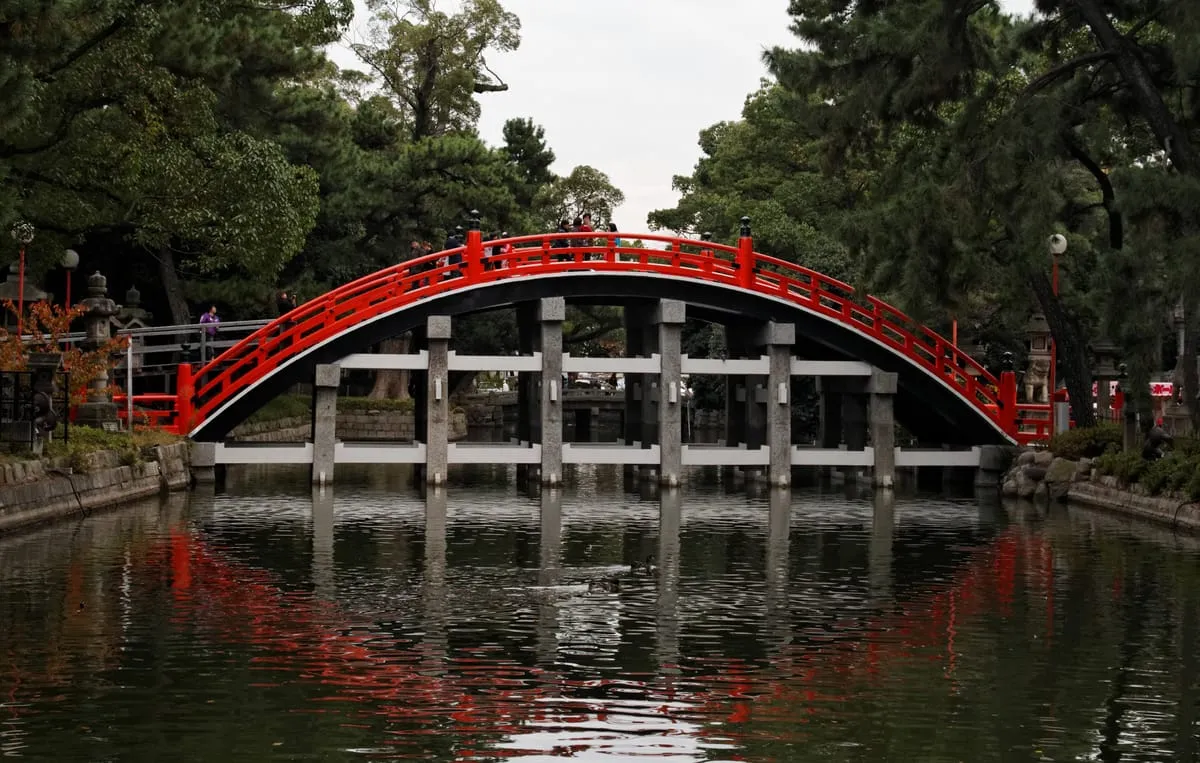
The sori-hashi at Sumiyoshi Taisha in southern Osaka is perhaps the most photographed shrine bridge in Japan. It is certainly one of the most physically demanding.
The grade is steep enough — around 48 degrees at its sharpest — that visitors moving slowly will grip the lacquered railings with both hands. Children sometimes freeze at the top, reluctant to trust the descent. The elderly sometimes take the longer alternative route around the pond. Crossing the bridge is, genuinely, a small physical achievement.
Sumiyoshi Taisha is among the oldest shrines in Japan, with origins said to predate the Nara period. It enshrines three ocean deities and the goddess Empress Jingu (神功皇后), and it served as the guardian shrine of sailors and fishermen on the Osaka Bay. The sori-hashi is said to have been crossed by Empress Jingu herself after returning victorious from the Korean Peninsula — a legend that lends the bridge a specifically martial sanctity.
The pond surrounding the bridge is home to large carp and reflected willows. In early spring, cherry blossoms overhang the approach, and the red bridge glows against white petals. In summer, the water surface stills in the early morning, and the reflection of the arch briefly forms a perfect circle.
The bridge is not merely an obstacle to surmount on the way to the main hall. It is a destination. Worshippers bow on both sides, photograph it from multiple angles, and watch others cross from the garden paths that ring the pond. Crossing the bridge is the act that defines a visit to Sumiyoshi Taisha.
Ise Jingu’s Uji-bashi, Mie
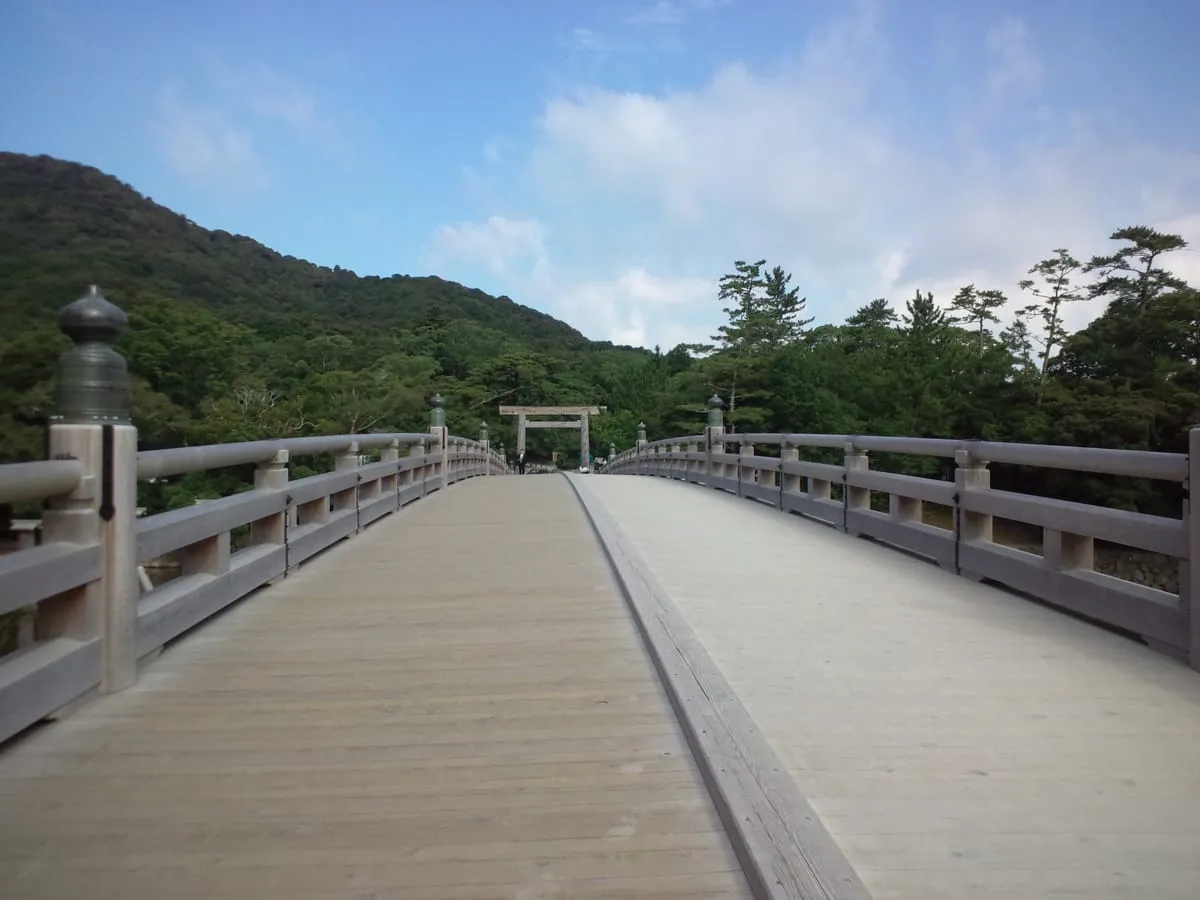
The Uji-bashi (宇治橋) at Ise Jingu’s Inner Shrine (Naikū) is the most sacred bridge in Japan by any conventional measure — it forms the threshold to the shrine that all other shrines in the country regard as the highest in the hierarchy of Shinto.
Unlike the steeply arched drum bridges seen at Sumiyoshi or Nikko, Uji-bashi is long and nearly flat: 101.8 meters from bank to bank, spanning the clear waters of the Isuzu River. Its significance lies not in its shape but in its materials and its role in the ritual cycle of the shrine.
The bridge is made entirely of hinoki cypress — Japanese cypress, the most revered timber in traditional architecture. The cypress comes from the shrine’s own forests (jingūrin), managed for centuries on a cycle timed to the construction needs of the shrine complex. Every plank, every pillar has been grown, felled, and shaped within this sacred ecosystem.
Like the shrine buildings themselves, the bridge is rebuilt approximately every twenty years as part of the Shikinen Sengū (式年遷宮) — the great ceremony of renewal in which the shrine structures are dismantled and rebuilt from scratch. The old bridge timbers are not wasted. They are transferred in stages: the retired bridge pillars become the new torii gates at the bridge ends, and those torii in turn become gates at a downstream location. Materials move down through the hierarchy of sanctity rather than being discarded.
The torii at the eastern (outer) end of the bridge is oriented so that the first light of the New Year’s sunrise enters directly through its center and travels the length of the bridge toward the main shrine. This alignment is intentional and has been preserved through every reconstruction. The bridge participates in a cosmological calendar that operates on a twenty-year cycle and is tied to the movements of the sun.
Visitors are expected to walk along the right side when approaching (i.e., keeping the center of the bridge — the “sacred center,” or seichū — to the left). The center is the deity’s path.
The Shinkyo at Nikko, Tochigi
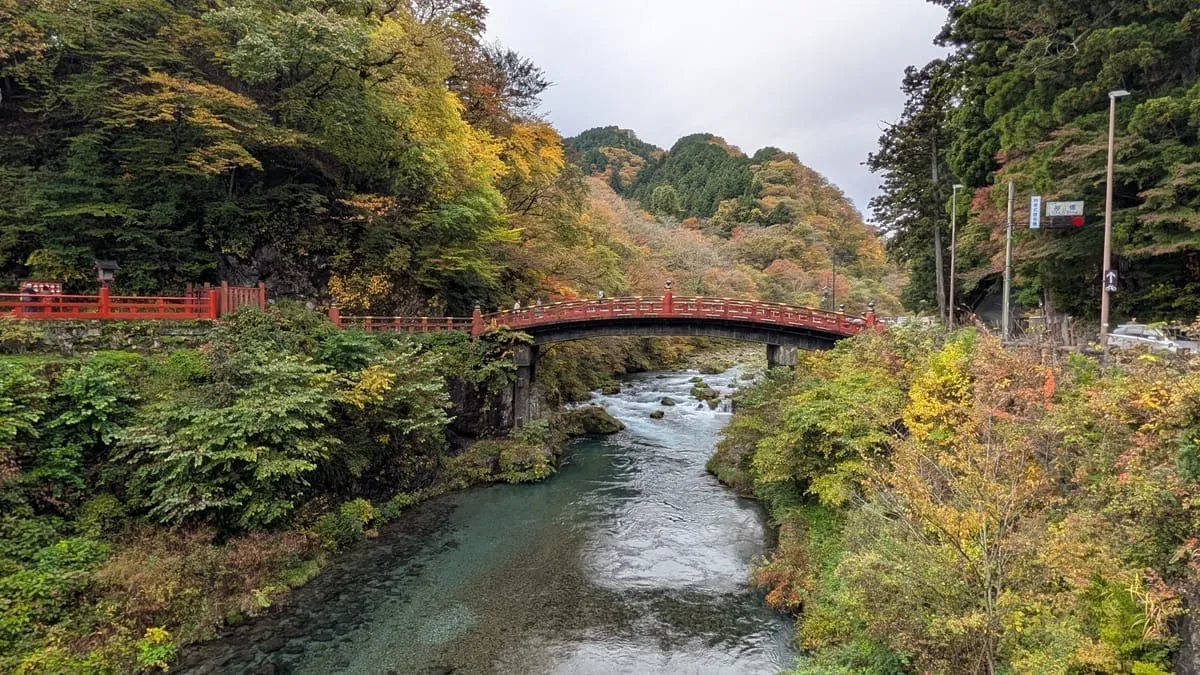
The first thing most visitors see when they arrive in the shrine-temple complex at Nikko is a bridge. The Shinkyo (神橋, “divine bridge”) spans the Daiya River at the foot of the mountain before you have climbed a single stone step toward the shrines and temples above.
It is spectacular: a vermillion arch supported by stone, crossing a rushing torrent whose banks are edged with enormous cedar trees. The bridge was originally known as the Yamasuge Bridge — named for the mountain sedge (yamasuge) that, according to legend, was manifested by the deity Jinja-Daiō to help the monk Shōdō cross the river when he arrived to establish the sacred site in the eighth century.
The legend describes two large snakes that appeared and stretched across the river, allowing Shōdō to cross. The bridge that was later constructed to formalize this crossing retained the sacred character of that original passage. For centuries, only emperors, shoguns, and imperial envoys were permitted to cross. In 1985, the bridge was formally designated a National Important Cultural Property. Visitors now pay a small admission fee to walk across.
The current bridge was largely reconstructed in 1636 under the Tokugawa shogunate, whose architects used it to communicate both power and sanctity. In autumn, the Daiya River reflects the crimson and gold of maple trees, and the red bridge becomes part of a total composition extending from waterline to mountainside — one of the most frequently photographed scenes in Japan.
Itsukushima’s Sori-hashi, Hiroshima
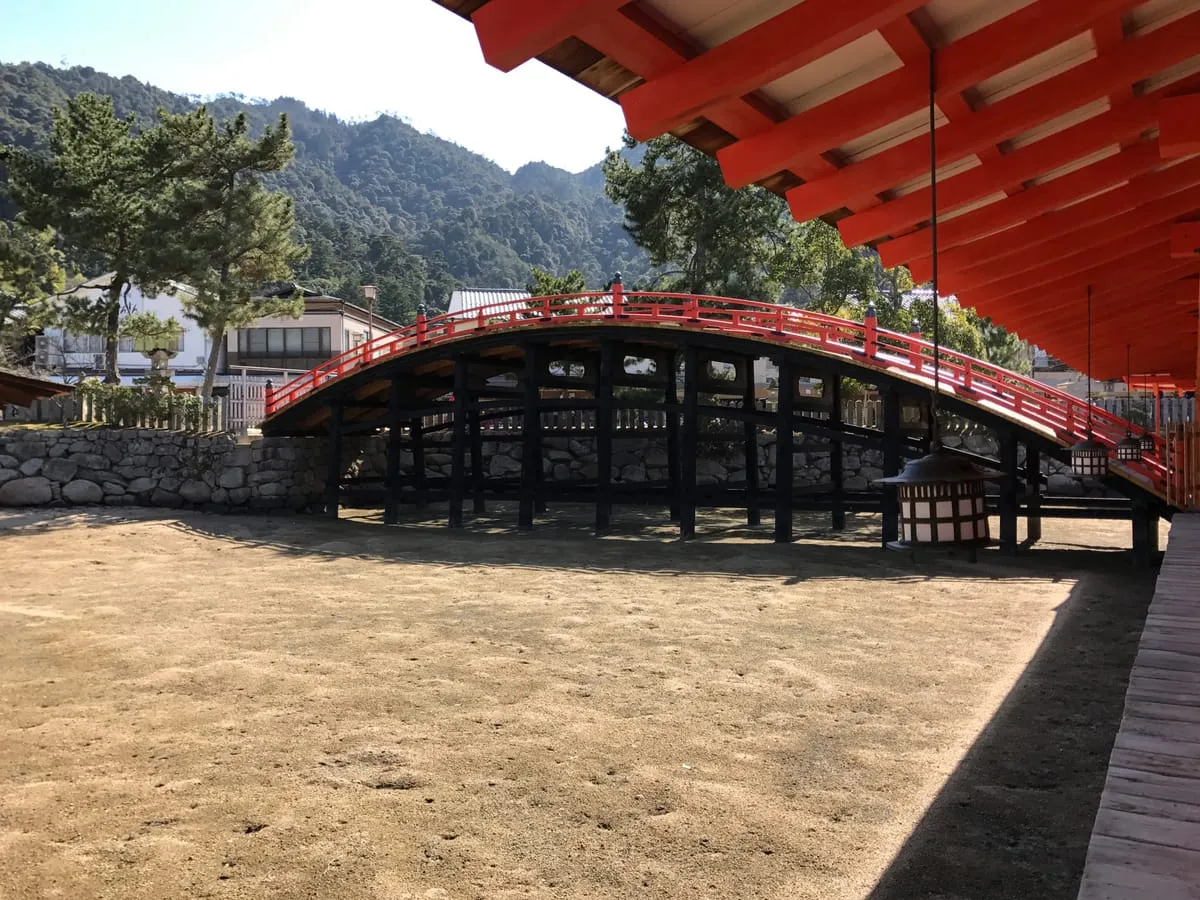
Itsukushima Shrine on Miyajima island is built on the sea. At high tide, the famous torii gate stands in water, and the corridors connecting the shrine buildings appear to float. This is a deliberate architectural statement: the shrine occupies the littoral zone, the meeting point of land and sea, and this liminal geography is the foundation of its sacred character.
Within this floating complex is a sori-hashi known as the Chokushi-bashi (勅使橋, “imperial envoy bridge”). It was reserved, historically, for the use of imperial messengers — those sent from Kyoto bearing the emperor’s offerings. The bridge was, in effect, a passageway for sanctified humans conveying the divine will.
At low tide, the bridge arches over sand and rock. At high tide, the sea rises beneath it, and the arch mirrors itself in water — bridge and reflection together forming an eye-shaped oval. The bridge is the most beautiful at precisely the moment when the tidal power of the sea deity rises to complete its geometry.
Access is restricted; most visitors see it from the shrine’s long corridors. Its presence within the composition — a single steep arch amid horizontal lines and tidal flats — gives it visual weight far exceeding its modest size.
Other Notable Bridges
Beyond these four, Japan’s shrines preserve a remarkable variety of bridge forms.
Tsurugaoka Hachimangu, Kamakura once had a drum bridge over the Genji Pond. The present structure is a reconstruction that cannot be crossed for safety reasons, but the white-painted arch between red railings remains one of the most photographed elements of the shrine. The bridge historically served as part of the ritual route for yabusame — mounted archery, in which warriors galloped past targets in a ceremony originating with Minamoto no Yoritomo’s offerings to the shrine deity.
Shimogamo Shrine in Kyoto has a rinkyō (輪橋, “wheel bridge”) that crosses the Mitarashi Pond. Viewed from the bank, the arch and its perfect reflection together form a circle — the geometry of the full moon, or a spinning wheel. The bridge’s name acknowledges this visual doubling. At the shrine’s famous summer ceremony, visitors wade into the cold spring water of the Mitarashi Pond — entering the water that flows beneath this bridge — to pray for good health.
How Bridges Are Built and Renewed
The most traditional shrine bridges are built by miyadaiku — shrine carpenters who work without iron nails, using only wooden joinery: wedge connections, dovetail joints, interlocking shapes developed over centuries to hold without metal fasteners. Iron nails rust; well-cut wooden joints last centuries. The craft is passed down through apprenticeship.
Hinoki cypress is the prestige material for sacred structures — dense, rot-resistant, aromatic, associated with purity and longevity. Ise Jingu’s bridges use hinoki from forests managed across generations specifically for this purpose. Stone became common from the Edo period onward, particularly in western Japan; stone bridges require no replacement but cannot arch as steeply, so stone drum bridges tend to gentler curves.
Sacred bridges participate in the Shinto practice of ritual renewal. The twenty-year cycle at Ise Jingu is the most elaborate example: the act of rebuilding is understood not as correction of deterioration but as affirmation of the living covenant between community and deity. At Ise, retired bridge timbers become torii gates, which later become gates at downstream locations — a cascade of diminishing sanctity that is also, practically speaking, a form of sustainable use.
Crossing with Awareness
Most visitors cross a shrine bridge in seconds, eyes on the main hall. The bridge repays slower attention.
At the top of the arch: pause. You are at the highest point of the transition. The world you came from is behind you; ancient trees and shrine buildings are ahead. This is the space between.
Watch the water: the stream or pond below is the reason the bridge exists. The Daiya River at Nikko — a mountain torrent — is the natural boundary that determined where the sacred site could be established. The Isuzu River at Ise is clear and cold. The garden ponds at Sumiyoshi are still and reflective. Water is not decoration here.
Watch the reflection: if the water is calm, the arch mirrors itself below. Arch plus reflection forms the circle associated with completion, the full moon, wholeness. A vermillion bridge over still water forms this image when the conditions align.
Notice the transition in your body: climbing a steep bridge and descending changes your breath and posture. Sacred spaces around the world use changes in elevation to mark transitions meant to be felt, not merely recognized.
The Bridge and the Goshuin
Shrine bridges appear in goshuin (御朱印) design more often than you might expect. At shrines where the bridge is a defining element, the arch silhouette — sometimes alone, sometimes paired with a torii — appears within the ink impression. Sumiyoshi Taisha’s goshuin references the curved bridge; some Nikko stamps incorporate the Shinkyo in stylized form.
The goshuin records a specific moment of pilgrimage. If you crossed the bridge before entering the shrine office, the bridge is part of what the calligraphy commemorates. The ink and the water are the two liquids that define the visit.
Closing
Shrine bridges are built to be crossed. But the crossing is the point.
In a tradition where the approach to a deity is understood as a sequence of transitions — the torii, the purification, the long walk down the sandō, the hand-washing — the bridge is one node in a carefully articulated journey. It contributes the specific element that the torii cannot: physical movement through a different register of space. You go up. You pause. You come down. The arc of the bridge is the arc of the transition.
The water below does not clean you in any literal sense. But crossing it, arched upward above it, you pass through the image of purification — water, below, between where you were and where you are going.
Japan’s shrines range from vast national institutions to tiny neighborhood altars. Most of them have some relationship with water, and many have some form of bridge. The drum bridge and the quiet pond bridge and the ancient cypress span over a mountain river are all expressions of the same understanding: that arriving at a sacred place should feel different from simply walking down the street.
The bridge makes arrival physical.
Image Credits
- Sumiyoshi Taisha drum bridge: Sumiyoshi Taisha Taikobashi (drum bridge) 1 (Kimon Berlin / CC BY-SA 2.0)
- Ise Jingu Uji-bashi: Ise Shrine Uji-bashi1 (Yanajin33 / CC BY-SA 3.0)
- Shinkyo Bridge Nikko: Shinkyo Bridge over the Daiya River at Nikko, Japan (Joli Rumi / CC BY-SA 4.0)
- Itsukushima sori-hashi: Soribashi Bridge of Itsukushima Shrine (そらみみ / CC BY-SA 4.0)