2026 marks 1,150 years since Daikakuji became “Daikakuji.”
In the 18th year of Jogan (876 CE), 34 years after the death of Emperor Saga, his imperial daughter Princess Seishi (Masako Naishinnō) converted the late emperor’s villa — Saga-in — into a Buddhist temple, and received the temple name “Daikakuji” by decree from Emperor Seiwa. It has now been exactly 1,150 years since that imperial grant. As a Buddhist temple, its history has just passed twelve full centuries.
From Villa to Temple — The Fact That the Place Did Not Change
Daikakuji is located in Saga (present-day Saga Osawa-cho, Ukyo Ward, Kyoto) — the site where Emperor Saga built an imperial villa in the 810s.
Emperor Saga was a sovereign of the early Heian period with a deep knowledge of Chinese poetry, calligraphy, and culture, and was known for his close relationship with Kukai (Kobo Daishi). Saga-in served as his retreat from affairs of state, with a garden centered on the great pond of Osawa-ike.
After the emperor’s death, the site became a temple. Ever since, Daikakuji has continued as a monzeki temple — one whose head priest is always an emperor or member of the imperial family. In the late Kamakura period, a distinct imperial lineage known as the “Daikakuji-to” (Daikakuji line) was formed, and through its connection with Emperor Go-Daigo, the temple became deeply intertwined with the movement to overthrow the shogunate.
What matters most is that the place itself has not changed.
Osawa-ike — the pond that Emperor Saga once gazed upon — still holds water today as one of Japan’s oldest extant artificial garden ponds, dating to the Heian period. The corridors, whose floorboards creak with the sound of “uguisubari” (nightingale floors) when you walk them at night, are themselves a layering of history. Buildings that carry the memory of the imperial court and palace culture have continued to exist, still functioning, as a temple.
Special Viewing and Limited Goshuin for the 1,150th Anniversary
In the year Reiwa 8 (2026), which marks 1,150 years since the imperial grant of the temple name, Daikakuji is holding ongoing special viewings of the Shoshinden (正寝殿).
The Shoshinden — whose name literally means “the place where the emperor slept and lived” — is a building normally excluded from general public viewing. This special access is an opportunity unique to the anniversary year of 2026.
| Item | Details |
|---|---|
| Special viewing | Shoshinden guided tour (approx. 15 min) |
| Times | 10:00 / 13:00 / 15:00 (no reservation required) |
| Additional admission | Adults ¥500 / Elementary–High School ¥300 |
| Limited goshuin | Paulownia-and-bamboo pattern (kiritage moyo) design |
The limited goshuin features the “kiritage moyo” (paulownia-and-bamboo pattern). The paulownia is a well-known symbol of the imperial family; bamboo represents integrity and moral rectitude. The design quietly conveys the dignity of a monzeki temple. Quantities are limited — offered while supplies last.
The Choice to Preserve
At Ise Jingu, the Shikinen Sengu rebuilds all shrine buildings from the ground up every 20 years — a philosophy of inheriting craft and memory through destruction and renewal.
Daikakuji represents the opposite. Preserving the buildings. Repairing them. Continuing to use them.
Neither approach is more correct. But what 1,150 years signifies is the simple fact that “in this place, this space has accumulated and continued to exist.” The pond that Emperor Saga gazed upon still holds water. Walk the corridors of his time, and the floor sounds beneath your feet. It is not the weight of records, but the weight of place and time.
When you receive a goshuin, you are standing in that place. This year, Daikakuji makes the context of “a place that has continued” visible through the number 1,150.
Also the Home of Saga Goryu Ikebana
Daikakuji is also the headquarters of “Saga Goryu” — one of the three great schools of ikebana (Japanese flower arrangement).
It is said that Emperor Saga admired the moon reflected in Osawa-ike, and took the natural scene as his model when he placed wild flowers on a small island in the pond — the origin of Saga Goryu. The temple thus claims to be the birthplace of ikebana.
A Buddhist temple. A site of imperial history. The headwaters of Japan’s flower culture. The layers run deep. The 1,150 years speaks to the full thickness of all those accumulated layers.
Access
| Item | Details |
|---|---|
| Address | 4 Saga Osawa-cho, Ukyo Ward, Kyoto |
| Nearest access | Approx. 20-min walk from JR Saga-Arashiyama Station / Approx. 15-min walk from Randen Saga Station |
| Visiting hours | 9:00–17:00 (last entry 16:30) |
| Admission | Adults ¥500 / Elementary–High School ¥300 |
| Official site | Daikakuji |
Sources:
- Reiwa 8 — 1,150th Anniversary of Daikakuji’s Imperial Temple Name Grant – Former Saga Palace, Daikakuji Head Temple
- 1,150th Anniversary – Shoshinden Special Viewing – Daikakuji
- Goshuin – Former Saga Palace, Daikakuji Head Temple
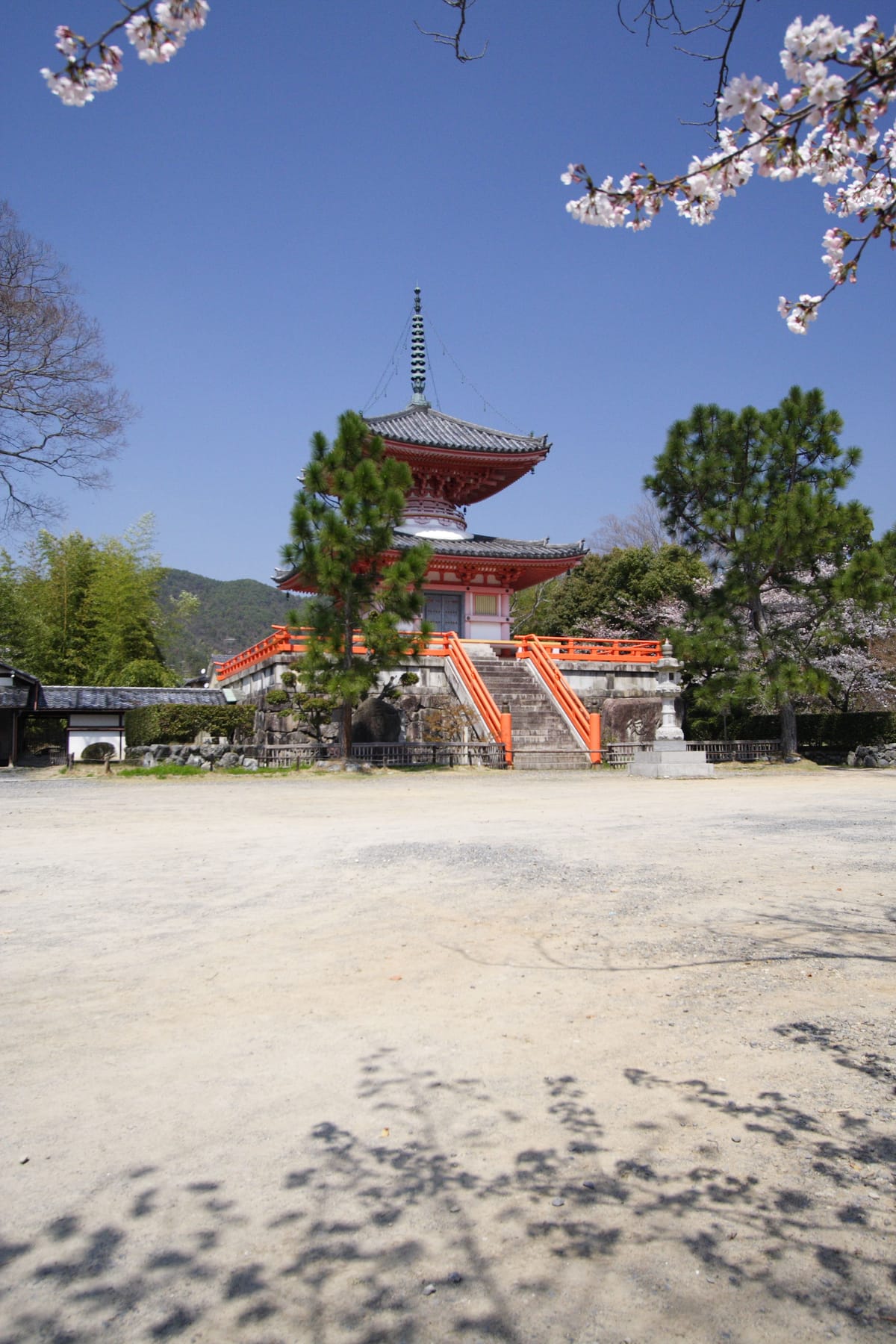
Image credit: Daikakuji (Heart Sutra Treasure Pagoda) — ignis, CC BY-SA 3.0, via Wikimedia Commons
Information in this article is current as of May 16, 2026. Viewing availability and goshuin distribution are subject to change without notice. Please check the Daikakuji official website for current details.