2026 is the Year of the Horse. For goshuin collectors, those three words are enough to know where to go: Hagurosan in Tsuruoka City, Yamagata Prefecture.
Hagurosan, one of the three sacred peaks of Dewa Sanzan, designates the Year of the Horse as its “go-en-nen” (special anniversary year). It is a once-in-12-years occasion, and it is said that visiting during this year earns 12 years’ worth of blessings. The previous go-en-nen was 2014. The next will be 2038. Miss this year, and the next chance is 12 years away.
What’s more, starting April 29, 2026, a commemorative paper-cut goshuin for the go-en-nen is scheduled to be offered — reason enough to start planning.
What Is Go-en-nen — Why “12 Years’ Worth of Blessings”?
Go-en-nen refers to a year when the Chinese zodiac aligns with a shrine’s special connection. Each of the three Dewa Sanzan peaks has a different zodiac year as its go-en-nen.
- Hagurosan → Year of the Horse (2026)
- Gassan → Year of the Rabbit (most recently 2023)
- Yudonosan → Year of the Ox (most recently 2021)
Hagurosan is regarded among the three peaks as the “mountain representing the present world,” the place where one prays for happiness in this life. During the go-en-nen, many pilgrims visit to express gratitude for daily life and seek protection for the years ahead. To have the opportunity for a once-in-12-years special pilgrimage at this site with over 1,400 years of history as a sacred mountain of shugendo ascetic practice — it is a rare experience.
2026 Limited Special Offerings — April 29 Is the Date for Goshuin Collectors
Special offerings unavailable in ordinary years have been introduced for the go-en-nen. All are offered at the summit granting office (juyosho). Here is what to know.
Uma-doshi Go-en-nen Commemorative Paper-Cut Goshuin (from April 29)
This is what goshuin collectors should pay most attention to. A commemorative paper-cut goshuin for the go-en-nen is scheduled to be offered starting April 29, 2026. The detailed design has not yet been announced, but given the high reputation of Hagurosan’s regular paper-cut goshuin featuring the five-story pagoda, the go-en-nen version should be something even more special.
Distribution begins on the first day of Golden Week, so congestion is unavoidable. Those who can target a weekday should aim for one in May.
Uma-doshi Go-en-nen Sacred Horse Statue (Shinme-zo)
Offered to those who receive a prayer ceremony (go-kito) with an offering fee of ¥20,000 or more. Available from ¥10,000 at the summit granting office. A horse statue crafted only once every 12 years will make for a remarkable conversation piece.
Horse-Day Amulet (Uma-no-hi Omamori)
Offering fee: ¥2,000. Offered only on horse days — one of the 12-day cycle days in the traditional calendar. An amulet available only once every 12 days during an already-once-in-12-years special year. The first distribution for the year was January 8, but there are still opportunities remaining in the year (see the horse-day calendar below).
Special Prayer Ema (Votive Tablet)
Offering fee: ¥1,000. A special ema unique to the go-en-nen, for writing and dedicating one’s wishes.
Source: Tsuruoka Tourism Guide — 2026 is the Once-in-12-Years Hagurosan Uma-doshi Go-en-nen
2026 Horse-Day Calendar — Planning for the Horse-Day Amulet
The horse-day amulet is offered only on “uma-no-hi” (horse days), which follow a 12-day cycle. Below is the full list of horse days in 2026. Use this as a reference for planning your visit.
Spring–Early Summer (stone steps pilgrimage season)
- March 9 (Mon) · March 21 (Sat, Vernal Equinox Day)
- April 2 (Thu) · April 14 (Tue) · April 26 (Sun)
- May 8 (Fri) · May 20 (Wed)
- June 1 (Mon) · June 13 (Sat) · June 25 (Thu)
Summer (five-story pagoda light-up season)
- July 7 (Tue) · July 19 (Sun) · July 31 (Fri)
- August 12 (Wed) · August 24 (Mon)
Autumn (fall foliage × stone steps)
- September 5 (Sat) · September 17 (Thu) · September 29 (Tue)
- October 11 (Sun) · October 23 (Fri)
- November 4 (Wed) · November 16 (Mon) · November 28 (Sat)
Winter
- December 10 (Thu) · December 22 (Tue)
Days that fall on weekends and holidays are prime targets. In particular, March 21 (Vernal Equinox Day), April 26 (Sun), June 13 (Sat), July 19 (Sun), and October 11 (Sun) offer rare alignment of a horse day with a weekend.
Dewa Sanzan Goshuin — 6 Varieties Year-Round, Plus Paper-Cut
The go-en-nen paper-cut goshuin is offered from April 29, but Dewa Sanzan’s goshuin selection is rich throughout the year as well.
Summit / Sangogsaiden Area
The Sangoshaiden (Hall of Three Shrine Deities) — which jointly enshrines Hagurosan, Gassan, and Yudonosan — offers a spread goshuin for all three peaks. In a sense, it is the ultimate goshuin: one page, three mountains visited.
In addition, individual goshuin are offered at the following shrines:
- Hachiko Jinja — enshrines Prince Hachiko, who opened the Dewa Sanzan
- Hagurosan Toshogu — No. 5 in the National Toshogu Association
- Ten’yusha
- Tenchi Kansha
Zuijinmon Gate Area
- National Treasure Five-Story Pagoda Paper-Cut Goshuin — offered year-round at the Zuijinmon gate granting office. Offering fee ¥1,200. The pagoda’s architecture and the cedar-lined avenue are rendered in delicate papercut form.
Goshuin source: Haguro Town Tourism Association / Hotokami — Dewa Jinja
National Treasure: Hagurosan Five-Story Pagoda — Oldest in Tohoku
Any discussion of goshuin here demands mention of the five-story pagoda that serves as its motif.
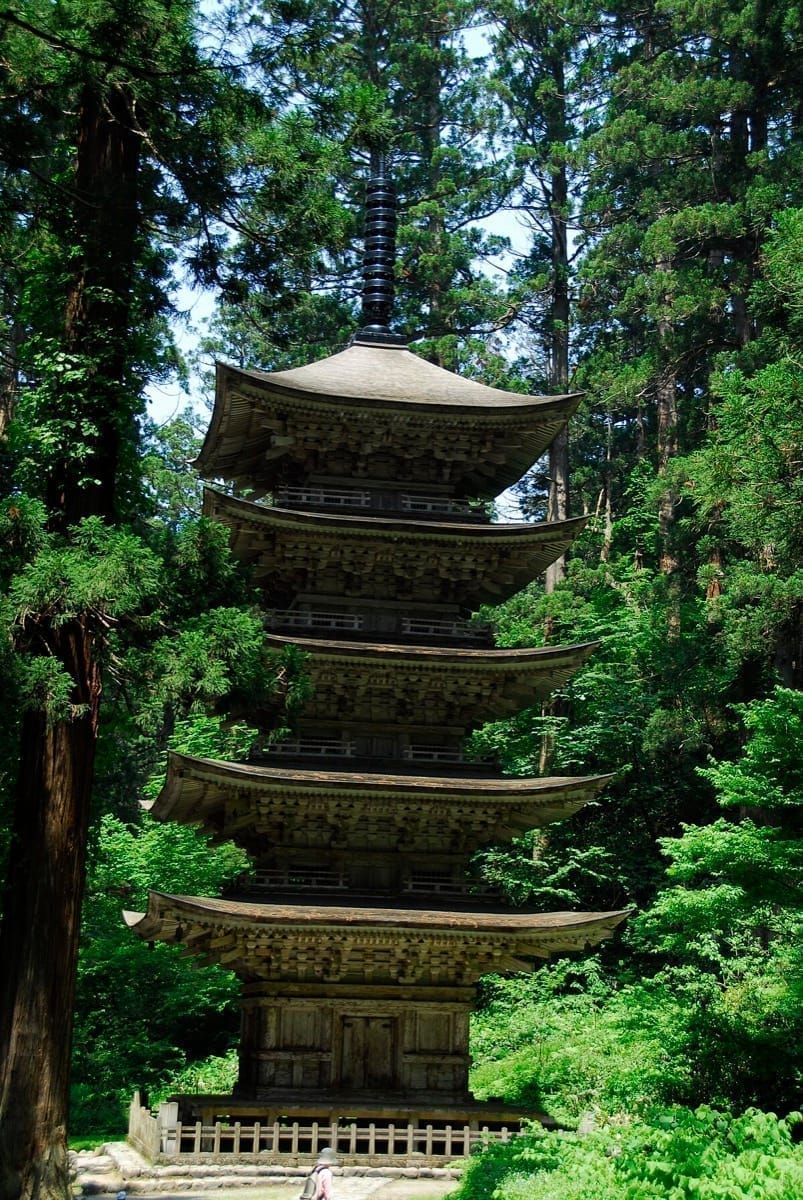
The Hagurosan Five-Story Pagoda is said to have been originally built in the Heian period (10th century), with the current structure dating from the Muromachi period. It is the oldest five-story pagoda in the Tohoku region and was designated a National Treasure in 1966. Standing approximately 29.2 meters tall, the sight of it suddenly appearing along the path lined by towering cedar trees is something photographs cannot fully convey.
Light-up events are held every summer, and for 2026’s go-en-nen, special programming is reportedly under consideration. A nighttime pilgrimage viewing the illuminated National Treasure pagoda rising from the dark — even imagining it gives you chills.
Hagurosan Hakke-zen Meal — Reviving the Pre-Mountain Ritual Dining
Food is part of the journey too. To mark the go-en-nen, the Hagurosan Saikan (lodge) is serving the “Hagurosan Hakke-zen” meal.
In the past, pilgrims ate a ritual meal at the lodge before entering the mountain, with dishes named after the viewing spots and places associated with the three peaks. Mountain ascetics (yamabushi) used this as an opportunity to explain what to expect on the mountain ahead. The Hakke-zen revives that cultural practice for modern visitors.
- Price: ¥3,850 (tax included)
- Period: March 1 – late December 2026
- Reservation: Required 3 days in advance
- Location: Hagurosan Saikan
Additionally, the Saikan’s signature sesame tofu is now available as a retort-packaged souvenir for the first time. ¥660 per piece (matcha flavor ¥720). Shelf-stable at room temperature for 2 weeks, so you can take it home alongside your goshuin book. A taste that was previously impossible to bring home due to its short shelf life can finally be enjoyed at home.
Access and Pilgrimage Guide
Basic Information
- Address: 7 Touge, Haguromachi Touge, Tsuruoka City, Yamagata Prefecture
- Phone: 0235-62-2355 (Dewa Sanzan Jinja)
- Visiting Hours: 8:30–17:00
- Official Website: Dewa Sanzan Jinja
Access
- Train + Bus: JR Tsuruoka Station → Shonai Kotsu Bus bound for “Hagurosan-cho” → approx. 50 minutes → 5 min walk from stop
- By Car: Yamagata Expressway Tsuruoka IC → approx. 30 minutes. Parking available at the summit (Lot 1: 90 spaces · Lot 2: 90 spaces · Lot 3: 230 spaces)
The Stone Steps Pilgrimage (Spring–Autumn)
For the full Hagurosan experience, the stone steps pilgrimage (“ishidan-mode”) from the Zuijinmon gate to the summit — 2,446 steps — is recommended. The traditional way is to wear a white paper rope (shime) as you climb. One way takes about 1 to 1.5 hours.
Note that the stone steps are effectively impassable due to snow in winter. From December through March, it is most practical to drive directly to the summit.
Recommended Seasons
- Late April–May: Fresh greenery + paper-cut goshuin begins (from 4/29). Golden Week is crowded, but ideal for those who want the go-en-nen goshuin as soon as possible.
- June–July: Deep green on the stone steps. On a clear day between rainy spells, the cedar fragrance is especially strong.
- Summer: Five-story pagoda light-up. Watch for special go-en-nen programming.
- October–early November: Fall foliage on the stone steps — the best time for photos.
To visit all three Dewa Sanzan peaks (Hagurosan, Gassan, Yudonosan), plan for 2 nights and 3 days. Hagurosan alone is doable as a day trip, but leave time for the Hakke-zen meal.
In Summary — The Year You’ll Thank Yourself for Going
Key points for the 2026 Hagurosan go-en-nen:
- Go-en-nen Commemorative Paper-Cut Goshuin → from April 29. For the earliest access, target a weekday in the first half of Golden Week.
- Horse-Day Amulet → only on horse days, every 12 days. Aim for days that fall on weekends.
- Hagurosan Hakke-zen → reservation required 3 days in advance. Don’t forget to book.
- Five-Story Pagoda Light-Up → summer season. Watch for special go-en-nen programming.
- Year-round paper-cut goshuin (pagoda motif) is also available at the Zuijinmon gate granting office.
Once in 12 years. The next time Hagurosan holds its go-en-nen, in 2038, no one knows where any of us will be. That’s exactly why it’s worth going this year. Yamagata may be far, but the view from the top of 2,446 stone steps, and the goshuin in your hand, should become a memory worth 12 years.
Image: National Treasure Hagurosan Five-Story Pagoda (Wikimedia Commons / Mimissu / CC BY-SA 4.0)