Hie Shrine in Akasaka, Chiyoda Ward, Tokyo will hold the Sanno Festival in June 2026. This year is a “hon-matsuri” year — the grand festival held every other year — meaning the climactic Shinko-sai procession takes place.
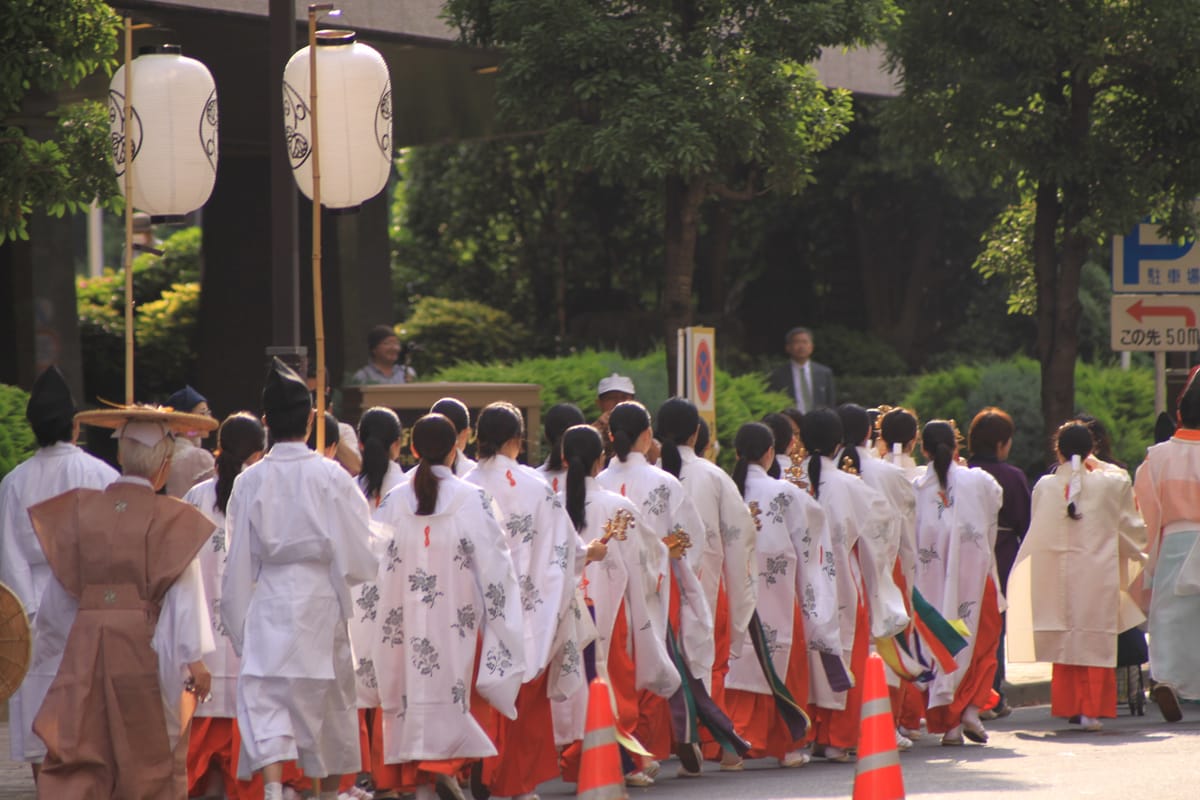
The procession features two gohoren (sacred palanquins), one mikoshi, six floats, and approximately 500 attendants in Heian court dress. The route spans Nagatacho, Yotsuya, Kojimachi, Kudan, the Imperial Palace grounds, Kasumigaseki, Ginza, and Nihonbashi — crossing four wards (Chiyoda, Shinjuku, Chuo, and Minato) for a total distance of roughly 23 kilometers. A full-day procession across the heart of Tokyo.
What Is the Sanno Festival?
The Sanno Festival is counted among the “Three Great Festivals of Japan” alongside Kyoto’s Gion Festival and Osaka’s Tenjin Festival, and is one of Tokyo’s most historic annual observances. It is also called the “Tenka Matsuri” (festival of the realm) — in the Edo period, it was performed before the shogun himself.
The deity enshrined at Hie Shrine is Oyamakui no Kami, whose home shrine is Hiyoshi Taisha in Shiga Prefecture. Venerated as a god of mountains and agriculture, he was enshrined as the guardian of Edo Castle’s kimon (the inauspicious northeast direction) and received deep devotion from the Tokugawa shogunate — a patronage that gave the Sanno Festival its exceptional prestige.
The festival is held every year in June, but the Shinko-sai (mikoshi procession) only takes place during hon-matsuri years, once every two years. 2026 is one of those years.
The Alternating Relationship with Kanda Festival
The Sanno Festival has a unique arrangement: it alternates with Kanda Myojin’s Kanda Festival, scaling up in alternate years.
Since 1681 (Tenna 1), to avoid both major festivals competing for shogunal attention in the same year, they have rotated — one holding its grand procession while the other scales down. If 2025 was Kanda Festival’s hon-matsuri year, then 2026 belongs to the Sanno Festival. It is a distinctly Edo form of coexistence.
Even today, the procession passes in front of the Imperial Palace, and the mikoshi parades through the prime minister’s official residence, Kasumigaseki, Ginza, and Nihonbashi — the nerve centers of political and economic power in modern Tokyo.
2026 Shinko-sai Overview
| Item | Details |
|---|---|
| Festival period | June 2026 (typically June 7–17) |
| Shinko-sai procession | Around June 14 (Sunday) |
| Procession scale | 2 gohoren, 1 mikoshi, 6 floats, approx. 500 attendants |
| Total route distance | Approx. 23km |
| Route area | Chiyoda, Shinjuku, Chuo, and Minato wards |
| Key waypoints | Nagatacho, Yotsuya, Kojimachi, Kudan, Imperial Palace, Kasumigaseki, Ginza, Nihonbashi |
On June 14, Chuo-dori (the Kyobashi–Nihonbashi stretch) is expected to be fully closed to traffic from around noon to 3 p.m., with viewing available along the roadside.
Goshuin
The goshuin at Hie Shrine is offered year-round at the goshuin counter. It features a restrained design with the aoi crest (futaba-aoi, double-leaf hollyhock).
On the day of the annual festival (traditionally June 7), a special limited goshuin has been offered in previous years. However, the shrine’s official website has announced that the special festival goshuin will not be offered in 2026. Regular goshuin will continue to be available as usual. Those visiting specifically for a limited item should take note.
Why Every Other Year?
Even in the modern era, staging a large-scale procession is no small undertaking. Preparation, coordination with neighboring areas, traffic restrictions, and costs all pose significant challenges. Running a 23km procession through central Tokyo every year is simply not realistic.
In that sense, the biennial hon-matsuri format is inherited wisdom from the Edo period. It is precisely because it happens only every two years that the Sanno Festival Shinko-sai carries special weight. The rarity — “this is the only year to see it” — draws crowds to the roadside.
Access and Visitor Information
| Item | Details |
|---|---|
| Address | 2-10-5 Nagatacho, Chiyoda Ward, Tokyo |
| Access | Tokyo Metro Ginza Line / Namboku Line “Tameike-Sanno” (direct escalator access); Tokyo Metro Chiyoda Line “Akasaka” — 5 min walk |
| Visiting hours | 6:00–17:00 (varies by season) |
| Goshuin counter | 8:00–16:00 |
| Official websites | https://www.hiejinja.net/ / https://www.tenkamatsuri.jp/ |
The Akasaka and Nagatacho area will be crowded with spectators during the festival. Public transport is strongly recommended.
The Shrine Beyond the Festival
Outside of hon-matsuri years, Hie Shrine remains worth visiting. Monkey statues are placed throughout the grounds — the monkey is the sacred messenger (mitsukai) of Oyamakui no Kami, making it a recurring motif across the precinct.
The goshuin counter offers goshuin books with the aoi crest and various other items. Set on a hilltop in Akasaka, the shrine grounds are surprisingly green and quiet, despite their proximity to the government offices of Nagatacho.
Image: Omikoshi parade, Tokyo; June 2010 by Hetarllen Mumriken, CC BY-SA 2.0, via Wikimedia Commons
Sources: Sanno Festival Official Site / Hie Shrine Official Site