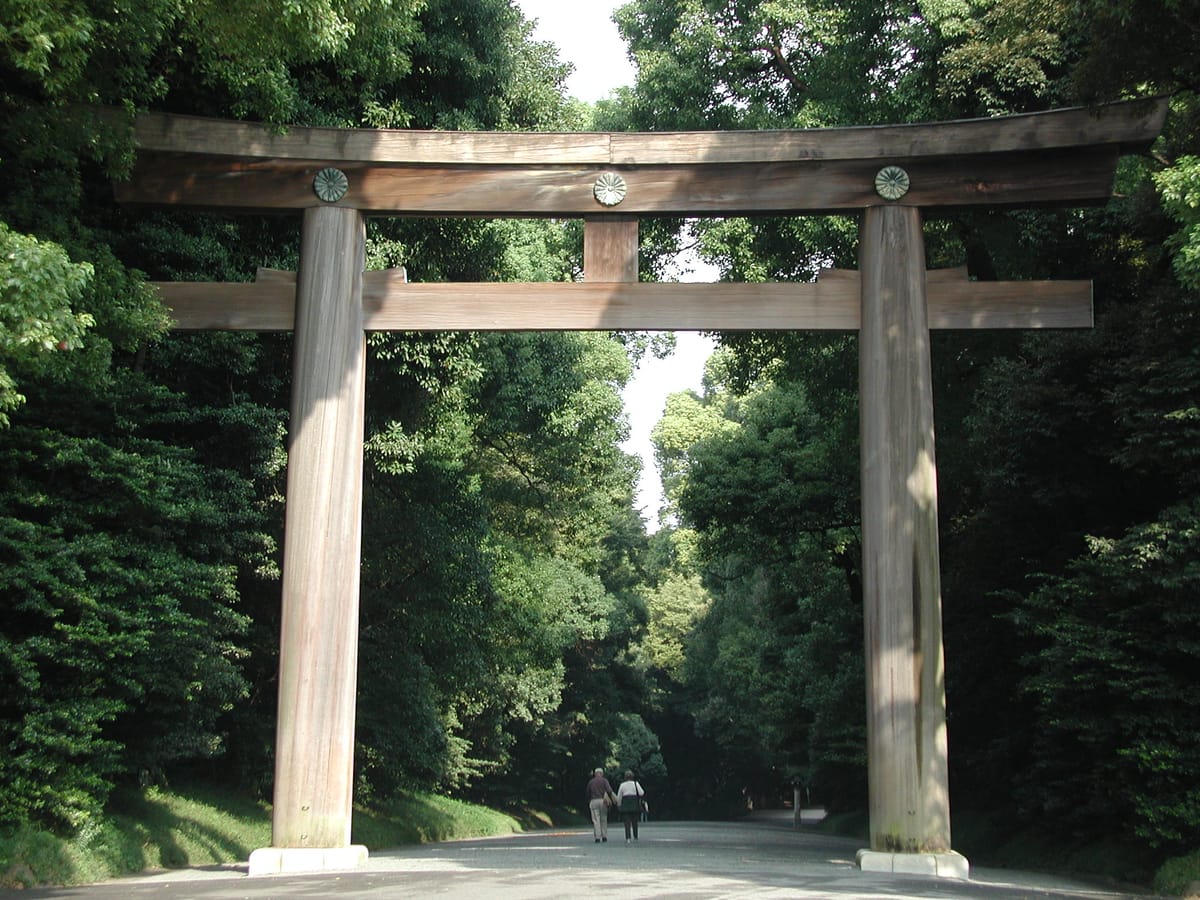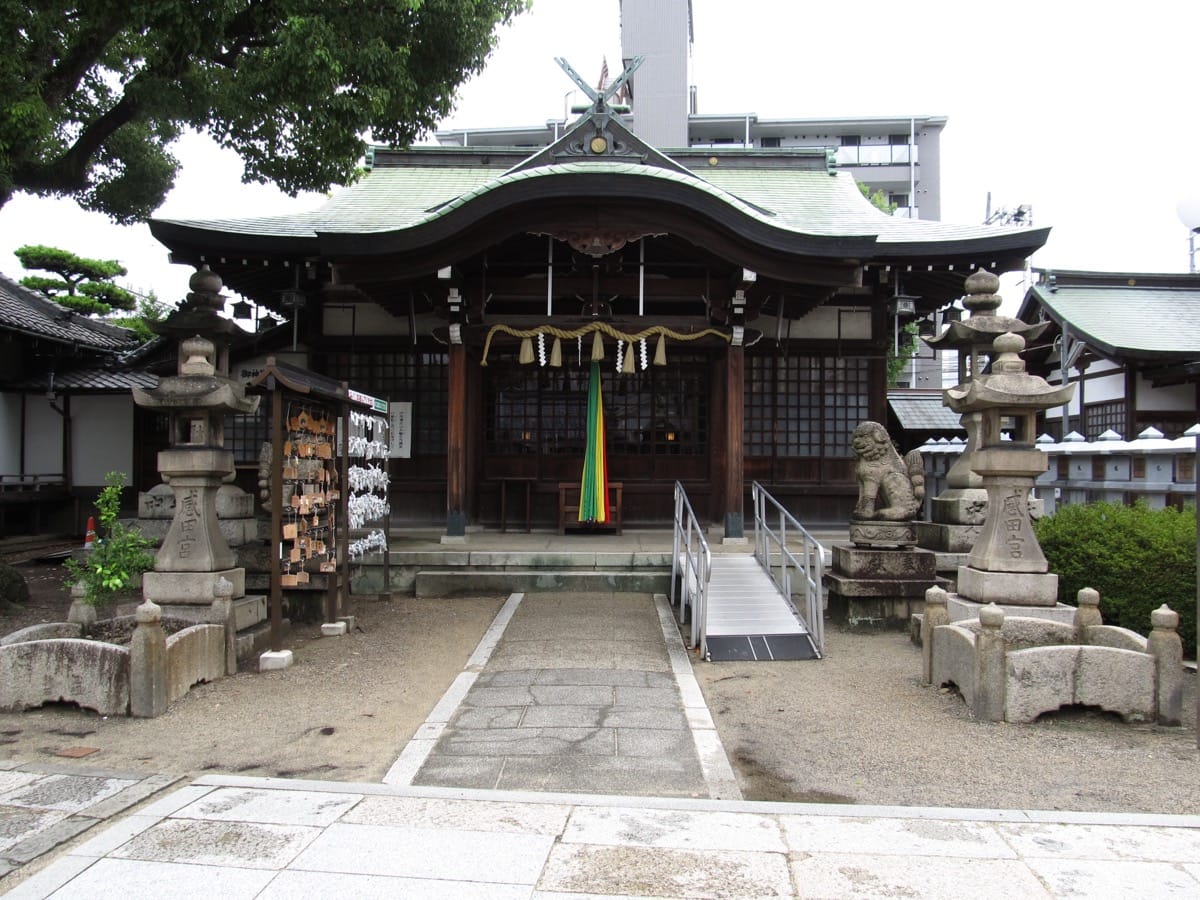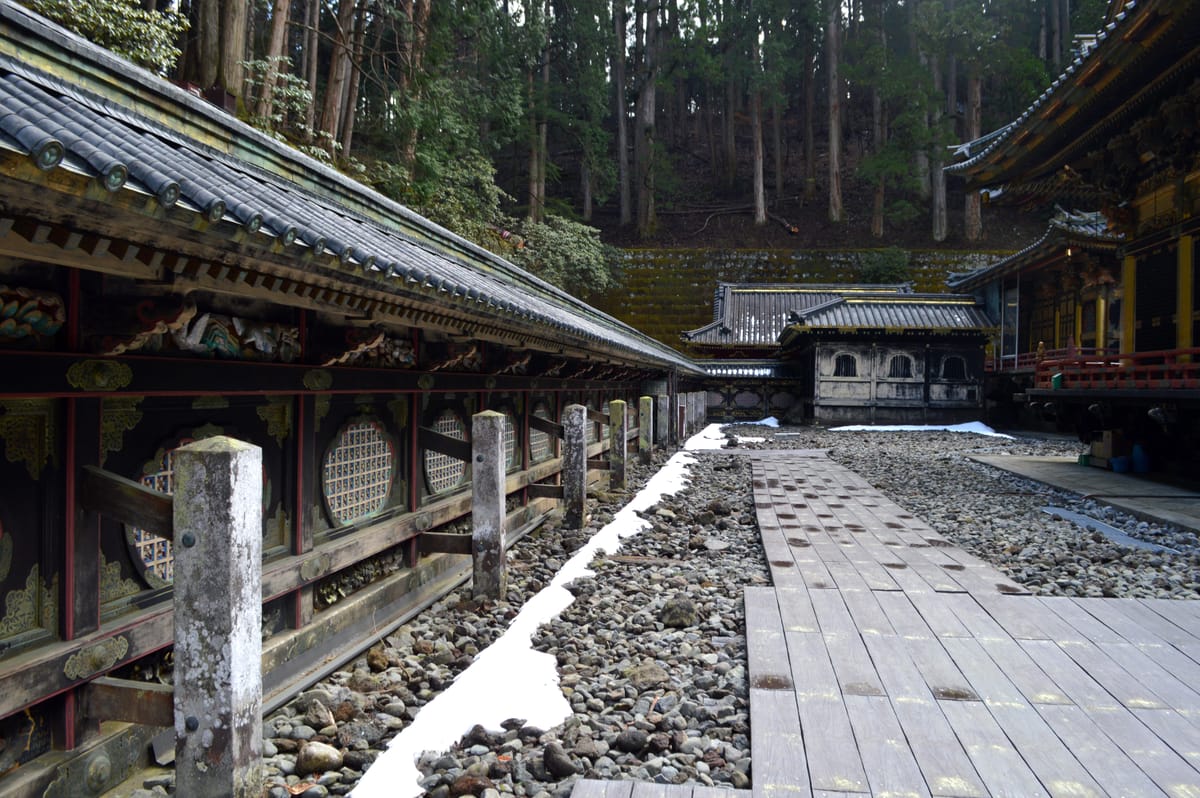
You’ve seen them in every Japan travel brochure — those striking red gates rising against green mountainsides and gray temple roofs. They’re the universal symbol of Japan, right up there with Mount Fuji and cherry blossoms. But if you’ve ever stood in front of a torii gate and wondered why this one looks completely different from the one at the last shrine, you’re about to find out.
Torii gates are not a single design. They are a family of forms, each with its own history, meaning, and structural logic. Knowing how to read them turns a casual shrine visit into something far more layered — and it’s easier than you might think.
What Is a Torii Gate?
A torii (鳥居) is the gateway that marks the transition from the profane world into sacred space — the domain of the kami, the gods and spirits of Shinto. When you walk through a torii, you’re crossing a threshold. Everything on the other side belongs to the deity.
The word itself is usually written with characters meaning “bird” (鳥) and “dwelling” (居). One popular theory traces this to the myth of Amaterasu, the sun goddess, who hid in a cave and plunged the world into darkness. The other gods gathered roosting birds (some accounts say a rooster) on a perch outside the cave, hoping their cries would lure her out. That perch — the “bird-dwelling” — became the torii. Whether this etymology is historically accurate is debated, but it makes for a vivid origin story.
Anatomy of a Torii
Before you can identify different styles, it helps to know the parts:
- Kasagi (笠木) — The topmost horizontal beam. Its shape (straight or curved) is the single biggest clue to identifying a torii’s style.
- Shimagi (島木) — A second horizontal beam that sits directly under the kasagi. Not all torii have one.
- Nuki (貫) — The horizontal crossbar connecting the two main pillars, positioned lower down.
- Hashira (柱) — The two main vertical pillars. Their angle (straight or slightly inward-leaning) varies by style.
- Gakuzuka (額束) — A tablet or nameplate mounted between the kasagi and the nuki. When present, it usually displays the shrine’s name or the deity’s name.
And one thing to clear up right away: not all torii are red, and not all torii are wooden. You’ll find them in stone, bronze, concrete, steel, and even stainless steel. The material and color each tell their own story.
Shinmei Torii — The Purest Form
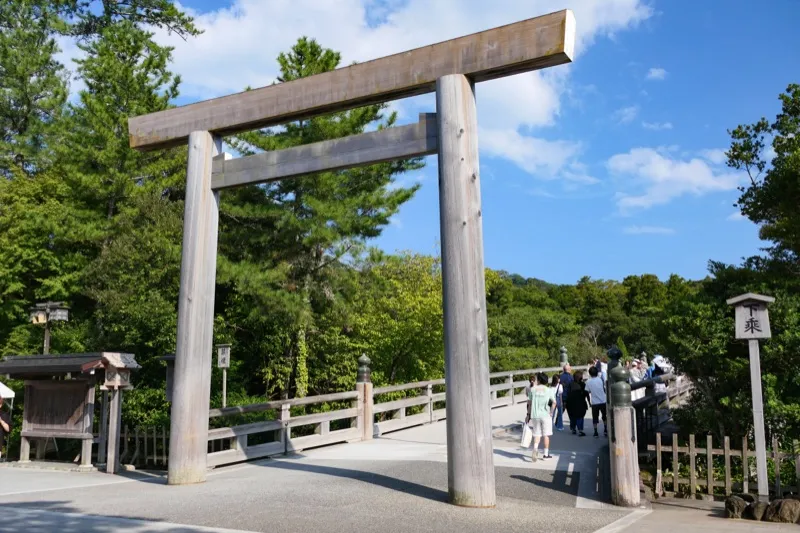
If you strip a torii down to its absolute essence — two pillars, two crossbeams, nothing ornamental — you get the shinmei torii (神明鳥居). This is the oldest and most austere style, and it is strikingly minimal.
The defining features are all about what isn’t there. The kasagi is straight and round (a simple log, essentially), with no upward curve at the ends. There is no shimagi beneath it. The pillars stand perfectly vertical — no inward lean. There’s no gakuzuka tablet, no decorative wedges, no paint. Just clean, honest timber.
The shinmei style is most closely associated with Ise Jingū, the supreme shrine of Shinto and the spiritual home of Amaterasu. Ise’s torii are made of unfinished Japanese cypress (hinoki), left in their natural state — a finish called shiraki (白木). The wood weathers to a soft silver-gray over the decades, then the entire shrine is rebuilt from scratch every twenty years in a ceremony called shikinen sengū.
That unpainted simplicity isn’t just an aesthetic choice. It reflects the Shinto value of purity — a direct, unadorned connection between the human world and the divine. When you see a straight-beamed, unpainted torii, you’re looking at the oldest surviving concept of what this gateway was meant to be.
How to spot it: Straight top beam, no curves, no second beam, no paint. Pillars vertical. Often made of natural wood.
Myōjin Torii — The Style You See Everywhere
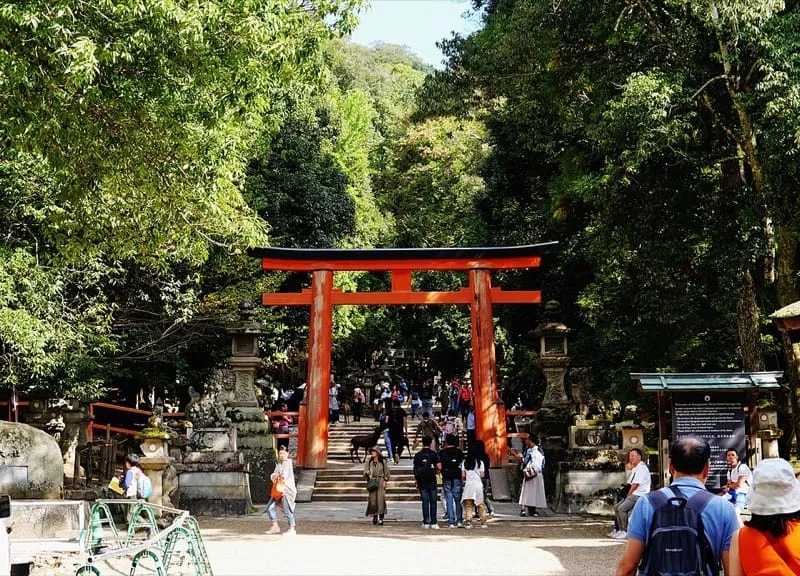
If the shinmei torii is the austere original, the myōjin torii (明神鳥居) is the crowd-pleasing evolution. This is the style that most people picture when they think of a torii gate — and for good reason. The vast majority of torii across Japan are myōjin-type or one of its many variants.
The differences from the shinmei style are immediately visible. The kasagi curves upward at both ends in a graceful sweep. Beneath it sits a shimagi (second beam), creating a layered, more substantial silhouette. A gakuzuka tablet often hangs between the upper beams and the nuki crossbar, displaying the shrine’s name in bold calligraphy. The main pillars typically lean slightly inward (a feature called korobashi), and the nuki crossbar extends past the pillars on both sides.
Myōjin torii are frequently painted vermillion (shu, 朱), though stone and unpainted wooden versions are also common. The vermillion color — a red-orange derived from mercury sulfide — has been used since antiquity in Japan. It was believed to ward off evil, symbolize vitality, and represent the life force.
This style has spawned an impressive number of sub-variants. The daiwa torii (also called inari torii) adds a small horizontal beam called a gakusou across the top of the pillars — you’ll see this at Inari shrines across the country. The kasuga torii, named after Kasuga Taisha in Nara, has a slightly different proportional balance. The hachiman torii has its own subtle distinguishing features tied to shrines of the war deity Hachiman. For a casual visitor, though, recognizing the broad myōjin family by its curved kasagi and second beam is more than enough.
How to spot it: Curved top beam with upswept ends, second beam underneath, often painted red. May have a name tablet. Pillars lean slightly inward.
Ryōbu Torii — The Four-Legged Gate
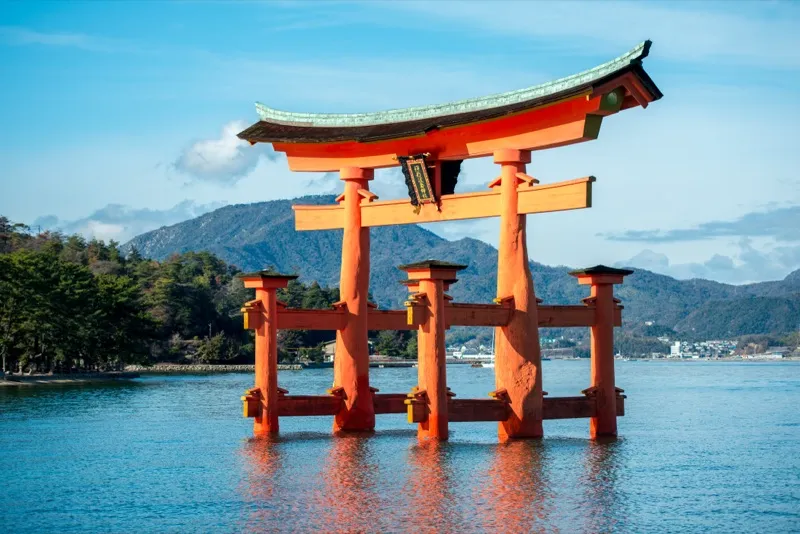
The ryōbu torii (両部鳥居) is the most visually distinctive variant, and the one that tells perhaps the most interesting historical story.
You can identify it instantly: in addition to the two main hashira pillars, a ryōbu torii has four smaller secondary pillars called wakibashira (脇柱), two on each side, that brace the main columns like buttresses. The overall structure looks more stable, more grounded — and more architecturally complex — than any other torii type.
The name “ryōbu” refers to the “Two Realms” (ryōbu, 両部) of esoteric Buddhism — the Kongōkai (Diamond Realm) and the Taizōkai (Womb Realm). This is a direct fingerprint of shinbutsu-shūgō (神仏習合), the centuries-long fusion of Shinto and Buddhism that shaped Japanese religious life from roughly the 8th to the 19th century. During this period, Shinto kami were often interpreted as manifestations of Buddhist deities, and shrine and temple architecture freely borrowed from each other. The ryōbu torii is a physical artifact of that blending — a Shinto gateway carrying Buddhist symbolism in its very name.
The most famous ryōbu torii in Japan — and arguably the most photographed torii on earth — is the great gate of Itsukushima Shrine on Miyajima island in Hiroshima Prefecture. Standing in the tidal waters of the Seto Inland Sea, it appears to float at high tide. The current structure, rebuilt in 1875 and reinforced in 2022, stands approximately 16 meters tall. Its four wakibashira aren’t just symbolic — they’re structurally essential, providing the stability needed to withstand tides, typhoons, and the sheer weight of the massive camphor-wood pillars.
How to spot it: Four extra bracing pillars flanking the two main columns. Usually large and impressive. Curved kasagi like the myōjin style.
Beyond the Big Three
Senbon Torii — The Tunnel of Gates
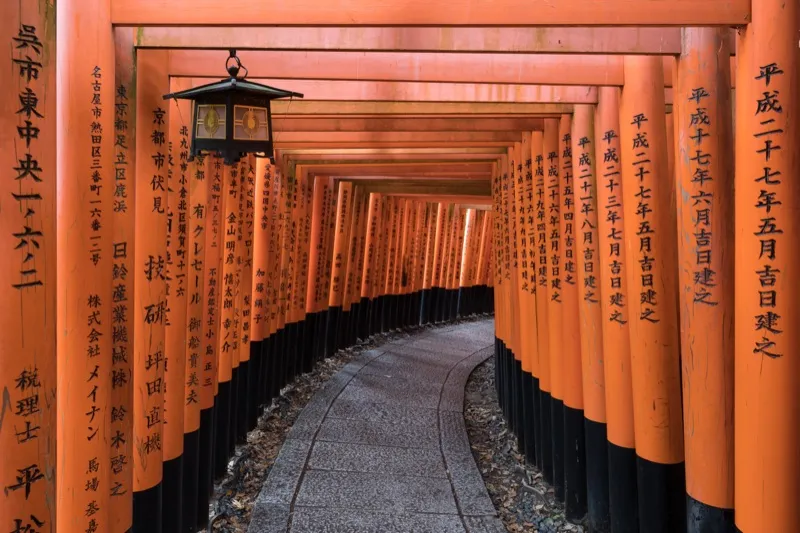
Strictly speaking, “senbon torii” (千本鳥居) isn’t a structural style — it’s a phenomenon. The term means “thousand torii” and refers to the dense rows of torii gates that form glowing vermillion tunnels along the paths of certain shrines.
The most famous example, by a wide margin, is Fushimi Inari Taisha in Kyoto, where roughly ten thousand torii line the trail up Mount Inari. Walking through these tunnels is one of Japan’s most extraordinary sensory experiences — the light filters through gaps between the gates, shifting from amber to deep red, and the path seems to extend without end.
Each of these gates is a votive offering. Businesses and individuals donate torii as prayers for prosperity, success, or gratitude for wishes granted. If you look at the back of each gate, you’ll find the donor’s name and the date of dedication inscribed in black ink. A small torii might cost several hundred thousand yen; a large one, over a million.
There’s a pleasing linguistic echo at work here. The Japanese word tooru (通る) means “to pass through,” and it sounds close to “torii.” The association isn’t accidental — donating a torii is a prayer that your wishes will “pass through” to the gods. At Inari shrines specifically, the connection to commerce is strong: Inari is the deity of rice (and by extension, business and prosperity), served by fox (kitsune) messengers. Those thousands of gates are, in essence, thousands of business cards left for the god of good fortune.
Stone Torii — Built to Last
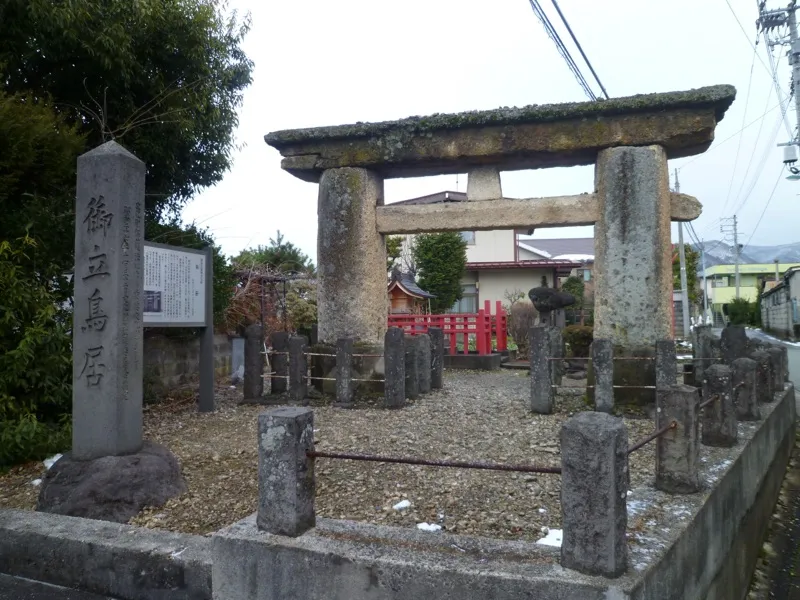
While wooden torii are the most traditional, stone torii (石鳥居, ishi-torii) represent a parallel tradition that prioritized endurance over ease of construction.
Stone torii began appearing in significant numbers during the medieval period, when communities and patrons sought more permanent markers for their sacred spaces. The advantages were obvious: stone doesn’t rot, doesn’t need repainting, and resists fire. The tradeoff was weight and difficulty of construction — stone torii tend to be simpler in design because elaborate curves and projecting elements are much harder to execute in stone.
Among the oldest surviving stone torii in Japan is the Motoki stone torii in Yamagata Prefecture, dating to the late Heian or early Kamakura period (12th–13th century). Standing in a quiet rural setting, it has the stark simplicity of a shinmei-style gate rendered in rough-hewn stone. Time has softened its edges and covered it with moss and lichen, giving it a quality that no wooden torii — rebuilt every few decades — can replicate.
Over the centuries, torii materials expanded further: bronze, iron, and eventually concrete and steel for modern constructions. Some of the most historically significant torii in Japan are stone, precisely because they survived the earthquakes, fires, and wars that destroyed their wooden counterparts.
The Color Code
The color of a torii is not random. It carries meaning — though the rules are more like tendencies than strict laws.
Vermillion (red-orange) is the color most people associate with torii gates, and it dominates at Inari shrines in particular. The pigment, called shu (朱), was originally made from cinnabar (mercury sulfide). It was believed to repel evil spirits, ward off disease and decay (the mercury compounds actually did have preservative properties for wood), and symbolize vitality and the life force. Today, most vermillion paint is synthetic, but the symbolic association remains powerful.
Natural wood (shiraki) is the hallmark of the shinmei tradition. Leaving the wood unpainted signals purity and a direct connection to nature. You’ll find this most prominently at Ise Jingū and its affiliated shrines, as well as at shrines that deliberately evoke the oldest Shinto aesthetic.
Stone gray isn’t a paint choice — it’s the material itself speaking. Stone torii carry an air of permanence and gravitas. The weathering of centuries gives each one a unique surface texture.
Black or dark finishes are rare but notable. You’ll encounter dark-painted torii at some Hachiman shrines and at certain shrines with specific historical or regional traditions. The black-and-red combination (black pillars with red upper beams) is particularly striking.
White appears occasionally, especially at newer or recently renovated shrines. It reads as clean and modern, though it can also carry connotations of purity similar to the shiraki tradition.
Quick Comparison Table
| Style | Kasagi shape | Support pillars | Typical material | Famous example |
|---|---|---|---|---|
| Shinmei | Straight, round | None | Natural wood | Ise Jingū |
| Myōjin | Curved, upswept | None | Painted wood/stone | Inari shrines nationwide |
| Ryōbu | Curved, upswept | 4 bracing pillars | Wood, painted | Itsukushima Shrine |
| Kashima | Straight | None | Stone | Kashima Jingū |
| Miwa | Myōjin-type | 2 flanking mini-torii | Wood | Ōmiwa Shrine |
How to Read a Torii at a Glance
When you’re standing in front of a torii and want to identify it, run through this quick checklist:
1. Check the top beam. Is the kasagi straight or curved? If straight, you’re likely looking at a shinmei-family torii. If curved with upswept ends, it’s a myōjin-family gate (or one of its many relatives).
2. Count the pillars. Two pillars only? That’s standard. Four extra bracing pillars flanking the main two? That’s a ryōbu torii.
3. Look at the material and color. Unpainted natural wood suggests a shinmei lineage and an emphasis on purity. Vermillion paint is classic myōjin territory and strongly associated with Inari shrines. Stone tells you the gate was built for the long haul.
4. Check for a name tablet. If there’s a gakuzuka between the upper beams, read it — it often carries the shrine’s name or the enshrined deity’s name, which tells you a great deal about what you’re about to visit.
5. Consider the context. A torii standing in the sea? That’s almost certainly the ryōbu torii at Miyajima. Hundreds of torii forming a tunnel up a mountainside? You’re at Fushimi Inari or one of its branch shrines. A lone, weathered stone gate beside a country road? You may be looking at something very, very old.
The torii is the first thing you encounter at a shrine, and it’s designed to prepare you — to signal that you’re leaving the ordinary world. Learning to read that signal adds a layer of understanding to every shrine visit that follows.
Torii and Goshuin
If you collect goshuin (御朱印) — the hand-brushed seal stamps that serve as proof of a shrine or temple visit — you’ve probably noticed that torii gates are one of the most popular motifs in goshuin design. Some goshuin feature elegant ink-brush illustrations of the shrine’s torii. Others use carved stamps that reproduce the torii in vivid red or gold ink.
Knowing your torii styles gives you an extra dimension of appreciation. When you see a shinmei-style torii drawn on a goshuin from an Amaterasu-affiliated shrine, or a ryōbu torii stamped on a goshuin from Miyajima, the design choice isn’t decorative — it’s telling you something specific about that shrine’s identity and tradition.
Some shrines release seasonal or limited-edition goshuin that specifically highlight their torii — during cherry blossom season, you might find a goshuin showing the shrine’s gate framed by sakura, or during autumn, backed by fiery momiji maple leaves. These are among the most sought-after pieces in any collection.
Want to preserve your shrine visits digitally? Goshuin Meguri lets you photograph, organize, and map every goshuin in your collection — torii photos and all. Build your own visual record of Japan’s sacred gates.
Image credits: Shinmei torii — by MaedaAkihiko (CC0), via Wikimedia Commons. Myōjin torii — by Zairon (CC BY 4.0), via Wikimedia Commons. Ryōbu torii — by JordyMeow (CC BY-SA 3.0), via Wikimedia Commons. Senbon torii — by Basile Morin (CC BY-SA 4.0), via Wikimedia Commons. Stone torii — by Suz-b (CC BY-SA 3.0), via Wikimedia Commons. Hero image (Heian Jingū) — by Zairon (CC BY-SA 4.0), via Wikimedia Commons.