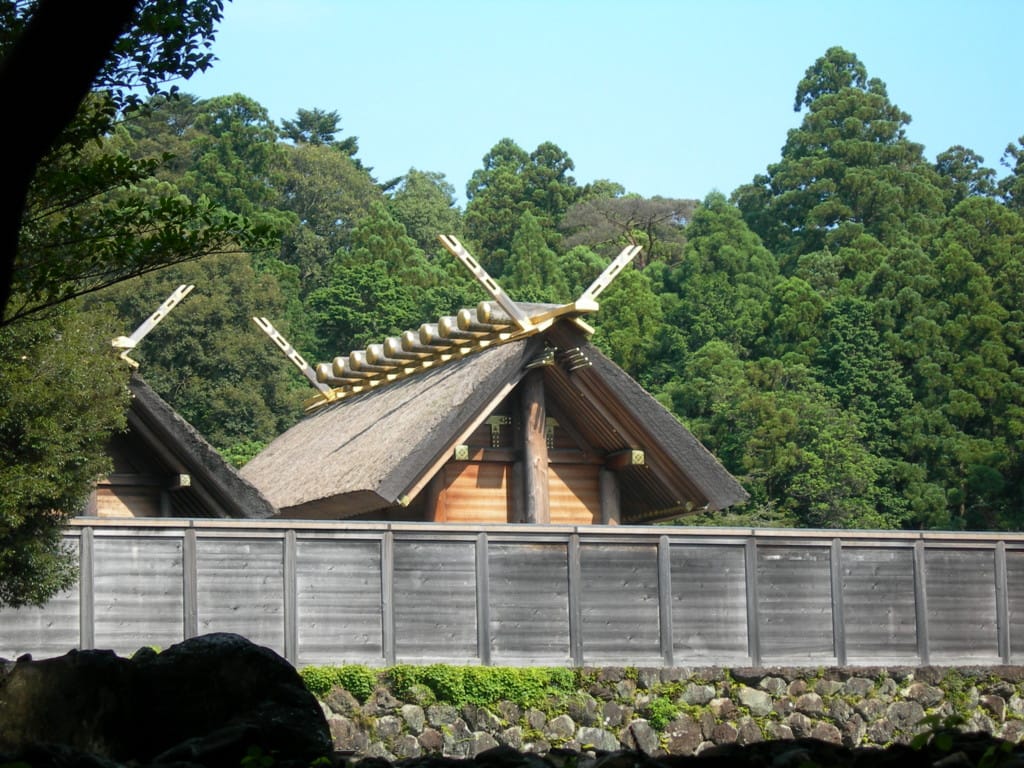
Tomorrow, May 14, at noon. Two pieces of cloth will be offered before the great deity at the Kotaijingu (Naiku, inner shrine) and the auxiliary shrine Aramatsuri-no-miya at Ise Jingu.
Silk and hemp.
Nigitae and Aratae — The Meaning of Two Cloths
The types of cloth are fixed.
Nigitae is silk; aratae is hemp. Offering both of these to Amaterasu Omikami on May 14 and October 14 each year is the “Kanmisosai.” It is a festival conducted at Ise Jingu for Amaterasu alone — no other deity receives this offering.
Why two kinds? There is meaning in offering both “that which is smooth and soft” and “that which is coarse and strong.” The idea is the completeness of divine attire. Offering cloth to deities appears in sacred rites throughout Japan, but at Ise, it has continued twice a year for more than 1,300 years.
Where the Cloth Is Made — Two Shrines in Matsusaka
What matters is that this cloth is not made within Ise City.
The nigitae (silk) is woven at Kanhatorihatadono Jinja, located on the outskirts of Matsusaka City in Mie Prefecture. The aratae (hemp) is woven at Kanomihatadonojinja, also in Matsusaka. Both are subsidiary shrines under Ise Jingu’s administration, and within their precincts, weaving takes place in facilities called “hatadono” (weaving halls).
This land has historically been home to people called “hatori” — weavers by trade. Even today, the place names “Kamimitoito” and “Shimoitoito” survive in the area, remnants of communities that dedicated thread to the shrine. Village names tied to the act of offering thread have endured as place names for over a thousand years.
Today, the Cloth Was Finished
Preparations for the festival began on May 1 with the “Kanmiso Hoshoku Hajimesai” (ceremony marking the start of sacred weaving).
In the early hours of today, May 13, the weaving was completed in the yahi-rodo (great hall) of both shrines. A ceremony was first held to pray for the cloth to be woven cleanly and beautifully, the cloth was then woven in a state of purity through the dedicated service of local volunteers, and upon completion, a ceremony of reverent conclusion was performed.
Tomorrow, the cloth will be carried to the Naiku, and at the Kanmisosai at noon, it will be offered before the great deity.
Repeating the Memory of Myth in Cloth
The Kojiki contains a story about Amaterasu Omikami’s weaving hall.
Susanoo-no-mikoto went on a rampage and hurled a flayed horse into Amaterasu’s weaving hall (hataya). A weaving woman was startled and died. Enraged, Amaterasu shut herself inside the cave of heaven (Ama-no-Iwato), and the world was plunged into darkness — that is the myth.
The Kanmisosai is not a festival directly commemorating that myth. Yet underlying the act of offering cloth to Amaterasu is an ancient Japanese awareness that “the deity has a connection to weaving.” The act of offering garments has long functioned as a gesture bridging the space between myth and reality.
This festival is already recorded in the “Kotaijingu Gishikicho” (804 CE) from the Heian period. Since then — through shrine reconstructions in the Shikinen Sengu, through wars that broke the line of people — the twice-yearly prayer in cloth has never stopped.
An Ise Beyond Tourism
The Kanmisosai is not open to the public. Visitors walking the approach path will almost never know it is happening, and may not even sense that anything is taking place within the Naiku precinct.
More than 8 million people visit Ise Jingu each year. Unknown to nearly all of them, in the weaving halls of two small shrines in Matsusaka, cloth is woven twice a year by the same ancient methods and carried to Ise.
The rhythm of time at the Jingu is different from the rhythm of tourism.
Basic Information
| Item | Details |
|---|---|
| Festival Name | Kanmisosai (かんみそさい) |
| Date | May 14 and October 14 each year (noon) |
| Location | Kotaijingu (Naiku) and auxiliary shrine Aramatsuri-no-miya |
| Weaving Location | Kanhatorihatadono Jinja and Kanomihatadonojinja (Matsusaka City, Mie Prefecture) |
| Public Access | Not open to the public |
Tomorrow at noon, cloth will be offered deep within the precinct. Visitors will see nothing. Hear nothing. And yet it has continued for 1,300 years.
Image: N yotarou, CC BY-SA 3.0, via Wikimedia Commons
Sources: Kanmisosai – Ise Jingu / 2026 May Ritual Calendar – Ise Jingu