The Sanja Matsuri at Asakusa Shrine will be held from Friday, May 15 to Sunday, May 17, 2026. One of the three great festivals of Edo and Tokyo, this grand matsuri transforms the entire Asakusa neighborhood into a sea of mikoshi for three full days. A special goshuin is offered exclusively during the festival period.
Sanja Matsuri Special Goshuin
A special goshuin — distinct from the standard one — is offered only during the three festival days.
- Availability: 3 days only — Friday, May 15 through Sunday, May 17, 2026
- Format: Direct-write calligraphy in your goshuin book only (no pre-written slips)
- Fee: ¥500
- Location: Asakusa Shrine shrine office
The standard goshuin features the “Sanja-sama” seal at the center, but the festival version adds a special design marking the matsuri. Since it’s only offered during these three days, missing them means waiting until next year. No pre-written slips are available, so bringing your own goshuin book is essential.
Sanja Matsuri Schedule and Highlights
May 15 (Fri) — Grand Procession and Reitaisai
Before the mikoshi, the “Daigyo-retsu” (grand procession) parades through Asakusa in the afternoon. Around 180 participants march past Nakamise-dori, including the “Shirasagi no Mai” (White Heron Dance) performers in costume, Edo geisha, Shinto priests, attendants, and children’s mikoshi.
In the evening, the Reitaisai (the principal annual festival ceremony) is held at Asakusa Shrine — the most formally sacred ritual of the entire festival.
May 16 (Sat) — Mikoshi Rengo Togyo: The Main Event
The highlight of the Sanja Matsuri. Over 100 town mikoshi from all 44 neighborhood associations in Asakusa gather in the shrine precinct. After a Shinto ceremony to enshrine the divine spirits, each association parades through its designated area. The sheer energy of mikoshi bearers filling every alley and street from the main approach to the surrounding lanes is overwhelming.
Goshuin lines are longest on Saturday. If you want to avoid the wait, aim for right after the gates open or late afternoon.
May 17 (Sun) — Miya-Mikoshi Procession
Three of the shrine’s own miya-mikoshi (Ichinomiya, Ninomiya, and Sannomiya) leave the precinct and travel through the parishioner district. All three being in the streets simultaneously is a scene unique to the Sanja Matsuri, each following a different route through its respective area. They return to the precinct in the afternoon in sequence.
Why This Year’s Sanja Matsuri Is Special
May 15, 2026 falls on the same day as the Aoi Matsuri (Kamo Festival). The Aoi Matsuri, held at Shimogamo Shrine and Kamigamo Shrine in Kyoto, is one of Kyoto’s three great festivals alongside the Gion Matsuri and the Jidai Matsuri — and it also offers a special goshuin available that day only.
The overlap of the Sanja Matsuri in Tokyo and the Aoi Matsuri in Kyoto creates a genuine dilemma for goshuin collectors. East or west — both offer once-a-year limited goshuin on the same date.
Travel distance makes choosing between them unavoidable for most people, but there’s more scheduling flexibility with the Sanja Matsuri: the Aoi Matsuri is one day only (May 15), while the Sanja Matsuri runs for three days (May 15–17).
Crowds and When to Visit
The Sanja Matsuri weekend brings some of the most intense crowds anywhere in Tokyo.
- Nakamise-dori: Near-impossible to move through on Saturday and Sunday afternoons
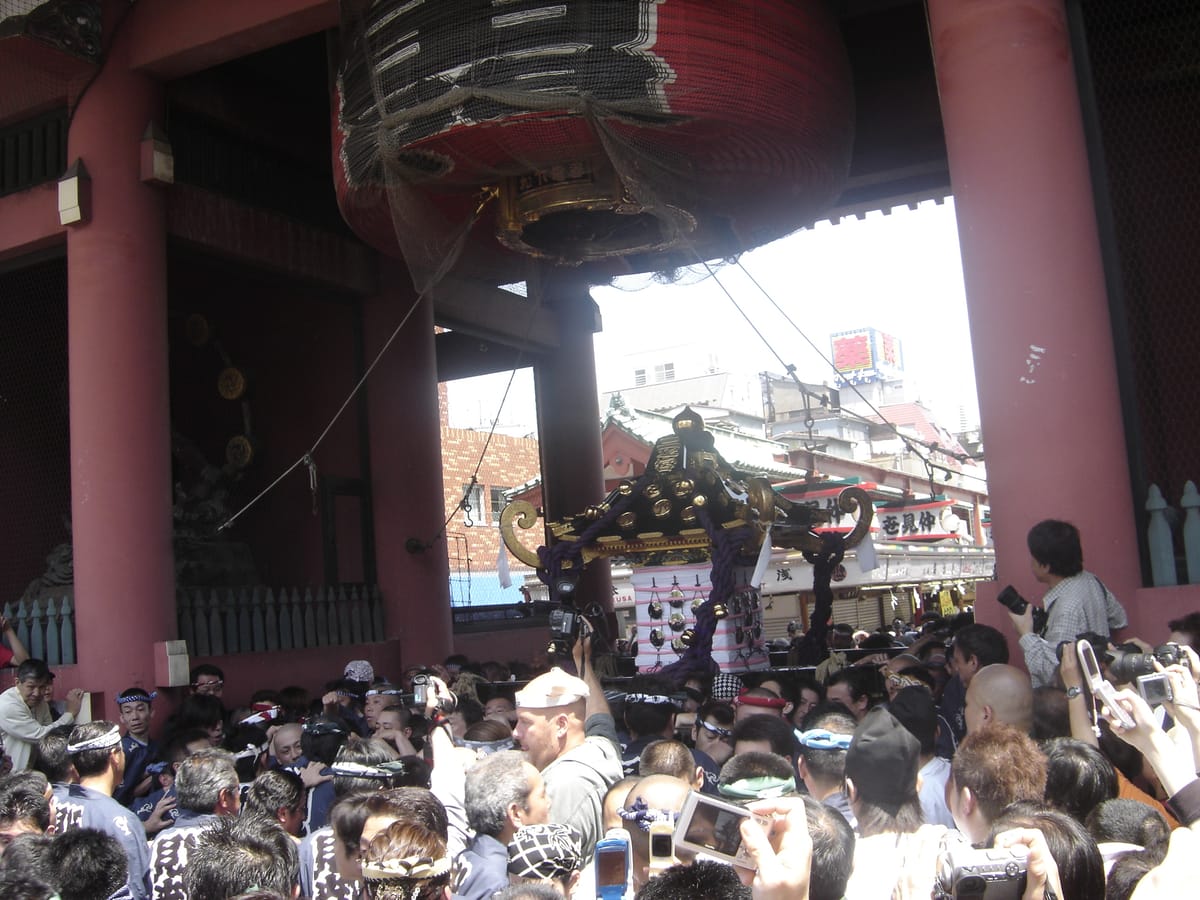
- Kaminarimon area: People concentrate whenever mikoshi pass through
- Goshuin wait times: Can exceed one hour on Saturday afternoon
If getting your goshuin is the priority, Friday morning or evening (May 15) is relatively calm. The grand procession is in the afternoon, so receiving your goshuin in the morning and then watching the procession is an efficient approach.
About Asakusa Shrine
Asakusa Shrine stands adjacent to Senso-ji Temple and is formally known simply as Asakusa Shrine (also called “Sanja-sama”). Its enshrined deities are the fishermen brothers said to have pulled the principal image of Senso-ji from the Sumida River — Haji no Nakatomo, Hinokuma no Hamanari, and Hinokuma no Takenari.
The side-by-side layout of shrine and temple preserves a structure that predates the Meiji-era separation of Shinto and Buddhism. The precinct is free to enter and draws visitors year-round alongside Senso-ji.
Basic Information
| Item | Details |
|---|---|
| Sanja Matsuri | Friday, May 15 – Sunday, May 17, 2026 |
| Special Goshuin | 3 days only (direct-write in goshuin book / ¥500) |
| Gates Open | 6:00 AM |
| Address | 2-3-1 Asakusa, Taito-ku, Tokyo |
| Access | 7-min walk from Asakusa Station (Tokyo Metro Ginza Line / Tobu Skytree Line) |
Image: Mikoshi passing through Kaminarimon during Sanja Matsuri, photo by Torsodog, CC BY-SA 3.0, via Wikimedia Commons
Source: Asakusa Shrine Official Website