June 14 (Sunday) – 16 (Tuesday), 2026 — Hokkaido Jingu’s grand festival, known locally as the “Sapporo Matsuri,” comes to the city.
Each year across these three days, under the kind of clear early-summer sky that simply doesn’t exist in Honshu, the streets of Sapporo from Maruyama Park to Nakajima Park fill with the classical beauty of Japan. The highlight is the Shinko-sai procession on the 16th, in which roughly 1,000 people dressed in Heian court attire parade through the city alongside 4 mikoshi and 9 festival floats.
This is Hokkaido’s largest shrine festival. It may be less famous than the great festivals of Honshu, but it loses nothing in spectacle.
About Hokkaido Jingu
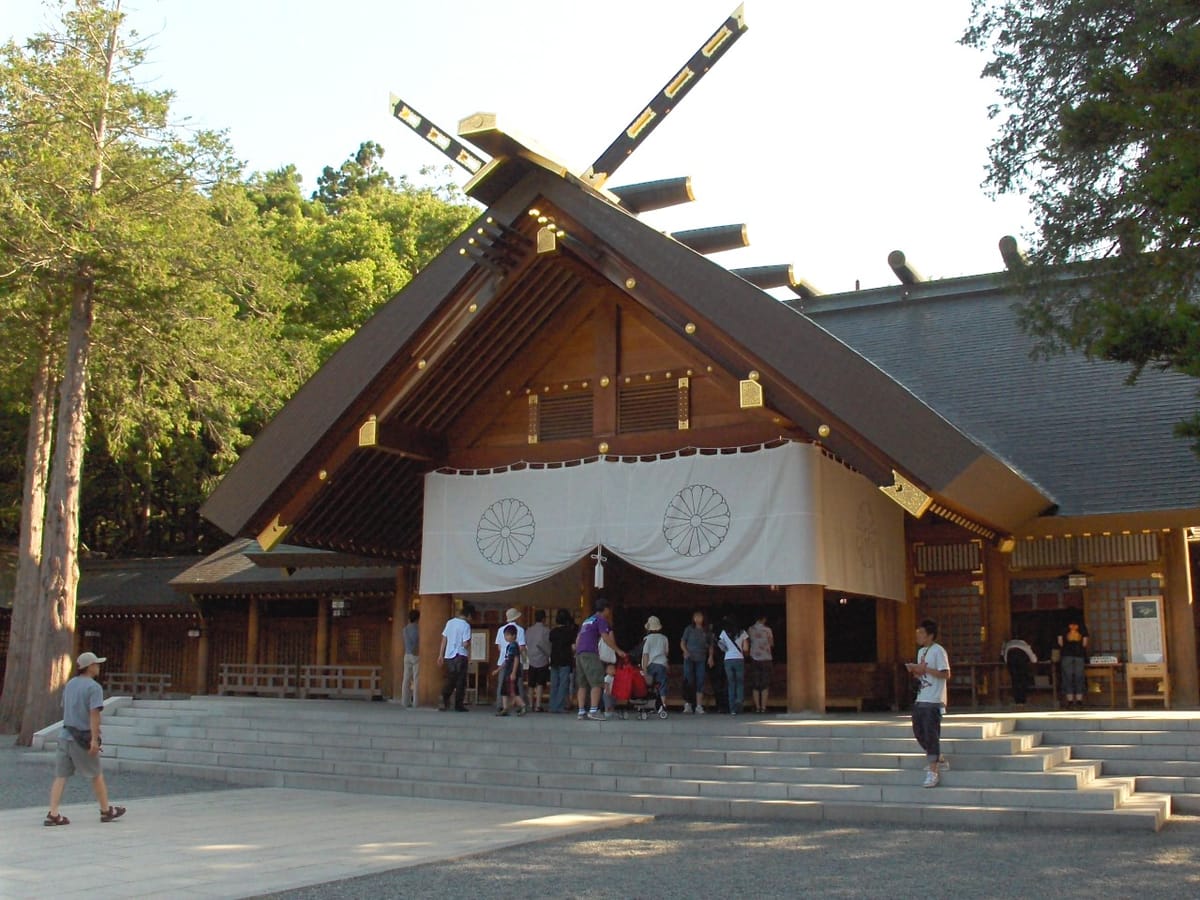
Hokkaido Jingu is enshrined adjacent to Maruyama Park in Chuo Ward, Sapporo. Its grounds cover approximately 180,000 square meters — roughly 38 times the area of the Tokyo Dome — making it one of the great shrines of Hokkaido.
Enshrined Deities: The “Three Pioneers” and Emperor Meiji
Four deities are enshrined here.
| Deity | Reading | Role |
|---|---|---|
| Okunitatama-no-kami | おおくにたまのかみ | The divine spirit of Hokkaido’s land |
| Onamuji-no-kami | おおなむちのかみ | Deity of land management, identified with Okuninushi-no-mikoto |
| Sukunahikona-no-kami | すくなひこなのかみ | Deity of land development, medicine, and industry |
| Emperor Meiji | めいじてんのう | Enshrined here in 1964 (Showa 39) |
The first three are collectively known as the “Kaitaku Sanjin” (Three Pioneer Deities). The selection of these names encapsulates the prayers of the pioneers who opened up Hokkaido’s harsh natural landscape.
Founded in 1869 — The Shrine and the Hokkaido Policy
Hokkaido Jingu was founded in 1869 (Meiji 2) — the very same year the Meiji government renamed “Ezochi” to “Hokkaido” and established the Development Commission (Kaitakushi).
This was no coincidence. For the Meiji government, securing the vast northern territory as part of Japan was an urgent priority. Border disputes with Russia, the question of engaging with the indigenous Ainu culture, settlement under a brutal climate — in order to overcome these challenges, a shrine as a spiritual foundation was established first.
“First enshrine the gods, then people open the land” — this was one aspect of the Meiji government’s philosophy of Hokkaido’s development.
The shrine was originally called “Sapporo Jinja.” In 1964, it was renamed and elevated to “Hokkaido Jingu” and the spirit of Emperor Meiji was enshrined there. The following year, 1965, it became a Beppyo Jinja (listed shrine), equivalent to the old rank of Kanpei Taisha.
In 1974, the main hall and other buildings were destroyed in an arson fire. Reconstruction was completed in 1978, and the current buildings date from that restoration.
The Three Days of the Sapporo Matsuri
June 14 (Sun) – 15 (Mon): Eve Festival and Rituals
The 14th is the yoimiya (eve of the festival), with many street stalls lining the shrine precincts and Nakajima Park. Sacred rituals including miko (shrine maiden) dance offerings at the kagura-den are also performed.
The 15th is the day of the central rituals of the reitaisai (main festival). Solemn ceremonies conducted by the shrine priests take place within the precincts.
June 16 (Tue): Shinko-sai — The Main Event
Departing from Hokkaido Jingu at around 9:00 AM, the Shinko-sai procession on the 16th is the climax of the entire Sapporo Matsuri.
- Mikoshi: 4 portable shrines
- Festival floats: 9
- Procession participants: approximately 1,000 citizens in Heian court dress
- Route: Hokkaido Jingu → Maruyama Park → Odori Park → Nakajima Park (temporary resting place) → return
The procession moves through the city streets to the accompaniment of traditional gagaku court music, arriving at the temporary resting place (inside Nakajima Park) in the afternoon. It returns to the shrine in the evening.
What distinguishes this from major festivals in Honshu is that it takes place in the clean, post-snowmelt air. June in Hokkaido has no rainy season and low humidity. The sight of mikoshi metalwork gleaming in dry wind has a singular clarity.
About Goshuin
Hokkaido Jingu’s goshuin is available at the shrine office year-round (both direct-write calligraphy and pre-written slips offered).
During the grand festival period, visitor numbers increase, so wait times at the counter may be longer. On the 16th in particular — the day of the Shinko-sai — visitors from outside Hokkaido also arrive in numbers. Allow extra time for your visit.
As for limited-edition goshuin, special versions tied to the grand festival have been offered in past years. Check Hokkaido Jingu’s official SNS accounts in advance for the latest information.
The precinct contains multiple subsidiary shrines, each offering their own independent goshuin. Hotaki Shrine (enshrining those who contributed to the opening of Hokkaido) and Kaitaku Shrine (enshrining 37 deities who contributed to Hokkaido’s development) are particularly worth visiting.
Why Is It Called the “Sapporo Matsuri”?
The official name is “Hokkaido Jingu Reitaisai,” but locals have long known it simply as the “Sapporo Matsuri.”
The festival’s center of gravity was originally the food stalls and entertainment tents around the temporary resting place in Nakajima Park — a lively hub of popular entertainment. The memory of “festivals mean Nakajima Park” has been passed down across generations. Through the Meiji and Showa eras, the majority of Hokkaido’s population consisted of migrants from Honshu. For people who had no hometown festivals of their own, the Sapporo Matsuri served as a place to form a shared identity.
Other Sapporo Shrines Worth Visiting for Goshuin
Sapporo has many distinctive shrines beyond Hokkaido Jingu — worth stopping by before or after the grand festival.
- Hokkaido Jingu Tongu: A branch shrine of Hokkaido Jingu located near Odori Park, and on the Shinko-sai procession route. Its goshuin features a different design from the main shrine.
- Miyoshi Shrine: A shrine established from Taiheizan Miyoshi Shrine in Akita. Located in Chuo Ward.
For a broader overview of Hokkaido’s shrines, see our Hokkaido Shrine and Goshuin Guide, which also covers notable shrines across the prefecture beyond Sapporo.
Research Before Your Visit
For advance viewing of visit records and goshuin photos for Hokkaido Jingu and other Hokkaido shrines, Hotokami is a convenient resource. From May 2026, a feature allowing simultaneous filtering across multiple prefectures was added, making it easier to plan wide-area pilgrimages. If you’re unsure which app suits you, our Goshuin App Comparison Guide may also help.
Access
Hokkaido Jingu
- Address: 474 Miyagaoka, Chuo Ward, Sapporo City, Hokkaido
- Phone: 011-611-0261
- Nearest station: Sapporo Municipal Subway Tozai Line “Maruyama Koen” Station, approx. 15-minute walk
- Best spots to view the Shinko-sai procession: along Odori Park and Nakajima Park
Temporary Resting Place (Shinko-sai Destination)
- Location: Inside Nakajima Park (south side of Hōheikan)
Sources:
- Hokkaido Jingu Official Website
- Sapporo Matsuri (Hokkaido Jingu Grand Festival)
- Hokkaido Jingu Grand Festival | Sapporo Official Tourism Site
- iwafu - Hokkaido Shrine Annual Festival 2026
Image: Hokkaido Jingu main hall (Wikimedia Commons / Daigaku2051 / CC BY-SA 3.0)
Information in this article is current as of May 17, 2026. Please confirm details on the Hokkaido Jingu official website.